Melanie McDonagh

Melanie McDonagh

Melanie McDonagh is an Irish journalist working in London.

What was it that made the Vicky Pryce trial so compelling?

Just about the only respectable moral that can be drawn from the grisly extended farce that was the Vicky Pryce trial is that the defence of marital coercion is a choice absurdity; one look at the feisty, tightlipped Ms Pryce should have been enough to persuade any jury that this one wasn’t a runner. Everything else about the trial was just horrible. And, obviously, utterly compelling.

The bossy state shouldn’t stop us buying cigarettes with pleasing packaging

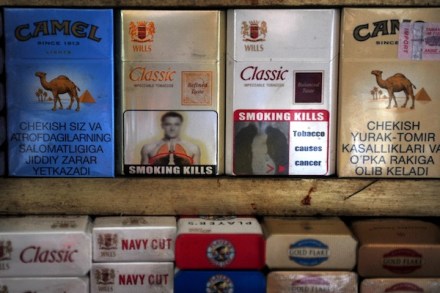
The Government’s bid to make Britain that little bit more like Australia, in a bad way, by requiring cigarettes to be sold in plain white packaging may well be announced on that annual irritant, No Smoking Day, next Wednesday. And for good measure, it may throw in a ban on smoking in cars carrying children under 16. The only upshot of that last one will be to make it that bit more difficult to get a lift for a child. I am not  a serious smoker. I can manage perhaps two or three cigarettes a year, Clinton style, but that’s enough to forfeit a premium rate of life insurance (actually a life insurance computer can’t handle a smoking rate of less than five a week). I don’t care at all for the smell of stale smoke.

Betty Friedan’s The Feminine Mystique at 50

It’s the 50th anniversary this year of the publication of Betty Friedan’s The Feminine Mystique. According to the quote on the cover of my Penguin edition, ‘Feminism … began with the work of a single person: Friedan.’ Quite something, then. In fact any mention of Betty Friedan brings out something like post-traumatic stress symptoms in me, even though she died in 2006. When I was a student I invited her to take part in a Cambridge Union debate on feminism. She came, and frankly it was like entertaining Cleopatra. She was heroically grand, heroically ugly and with a brilliantly American, unabashed sense of her own importance. She asked me what subject I was reading and I said clumsily that I was ‘in history’.

Keith O’Brien’s resignation is no good thing. But it might be good for the Catholic church

The downfall of Cardinal Keith O'Brien could not have been more complete if it had been orchestrated by Stonewall, which, if you recall, awarded him Bigot of the Year for his opposition to gay marriage. Actually, the one surprise is that it wasn't Stonewall that brought him down, but three Scottish priests, and one ex-priest, courtesy of The Observer.  The most senior Catholic cleric in Britain, the most forthright opponent of gay marriage; quite a scalp for secularists, gay rights activists and indeed for some Catholics of a liberal persuasion. One Catholic academic, when he heard the news, observed that this marked the end of the Church's authority on matters to do with sex - no more Rome in the bedroom. Which is one take on it.

How Pope Benedict’s wisdom was often lost in translation

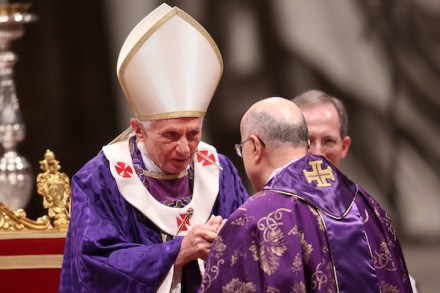
The pope made his first public appearance since his resignation today, before putting ashes on the foreheads of pilgrims for Ash Wednesday. It’s one of those jos which isn't itself particularly demanding but which amounts, together with the running of a global church and a mini state, to a role that would tax a younger man. He got a standing ovation reaction from the crowd at his audience. Rather different, then, from the pundits' judgement here on his pontificate.

Nick Clegg forgets that many married couples struggle to pay their way

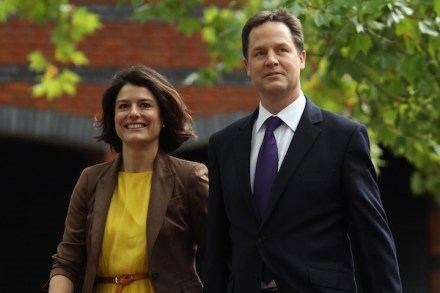
The disadvantage of live phone-in radio programmes is precisely that you don’t get to weigh your words. No doubt Nick Clegg would have expressed himself a bit differently on the subject of a transferable married couple’s tax allowance if he hadn’t had the subject thrown at him by a caller. But in response to a question on the issue, he said: 'The more people will look at this, the more they will think... why should you be giving, whatever it is, £3 a week to married couples?’  Naturally, people took this as indicative of just how out of touch the ruling elite is from everyone else... three pounds a week? Pah! And you know what? I think they’re right. Julius Caesar declared that he wanted men around him who were fat.

Women on the frontline isn’t simply a matter of equality

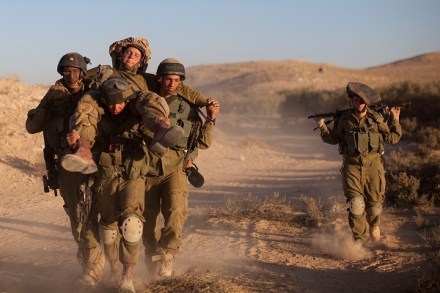
It won’t take long for the US decision to allow women in combat roles to travel here according to The Times today, on the basis of, it must be said, unnamed sources. And the paper’s leader is duly supportive of the idea: 'The number of women who want the risk and pass the tests will not be large, but those who earn a place at the spear tip of Western defence should be assigned there.' On this reckoning, the right to join combat units – to kill – is just one more of those equality hurdles to surmount, like women becoming bishops or CEOs. I’m against, myself. Partly this is wholly selfish – where does the principle of women and children go if women are going to be targeted as combatants?

Eric Pickles ‘does God’, but does the government really agree?

Personally, I don't wear a cross, on the basis that I'm not much of an advertisement for Christianity and I'd risk diminishing the brand. But for Eric Pickles, Communities Secretary, and Nadia Eweida, the former British Airways employee who has just won her appeal about cross-wearing at work at the European Court of Human Rights, it's a basic freedom. It's hard to gainsay the judges' view that manifesting your faith is a 'fundamental right'. Any organisation that doesn't have a problem about Muslim women wearing scarves and Sikh men wearing turbans but which gets uppity about a small cross, really does have a problem with consistency.

Gay bishops and women bishops are not the same issue

This being the Ephiphany, churchgoing Anglicans will be on the receiving end of any variety of sermons on the visit by the three kings to the infant Christ. There won't, by and large, then, be much attention given to the whole issue of gay bishops. No attention at all, probably. You'd never think it, though, judging from the broadcast and press reaction to the news. On the Radio 4 Today programme yesterday, the presenter said sternly to one conservative Anglican, Norman Russell, the Archdeacon of Oxford, that the fuss over the issue of gay bishops just goes to show why people are turned off by the church: it can only ever think about sex. The archdeacon replied mildly that this wasn't quite the case: the church did talk about other things. Russell could have made a stronger case.

The formidable female politicians of the year

Audits of the last year are a blessing to journalists: a postmortem of the gainers and losers of 2012 are a useful means of covering for the fact that there's next to nothing happening on the political front, nobody's at work and the only actual news is hinged on that annual festival of recrimination, the New Year's Honours List. But the lists are good for sparking off debate, at least among the politically interested, and one of them, the Telegraph's summary of the top five political women of the last year had at least the merit of getting me worked up. To cut to the chase, the women who matter by this reckoning are Theresa May, Harriet Harman - fair enough - Hillary Clinton, fine, Nadine Dorries (yes, yes) and Louise Mensch.

The political impact of immigration

It won’t actually come as a surprise to anyone living in London that the census results from the Office of National Statistics this week showed that 'white British' are down to 45 per cent in the capital. There are bits of the capital whose look and feel suggests that the percentage is much higher – well, the figures are from people who filled in the census forms, which isn’t quite the same thing as the actual population. Remember that cover story in The Spectator a couple of months back, based on the premise that London was practically a city-state, radically different from most other parts of the UK?

Don’t watch The Hobbit

Once, I met Priscilla Tolkien, the daughter of J.R.R. Tolkien. It was at the Oxford Catholic chaplaincy, and she was giving a talk about her father. She was charming, something of a hobbit herself with her neat figure, and an engaging talker. But she seemed taken aback by some of her audience. It was divided into two distinct parts. Some were the ordinary Tolkien admirers, the normal, slightly shabby young people you get at chaplaincy talks, and the others were, well, a bit scary. They almost all had black T-shirts, pale faces and intense expressions, and there was a weird sort of obsessiveness about their questions. They read all sorts of things into the books, symbolic meanings that had never occurred to the rest of us.

Justin Welby’s social conscience

One of the things we know about the next Archbishop of Canterbury, Justin Welby, is that he doesn’t like bankers. Another is that he has given a good deal of thought to the question of social sin – a trickier concept than personal, individual failings. A third is that he has been profoundly influenced by the social teaching of a nineteenth century pope, Leo XIII, as expressed in his 1891 encyclical, Rerum Novarum. It’s available online, just twenty pages long. That encyclical is a curious document to read now: some of it feels anachronistic (if you like women bishops, you’re going to hate the bit about fathers as the natural rulers of families), much feels self evident.

In defence of the CofE’s House of Laity

Even friends of an Established church like myself – though I’m a Catholic – should think twice about the wisdom of the idea after the naked political interference in the affairs of the CofE in the Commons. The Speaker, who is non-religious/agnostic, was among the most overt in encouraging MPs to overturn the church’s decision not to approve women bishops. Perhaps, he suggested, they might like to refer the matter to the Equalities Minister (Maria Miller)? It was more or less to say that the equalities legislation should be brought to bear on the CofE when it comes to its way of appointing bishops. Ben Bradshaw too was all in favour of parliament getting involved. So was Chris Bryant, who is not only an ex-Anglican vicar, but by his own account an ex-Christian.

Marriage tax breaks would alleviate child poverty, Mr Duncan Smith

The problem about relative poverty is precisely its relativity. The child poverty index, which measures whether a family’s income is below 60 per cent of the average, is a case in point; when incomes go down, bingo, so does child poverty. Which means that one sure fire if controversial way to improve the Government’s child poverty record would be to drive down everyone’s earnings. Iain Duncan Smith, Work and Pensions Secretary, made just this point yesterday when he made a speech about whether the definition should be rather wider than it is. ‘As we saw last year,’ he observed, ‘when the child poverty level dropped by two per cent – a fall in the median income may lift a family out of poverty on paper.

George Osborne’s combination of austerity and social libertarianism is repellent

George Osborne’s spirited bid in The Times (£) earlier this week  to appropriate the Obama victory for the Tories is a curious mirror image of the Labour Party’s arguments to the same effect. Both ignore the reality that the US is the US, not us, and Obama is Obama; formulas for election success aren’t a peel-off/stick-on tattoo, to be transferred between one body politic and another. But the article was interesting for what it told us about the Chancellor himself, quite apart from a slightly nerdy obsession with American elections. The fifth and decisive point in his piece was all about how social liberalism plus fiscal conservatism was the key to electoral success.

Harriet Harman was not ‘bullied’ at PMQs today

Barack Obama’s re-election has naturally perked up the Labour party, on the optimistic basis that the Obama formula for success, sans Obama, could work perfectly well here. But there’s a limit to how far you can take that approach and it was reached, PDQ today, by the feisty editor of the LabourList website, Mark Ferguson, today. The key to Obama’s victory, he correctly observed, was his appeal to women, some of whom took a dim view of some Republicans’ attitudes to rape and abortion. The working equivalent of the Republicans over here, he went on, is obviously the Tories, whose antique and regressive attitudes to women could be observed in, um, the treatment of the Shadow Deputy PM, Harriet Harman, in the Commons today.

Can you trust a Christian?

For some time we have known about the tension between George Osborne and Iain Duncan Smith over welfare reform. The Chancellor wanted more welfare cuts, and the Work and Pensions Secretary resisted: real reform, he said, would cost money. So far, so understandable. But a new biography of the Chancellor by Janan Ganesh reveals another element behind the struggle. Ganesh writes that Osborne ‘questioned the analytical rigour of the Christian Conservatives who hovered behind the project’. A Treasury source is quoted making it clearer still: ‘He thinks the people pushing this are such total advocates and evangelicals that they blind themselves to any downsides.’ To put it another way, the Christianity of Mr Duncan Smith and his associates makes them suspect.

Labour’s three-line whip on gay marriage is illiberal

Ed Miliband tells the Evening Standard today that Labour will give 'wholehearted' backing to gay marriage and says that churches and religious bodies should be allowed to conduct these ceremonies. At the same Labour has let it be known to the Standard that the party is 'highly likely' to impose a three-line whip on the gay marriage bill, though it can’t say so for certain until it knows the wording. Same as the Lib Dems, then, but unlike the Tories, who are allowing a free vote. As Mr Miliband says, 'I think whether you’re gay or straight, you should be able to signify your commitment, your love, with the term “marriage”'.

The one thing worse than universal benefits? Means-testing them.

There’s nothing, but nothing, easier than for politicians to sound off about universal benefits, and sure enough, Nick Clegg was complaining on the World at One today about the iniquity of, as he says, paying for Alan Sugar’s bus pass. He was being asked about the sustainability of universal benefits and perks following Don Foster, one of his MPs, grumbling about it being absurd that someone like him is entitled to a winter fuel allowance. Mr Clegg went on to make clear that as part of the coalition deal for this parliament there wouldn’t actually be any fiddling with things like the fuel payment for oldies, but after that, these universal perks would be up for grabs.