Matthew Lynn

Matthew Lynn is a financial columnist and author of ‘Bust: Greece, The Euro and The Sovereign Debt Crisis’ and ‘The Long Depression: The Slump of 2008 to 2031’

Emperor Soros’s new clothes

Matthew Lynn says hedge-fund pioneer and currency speculator George Soros is still a brilliant player of markets — but as a philosopher, frankly, he’s incomprehensible If nothing else, three decades as one of the world’s most successful speculators has taught George Soros how to pitch a book. While the main title of his latest work, The New Paradigm for Financial Markets, might not be the kind of thing to get Waterstone’s managers clearing their shelves, its subtitle — The Credit Crisis of 2008 and What It Means — makes it bang up to date. Even better, Soros rushed it out as a digital download within days of the final words being penned.

Has the Celtic tiger lost its roar?

A collapsing property market, slowing consumer spending, rising unemployment and an economy that is fast deflating: that might sound all too much like a forecast for the British economy. But actually it’s a description of the Irish economy right now. For the last decade, Ireland has been the most dynamic economy in Europe, with growth rates that far outstripped any of its rivals. This republic of not much more than 4 million citizens has turned itself into one of the most prosperous nations in the Western world. Fuelled by a long boom, a swaggering generation of Irish tycoons has emerged, buying up businesses around the world. Yet in the space of a few months all that has swiftly turned around, amid collapsing property prices and fears of a subprime financial meltdown.

Was ABN Amro a deal too far for Fred the Shred?

The title of the worst deal in British corporate history is hotly contested. Glaxo and SmithKline were worth £107 billion on the day they announced their merger: eight years later, they’re worth £57 billion, and they’re not quite the ‘kings of science’ their chief executive Jean-Pierre Garnier said they would be. Getting on for a decade after it paid £75 billion for Mannesmann of Germany in Europe’s largest hostile bid, Vodafone still hasn’t recovered. Capping both of those, Lord Simpson’s foray into the American telecoms industry after he took over at GEC and renamed it Marconi is always going to take some beating for the speed and thoroughness with which he destroyed one of Britain’s largest companies.

A paragon of Britishness reinvented by Germans

Matthew Lynn visits the Bentley factory in Crewe — where Spitfires were once built — and discovers how Volkswagen’s engineers and marketing men have revived the classic marque Turn right as you step into the plush foyer of Bentley’s Crewe headquarters and you find yourself in the company’s museum — a display of gorgeously preserved vehicles from Bentley’s prewar heyday, all gleaming brass and steel, all with their tax discs up to date so they can be taken out on the road at any time. For most companies, the museum might be tucked away somewhere. Not at Bentley. Since the almost-forgotten brand was bought by Volkswagen of Germany a decade ago, its history has been woven into everything it does.

The last Victorian bastion besieged

Matthew Lynn says London’s last 19th-century merchant bank, Close Brothers, is under threat of takeover by one of the modern breed of aggressive City traders, Andy Stewart Anyone approaching the headquarters of Close Brothers just off Broadgate in the heart of the City may be reminded of the words that open the Asterix books, about how one small village of indomitable Gauls held out against the invading Romans. In the last two decades, almost all the great names of what was once the Square Mile — the Flemings, the Kleinworts, the Schroders — have either been erased from the record books or reduced to nothing more than a couple of oil paintings and a brass plate inside a giant American, German or Swiss investment bank.

Shock and ore: the fight for the world’s mineral riches

Marius Kloppers is a man who has clearly learnt that business is like warfare in at least one respect: if you’re planning an attack, it might as well be done quickly. On 1 October this year, the 45-year-old South African was installed as chief executive of the Australian mining conglomerate BHP Billiton. Within less than a month, he’d pressed the button on an audacious £67 billion bid for BHP’s mighty British-based rival Rio Tinto. The prize: a £170 billion conglomerate that would be far and away the world leader in its sector, with mines everywhere from Brazil to Australia and control of vast reserves of mineral riches.

A hellfire sermon for HSBC’s boss

Matthew Lynn says shareholder activist Eric Knight is right to castigate HSBC’s strategy, and that the bank’s deeply religious chairman Stephen Green now faces a battle to hang on to his job When he isn’t running the world’s second biggest bank, Stephen Green, the chairman of HSBC, is an ordained priest and amateur theologian. In 1996 he published Serving God? Serving Mammon? Christians and the Financial Markets, in which he explored whether you can do the Lord’s work whilst also commuting to Canary Wharf every morning to do battle in the boardroom and kick ass on the trading floor. ‘Christians can serve God in the world of finance and commerce, but it is also possible to fall into the trap of serving Mammon there,’ he wrote.

A symbol of change – but is she the real thing?

It wasn’t hard to see what was in it for President Nicolas Sarkozy when he appointed Christine Lagarde as France’s new finance minister in June this year. After a glittering career in international law, Lagarde had become a star in American business circles: the 30th most powerful woman in the world, according to that ultimate arbiter of commercial influence, Forbes; the fifth best female executive in Europe, according to the Wall Street Journal. Sarkozy, like all modern politicians, is obsessed with symbols and narratives. In Lagarde, he had his storyline made flesh. Look, he’s saying — we’re changing. This is not the old, closed-for-a-four-hour-lunch, anti-globalisation France. This is the new, power-breakfasting, 24/7, change-embracing France.

Sarkozy picks a new CEO of France Inc: himself

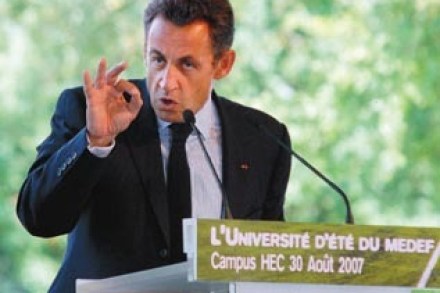
Nobody expects total honesty from politicians, particularly on the campaign trail. Still, when the new French president Nicolas Sarkozy promised a ‘rupture’ with France’s past, and even praised Margaret Thatcher for her willingness to ‘break taboos’, you might have expected the pledge to hold good at least for a few months. And yet since assuming the presidency, Sarkozy has shown himself as wedded as any of his predecessors to the traditional French industrial policy of creating sturdy national champions. He has just engineered the merger of Suez and Gaz de France to create one of Europe’s largest utilities. He has extended France’s influence at EADS, the Franco-German defence and aerospace conglomerate that controls Airbus.

Does Britain still need an arms industry?

The fiercer the fighting for our boys in Basra and Helmand, the more important you may think it is that Britain has a thriving arms industry to supply them. The reasons that this isn’t so can be summed up in one Arabic phrase which translates, ironically, as ‘dove of peace’: Al Yamamah. The fiercer the fighting for our boys in Basra and Helmand, the more important you may think it is that Britain has a thriving arms industry to supply them. The reasons that this isn’t so can be summed up in one Arabic phrase which translates, ironically, as ‘dove of peace’: Al Yamamah. Over the past 20 years, Saudi Arabia has paid tens of billions of pounds to BAE Systems under a deal negotiated by the British government called Al Yamamah.

Can private equity halt EMI’s decline?

Amid the acres of coverage devoted to the 40th anniversary of Sergeant Pepper’s Lonely Hearts Club Band, the most celebrated record in pop history, one irony has been overlooked. The album was considered as ephemeral as any other when it came out, but has grown mightier and mightier; the company that made it, on the other hand, was rightly regarded as one of the giants of British industry back in 1967, but has never looked weaker than it does now. Indeed, by the time the Sergeant celebrates his half-century — not to mention the palaver when he hits 64 — EMI may have shuffled into the history books, at least as far as being a public company is concerned. It has already agreed to a takeover bid from Guy Hands’s private equity firm Terra Firma.

How ‘Bid ’em Up Bruce’ became yesterday’s man

When Lazard presented its results at the start of May, you might have expected the investment bank’s smooth-talking chairman Bruce Wasserstein to have been in upbeat mood. After all, Wasserstein trades on his reputation as the greatest mergers and acquisitions banker of all time. Lazard likes to think of itself as the finest M&A house in the world. And we are, in case you hadn’t noticed, going through one of the greatest merger booms of recent times: so far this year deals worth $2 trillion have been struck globally, a 60 per cent advance on the same point last year. So was Lazard raking in money? Well, not quite. In truth, its results were disappointing: first-quarter profits up by a rather modest 4.

The real driving force in the battle for ABN

Most of the young men working on ‘hedge fund alley’, the narrow streets leading away from Berkeley Square in Mayfair, have expensive but unsinister ambitions. They’d like a new Aston Martin DB7, preferably convertible. They’d like a swanky new penthouse overlooking the Thames, plus a girlfriend who might have stepped out of the pages of Vogue. They certainly aren’t setting out to re-draw the industrial map of Europe; but the law of unintended consequences applies as much to business as to any other field of human endeavour, and that is what they appear to be doing. Over the last few weeks, the City and the business press have been held in thrall by the battle for control of the Dutch bank ABN Amro.

The brothers are back — and they’re setting the agenda

Even allowing for retro-chic, there were some things from the 1970s that most of us assumed were never coming back: cheese-and-wine parties, lime-green bathroom suites, and trade unions setting industrial policy. The little cubes of cheese and the green baths look safely forgotten. But the brothers? They’re back. In the past few months, trade unions have been making the running on issues ranging from the role of private equity to the responsibility of manufacturers to keep their factories in Britain. Led mainly by the GMB and the Transport & General Workers, the unions have developed a stunt-happy, web-friendly, celebrity-savvy campaigning style that has left the overpaid suits of City PR looking tired and lazy by comparison.

The shipwreck of the last buccaneer

Before the number-crunchers of private equity and the hedge-fund world took control, the City was dominated by a pretty rough gang. Predatory tycoons such as Lords Hanson and White, Tiny Rowland of Lonrho and Sir Nigel Broakes of Trafalgar House were the big beasts of the stock market. They created conglomerates to match their  egos, and made themselves fortunes in the process. Yet either time or shareholders caught up with them, one by one, and their empires disintegrated. Except, until recently, for one. James B. Sherwood, baron of the Orient-Express hotel chain, Great North Eastern Railways, cross-Channel ferries, container-leasing and dozens of other businesses, somehow managed to cling on. He, too, now appears to be on the way out.

The front-row forward who never loses a fight

Of the Australian tycoon Alan Bond it used sometimes to be remarked that, after a nuclear war, there would be only three things left alive: seaweed, cockroaches and Bond. In British business these days, there is probably only one man with the same kind of durability: Peter Sutherland, chairman of BP. The recent warfare at the top of the giant oil company, which led to the early departure of its much-admired chief executive Lord Browne, might not have been nuclear. But it was noticeable that after the dust had cleared, Sutherland was still in his job and Browne wasn’t. To anyone who knows him, that was no surprise. Sutherland has one of the toughest skins in global business.

Why we need no-frills, low-cost private schools

If you ever happen to find yourself teaching an economics class at a private school, here’s a question you could write on the blackboard. Which industry manages to keep pushing up its prices faster than inflation, and expanding its market share at the same time? The answer is the one you’re in: private education. In the last two decades, the British private schools industry has pulled off a trick that most business-school textbooks would tell you is impossible: attracting more business while becoming more and more expensive. Schools have broken out of what is usually the most rigid of all the dismal science’s iron laws: that as prices rise, demand declines.

Why Porsche would be mad to bid for Volkswagen

Matthew Lynn says Porsche is supremely successful in its own niche, but that does not qualify it to run Europe’s largest mass-market car maker There are only three hard and fast rules in the motor industry, if you want to make money. Never build an orange car; steer clear of Formula 1; and never bet against Porsche. For the last decade the Stuttgart-based manufacturer of high-performance sports cars has existed in its own parallel universe. While the rest of the European industry battles with intransigent unions, soaring costs and vicious global competition, Porsche just taps the accelerator and flashes away into the distance. But now the moment of hubris seems to have arrived.

Men with guns are the new dotcoms

Matthew Lynn finds private military contractors such as Colonel Tim Spicer — formerly known as mercenaries — responding to demand in a high-growth business sector Sitting behind his smartly fashioned desk in one of the new, antiseptic office blocks that line London’s Victoria Street, Tim Spicer looks the very model of the modern entrepreneur. He talks smoothly about service delivery, market share and profit margins. If he were running a hedge fund or a new media company, you wouldn’t be in the least surprised. In fact, his business supplies tough blokes with guns. And a very lucrative trade it has recently become.

Why Google has already passed its peak

If you happened to be scripting a James Bond movie and were looking for a role model for a fabulously sinister corporation, there can be little doubt where you would look for inspiration today. Gold no longer matters to the global economy, oil is running out, and old-style media magnates are too busy fretting about tumbling circulations to threaten the free world. Right now, only one company has the right combination of fabulous wealth, hidden power, global reach and slightly crazed megalomania that made Ian Fleming’s villains so memorable. It is, of course, Google. Since it was founded in September 1998 by Sergey Brin and Larry Page, the California-based search engine has become the world’s most breathtakingly successful business.