Madeline Grant

Madeline Grant

Madeline Grant is The Spectator’s assistant editor and parliamentary sketch writer.

What does Jenrick’s defection mean for the right?

Robert Jenrick arrived late to his own defection. ‘It’s time for the truth,’ he said, before launching into a speech that he would have no doubt preferred to deliver at a more opportune moment. In Nigel Farage’s opening remarks, which he had to pad out as Jenrick failed to arrive at the lectern, he implied that his new recruit had only been pushed into jumping by the actions of an over-hasty Kemi Badenoch. He described her sacking of Jenrick as an avoidable own goal, ‘the latest Christmas present I’ve ever had’. In reality, Jenrick could scarcely have been allowed to stay on after senior Reform UK figures had publicly admitted to being in secret discussions with him. The more important question is, what does it mean for both parties of the Right?

Starmer’s ‘jokes’ make him sound like a creepy uncle

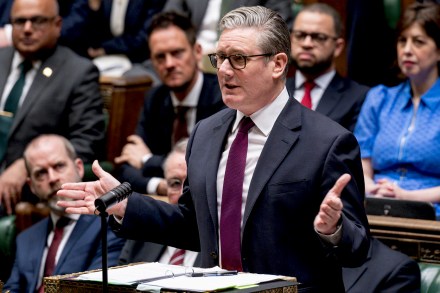
Another week, another U-turn! This time the PM had chosen to make Prime Minister’s Questions even more torturous for himself by beating an ignominious retreat on the issue of compulsory digital ID. The climb-down was inevitable. The government has totalitarian aspirations that would make Brezhnev blush, but is sadly fated to be run by people for whom the ‘Do Not Eat’ instructions on Playdoh are designed.  The gap between Labour’s authoritarian instincts and its actual abilities has enormous comic potential. Indeed I’m sure that in time Sir Keir will be considered to have added greatly to the gaiety of nations: just not the one that has to suffer him as its prime minister.

The tragedy of Keir Starmer

For someone who likes to present the general public with the idea that he doesn’t have a personality, Sir Keir ‘I don’t dream’ Starmer has actually provided plenty of insight into who he really is. From his occasional flashes of fury when thwarted in the Commons to his chronic lack of authenticity when out bothering voters, a picture emerges of a man who doesn’t much like the ‘people’ side of politics. Perhaps the most revealing example was when, in opposition, he unhesitatingly told Emily Maitlis that he preferred Davos over Westminster. By his own revealed preferences and statements, Starmer is an aspirant technocrat, not an enthusiastic democrat.

Why Nadhim Zahawi (and Reform) are making a mistake

50 min listen

This week on Quite right!, Michael and Maddie examine Nadhim Zahawi’s dramatic defection to Reform UK and ask whether it strengthens the party’s insurgent credentials or exposes a deeper strategic mistake. Is Reform becoming a genuine outsider movement, or simply a refuge for disaffected Tories? And what does the pattern of Boris-era defections reveal about credibility, competence and the challenge of turning populist energy into a governing force? Then, Iran: mass protests against the regime have erupted onto the streets of Tehran and beyond. Are these demonstrations the prelude to real regime change – or another brutal crackdown waiting to happen? And what role should the West, and the United States in particular, play as the situation escalates?

Q&A: A Labour rebellion is coming – can Starmer survive?

30 min listen

This week: Michael and Maddie look ahead to a turbulent political year, asking who will rise, who will fall – and whether Keir Starmer can survive the mounting unrest within his own parliamentary party. With Labour backbenchers showing an increasing willingness to defy the leadership, is a full-blown rebellion inevitable? They also discuss the government’s controversial decision to welcome Alaa Abdel-Fattah back to Britain, and ask what the episode reveals about two-tier politics, herd mentality in Westminster, and a Prime Minister more comfortable in the role of human rights lawyer than national leader. And finally: should Britain bring back national service?

Starmer brings the spirit of Dry January to PMQs

‘New year, new you’. One can imagine the Prime Minister repeating this most hollow of secular mantras in front of a full length mirror in Downing Street. As the embodiment of vapid and valueless 21st century Britain, the PM probably loves New Year’s resolutions. He is the walking embodiment of Dry January after all. Yet, if he did vow to turn over a new leaf as the calendars changed there was little evidence of it at the first Prime Minister’s Questions since the recess. Mrs Badenoch focussed on two areas, not unrelated: foreign policy and the PM’s constant refusal to be scrutinised about it or any other matter.

Venezuela vs Chagos: what Britain can learn from America’s ‘audacity’

50 min listen

This week: Michael and Maddie dissect Donald Trump’s audacious raid on Venezuela and ask what it reveals about power, national interest and the unravelling of the rules-based order. Was America acting like a rogue state – or simply doing what states do when their interests are at stake? And could Britain learn a thing or two from how they conduct their foreign policy, specifically with regard to the Chagos Islands? Then, closer to home, they unpack the scandal surrounding West Midlands Police and the banning of Maccabi Tel Aviv fans. Who really made the call – and what does it tell us about two-tier policing and the erosion of equal justice?

The Maccabi mess has exposed Britain’s babbling bobbies

You may recall the cancellation of the Maccabi Tel Aviv-Aston Villa game back in November. What has happened since is that, due to constant scrutiny by Nick Timothy MP, Lord Austin and a small number of journalists, the narrative that West Midlands police spun at the time – that the Israeli fans were too dangerous to host – has slowly been unravelling. The force stands accused of retroactively cobbling together evidence for a ban that was actually rooted in fears about sectarian violence in Birmingham; ‘elements’ of the local community reportedly wished to ‘arm themselves‘ and target visiting fans. So far, so reassuring.

There’s a lesson for Britain in the fall of Venice

I’ve just come back from a short holiday in Venice. The city is an unsurpassable monument to the glories of the Renaissance, but its streets and waterways also bear witness to the absolute non-existence of 'international rules'. When confronted by Bonaparte's expansionist aims in 1797, the millennium-old Venetian republic responded as it had always done, relying on diplomatic assumptions maintained for centuries. Meanwhile Napoleon, promising to be 'an Attila to the state of Venice', simply invaded, bringing the Serene Republic to an ignominious end. Venetian art and treasures were plundered to fund the French war effort. In a particular humiliation for the city-state, Bonaparte began filling in the canals to resemble Parisian boulevards.

Dominic Cummings: what I told Farage & why the system will ‘do anything’ to stop him | part two

42 min listen

This is the second of a two-part discussion with Dominic Cummings, in which he reflects on his time in government – what he got right and what he regrets – and what he believes must change for the country to thrive. In part two, Dominic diagnoses the ‘pre-revolutionary’ mood of British politics, marked by voter rage, economic stagnation and institutional failure. He dismisses government promises on immigration as ‘total nonsense’, attacks the political class’s handling of the cost-of-living crisis and the war in Ukraine, and delivers a sobering account of why the Conservative Party is ‘completely dead’.

‘Boris didn’t care!’: Dominic Cummings on lawfare, lockdowns & the broken British state | part one

47 min listen

In this special two-part interview, Michael and Maddie are joined by Dominic Cummings. After starting his political career at the Department of Education, Dominic is best known as the campaign director of Vote Leave, the chief adviser in Downing Street during Boris Johnson’s premiership, and one of the most influential strategists of modern times. Whether you consider him a visionary reformer or (as David Cameron once said) a ‘career psychopath’, his ideas – on government, technology, the blob, education and the future of the right – continue to provoke debate. In part one, Dominic diagnoses Britain’s institutional decline and takes us inside Whitehall’s ‘heart of darkness’.

Year in Review 2025 – Live

32 min listen

From scandals and cabinet chaos to Trumpian antics and the ‘special’ relationship that some say is anything but, The Spectator presents The Year in Review – a look back at the funniest and most tragic political moments of 2025. Join The Spectator’s editor Michael Gove, deputy editor Freddy Gray, political editor Tim Shipman, deputy political editor James Heale and parliamentary sketch-writer Madeline Grant, along with special guests, who’ll all share their favourite moments from the past 12 months.

Q&A: How has being adopted impacted your politics?

27 min listen

Submit your urgent questions to Michael and Maddie at spectator.co.uk/quiteright. This week on Quite right! Q&A: is demography destiny? With Britain’s birth rate falling, Michael Maddie Grant discuss whether the country is quietly drifting towards decline – and whether immigration, pro-natal policy or something more radical is the answer. Is importing labour a short-term fix that stores up long-term problems? And can advanced economies really persuade families to have more children? Then: adoption, identity and love. Michael reflects candidly on being adopted, how it shaped his sense of responsibility and gratitude, and why he believes the system too often lets the perfect become the enemy of the good. And finally, a festive question: favourite Christmas carols and songs.

An unhappy Christmas PMQs for Keir Starmer

Thank God! Today was the last Prime Minister’s Questions before Christmas and so Sir Keir and Mrs Badenoch began their speeches with seasonal greetings. Was a Christmas truce about to break out? Unlikely; Sir Keir couldn't resist a poke at Reform’s Russian problems. ‘If wise men from the East come bearing gifts, this time report it to the police’ he scoffed. Today, Nigel Farage, Sir Keir's very own Ghost of Christmas Yet to Come, loomed down on proceedings from the Commons viewing gallery. Even he chuckled at this opening gag.

Bondi attack: understanding Islamism & the causes of anti-Semitism

50 min listen

Michael Gove and Madeline Grant confront the horror of the Bondi Beach massacre and ask why anti-Semitic violence now provokes despair rather than shock. As Jewish communities are once again targeted on holy days, they examine the roots of Islamist ideology and the failure of political leaders to name it. Why has anti-Semitism metastasised across the radical left, the Islamist world, and the far right – and why does the West seem so reluctant to grapple with its causes? Then, on the 250th anniversary of Jane Austen’s birth, Michael and Maddie ask why Austen is endlessly repurposed, politicised and rewritten by modern adaptors? Was she an abolitionist, a moralist, or something far subtler – and why do her novels continue to resist ideological shoehorning two centuries on?

There are bin liners with more empathy than Keir Starmer

The liaison committee is always a laugh. It’s sort of like a year in review for the government’s litany of failures. Like an advent calendar but behind each door there’s a little puddle of cat sick. The specific aim of this particular roundup was ‘the work of the Prime Minister’, and so as a festive treat our very own pig in a blanket was dragged in for an extra big Christmas helping of his least favourite thing in the world – scrutiny. First up was Alberto Costa, appropriately the chair of the Standards Committee, which during this parliament must be like being the person whose job it was to keep the deck dry on the Titanic. Mr.

Q&A: Should Ukraine join the Commonwealth?

31 min listen

Submit your urgent questions to Michael and Maddie at spectator.co.uk/quiteright. This week on Quite right! Q&A: should Britain reinvent the Commonwealth – and should Ukraine be invited to join? Is the Commonwealth an embarrassing relic… or an untapped strategic asset? Then: what if Jeremy Corbyn had actually won in 2019? Maddie and Michael sketch the counterfactual Britain – from a Jezza-led lockdown to vaccine chaos, union-driven school closures and a very different Brexit. Plus: the greatest artwork of the 21st century. Michael champions a modern choral masterpiece, Maddie defends The Lord of the Rings as the true Gesamtkunstwerk, and both confess their musical shortcomings (including Michael’s rogue childhood instrument). Produced by Oscar Edmondson.

Keir Starmer is not waving but drowning at PMQs

Benjamin Disraeli once observed that the difference between a misfortune and a calamity was that if Mr Gladstone fell in the Thames it would be a misfortune, but if someone pulled him out it would be a calamity. As the government moves indisputably from being victims of misfortune to being agents of calamity, so we might recycle the quip about Sir Keir Starmer. The Prime Minister today entered his ‘not waving but drowning’ era. And he is, to use the sort of girlboss gibbering signalling which his MPs routinely resort to, slaying it. Today’s Prime Minister’s Questions was, deliciously, one of his worst yet.

Has Reform peaked? – racism allegations & Farage’s toughest week yet

45 min listen

After a summer in which Nigel Farage seemed to bend the news cycle to his will, Michael and Maddie ask whether the party’s momentum is slipping. Do the allegations dredged up from Farage’s schooldays mark a decisive turning point – or, perversely, strengthen his outsider appeal? And with questions over Reform’s election spending, defections from the Conservatives, and the small matter of finding 500 people to staff a government, is the insurgent right entering its moment of vulnerability? Then: two stories that lay bare a crisis in women’s healthcare. Baroness Amos’s damning interim review of maternity services and the astonishing employment tribunal ruling in the Sandy Peggie case raise the same question – why does the system still fail women at their most vulnerable?

Keir Starmer goes walkies

‘Nurse! Nurse! He’s out again!’ That’s right, Sir Keir had escaped his handlers and was mingling with the public once more. This time he was ruining the coffee break of some workers at McLaren to talk about apprenticeships. Presumably he takes any opportunity he can to avoid the company of his own MPs at the moment, morale being about the same as it was on HMS Bounty a minute or two before the mutiny. Sir Keir was introduced by Pat McFadden, the cadaverous figure whom Labour trot out when things are going particularly badly. It was like having Nosferatu as your warm-up act. Yet even with this inauspicious intro, Sir Keir still managed to look like the weirder one of the pair.