Luke McShane

Luke McShane is chess columnist for The Spectator.

No. 607

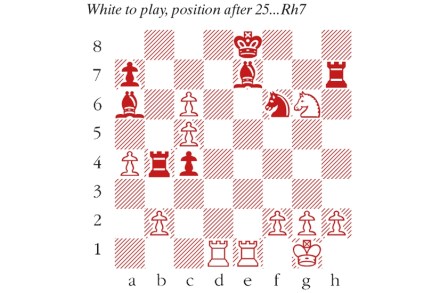
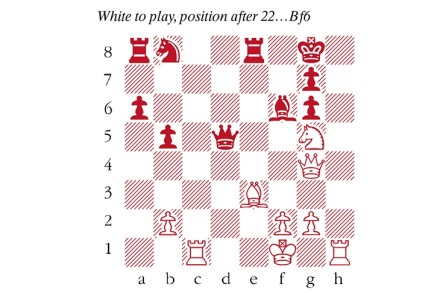
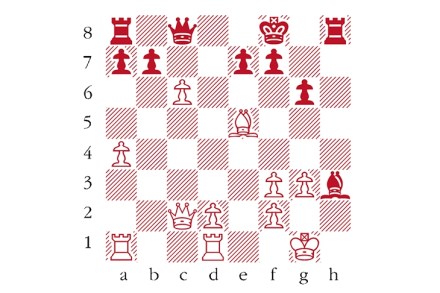
White to play, Stockfish–AllieStein, TCEC Season 16. Stockfish found a beautiful knockout blow in this game against a different neural net engine. What did it play? Answers should be emailed to chess@spectator.co.uk by Monday 8 June. There is a prize of £20 for the first correct answer out of a hat. Please include a postal address and allow six weeks for prize delivery. Last week’s solution 1 Qe5?? g5+! and White resigned, since 2 Kh5 Qxh3 is mate.

Swindlers’ art

A lost cause at the chessboard is hard to define, but, like obscenity, I know it when I see it. There comes a point where prolonging the matter is downright indecent, so thank goodness that custom permits us to save our blushes with a timely resignation. Then again, there are a great many chess positions that lurk in the shadows — distasteful, but not beyond redemption. The degenerate defender must thirst after a swindle to salvage a draw (or more!). I confess that so long as some hope remains of a juicy swindle, I can stomach almost any position, no matter how unseemly. The Complete Chess Swindler (New in Chess), a new book by Australian grandmaster and economist David Smerdon, is a thrilling guide to this netherworld of not-quite-resignable positions.

No. 606

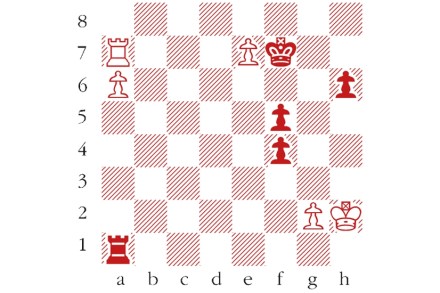
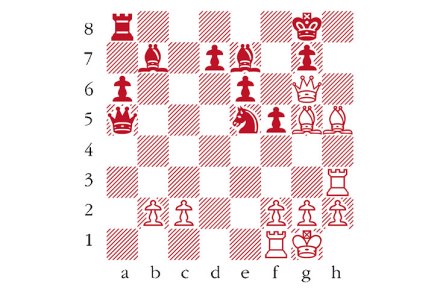
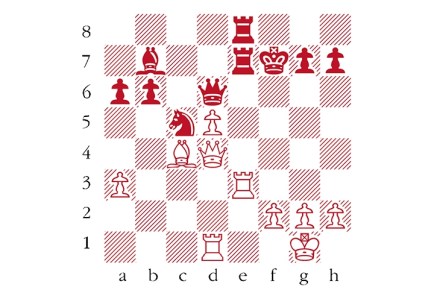
Tamas Fodor — Michael Adams, Hull 2018. White to play. One from the puzzles section of Smerdon’s book, which I witnessed myself. Adams’s last move, 60...Kf6-f7 set a trap. White’s next was a queen move that walked right into it. What was the losing move? Email answers to chess@spectator.co.uk by Monday 1 June. There is a prize of £20 for the first correct answer out of a hat. Please include a postal address and allow six weeks for prize delivery. Last week’s solution 1.Qf6! Mate follows with Qf2/Qf3/Qxe5/Qxd4/Nxf5/Rb3, depending on Black’s reply.Last week’s winner A.

Steinitz Memorial

I like a memorial tournament. It’s true that the champions they celebrate may be less skilled than their modern counterparts. That’s to be expected, as players of today stand upon the shoulders of their predecessors. So I tend to picture the world champions as squabbling gods of myth, made vital by their flaws, and memorial tournaments as temples in their honour. Some characters, like the urbane Capablanca or the charismatic Tal, capture the imagination more readily, but they all have a place, as do the demigods such as Chigorin, Keres or Korchnoi, who never reached the summit but are revered in turn. Usually a memorial event bears a national significance too, such as the Capablanca Memorial in Cuba, or the Chigorin Memorial in Russia.

No. 605

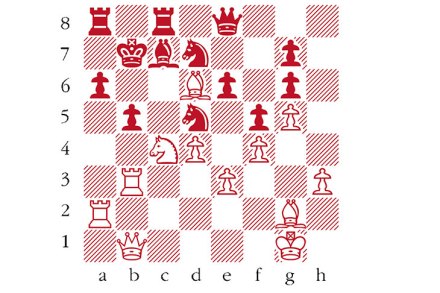
White mates in two moves against any defence (composed by Walter Pulitzer). Steinitz admitted he could not crack this within 15 minutes. What is White’s key first move? Answers should be emailed to chess@spectator.co.uk by Monday 25 May. There is a prize of £20 for the first correct answer out of a hat. Please include a postal address and allow six weeks for prize delivery. Last week’s solution 1 Bb2! entombs the Bc2. The a-pawn decides the game. After 1... h5 2 g5 h4 3 a4 Black was completely lost.

Online Nations Cup

Fifty years ago, the USSR faced a ‘Rest of the World’ team in a match in Belgrade, with the likes of Spassky, Petrosian, Larsen and Fischer doing battle on the top boards. The Soviet team, which included five world champions, managed a narrow 20.5-19.5 victory. In 2020, there are three chess superpowers: the USA, Russia and China. Russia has the deepest pool of talent, and between all three, they boast around half of the world’s top 100 players. Each country occupied a podium spot at the most recent Olympiad in 2018. The Olympiad is normally biannual, but the 2020 edition, due to be held in Russia this summer, has been postponed for a year. An online version of the event has been mooted by Fide, but there has been no official announcement.

No. 604

Aronian–Vidit, Online Nations Cup, May 2020. Vidit has just captured axb3 en passant. Aronian’s next move revealed a powerful concept. What was it? Answers should be emailed to chess@spectator.co.uk by Monday 18 May. There is a prize of £20 for the first correct answer out of a hat. Please include a postal address and allow six weeks for prize delivery. Last week’s solution 1…b5! 2 Qd3 (2 Qc6 Qe4+) Qb7! White resigned in view of 3 Rc5 Re5! winning the rook.

Magnus wins Magnus Carlsen Invitational

‘I haven’t felt this kind of tension in a long while. This was real!’ Those were Magnus Carlsen’s words, after barely scraping through his semi-final match with Ding Liren at the Magnus Carlsen Invitational, which concluded last weekend. The event was hosted on the chess24 website and boasted a $250,000 prize fund. (Carlsen’s company, Play Magnus, merged with chess24 last year). The world champion assembled a formidable line-up, including five players from the recently postponed World Championship Candidates tournament. It is clear that Carlsen finds Ding to be a troublesome opponent. China’s top player has notched up several victories in speed chess, including a memorable triumph in the playoff of last year’s Sinquefield Cup.

No. 603

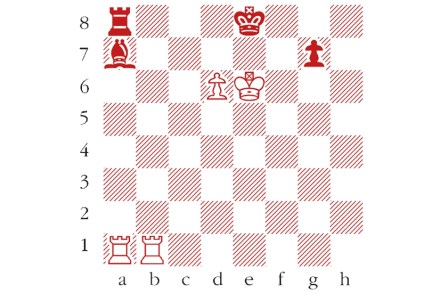
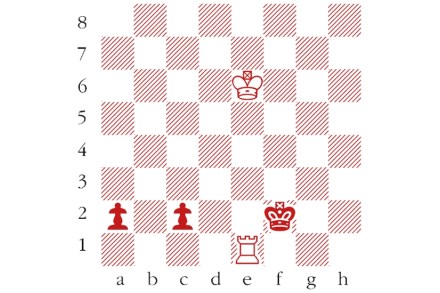
Black to play. Ding–Nakamura, Magnus -Carlsen Invitational, April 2020. The position appears sterile, but Nakamura spotted a clever winning move. What was it? Answers should be emailed to chess@spectator.co.uk by Monday 11 May. There is a prize of £20 for the first correct answer out of a hat. Please include a postal address and allow six weeks for prize delivery. Last week’s solution 1 Rg4+! Kf3 2 Rf4+! Ke3 3 Rf3+ Kxf3 is a draw by stalemate. Black can only avoid this by giving up his knight.

Hovering amid the din

‘I am extraordinarily patient — provided I get my own way in the end’. That’s a disposition fit for a chess player, even if it was Margaret Thatcher who said it. Learning when, and how, to mark time is an essential practical skill, so the classic text Endgame Strategy by Shereshevsky dedicates a whole chapter to the motto ‘Do not hurry’. When I won a 163-move, 7.5-hour game against Nigel Short in 2009, I did feel I had got the hang of it. But it’s so much easier to exercise patience when you have plenty of time, like I did. (Thatcher had it easy too — she was locked in some glacial negotiation with the EEC.) How much harder it is to restrain the impulses amid the hurly-burly of a blitz game.

No. 602

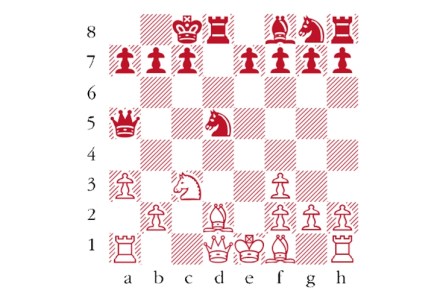
Nepomniachtchi (lachesisQ)–Andriasian (Zaven_ChessMood), Abu Dhabi Super Blitz, April 2020. White is in danger here. Which move did he play to put the draw beyond doubt? Answers should be emailed to chess@spectator.co.uk by Monday 4 May. There is a prize of £20 for the first correct answer out of a hat. Please include a postal address and allow six weeks for prize delivery. Last week’s solution 1…Rxe5! 2 dxe5 Qg3 and mate follows on g2. Or 2 Nxe5 Qg5! threatens mate and …Nxh3+ to win the Qd2.

FantasticStar beats MagzyBogues

‘I’m just completely collapsing in these games… unbelievable.’ World Champion Magnus Carlsen didn’t hide his anguish after losing a game against Alireza Firouzja, the 16-year-old who went on to defeat him 8.5-7.5 in an online blitz match last week. It was a dream final for the Chess24 website’s ‘Banter Blitz’ knockout tournament. Carlsen is the reigning World Blitz champion in over-the-board play. Firouzja, originally from Iran but now living in France, is an exceptional talent, and a serious candidate to succeed him in the future. He is still inexperienced in elite classical tournaments, and was convincingly beaten by Carlsen at the Tata Steel tournament in January. But in online speed chess, he is already among the world’s best.

No. 601

Black to play. Sjugirov–Carlsen, Chess24 Banter Blitz Semi Final. In this wild position, Carlsen’s next move put the result beyond doubt. What did he play? Answers to chess@spectator.co.uk by Monday 27 April. There is a prize of £20 for the first correct answer out of a hat. Please include a postal address and allow six weeks for prize delivery. Last week’s solution 1…Qg3+! 2 Rxg3 hxg3+ 3 Kg2 (3 Kxg3 Rxg5#) Rh2+ 4 Kxg3 (4 Kf1 g2+) Bf4+ 5 Kg4 Rxg5 mate.

Old wine, new bottles

‘Old wine in new bottles’ must be the most protean idiom in the English language. I encountered it a few years ago, as a title to an article by the Romanian grandmaster Mihail Marin, who likes to lean upon his deep knowledge of the chess classics to elucidate games played in the modern era. (Recently he published a book of the same name, which grew out of a series of such articles.) That such vintage wisdom might still find favour with contemporary palates is, for Marin, something to celebrate. So I was perplexed to learn that the phrase also refers to the practice of sprucing up something tired and unappetising.

No. 600

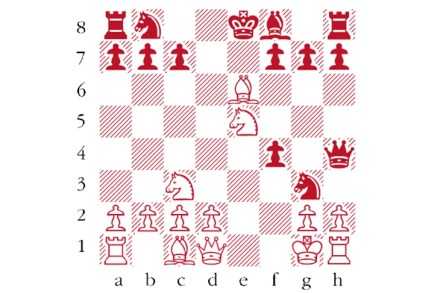
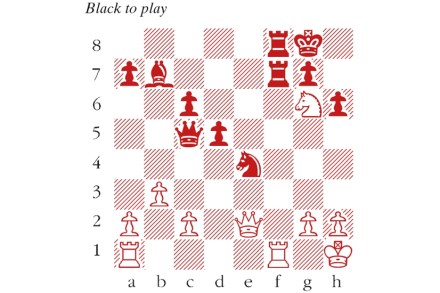
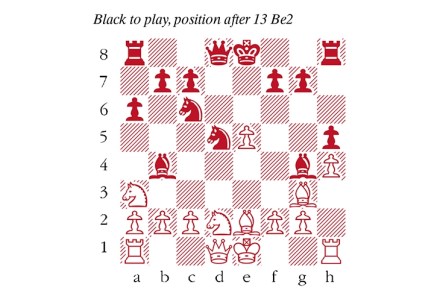
Black to play. Andrew Stone–Martin Jogstad, 4NCL Online, April 2020. The queen is trapped on f4, so 1…Rxg5 looks worth a try, as after 2 Rxf4 Bxf4 threatens Rg5-g3+. But in the diagram, Black found a far stronger move. Which one? Answers should be emailed to chess@spectator.co.uk by Monday 20 April. There is a prize of £20 for the first correct answer out of a hat. Please include a postal address and allow six weeks for prize delivery. Last week’s solution 1 Ne8+! Qxe8 2 Qxe8 Nxe8 3 d7 wins.

At your own risk

If there were regulatory oversight of chess openings, some would come with a litany of disclaimers. ‘You may lose more than your initial gambit.’ ‘Possible side effects may include dizziness and nausea.’ ‘Use at your own risk.’ Nonetheless, such openings as the King’s Gambit, the Dragon Sicilian, or the Botvinnik Semi-Slav often enjoy a cult following. Their devotees tend to be audacious types, who won’t let a few slings and arrows obscure the prospect of a glorious victory. These openings are exciting to play, and not necessarily bad, but they demand a special energy to handle well. In general, grandmasters prefer more conservative, rugged openings, particularly when they are Black.

No. 599

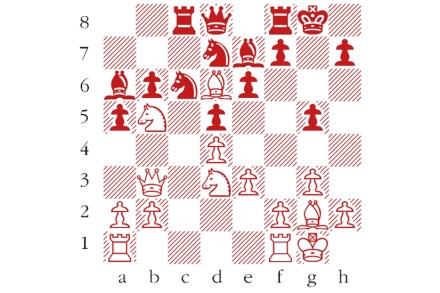
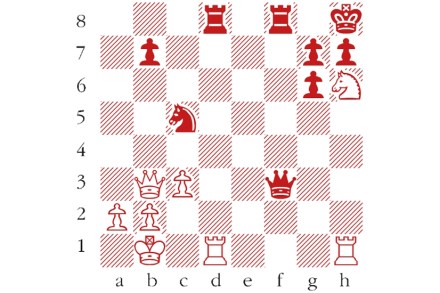
A position adapted from Vojtech Plat–Ravi Haria, Hull GM tournament, 2019. The d6-pawn is crucial here, but White needs a clever move to sweep aside the blockade. What is it? Email answers to chess@spectator.co.uk by Monday 13 April. There is a prize of £20 for the first correct answer out of a hat. Please allow six weeks for prize delivery. Last week’s solution 1 Qh2! threatens 2 Qb8+ Qg8 3 Qd6! with a winning attack. (But not 1 Qg3? Qc1+!, or 1 Qe3? Qf7!

No. 598

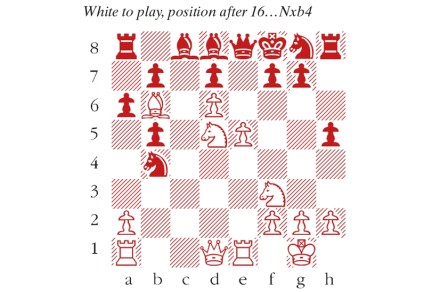
A variation from the game above. Although White is a pawn down, he can rustle up decisive counterplay with one accurate move. Which one? Answers should be emailed to chess@spectator.co.uk by Monday 6 April. There is a prize of £20 for the first correct answer out of a hat. Please include a postal address and allow six weeks for prize delivery. Last week’s solution 1 Qg1! Mate follows with Qg7/Qh2/Qa1/f4 depending on Black’s response.

Half measures

Would you slice a book in two? I learned of this peculiar practice in January, and I can’t fault its brutal pragmatism. Undeniably, half of War and Peace is more portable than the whole thing, and perhaps even less intimidating. When you finish the first chunk, you just swap it for the second. Books want to be read, not fetishised. For all that, I recoil from the idea, and I’m not alone. The Candidates tournament in Yekaterinburg, a 14-round epic, was put on hold after just seven, but not due to illness among the players.

The slow puzzle movement

I could list all manner of things I don’t try, because I know I won’t like them, like skydiving and revolting cocktails. But there’s another list of things I don’t try, knowing I might like them just a bit too much. ‘Puzzle Rush’ was, for some time, in the second category. Chess.com is one of the websites where people go seeking out internet games, and their release of ‘Puzzle Rush’ in late 2018 was an instant hit. The challenge is to solve as many chess puzzles as you can in five minutes. The puzzles get gradually harder, and after three strikes, you’re out. It goes to show that even games can be gamified, and many found this virtual chess whack-a-mole ludicrously addictive. Eventually curiosity got the better of me.