Luke McShane

Luke McShane is chess columnist for The Spectator.

No. 597

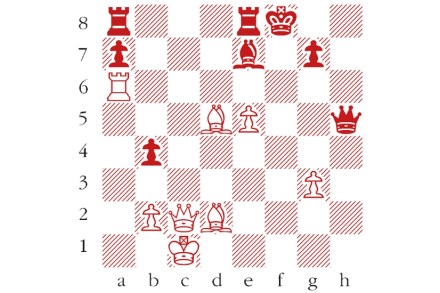
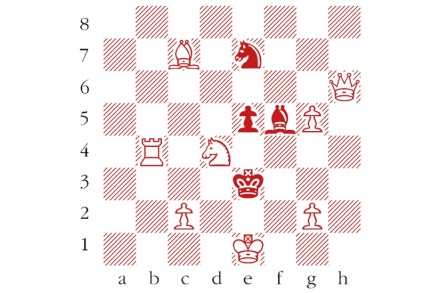
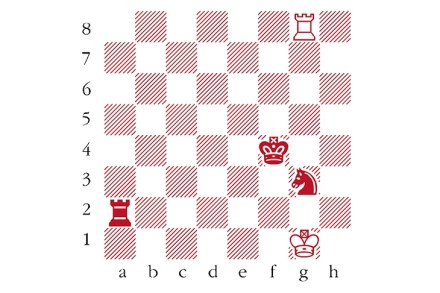
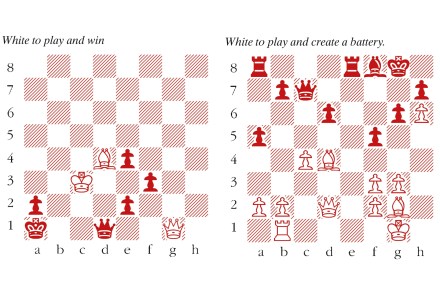
A puzzle used in the solving championship, composed by Vittorio de Barbieri in 1918. White must give mate in two moves, against any defence. It is tempting to use the long diagonal directly, but the solution is more subtle: look for a move without a direct threat. Answers (first move only) to chess@spectator.co.uk by Monday 30 March. There is a prize of £20 for the first correct answer out of a hat. Please include a postal address. Last week’s solution 1 Rhf3! breaks the pin. 1… exf3 2 Rxe7 Bxe7 3 Qe6 and White won.

Candidates goes ahead

Coronavirus is causing chess events to fall like dominoes, with cancellations all over the world. But the Candidates tournament in Yekaterinburg, which selects a challenger for the World Championship, is still standing. The first round took place on Tuesday 17 March. It goes ahead without Teimour Radjabov, from Azerbaijan, whose request to postpone the event was denied by Fide, the governing body. Emil Sutovsky, Fide’s director-general, pointed to the size of the event (just eight players) and a number of sanitary measures that will be instated. (Larger events have been cancelled or postponed). But a photo of a packed auditorium at the opening ceremony looks distinctly at odds with a safety-first approach.

No. 596

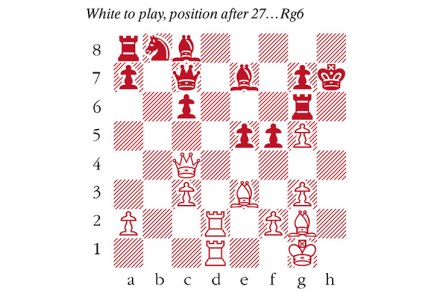
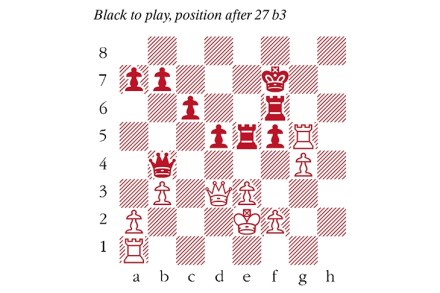
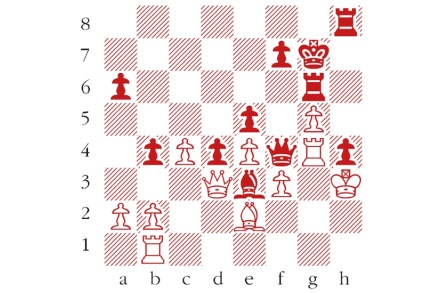
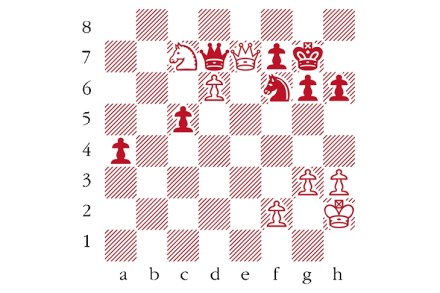
White to play. Shirov–Yuffa, Nutcracker Battle of the Generations, Moscow 2020. The rook on f7 is pinned, and 1 Rxf8+ Qxf8+ costs White the rook on h3. How did Shirov turn the tables? Answers should be emailed to chess@spectator.co.uk by Tuesday 24 March. There is a prize of £20 for the first correct answer out of a hat. Please include a -postal address and allow six weeks for prize delivery. Last week’s solution 1…Rd7! 2 Nd6 Rxd6! 3 exd6 Qe1#. Instead 1…Qxb7? 2 Rc7, provoked resignation as Rxf7 and Qxh7 mate will follow.

Chess borders

In the 1800s, several chess matches were conducted by telegraph. Modern technology ought to make long-distance matches easier than ever, but in fact competitive international chess is almost always played in person these days. That is partly because it is impossible to police computer-assisted cheating if the players play at home. But equally, the practical barriers to travel are (usually) much fewer in the modern age. But prominent chess players (especially in the days of the USSR) have often had to negotiate political obstacles. Shohreh Bayat, from Iran, was in Shanghai in January for the first leg of the Women’s World Championship, where she was the chief arbiter — one of very few women in the world qualified to perform that role.

No. 595

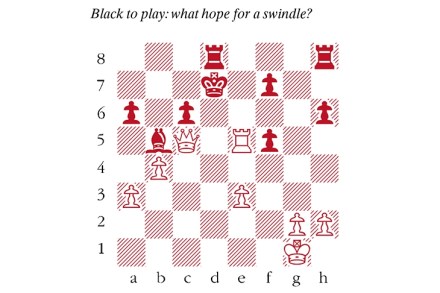
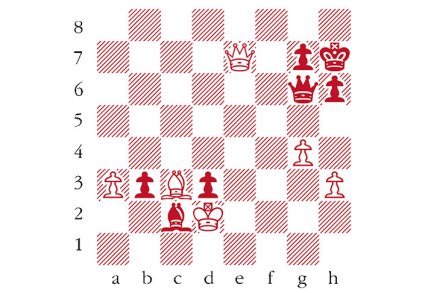
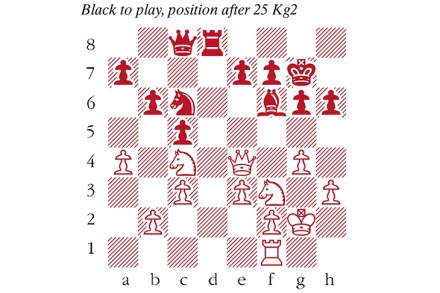
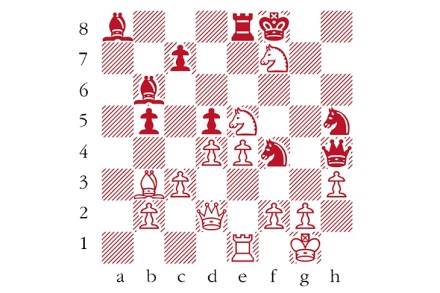
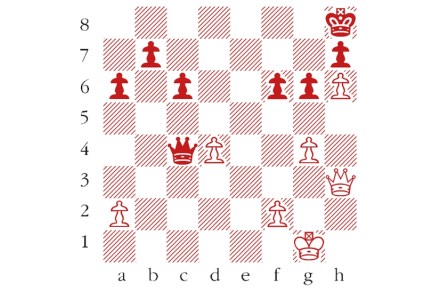
Black to play. Tomashevsky–Lomasov, Nutcracker Battle of the Generations, Moscow 2020. A position with a surprising twist. Tomashevsky has just captured a bishop on b7. What is Black’s best response? Answers to ‘Chess’ at The Spectator by Tuesday 17 March or via email to victoria@-spectator.co.uk. There is a prize of £20 for the first correct answer out of a hat. Please include a postal address and allow six weeks for prize delivery. Last week’s solution 1…Rxf1+! 2 Kxf1 Bh3+ 3 Kg1 Nd4! 4 Qxc3 Ne2+ 5 Kh1 Bg2 mate.

Peasants’ revolt

The German word for pawn, ‘bauer’, can also be translated as peasant, or farmer. There are many spectacular games in which the pawns pick up their pitchforks and overrun the landed gentry. A historic example, played in 1834, is the game McDonnell–de La Bourdonnais, in which the Frenchman playing Black advanced his pawns to d2, e2 and f2, overwhelming White’s rook and queen. A modern example is the game Saric–Suleymanli, which I wrote about in December last year. Aydin Suleymanli, just 14 years old from Azerbaijan, acquitted himself well but eventually succumbed to the advancing horde. Much less gets written about failed uprisings, but in this week’s game Suleymanli found himself yet again facing down an angry mob.

No. 594

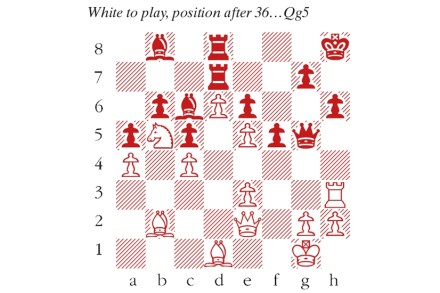
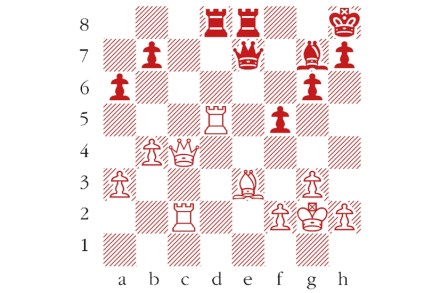
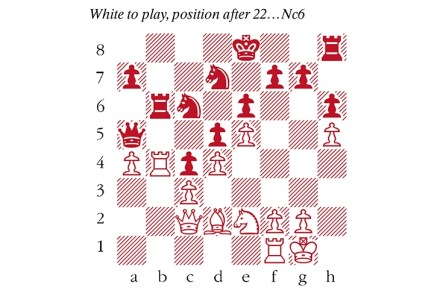
Black to play. Puranik–Sjugirov, another spectacular game played at the Aeroflot Open. Puranik was perhaps counting on 1…Rc1 2 Qa3 Bd2 3 Qb2! threatening mate on g7. Sjugirov found a much more powerful move. What was it? Answers to ‘Chess’ at The Spectator by Tuesday 10 March or via email to victoria@-spectator.co.uk. There is a prize of £20 for the first correct answer out of a hat. Please include a postal address. Last week’s solution 1 Re8+!

Increment and excrement

The science-fiction writer Douglas Adams ridiculed our primitive species for considering digital watches to be ‘a pretty neat idea’. Digital chess clocks really are pretty neat, because they enable modern competitive games to be played with an ‘increment’. For each move played, you earn extra seconds to make the next one, a simple innovation which allows all games to reach a natural conclusion. (By contrast, analogue clocks allot a tranche of thinking time for a series of moves). A lack of increment on the clock occasionally makes for excrement on the board; bashing out 20 moves in five remaining seconds may be physically impossible, but that never stops people trying. Pieces topple like bowling pins and the clock gets thumped like a broken television.

No. 593

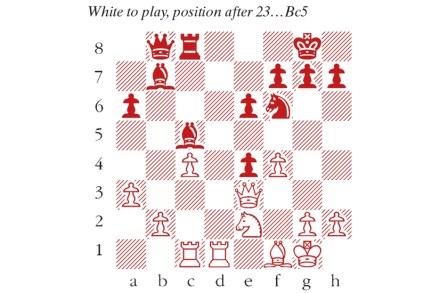
White to play, a variation from McShane–-Kamsky. In the game above, I was hoping to see 31…Qa5, as I had spotted an opportunity to turn the tables completely. What is White’s next move? Answers should be sent to ‘Chess’ at The Spectator by Tuesday 3 March or via email to victoria@spectator.-co.uk. There is a prize of £20 for the first correct answer out of a hat. Please include a postal address and allow six weeks for prize delivery.  Last week’s solution 1…Rd5! threatens …Qd1 mate and 2 Qxd5 Nf4+ picks up the queen.

Confidence tricks

Three consecutive losses in a tournament is dryly termed ‘castling queenside’, in reference to the chess notation for that move (0-0-0). Carissa Yip went one worse, starting with four demoralising zeros at the Cairns Cup in St Louis this month. The 16-year-old American was the lowest ranked player in the elite women’s all-play-all tournament, so it wasn’t about to get any easier, and her experienced opponents were surely looking to capitalise. In the fifth round, she bounced back in style with a win over seven-time US women’s champion Irina Krush. ‘Someone told me that I should just fake it till I make it,’ Yip explained after the game. Those were wise words, not just teenage insouciance.

No. 592

Black to play, Kateryna Lagno–Ju Wenjun, February 2020. Material is approximately balanced, but White’s king is in serious danger. What was Ju’s next move, which prompted immediate resignation? Answers should be sent to ‘Chess’ at The Spectator by Tuesday 25 February 2020 or via email to victoria@spectator.co.uk. There is a prize of £20 for the first correct answer that is pulled out of a hat. Please include a postal address and allow six weeks for prize delivery. Last week’s solution 1 Ra5! (idea 1...Nxa5 2 Rc8+). Black tried 1...

Beasts of the board

The Dutch artist Theo Jansen has a unique speciality. His ‘Strandbeest’ (beach animals) are kinetic sculptures, which he likes to set free upon a windswept beach. Fashioned from plastic tubes, bottles and the like, these imposing skeletons appear to ‘walk’ along the seafront with a gait at once laboured and graceful: a compelling synthesis of engineering and art.  When I first watched this magnificent spectacle on YouTube, I was immediately reminded of the cold, gusty walks along the beach at Wijk aan Zee, the town in Holland where the annual Tata Steel tournament is held. (Curiously, Jansen hails from Scheveningen, a seaside resort which lends its name to a variation of the Sicilian defence and to a format of team chess).

No. 591

White to play, Dubov–Artemiev, Wijk aan Zee 2020. White is pressing here, but Black seems to have everything covered. Which subtle move allowed Dubov to force a quick resignation? Answers to ‘Chess’ at The Spectator by Tuesday 18 February or via email to victoria@spectator.co.uk. There is a prize of £20 for the first correct answer out of a hat. Please include a postal address and allow six weeks for prize delivery.  Last week’s solution 49…Bxd1 50 g6! forces a pawn through, e.g. 50…hxg6 51 h7! wins.

Meeting an idol

We had never met, but David Paravyan, from Russia, has been something of a personal idol since August 2018. My veneration was exclusively based on one game whose dazzling ingenuity was, to my eyes, awesome. Last week he took first place (and a £30,000 prize) at the Gibraltar Masters, one of the most prestigious open tournaments in the world. Paravyan is an accomplished grandmaster, but this was a huge career breakthrough in a field that included the likes of Shakhriyar Mamedyarov and Maxime Vachier-Lagrave. Seven players tied for first place on 7½/10, and Paravyan triumphed in a gruelling series of tiebreak games after the final day’s play. Nevertheless, I cannot resist showing the earlier game which so impressed me.

no. 590

Black to move, Paravyan vs McShane, Isle of Man 2019. Here I intended 49…Bxd1. What had Paravyan planned after that move? Answers should be sent to ‘Chess’ at The Spectator by Tuesday 11 February or via email to victoria@spectator.co.uk. There is a prize of £20 for the first correct answer out of a hat. Please include a postal address and allow six weeks for prize delivery.   Last week’s solution 1…Rf3+! 2 Kxe4 Rxf7! wins.

no. 589

Black to move. Javakhishvili–Adams, Gibraltar 2020. Adams has a few plausible moves here, including Rf1, Rf3+ and Rxf7, but only one of them wins. Which is the right one? Answers should be sent to ‘Chess’ at The Spectator by Tuesday 4 February or via email to victoria@spectator.co.uk. There is a prize of £20 for the first correct answer out of a hat. Please include a postal address and allow six weeks for prize delivery.   Last week’s solution 1 Ng1! keeps everything secure. 1… Bg5 2 exd6 with a decisive advantage.

Women’s World Championship

Looking at the first 12 games of the 2018 Carlsen-Caruana World Championship, which all ended in draws, I saw a statistical blip where others saw an ossified match format and the death of classical chess. But nobody could decry the drama at this year’s Women’s World Championship, in which reigning champion Ju Wenjun from China saw off a fierce challenge from 21-year-old Russian Aleksandra Goryachkina.   The early games saw Goryachkina willing to engage in protracted battles, but it was Ju who got the first win from a tricky queen ending in the fourth game. Undeterred, Goryachkina struck back immediately, and went on to take the lead herself in the eighth game. Ju was rewarded for several bold decisions in the ninth, leaving the scores level.

More than a game

Cars, computers and cadavers: taking them apart is normally reserved for experts and the pathologically curious. In his new book, The Moves that Matter, Jonathan Rowson takes a scalpel to the game of chess itself, and finds abundant meaning in its cultural, psychological and metaphorical aspects. Or as he puts it: ‘Chess is just a game in the way that the heart is just a muscle.’ It’s ambitious stuff, but we’re in good hands. Dr Rowson is a three-time British champion (2004-2006), writer, philosopher and co-founder of Perspectiva, a research institute that examines the relationship between complex global challenges and the inner lives of human beings.   The Moves that Matter is unusual in that Rowson has written a chess book with a general audience in mind.

no. 588

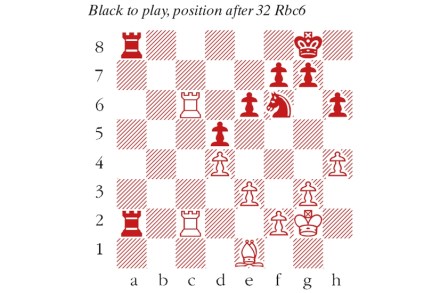
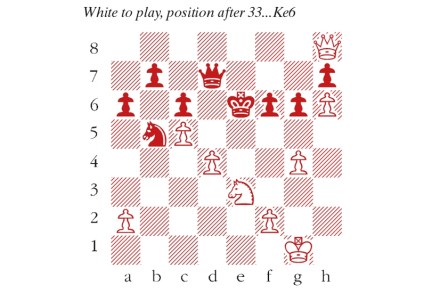
Rowson-Yermolinsky, World Open 2002. This position arose after a tactical skirmish. White has only one good way to meet the threat to the rook, which had to be seen well in advance. What is it? Answers should be sent to ‘Chess’ at The Spectator by Tuesday 28 February or via email to victoria@spectator.co.uk. There is a prize of £20 for the first correct answer out of a hat. Please include a postal address and allow six weeks for prize delivery.   Last week’s solution 1 Qg8+!

no. 587

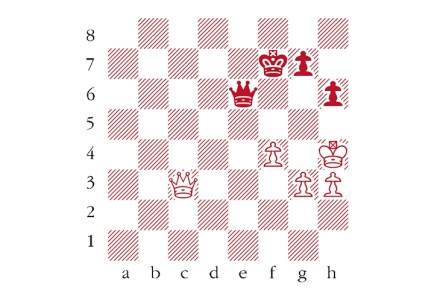
Sanguineti–Najdorf, Mar del Plata 1956. White to move. White played 1 Kd8?, to threaten 2 Qe7#. Black resigned, overlooking 1…Rxg4 to prepare Ke6-f5. White should have chosen a queen check instead. Which one? Answers by Tuesday 21 January to ‘Chess’ at The Spectator or victoria@-spectator.co.uk. There is a prize of £20 for the first correct answer out of a hat. Please include a postal address and allow six weeks for prize delivery.   Last week’s solution 1 Rxh7+! Kxh7 2 Qh5+ Kg8 3 Ne7 mate.