Luke McShane

Luke McShane is chess columnist for The Spectator.

No. 620

From our UK edition

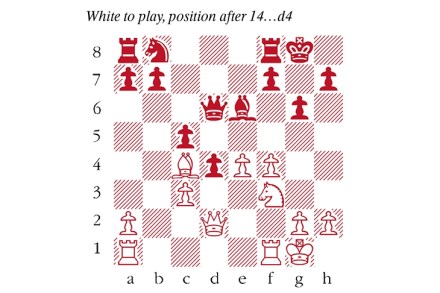
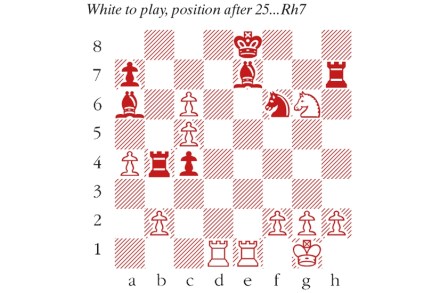
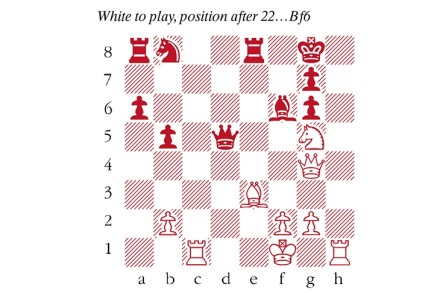
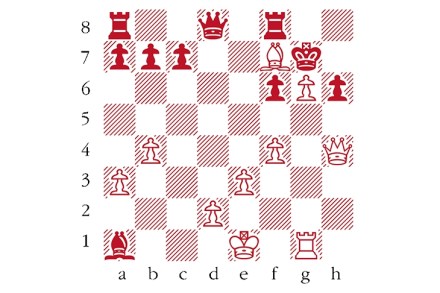
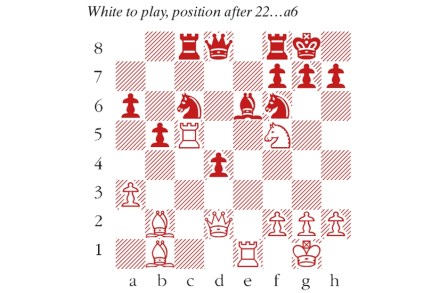
White to play. Zaibi–Napoleao, Online Olympiad, August 2020. White has just sacrificed the rook on a1. He concluded the attack in fine style. What was the winning move? Answers should be emailed to chess@spectator.co.uk by Monday 7 September. There is a prize of £20 for the first correct answer out of a hat. Please include a postal address and allow six weeks for prize delivery. Last week’s solution 1 hxg5! White eventually drew. Not 1 Kxg5? Qh6+ 2 Kf5 g6+! and 3…Qxf8. 1 Kg3? Qe3+ 2 Kg2 gxh4 is bad too.
Carlsen vs Nakamura

From our UK edition

Facing Magnus Carlsen, you have two problems. The first is obvious — he’s the best player in the world. The second lies in your awareness of the first. Countless players have seemed bewitched by the world champion, drained of the confidence needed to push for a win. In a single game, a strong grandmaster may well hunker down and steer the game towards a draw, but that’s a doubtful strategy in a long match, where critical mistakes will inevitably occur. I didn’t credit Hikaru Nakamura with much of a chance against Carlsen in the finals of the Magnus Carlsen Chess Tour, the series of elite online events held over recent months. On paper, he is a strong contender. Online rapid chess plays to Nakamura strengths, and he is even more dangerous in blitz playoffs.

No. 619

From our UK edition

Nakamura–Carlsen, August 2020. Carlsen has just advanced 40…g6-g5+, laying a nasty trap. Only one move gives White a fighting chance here — what is it? Answers should be emailed to chess@spectator.co.uk by Monday 31 August. There is a prize of £20 for the first correct answer out of a hat. Please include a postal address and allow six weeks for prize delivery. Last week’s solution 51…Qh3+!! 52 Kxh3 Rh1 mate.

Streaks of brilliance

From our UK edition

Last week, snooker ace Ronnie O’Sullivan won his sixth World Championship at the age of 44, a full 19 years on from his first title. A few days earlier, he had taken a pop at the younger generation: ‘They’re not that good really… I’ve probably got to lose an arm and a leg to fall outside the top 50!’ You wouldn’t expect the same blunt turn of phrase from Vishy Anand, but in terms of longevity, he’s the obvious counterpart in chess. Almost 25 years have passed since he first challenged Kasparov for the world title. Anand turned 50 last year, and just three years ago added another World Rapid Championship to his collection.

No. 618

From our UK edition

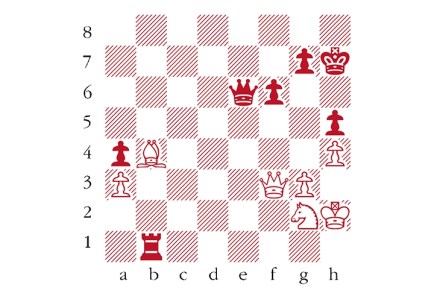
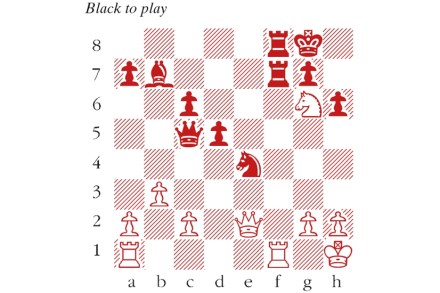
Black to play. McShane–Anand, World Rapid Championship 2017. While executing my last move, 51 Qf4-f3, attacking the h5-pawn, I got a horrible sinking feeling, as I saw what was about to hit me. What did Anand play? Answers should be emailed to chess@spectator.co.uk by Monday 24 August. There is a prize of £20 for the first correct answer out of a hat. Please include a postal address and allow six weeks for prize delivery. Last week’s solution 1…Bc5+ 2 d4 Bxd4+! 3 Qxd4 Ne2+!

The King’s Gambit

From our UK edition

Does Bear Grylls play chess? If he does, I’m sure he would favour the King’s Gambit. As chess openings go, it is primitive and hazardous. Playing it well demands a kind of reckless, wholehearted optimism that few can muster. Ostensibly, you sacrifice just a pawn (1 e4 e5 2 f4), but really, you’re already in deeper, since the aspiring gambiteer mustn’t flinch from chucking a piece or more on the bonfire. Most players find it more agreeable to watch others sacrifice their pieces. Indeed, sacrificial classics such as the ‘Immortal Game’ (Anderssen–Kieseritzky, London 1851) have a timeless appeal. But for those with the requisite swagger, nothing stokes the imagination like playing the opening.

No. 617

From our UK edition

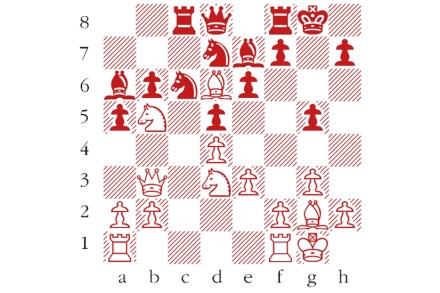
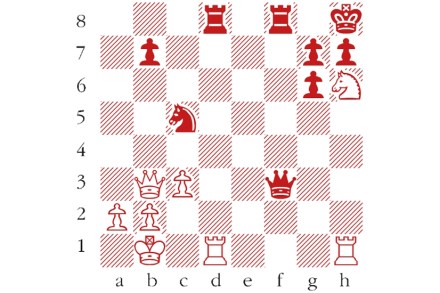
Black to play. Efimov–Bronstein, Kiev 1941. Normally White seeks glory in the King’s Gambit, but here Bronstein scored a lightning victory for the Black side. Which move did he choose? Email answers to chess@spectator.co.uk by Monday 17 August. There is a prize of £20 for the first correct answer out of a hat. Please include a postal address and allow six weeks for prize delivery. Last week’s solution 1...a4! wins, as 2 Bxe7 axb3 3 Bxd8 Bxb5 4 Bxg5 Bxd3 left Black a piece up. Or 2 Qxa4 Bxb5! hits the queen.

The view from on high

From our UK edition

‘Cabin crew, ten minutes to landing!’ Are there any more exhilarating words? Soon, for a few precious minutes, one can fix one’s gaze on the approaching landscape. The patchwork fields, the lines of terraced houses and shuffling cars — all woven together in an intricate fractal. From a certain point of view, these simple things are the crowning achievements of civilisation. Photographers at large chess tournaments often choose to capture an aerial view of the playing hall. To my eyes, it makes for a similarly uplifting sight. Hundreds of chess boards aligned in an arena, their occupants riveted with dedication — what better evidence of human society in rude cultural health?

No. 616

From our UK edition

Black to play. Studer–Naiditsch, Biel, July 2020. White intends to meet 1…Bxb5 with 2 Bxe7 Qxe7 3 Qxb5, with an equal position. Which move did Naiditsch play to pinpoint the flaw? Answers should be emailed to chess@spectator.co.uk by Monday 10 August. There is a prize of £20 for the first correct answer out of a hat. Please include your address and allow six weeks for prize delivery. Last week’s solution 1 Ra8! Kxe7 2 a7! The threat of 3 Rh8 Rxa7 4 Rh7+, winning with a skewer, is decisive. If 2…Kf6 3 Rf8+ and 4 a8=Q. Last week’s winner W.

Tech mate

From our UK edition

I am sure I have posed more questions to the chess engine Stockfish than to any living being. I love the instant gratification: you give it a chess position and it gives you an answer: the best move and an evaluation measured in hundredths of a pawn, like +1 24. Leave it alone, it will delve deeper; move a piece, it will respond anew. In human terms, ‘Ooh, a smidgen better for White’ gives way to ‘Go there, and your rook gets blown away’. The chess engine is, by turns, a spirit level and a hurricane forecast. The basic design of a traditional chess engine like Stockfish is simple: check all the moves, back and forth, for both sides, and tot up the value of the pieces in each scenario. Then choose a move accordingly.

No. 615

From our UK edition

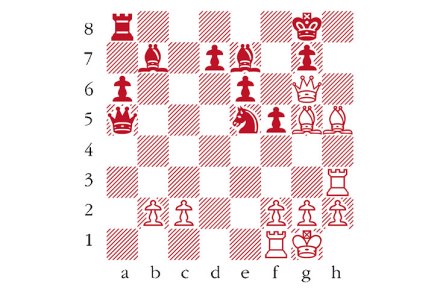
White to play. Stockfish–Leela Chess Zero, TCEC 18, Game 92, July 2020. It looks hard to make progress, despite the far advanced pawns. What was Stockfish’s winning move? Answers should be emailed to chess@spectator.co.uk by Monday 3 August. There is a prize of £20 for the first correct answer out of a hat. Please include a postal address and allow six weeks for prize delivery. Last week’s solution 1 Qh7+ Kxh7 (1...Kf8 2 Qh8 mate) 2 Bf7 mate.

The maestro

From our UK edition

‘Had I not become a composer, I would have wanted to be a chess player, but a high-level one, someone competing for the world title.’ So said Ennio Morricone, who died earlier this month at the age of 91. Looking back on a lifetime of work, you don’t doubt that he could have done it. The Italian ‘maestro’ was best known for his transcendent film scores; the coyote howl theme from Sergio Leone’s The Good, the Bad and the Ugly, came to symbolise the Italian Western genre. Less well-known is that Morricone composed ‘Inno degli scacchisti’ (‘Chess players’ anthem’) for the Turin Olympiad in 2006.

No. 614

From our UK edition

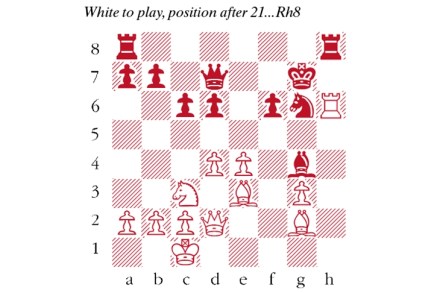
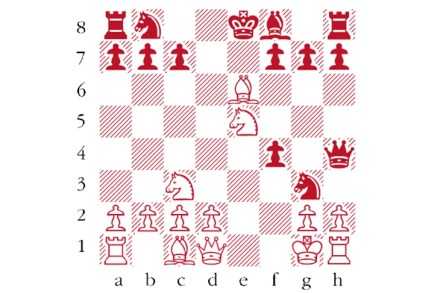
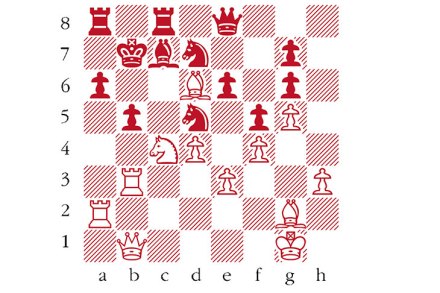
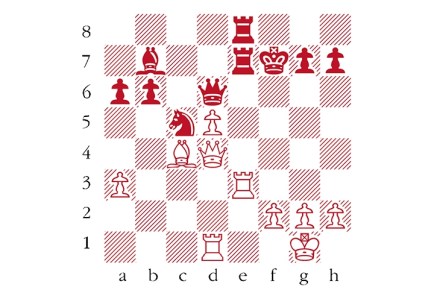
White to play. Stefano Tatai–Spyridon Skembris, Budva Zonal 1981. Morricone’s teacher found a delightful conclusion to this attack. What was his next move? Answers should be emailed to chess@spectator.co.uk by Monday 27 July. There is a prize of £20 for the first correct answer out of a hat. Please include a postal address and allow six weeks for prize delivery. Last week’s solution 1 Rb8+! Rxb8 (or 1...Bxb8 2 Rxa8 and 3 Rxb8 mate) 2 Rh1! and 3 Rh8 mate. Not 1 Rh1 0-0-0!, or 1 Rxa7 Rd8!

An ugly duckling problem

From our UK edition

The position shown in this week’s main diagram is the starter problem for the Winton British Chess Solving Championship, an annual competition. White must force mate in two moves, against any defence. (White moves, then Black moves, then White delivers checkmate.) For entry details, see the final paragraph. Many composed positions have an ugly duckling problem. Practical players are accustomed to discernible pawn structures and an approximate balance of material. An irrational starting position, like this one, is apt to draw a little wince. But look deeper, as there is grace and harmony to be found. Composed problems teem with ingenious and beautiful ideas expressed in ways that you might never encounter in practical play.

No. 613

From our UK edition

White to play and mate in three moves. A problem composed by grandmaster Jonathan Levitt (British Chess Magazine, 1995). One tip: note that there is an ‘obvious’ mate in two which actually falls short. Answers (first move only) should be emailed to chess@spectator.co.uk by Monday 20 July. There is a prize of £20 for the first correct answer out of a hat. Please include a postal address and allow six weeks for prize delivery. Last week’s solution 1 Re6! wins, as taking the rook costs Black his queen. The game ended 1...Qd8 2 Qf4+ Kg8 3 Rxe7 Rxe7 4 d6+ Re6 5 d7 g6 6 Rd6 and Black resigned.

The Streisand effect

From our UK edition

There is no sight so compelling as one that would be hidden. I am fascinated by the Streisand effect, named after Barbra Streisand, whose Malibu house appears in a large online collection of aerial photographs documenting the California coastline. In 2003, she filed a lawsuit to have it removed, which as well as being unsuccessful drew much more publicity to the photo. You can count on that appetite for mischief: Goya’s ‘Portrait of the Duke of Wellington’ was more in the public eye after it was stolen from the National Gallery in 1961 than before. (Wittily, the painting ‘appeared’ the following year in the hideout of Bond villain Dr No; the real thing was returned in 1965).

No. 612

From our UK edition

White to play. Giri–Nepomniachtchi, Chessable Masters 2020. Giri has sacrificed a knight to lure the black king forward. Which move forced a decisive breakthrough? Answers should be emailed to chess@spectator.co.uk by Monday 13 July. There is a prize of £20 for the first correct answer out of a hat. Please include a postal address and allow six weeks for prize delivery.

Twitch pageant

From our UK edition

Chess has much in common with video games — not least, the eager disdain of uninformed critics. An 1859 article in Scientific American noted the achievements of Paul Morphy ‘vanquishing the most distinguished chess players of Europe’ but concluded sniffily that ‘skill in this game is neither a useful nor graceful accomplishment’. You can’t please everyone. Gamers are used to suffering the same old brickbats — their pursuits are addictive, isolating, sedentary, a channel for violent impulses, or just a waste of time. This is mostly silly: games can offer a rich and fulfilling competitive environment.

No. 611

From our UK edition

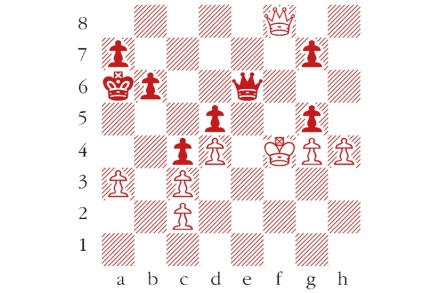
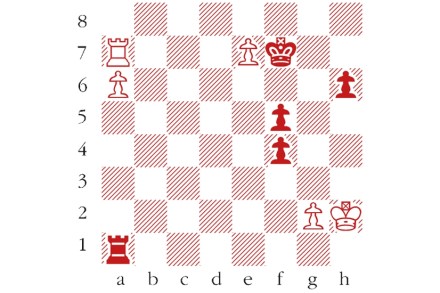
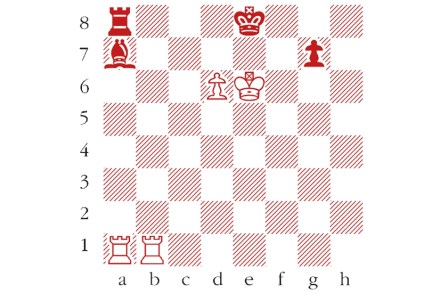
White to play. From the ridiculous to the sublime. According to the ‘Chess Notes’ website, a game won by Edward Gestesi in Paris, 1911. Which move forces a quick checkmate? Answers should be emailed to chess@spectator.co.uk by Monday 6 July. There is a prize of £20 for the first correct answer out of a hat. Please include a postal address and allow six weeks for prize delivery. Last week’s solution 1 Ra1! draws. The key line is 1…Ke3 2 Ke5 Kd3 3 Kf4 Kc3 4 Ke3 Kb2 5 Kd2 Kxa1 6 Kxc2 stalemate.

Clutch fun

From our UK edition

‘May the best scoring system win!’ is hardly a sentiment to stoke the passions. In the 2011 referendum, the alternative vote (AV) system was mooted to replace first-past-the-post. The electorate didn’t care for AV, which lost by two votes to one. Indeed, people didn’t much care for the issue at all: the 42 per cent turnout was far feebler than 72 per cent for the Brexit referendum in 2016. The fact remains — how you keep score does matter. In elections, the ‘popular vote’ does get counted, but it isn’t usually what counts, much to the chagrin of, say, Hillary Clinton’s supporters in 2016. In sport, as in politics, much depends upon the scoring system, even as we know that the exact details are arbitrary.