Luke McShane

Luke McShane is chess columnist for The Spectator.

No. 651

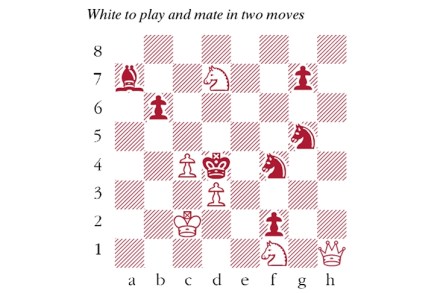
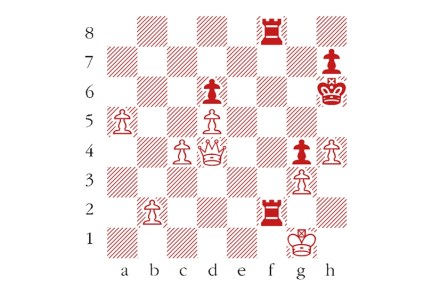
White to play and mate in two moves. Composed by Henry William Butler. Answers should be emailed to chess@spectator.co.uk by Monday 3 May. There is a prize of £20 for the first correct answer out of a hat. Please include a postal address and allow six weeks for prize delivery. Last week’s solution 1…Ng6! traps the White queen. The game saw 1…Nd3 2 Rxd3 Qxd3 3 Bxh5 and White won after many adventures.

Immovable object meets irresistible force

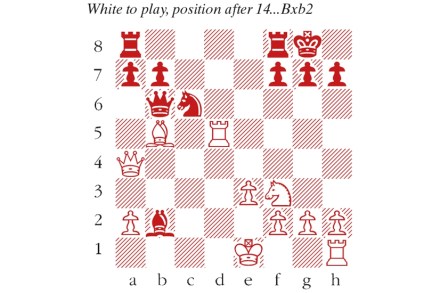
The Candidates tournament resumed on 19 April in Yekaterinburg. Eight players competed for a €500,000 prize fund, but only one prize mattered — first place, and the right to challenge Magnus Carlsen in a world championship match. It was Russia’s Ian Nepomniachtchi who triumphed — more on that next week. But the clash below, a true chess epic, gets my vote for the best game. At the halfway mark, Fabiano Caruana trailed his next opponent, Maxime Vachier-Lagrave, by a full point. Caruana is feared for the depth of his preparation and had a year to prepare for this game, knowing that Vachier-Lagrave is stubbornly principled in sticking to his Najdorf Sicilian (characterised by the move 5…a6), whose intricacies he knows inside out.

No. 650

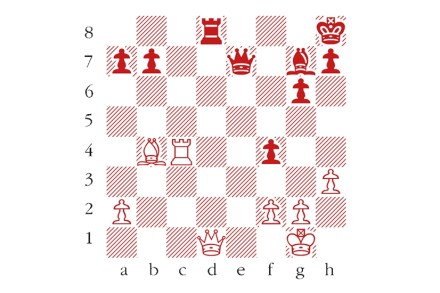
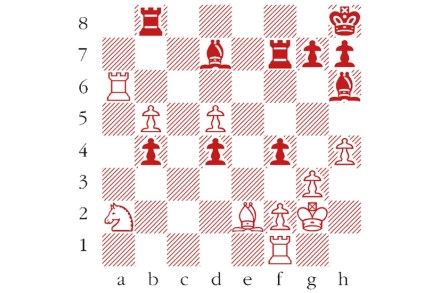
Black to play. Praggnanandhaa–Salimova, April 2021. White’s last move, Bg2-f3, was a blunder. Which move should Black play to exploit it? Email answers to chess@spectator.co.uk by Monday 26 April. There is a prize of £20 for the first correct answer out of a hat. Please include a postal address and allow six weeks for prize delivery. Last week’s solution 1 Rxd5! set up a queen trap: exd5 2 g3! Qh3 (2…Qxh5 3 Nf6+) 3 Bf5 Kf8 4 Nxh6 and Black resigned. Less effective are 1 Qd3 f5! 2 exf6 Qxg4, or 1 Rd4 Kf8! 2 Nh2 Rc1+!

The Polgar Challenge

Rameshbabu Praggnanandhaa, at 15 years old one of India’s most exceptional young players, emerged as the winner of the Polgar Challenge, an online event between 20 of the world’s brightest talents which took place earlier this month. It was the opening event of the $100,000 Julius Bär Challengers Chess Tour, and Praggnanandhaa earned himself a qualifying spot in the next Meltwater Champions Chess Tour event, alongside Carlsen and others. The mixture of ten male and ten female players gave the event an interesting spin. The top two women were both from China: Lei Tingjie and Zhu Jiner scored 10/19. The examples below show each get the better of a sharp tactical exchange. Lei Tingjie–Nurgyul SalimovaPolgar Challenge, April 2021 Strategically, Black is busted.

No. 649

From our US edition

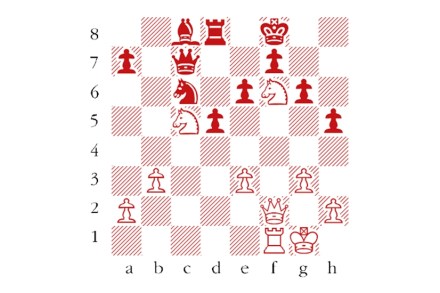
White to play. Van Wely–Shimanov, March 2021. White has several tempting options here, but one move is much stronger than the rest. Which one? Answers should be emailed to chess@spectator.co.uk by Monday 19 April. There is a prize of £20 for the first correct answer out of a hat. Please include a postal address and allow six weeks for prize delivery. Last week’s solution 1…Rc1! threatens to promote the d-pawn. After 2 Rd7 b3 3 Rxd3 b2 4 Rb3 b1=Q 5 Rxb1 Rxb1 Black wins easily.

European Online Club Cup

Since the start of the pandemic, opportunities for serious competition between players ranked outside the world’s top 20 have been scarce. So there was a pent-up appetite for the European Online Club Cup, which took place at the end of March, with more than 500 players registered (including more than 150 grandmasters) across 91 teams. Several teams from the 4NCL (Four Nations Chess League) took part: current champions Guildford, as well as Wood Green, Wood Green Monarchs, and Celtic Tigers. With backing from Roger Emerson and Nigel Povah, the Guildford lineup consisted of England team regulars Michael Adams, David Howell, myself and Gawain Jones, as well as Ivan Cheparinov from Bulgaria.

No. 648

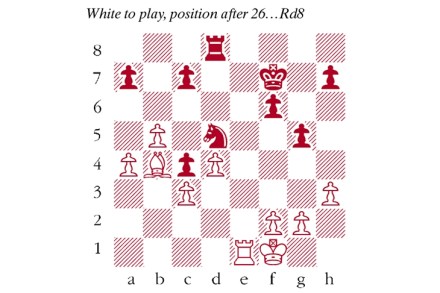
Black to play. Livaic-–Oparin, Fide World University Online Championship, March 2021. After 1…Rxc5 2 Rxb4, a draw was soon agreed. Which move should Black have preferred? Answers should be emailed to chess@spectator.co.uk by Monday 12 April. There is a prize of £20 for the first correct answer out of a hat. Please include a postal address. Last week’s solution 1 Rc5! threatens discovered check and mate with the Rb4. If 1…Bf6 2 Rd4# or 1…Bg5 2 Rf4#, while if 1…Bd8 or Be1, White has 2 Q(x)d8#.

Unfair play

Twenty players were disqualified from the Fide World University Online Championships, out of almost 900. Does that call for moral despair, righteous jubilation, or just a weary shrug? It is no revelation that policing the game has become a major challenge, made all the more urgent by the shift toward playing online. The first obstacle is a technical one — how to identify all the bad apples without picking up false positives? Kenneth Regan is a computer scientist and international master whose statistical research has shown that the raw moves are packed with clues. Using the suggested moves from a top chess engine as a benchmark, his software can quantify how precisely a player has played.

No. 647

White to play and mate in two moves. Composed by B.P. Barnes, Skakbladet 1961. Answers should be emailed to chess@spectator.co.uk by Monday 5 April. There is a prize of £20 for the first correct answer out of a hat. Please include a postal address and allow six weeks for prize delivery. Last week’s solution 1…Qf5?

Fortune favours the brave

If you wish to unsettle your opponents, first attack them and second, play the moves quickly. It’s far from easy to pull it off, but nobody does it better than Ian Nepomniachtchi. Among the world’s best, ‘Nepo’ stands out for his aggressive play, made all the more dangerous by marshalling an element of bluff. Are those moves coming so fast because he is still playing from memory, following his sharp opening repertoire? Has he already seen that the attack is overwhelming, and barely merits a second thought? One cannot know for sure, but Nepo is such a strong player (fourth in the world, at the last count) that one has to take him seriously. Nor does staring down a bluff promise an easy victory.

No. 646

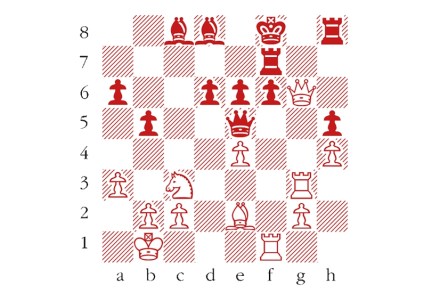
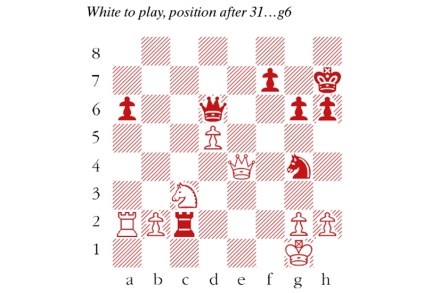
Black to play… and lose! Aronian–Van Foreest, March 2021. Van Foreest’s next move didn’t blunder his queen but was nonetheless a fatal error. Can you see what he played? Answers should be emailed to chess@spectator.co.uk by Monday 29 March. There is a prize of £20 for the first correct answer out of a hat. Please include a postal address. Last week’s solution 1…Rb4! 2 Rxh4+ Kg3! Now 3 Rxb4 is stalemate, or 3 Rg4+ Rxg4 4 hxg4 Kxg4 is a draw. White played 2 Kh2 and after Ke3 a draw was agreed soon after.

Everybody must get stoned

Have you ever played the Frankenstein-Dracula variation? The Monkey’s Bum? The Nescafé Frappé Attack? These are all real chess openings, and each has some merit. That is more than can be said for the Bongcloud, which begins with the moves 1 e4 e5 2 Ke2. This daft opening exploded in popularity last year when it was championed (in jest) by grandmaster and Twitch streamer Hikaru Nakamura. In fact the Bongcloud has hung in the air for much longer than that. According to one origin story (which appears genuine, but who knows?) an online persona named Lenny_Bongcloud was already playing it more than a decade ago. The Bongcloud has impeccable memetic credentials.

No. 645

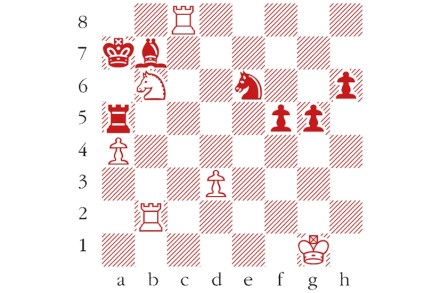
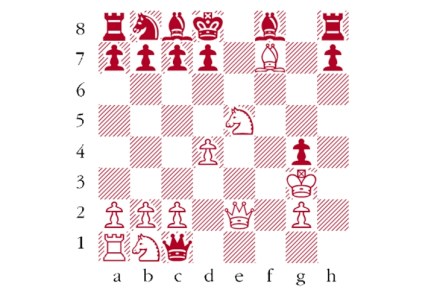
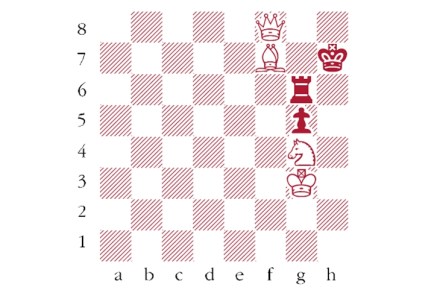
Black to play. Kosteniuk–Koneru, Skolkovo Grand Prix, 2019. The obvious 1…Kg3 fails to 2 Rg5+ Kf4 3 Rg4+. Losing the pawn looks inevitable, but Koneru found the only move to save herself. What did she play? Answers should be emailed to chess@spectator.co.uk by 22 March. There is a prize of £20 for the first correct answer out of a hat. Please include a postal address and allow six weeks for prize delivery. Last week’s solution 1 Qh3!

When the universe winks

I write this with a sunny feeling. That’s partly because spring is upon us, but mostly because I have just spotted one of those winsome coincidences which lifts the spirits with its serendipity. The first part of this delightful dyad occurred in the preliminary stage of the latest (and ongoing) Magnus Carlsen invitational event. Shakhriyar Mamedyarov–Daniil Dubov,Magnus Carlsen Invitational, March 2021 Two pawns up, Mamedyarov is certainly expecting to grind out a win. His last move, 66 Bd4-e5 threatens Re7-c7+, skewering the bishop on c2. Quick as a whip, Dubov fires back with 66…Rf1!! to attack the pawn on f5. If White loses that pawn, the game is bound for a draw, and anyway Mamedyarov’s move 67 Rc7+ appears to win the bishop.

No. 644

White to play and mate in two moves. Composed by Philip Hamilton Williams, Birmingham Post, 1890. Answers should be emailed to chess@-spectator.co.uk by Monday 15 March. There is a prize of £20 for the first correct answer out of a hat. Please include a postal address. Last week’s solution : 1 Qd5! Nc5+ 2 Ka2 and the threat Qd5-g8 is decisive. 1 Bxe6? Qa3+! soon led to a draw, because it’s stalemate if the queen is captured: 2 Kc4 Qb4+ 3 Kd5 Qd6+ etc. Or 1 Qe3? Nd4+ 2 Qxd4 Qa3+ is similar.

Armenian champions

In the 21st century, which country has won more international chess Olympiads than any other? Russia? USA? China? None of the above — it’s Armenia, which won gold three times (2006, 2008 and 2012). Despite a population of just 3 million, the country has a healthy number of top flight grandmasters, and Levon Aronian (the current world no. 5, and former world no. 2) has been its pre-eminent player for many years. So Aronian’s announcement that he will switch federations, representing the USA in future events, is significant. He will relocate to St Louis, which has become a major chess centre in recent years, with the backing of the American philanthropist Rex Sinquefield.

Play from home

Is working from home the future of a productive society, or a fleeting aberration? Nobody knows yet, but a significant minority (at the very least) have found it viable, and even desirable. The shift in perception creates possibilities that weren’t there before. Similarly, chess organisers are discovering a strong appetite for ‘play from home’ events, and I anticipate that we will see lots of new online tournament formats in the coming years. Last summer, Fide’s Online Olympiad was the first of its kind, and later in 2020 came the Online Olympiad for People with Disabilities, which I wrote about last week. February 2021 saw another new event — the Fide Online World Corporate Chess Championship.

No. 643

White to play. Garcia Ramos–Maurizzi, -Barcelona 2021. Black has just played Kg8-h7, to attack White’s queen by unpinning the knight on e6. Choose between 1 Qd5, 1 Qe3 and 1 Bxe6. Which do you prefer? Answers should be emailed to chess@spectator.co.uk by Monday 8 March. There is a prize of £20 for the first correct answer out of a hat. Please include a postal address and allow six weeks for prize delivery. Last week’s solution 1…Rb8! and White resigned, since 2 Rxb6 Bxg2+! wins easily.

No. 642

Black to play. Warakomski-–Korobov, February 2021. White has a pin on the b-file and 1…Bxg2+ 2 Kxg2 Bc5 3 Rb7 should suffice for a draw, despite the pawn deficit. But Korobov’s next move provoked instant resignation. What did he play? Answers to chess@spectator.co.uk by Monday 1 March, for a prize of £20 for the first correct answer out of a hat. Please include your address. Last week’s solution 1 Rc8! Now 1…Rxc8 or 1…Raa8 are both met by 2 Bd4 mate. Or 1…Bxc3 2 Rxd8+ leaves White with an easy win.

Synthetic diamonds

Diamonds are forever, they say. Likewise, brilliant games of chess have an everlasting sparkle. I will never tire of replaying the combination from Steinitz–von Bardeleben, Hastings 1895. So I’m a huge fan of tournaments which award brilliancy prizes, in recognition of these achievements. Fide recently organised an Online Olympiad for People with Disabilities. This excellent initiative was a reminder that the game is uniquely accessible, and saw 61 teams competing from 45 different countries. Many players overcame significant physical obstacles in order to take part. Vladimir Trkaljanov, who is visually impaired, was awarded the Gazprom Brilliancy prize, his game singled out from the shortlist by six out of 13 international judges.