Luke McShane

Luke McShane is chess columnist for The Spectator.

The back-rank mate

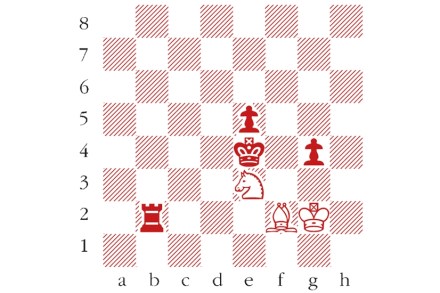
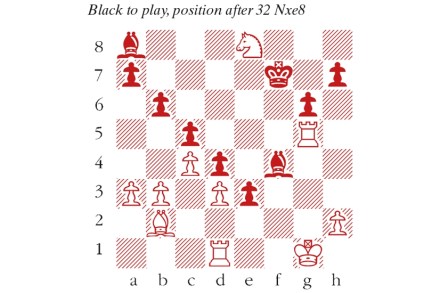
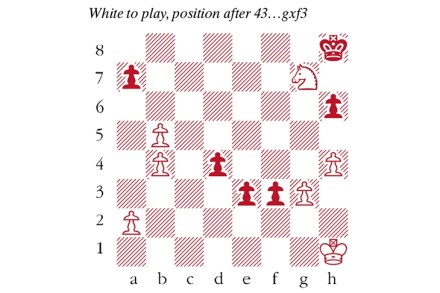
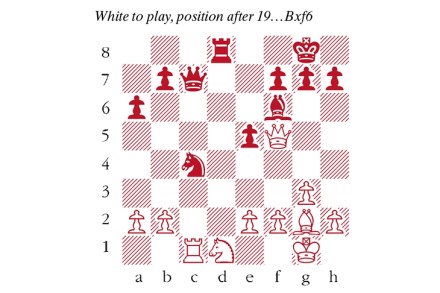
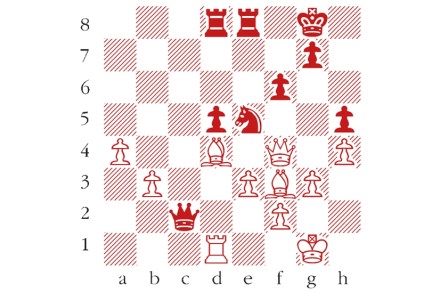
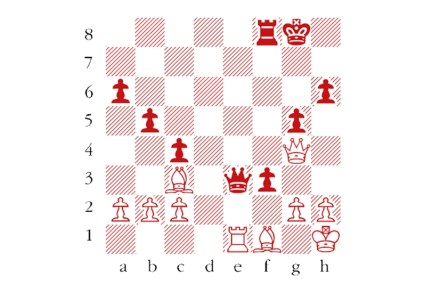
Compared with Anastasia’s mate, or an epaulette mate, the humble back-rank mate is named without imagination or whimsy. It is the Ronseal of mating patterns, administered by a rook or queen to a hapless king stuck on the rank behind its own pawns. But there is a rich variety of tactical motifs which culminate in this simple pattern, as shown by two of Magnus Carlsen’s recent games. Dubov–Carlsen FTX Crypto Cup Prelims, May 2021 (see left diagram) Carlsen has just grabbed a pawn on e4, so the knight on d5 lacks support. The simple 21 Nc3 looks roughly equal, but Dubov launched a volley of tactics with 21 Qxe5. His idea was revealed after 21…Rf5 22 Qxd4 Bxd4 23 Rxc8, because after 23…Qxc8 24 Ne7+ White emerges a knight up.
No. 657

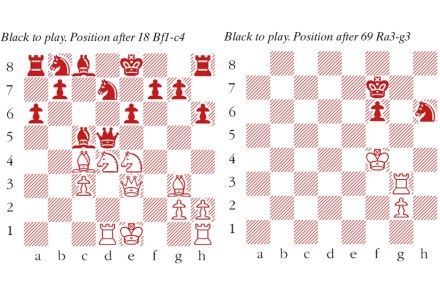
Black to play. Vodopyanov–Kantsyn, 1974. Two bishops up, White appears to have everything covered. Which move allows Black to force a quick win? Answers should be emailed to chess@spectator.co.uk by Monday 14 June. There is a prize of £20 for the first correct answer out of a hat. Please include a postal address and allow six weeks for prize delivery. Last week’s solution 1…g3! 2 Kxg3 Rb3. White resigned in view of 3 Kg2 Rxe3 4 Bxe3 Kxe3 5 Kf1 Kd2.

No. 656

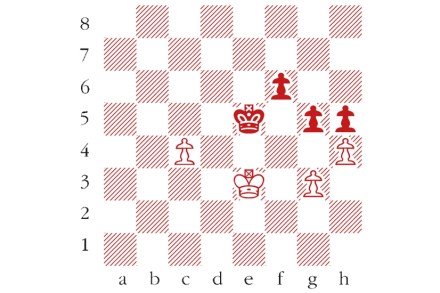
Black to play. Vocaturo–Gokerkan, May 2021. After a long defence, White’s last move 101 Nf1-e3 was a decisive error. Which move did Black play to wrap up the game? Answers should be emailed to chess@spectator.co.uk by Monday 7 June. There is a prize of £20 for the first correct answer out of a hat. Please include a postal address and allow six weeks for prize delivery. Last week’s solution 1 g4! hxg4 2 h5! (or 1…gxh4 2 gxh5). Black’s king cannot stop both passed c and h pawns.

Hybrid chess

Chess was played by cable in the 19th century because… well, why not? And because everything old is new again, 2021 has brought us ‘Hybrid chess’, in which players play online, but congregate in hubs shared with other players under the supervision of an arbiter. This time, put it down to human frailty and our need to visit the loo. In a time when a smartphone will suggest moves to beat the world champion, competitive online chess relies on the watchful eye of a webcam to deter casual cheating when people play from home. For that reason, online games are overwhelmingly played at rapid and blitz time controls, because when games last less than 40 minutes, it is reasonable to require that players remain at their desk throughout.

No. 655

White to play, Kharlov–Ernst, Haninge 1992. Black’s last move, g6-g5 was a decisive mistake. Which move did White play to exploit it? Answers should be emailed to chess@spectator.co.uk by Monday 31 May. There is a prize of £20 for the first correct answer out of a hat. Please include a postal address and allow six weeks for prize delivery. Last week’s solution 1 Ng5+!

Daredevil kings

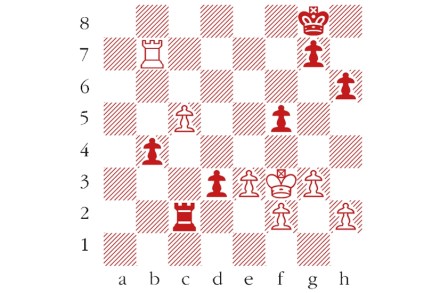
The fifth match game between Potter and Zukertort, played in London in 1875, saw a dogged struggle. The final position is shown in the diagram below, where the players agreed to a draw after 91 Kb5-c4. William Norwood Potter, an English master, must have reasoned as follows: the protected passed pawn on d4 obliges the White king to stand guard. The passed a- and b-pawns cannot overcome Black’s king on their own, and so a draw is inevitable. But Potter missed a splendid winning idea, in which the White king makes a heroic charge up the board. An illustrative variation: 91…Kc6 92 b5+ Kb7 93 b6 Ka6 94 Kb4 Kb7 95 Kb5! d3 96 a6+ Kb8 97 Kc6 d2 98 a7+ Ka8 99 Kc7 d1=Q 100 b7+ Kxa7 101 b8=Q+ Kxa6 102 Qb6 mate! There is no room for error in this kind of operation.

No. 654

White to play. Cochrane–Bonnerjee, 1852. Out of eight discovered checks with the knight on e6, Cochrane found the only one which wins the game. Which move did he choose? Answers should be emailed to chess@spectator.co.uk by Monday 24 May. There is a prize of £20 for the first correct answer out of a hat. Please include a postal address and allow six weeks for prize delivery. Last week’s solution 1 Rh2+!

Indian variant

Modern chess includes a panoply of ‘Indian’ openings, which share a common root in the starting moves 1 d4 Nf6 and include the King’s Indian, Nimzo-Indian, Queen’s Indian, Bogo-Indian, and Old Indian. But before 1900, the prevailing wisdom held that it was advisable for Black to contest the centre with a pawn advance. So the ‘Indian defence’, whose main characteristic was the fianchetto of the king’s bishop to g7, was a rarity — at least in games whose records survive. It was championed, with considerable flair, in a remarkable series of games played in Calcutta. John Cochrane was a Scottish barrister who practised in India for much of his career.

No. 653

White to play, Jones–Dominguez, New in Chess Classic, April 2021. Gawain Jones was hoping that his rook and pawn would cordon off Black’s king indefinitely. But here, at move 125, a surprising opportunity arose. What move should White have played? Email answers to chess@spectator.co.uk by Monday 17 May. There is a prize of £20 for the first correct answer out of a hat. Please include a postal address. Last week’s solution 1 Rh8!

What’s it worth?

The rule of thumb for weighing up piece exchanges says that pawns are worth one, knights and bishops three, rooks five and queens nine. It is such a useful guideline that one can go a long way without ever questioning it, but strong players have a feeling for the limitations. The first diagram shows a critical moment from the final of the New in Chess Classic, the latest online event in the Meltwater Champions Chess Tour, which was won by Magnus Carlsen. He didn’t hesitate to sacrifice rook for knight and pawn, because the resulting position looks so cosy for Black. The knights on f6 and h5 are secure and ready to jump into e4 and g3. White’s pawn on f5 is an impediment to his own pieces, so the bishop and rooks are bystanders, while the pawn on e3 is permanently weak.

Dead brain cells

As round 14 of the Candidates tournament unfolded, I had the feeling of watching an anti-climactic post-exam bender. Ian Nepomniachtchi had already passed with distinction, wrapping up tournament victory with a round to spare. The Russian plays energetic chess, but part of his success in Yekaterinburg was surely attributable to tempering his impulses throughout the event. In the final round he knocked out a few brain cells with his exuberant attack against Ding Liren. It was soundly refuted, but that hardly mattered. Nepomniachtchi’s instinctive aggression promises a thrilling clash of styles in the World Championship match against Magnus Carlsen, which is scheduled to commence in November 2021.

No. 652

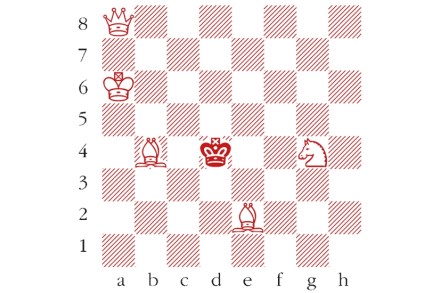
White to play and mate in two moves. Composed by Revd Ernest Clement Mortimer, The Problemist, 1942. Answers should be emailed to chess@spectator.co.uk by Monday 10 May. There is a prize of £20 for the first correct answer out of a hat. Please include a postal address and allow six weeks for prize delivery. Last week’s solution 1 Bd1! Kd3 2 Qd5 mate, or 1…Kc4 2 Qe4 mate.

No. 651

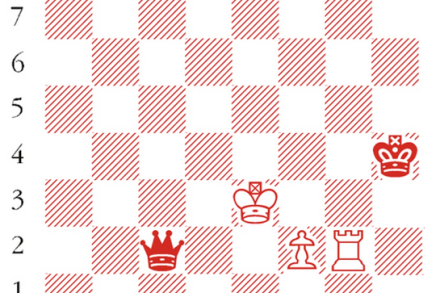
White to play and mate in two moves. Composed by Henry William Butler. Answers should be emailed to chess@spectator.co.uk by Monday 3 May. There is a prize of £20 for the first correct answer out of a hat. Please include a postal address and allow six weeks for prize delivery. Last week’s solution 1…Ng6! traps the White queen. The game saw 1…Nd3 2 Rxd3 Qxd3 3 Bxh5 and White won after many adventures.

Immovable object meets irresistible force

The Candidates tournament resumed on 19 April in Yekaterinburg. Eight players competed for a €500,000 prize fund, but only one prize mattered — first place, and the right to challenge Magnus Carlsen in a world championship match. It was Russia’s Ian Nepomniachtchi who triumphed — more on that next week. But the clash below, a true chess epic, gets my vote for the best game. At the halfway mark, Fabiano Caruana trailed his next opponent, Maxime Vachier-Lagrave, by a full point. Caruana is feared for the depth of his preparation and had a year to prepare for this game, knowing that Vachier-Lagrave is stubbornly principled in sticking to his Najdorf Sicilian (characterised by the move 5…a6), whose intricacies he knows inside out.

No. 650

Black to play. Praggnanandhaa–Salimova, April 2021. White’s last move, Bg2-f3, was a blunder. Which move should Black play to exploit it? Email answers to chess@spectator.co.uk by Monday 26 April. There is a prize of £20 for the first correct answer out of a hat. Please include a postal address and allow six weeks for prize delivery. Last week’s solution 1 Rxd5! set up a queen trap: exd5 2 g3! Qh3 (2…Qxh5 3 Nf6+) 3 Bf5 Kf8 4 Nxh6 and Black resigned. Less effective are 1 Qd3 f5! 2 exf6 Qxg4, or 1 Rd4 Kf8! 2 Nh2 Rc1+!

The Polgar Challenge

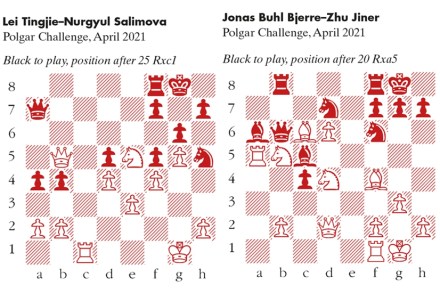
Rameshbabu Praggnanandhaa, at 15 years old one of India’s most exceptional young players, emerged as the winner of the Polgar Challenge, an online event between 20 of the world’s brightest talents which took place earlier this month. It was the opening event of the $100,000 Julius Bär Challengers Chess Tour, and Praggnanandhaa earned himself a qualifying spot in the next Meltwater Champions Chess Tour event, alongside Carlsen and others. The mixture of ten male and ten female players gave the event an interesting spin. The top two women were both from China: Lei Tingjie and Zhu Jiner scored 10/19. The examples below show each get the better of a sharp tactical exchange. Lei Tingjie–Nurgyul SalimovaPolgar Challenge, April 2021 Strategically, Black is busted.

No. 649

From our US edition

White to play. Van Wely–Shimanov, March 2021. White has several tempting options here, but one move is much stronger than the rest. Which one? Answers should be emailed to chess@spectator.co.uk by Monday 19 April. There is a prize of £20 for the first correct answer out of a hat. Please include a postal address and allow six weeks for prize delivery. Last week’s solution 1…Rc1! threatens to promote the d-pawn. After 2 Rd7 b3 3 Rxd3 b2 4 Rb3 b1=Q 5 Rxb1 Rxb1 Black wins easily.

European Online Club Cup

Since the start of the pandemic, opportunities for serious competition between players ranked outside the world’s top 20 have been scarce. So there was a pent-up appetite for the European Online Club Cup, which took place at the end of March, with more than 500 players registered (including more than 150 grandmasters) across 91 teams. Several teams from the 4NCL (Four Nations Chess League) took part: current champions Guildford, as well as Wood Green, Wood Green Monarchs, and Celtic Tigers. With backing from Roger Emerson and Nigel Povah, the Guildford lineup consisted of England team regulars Michael Adams, David Howell, myself and Gawain Jones, as well as Ivan Cheparinov from Bulgaria.

No. 648

Black to play. Livaic-–Oparin, Fide World University Online Championship, March 2021. After 1…Rxc5 2 Rxb4, a draw was soon agreed. Which move should Black have preferred? Answers should be emailed to chess@spectator.co.uk by Monday 12 April. There is a prize of £20 for the first correct answer out of a hat. Please include a postal address. Last week’s solution 1 Rc5! threatens discovered check and mate with the Rb4. If 1…Bf6 2 Rd4# or 1…Bg5 2 Rf4#, while if 1…Bd8 or Be1, White has 2 Q(x)d8#.

Unfair play

Twenty players were disqualified from the Fide World University Online Championships, out of almost 900. Does that call for moral despair, righteous jubilation, or just a weary shrug? It is no revelation that policing the game has become a major challenge, made all the more urgent by the shift toward playing online. The first obstacle is a technical one — how to identify all the bad apples without picking up false positives? Kenneth Regan is a computer scientist and international master whose statistical research has shown that the raw moves are packed with clues. Using the suggested moves from a top chess engine as a benchmark, his software can quantify how precisely a player has played.