Luke McShane

Luke McShane is chess columnist for The Spectator.

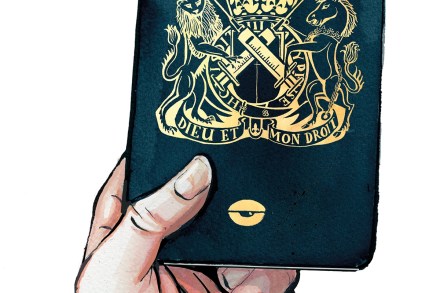
Papers please: what will immunity passports look like?

40 min listen

On this week's episode, we talk vaccine passports (1:10), Nord Stream 2 (14:55) and the appeal of chess (30:50).With entrepreneur Louis-James Davis, journalist James Ball, analyst Wolfgang Münchau, academic Kadri Liik, chess columnist Luke McShane and chess streamer Fiona Steil-Antoni.

Knights before bishops

In 2005 Steve Jobs gave a commencement address at Stanford University. The late Apple CEO kicked off with a story about a calligraphy course he took after dropping out of college in the 1970s. He was fascinated by the artistry of it, but what seemed like a whim of idle curiosity found a practical application ten years later when it came to designing typography for the Mac. Jobs’s tale of resurgent aesthetic ideas came to mind when I read an interview which Demis Hassabis, the CEO of artificial intelligence company DeepMind, gave to the Times last year. Hassabis is a brilliant technologist, but while growing up he was also one of the top-ranked junior chess players at international level.

No. 640

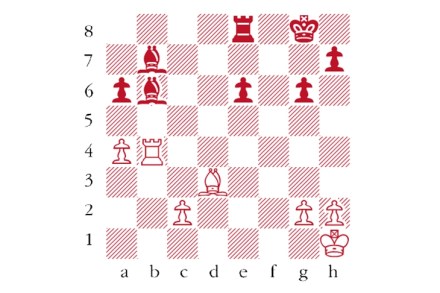
White to play and mate in two moves. Composed by Theodore Herlin, Schachzeitung 1852. Answers to be emailed to chess@spectator.co.uk by Monday 15 February. There is a prize of £20 for the first correct answer out of a hat. Please include a postal address and allow six weeks for prize delivery. Last week’s solution 1 Rxh7! and then Kxh7 2 Rd7+ Kg8 (or 2… Kh8 4 Nxg6+) 3 h7+ Kh8 4 Nxg6 mate.

How chess got cool

Ten years ago, comedian Matt Kirshen’s one-liner was voted the fifth-best at the Edinburgh Fringe. ‘I was playing chess with my friend and he said “Let’s make this interesting”. So we stopped playing chess.’ Not bad, as jabs go, and I’ve heard a few — as has any lifelong chess player. Well, times have changed. Late last year, Netflix TV series The Queen’s Gambit was watched by 62 million households in its first 28 days. Who’s laughing now? I suppose I can admit that the popularity of the series wasn’t entirely down to the chess. The wondrous eyes of Anya Taylor-Joy as heroine Beth Harmon surely played a part, and period styling works like catnip on TV audiences.

Double Dutch

Are you not entertained? The climax of this year’s elite Tata Steel tournament was as riveting as it was vulgar. After two weeks of sublime classical chess played over-the-board in the Dutch town of Wijk aan Zee, the winner was decided by two blitz games and an armageddon playoff — crash, bang, wallop. Surprisingly, neither Carlsen nor Caruana remained in contention. Instead, it was the Netherlands’ two top players, Anish Giri and Jorden van Foreest, vying for the title. Giri is a steady world-class player who already tied for first in 2018, losing out to Carlsen in the playoff. The Dutch no. 2, van Foreest, is less experienced, but his games have always fizzed with ideas. He seems to have fused that with some extra maturity, and, like Giri, was undefeated on 8.5/13.
No. 639

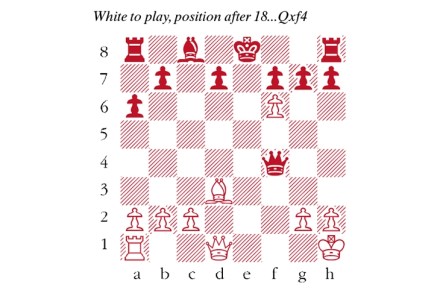
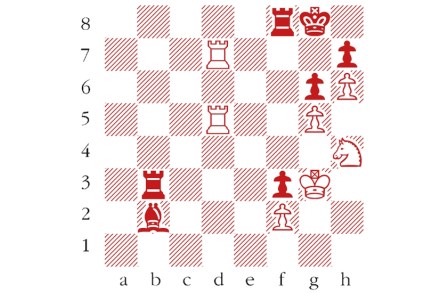
White to play. Giri-Wojtaszek, Wijk aan Zee 2021. On his last move, Black waited with 48… Ba1-b2, yielding White a decisive opportunity. Which move enabled Giri to break through? Answers should be emailed to chess@spectator.co.uk by Monday 8 February. There is a prize of £20 for the first correct answer out of a hat. Please include a postal address and allow six weeks for prize delivery. Last week’s solution: 1...Bc3+!

Remembering Kavalek

‘I began my escape from the communist Czechoslovakia 42 years ago, on Sunday, September 1, 1968. According to Wikipedia, I bought several crates of vodka with my winnings at the Akiba Rubinstein Memorial in the Polish spa of Polanica Zdroj, bribed the border guards and drove to West Germany.’ Thus began an article written by Lubomir Kavalek in the Huffington Post in 2010. How curious to write ‘according to Wikipedia’ about oneself! Was this, I speculate, a gentle hint to the reader that the story might be apocryphal? The Soviet tanks in Prague were decidedly real. Born on 9 August 1943, ‘Lubosh’ Kavalek had studied journalism, and was the reigning chess champion of Czechoslovakia when he defected.

No. 638

Kokkoris–Kavalek, Athens 1968. Kavalek’s next move initiated a beautiful forced mating sequence. What did he play? Answers should be emailed to chess@spectator.co.uk by Monday 1 February. There is a prize of £20 for the first correct answer out of a hat. Please include a postal address and allow six weeks for prize delivery. Last week’s solution 1 Bxe7! Kxe7 2 cxb6! Rxc1 3 b7 Rxf1 4 b8=Q and the queen prevailed.

History at Hastings

The Hastings International Chess Congress hasn’t skipped a year since the second world war, so I was delighted to learn that the tradition would be honoured by a strong online event which took place earlier this month, featuring a dozen top British players. For the second year running, the event was sponsored by Caplin Systems, makers of financial trading technology. (The Caplin British Online Championships were held last month and won by Michael Adams. Matthew Wadsworth and Matthew Turner secured qualifying spots for Hastings.) Reading that this year’s event would be a centenary caused me some puzzlement, because I was certain that the Hastings centenary took place in 1995 — I was there. My event, the Hastings Challengers, was played on Hastings pier.

No. 637

White to play. Howell — Adams, Caplin Hastings Online 2021. Adams’s last move, 35...Ba4-b3, gave Howell the chance for a tactical strike, gaining a decisive advantage. What was his next move? Answers should be emailed to chess@spectator.co.uk by Monday 25 January. There is a prize of £20 for the first correct answer out of a hat. Please include a postal address and allow six weeks for prize delivery. Last week’s solution 1 b4!

Missed opportunities

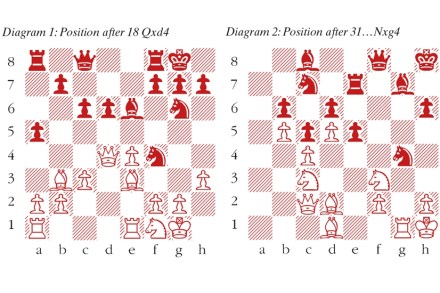
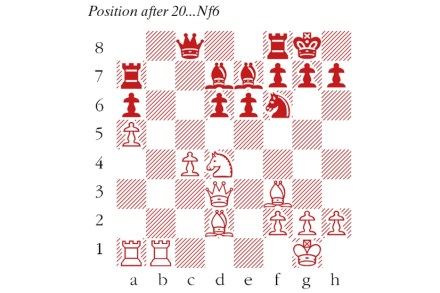
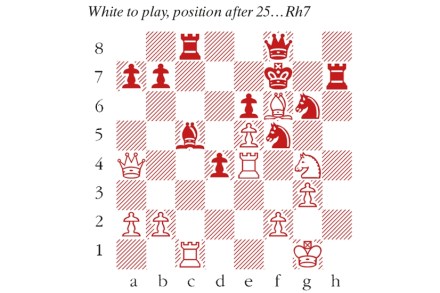
In game 1 of his Airthings Masters Final against Radjabov, Aronian’s pawn push 21 e4-e5 (shown in the first diagram) created a tactical explosion. This was rapid chess at its best — stylish and exuberant. And yet, as thrilling as this game was, it was a pity that the players had so little time to navigate the complications. If they had, each player might have unearthed an even deeper idea. In the first diagram, Radjabov had an improvement, as subtle as it is stunning: 21…d3!! 22 Qxd3 fxe3 23 Qg6+ reaches the same position as in the game, with one crucial difference; the missing pawn on f4 benefits Black, for reasons explained in the comment to 26…Bf5. The second diagram shows Aronian’s missed opportunity. The immediate 29 Ng5 allows 29…Qc4+.

No. 636

Gormally–Turner, Caplin Hastings Online 2021. Black looks safe, but Gormally’s next move forced a win of material. What did he play? Email answers to chess@spectator.co.uk by Monday 18 January. There is a prize of £20 for the first correct answer out of a hat. Please include a postal address and allow six weeks for prize delivery. Last week’s solution 1 Qg6+!! If 1…fxg6 2 Nxh6 mate, or 1...Nxg6 2 Nxh6 mate, or 1…Rxg6 2 Nxe7 mate.

Antiques Roadshow

It is one of life’s comforts to see a forgotten trinket being dusted off and appreciated afresh. So in chess, I am gently heartened to see a chess opening pass through that same phase of life. The game has its share of magpies, for whom a shiny new opening gambit is irresistible. Their approach has merit — after all, an ambushed opponent is a weakened one. But with time, the defence is remedied, and when the opening begins to look tarnished, it will soon be stuffed in the attic. It might be years, or decades, before it attracts any more attention. Even in the 19th century, some chess fashions had already been and gone, and come back around.

No. 635

Mastrovasilis–Marechal, Cappelle la Grande 2011. Black is a whole rook up, so his last move 34… Nd5-e7, angling for an exchange of knights, looks plausible. Which move did White play to expose a hidden flaw? Answers should be emailed to chess@spectator.co.uk by Monday 11 January. There is a prize of £20 for the first correct answer out of a hat. Please include a postal address. Last week’s solution 1 Be5! Bh1 2 Bxg3 and 3 Bd6, 4 Bf8, 5 Bg7 mate. Not 1 Bb2? Bh1! 2 Ba3 g2! 3 Bf8 and Black is in stalemate.

A puzzling dozen

This Christmas, government guidance says that board games are out and quizzes are in. Thus, 12 questions for Christmas. Answers here. 1. The Candidates tournament decides a challenger for the World Championship. Seven rounds were played in Yekaterinburg in March, but scheduling the second half is proving difficult. Which player declared ‘I’m ready to play, so to speak, in a garage, basement, zoo or train station.’ 2. The Queen’s Gambit was watched by 62 million households in its first 28 days, according to Netflix. ‘I thought nothing would beat THE TRIAL OF THE CHICAGO SEVEN but this does’. Which American author tweeted that?

No. 634

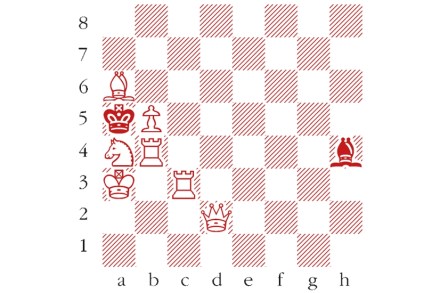
White to play and mate in five moves. Composed by Kohtz & Kockelkorn, 1875. Be careful — four moves isn’t enough! What is White’s key first move? Answers should be emailed to chess@spectator.co.uk by Monday 4 January. There is a prize of £20 for the first correct answer out of a hat. Please include a postal address and allow six weeks for prize delivery.

A puzzling dozen – answers

1. Alexander Grischuk 2. Stephen King 3. Iepe Rubingh 4. Shohreh Bayat 5. Ding Liren vs Magnus Carlsen 6. White plays 1 Bd2, 2 Ba5, 3 b4. Regardless of Black’s moves, the result is a draw by stalemate 7. The Bongcloud (Attack) 8. Agadmator 9. The Complete Chess Swindler, by David Smerdon 10. Irina Krush 11. Ennio Morricone 12. 1 Qe4!! Now 1…dxe4 2 Bxc4#; 1…d4 2 Bxc4#; 1… Rxe4 2 Nc5#; 1…Rc3 Nd4#. Black moves with Rg4 or the f5 pawn are met in mirrored fashion.

Birthday surprise

The Magnus Carlsen Chess Tour is back. This time, the series of online events is rebranded as the Champions Chess Tour with a total $1.5 million prize fund. It marks an ambitious step forward for the Play Magnus group, which floated on the Oslo Stock Exchange in October and is currently valued in the ballpark of $100 million. Norwegian companies NRK and TV2 have purchased domestic broadcasting rights for the tour, while a separate deal with Eurosport looks set to attract a fresh audience. Games will be played on the chess24 platform, and the tenth and final event in the series will finish on Sunday 3 October, 2021. It’s a mundane observation that chess tournaments usually end on a Sunday. Usually, participants and organisers have jobs to return to on Monday.

Four puzzles in one

Four puzzles in one, composed by Werner Speckmann, 1963. In each case, White to play and mate in two. (a) As in diagram; (b) In (a), move Qh7 to a7; (c) In (b), move Ke6 to c6; (d) In (c), move Ke4 to c4. We regret that there is no prize for this puzzle, owing to the Christmas printing schedule. Last week’s solution 1 g4!! blocks the c8-h3 diagonal, so a back rank mate with 2 Rc8+ is threatened. In defending the threat, Black loses the queen.

Chess improvement

The juicy prospect of improvement constantly dangles above a chess player. Those morsels of knowledge one has acquired whet the appetite for others which lie just out of reach. Even players at peace with their ambient proficiency can’t help but acknowledge that their better games coexist with lousy ones. Once you admit that, it’s a hop, skip and a jump to the idea that replicating the good games might confer improvement. Unless you have the equanimity of a monk, wanting to play well becomes an unshakeable existential burden. Many chess books will promise to boost your results at the board. Usually, it is taken for granted that absorbing the book’s insights will generate the desired improvement.