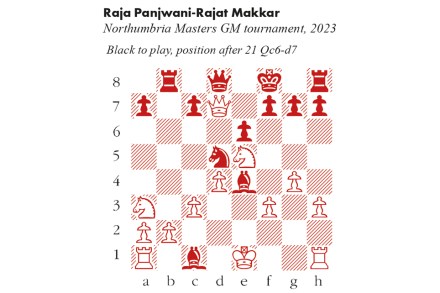
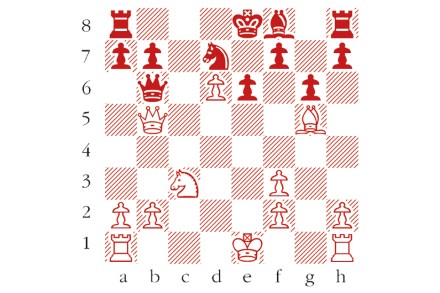
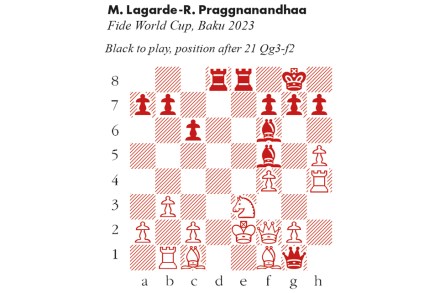
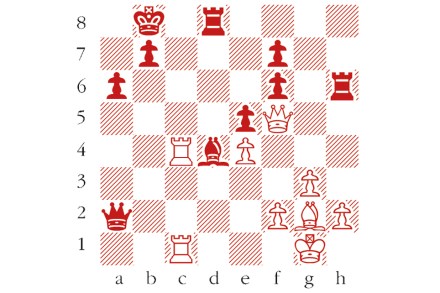
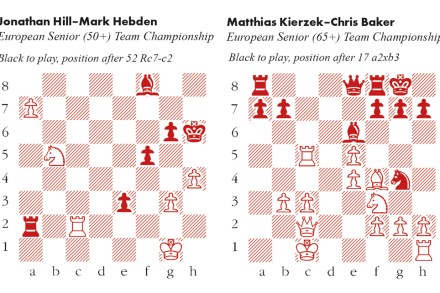
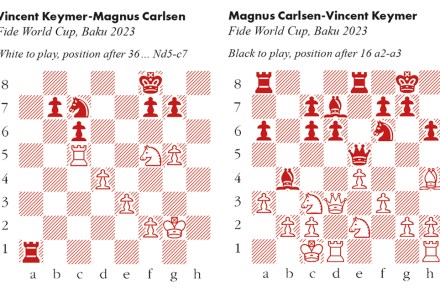
Luke McShane

Luke McShane is chess columnist for The Spectator.

No. 758

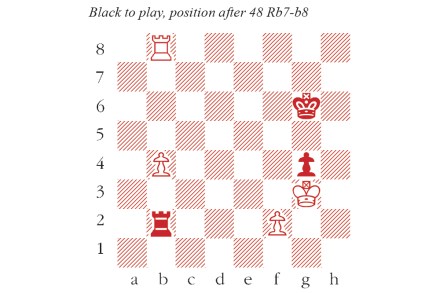
White to play and win. Composed by Josef Hasek, 1929. One plausible try is 1 Kc5 but 1…f5! prepares to meet Kc5-d6 with Rf8-f6+. Which first move should White prefer? Answers should be emailed to chess@spectator.co.uk by Monday 3 July. There is a prize of £20 for the first correct answer out of a hat. Please include a postal address and allow six weeks for prize delivery. Last week’s solution 1 Kc7!

The hell of speed chess

Somewhere in hell, there is a cavernous hall filled with row upon row of people playing online speed chess. Their games bear not a trace of exuberance or wit. Instead, these wretched souls are confronted with utterly sterile positions, perhaps a lone king and rook on each side, but their flinty, remote adversaries will not agree to a draw. Instead, they shuffle the pieces back and forth – a pointless rook check here, a king sally there, and before long our infernal victims have run out of time, and lost. They curse at the injustice, and yet the next game is groundhog day. If you play enough games online, you too will run into one of these unscrupulous opponents, who stop at nothing in pursuit of the full point.

No. 757

White to play and mate in 4 moves, composed by Theodore Herlin, 1845, Le Palamède, 1845. The solution has just a single line of play. Answers should be emailed to chess@spectator.co.uk by Monday 26 June. There is a prize of £20 for the first correct answer out of a hat. Please include a postal address and allow six weeks for prize delivery. Last week’s solution 1 axb4! Qxa1+ 2 Kd2!

Great discoveries

David Hodge is the 2023 British Chess Solving champion, after winning the Winton British Chess Solving Championship in Nottingham last month. Hodge is now a two-time champion, having first won the event in 2019. Above left is a position which caught my eye, taken from the Category B event, which is aimed at less experienced solvers. The problems are slightly less formidable than those in the main event, though still replete with beautiful ideas. This is White to play and mate in 4, composed by Chimedtseren (Probleemblad, 1973). If you don’t want to see the answer, skip forward a couple of paragraphs. One approach is to arrange a mating pattern with Rb3-b1-d1 and Bg2-f1, but that falls short, e.g. 1 Rb1 a4 2 Rd1 Kb5 3 Kb7 h3 4 Bf1+ c4 denies the mate.

No. 756

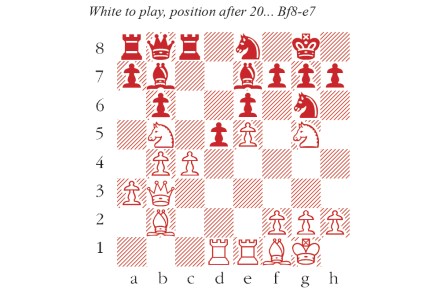
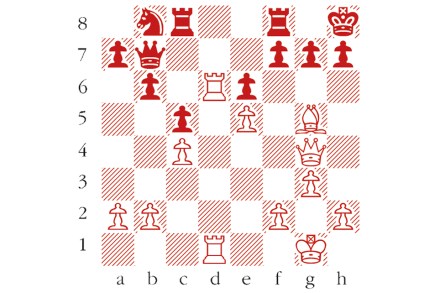
White to play. Canal – NN, Simultaneous exhibition, 1934. Black has just castled queenside, in a game sometimes referred to as the ‘Peruvian Immortal’. Which move did Canal play to take advantage? Answers should be emailed to chess@spectator.co.uk by Monday 19 June. There is a prize of £20 for the first correct answer out of a hat. Please include a postal address and allow six weeks for prize delivery. Last week’s solution 1 Bg5! attacks e7 and threatens Nd3-f4 to trap the queen. After 1...Nxb3 2 axb3 Nd5 3 Ra4! f6 4 Rh4! and Black soon resigned. Also good were 3 Re4, or 3 Kh2 (idea g2-g4).

First among equals

In recent years, the battle for the number two spot in the world rankings has resembled the gentle undulation of a lava lamp. Players rise and fall, and others take their place. I counted 11 different players who have occupied that spot over the past decade, all while Magnus Carlsen sits at the apex. The world championship match between Ian Nepomniachtchi and Ding Liren, in light of Carlsen’s abdication, had the convenient narrative of being a contest between the world numbers two and three. But neither Nepo nor Ding participated at the elite Norway Chess tournament, which concluded last week, and both were narrowly overtaken in the rating list, thanks to a return to form for two players from the US: Hikaru Nakamura and Fabiano Caruana.

No. 755

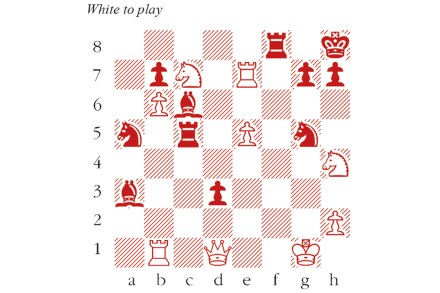
White to play. Nunn-Gaprindashvili, ECU Senior Championship, Acqui Terme 2023. The former women’s world champion Gaprindashvili has just played 16...Nc6-a5. Which move did Nunn play to capitalise on this mistake? Answers should be emailed to chess@spectator.co.uk by Monday 12 June. There is a prize of £20 for the first correct answer out of a hat. Please include a postal address and allow six weeks for prize delivery. Last week’s solution 1 Rg2! Then 1…Kf3 2 Qa8# or 1...

Over the top

One of the quirkier books on my shelf is titled Kingwalks: Paths of Glory (Seirawan & Harper, 2021, Russell Enterprises). King safety is a fundamental imperative for chess – after all, checkmate is the aim of the game – so the exceptions where that instinct is best overridden tend to be rather appealing. Probably the most famous example is the game Short-Timman, from Tilburg 1991, in which England’s future world championship challenger marched his king far into enemy territory to assist with a mating attack. But Kingwalks identifies plenty of other possible motives for these adventures. King evacuations (vertically, or horizontally) in the face of an attack are common, but a king might also run away to prepare an aggressive pawn storm on the wing it has vacated.

No. 754

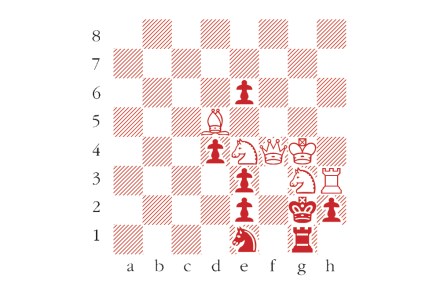
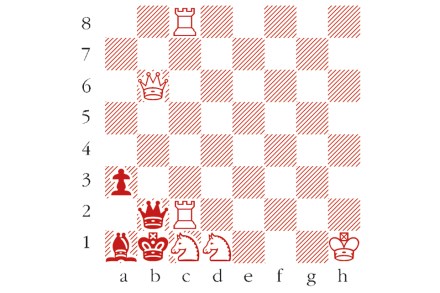
White to play and mate in two moves. Composed by David Murray Davey, the Tablet, 1946. Email answers to chess@spectator.co.uk by Monday 5 June. There is a prize of £20 for the first correct answer out of a hat. Please include a postal address and allow six weeks for prize delivery. Last week’s solution 1 Nxg6! wins.

English Championship

Michael Adams took first place at the Chessable English Championship in Kenilworth last weekend, winning the tournament with 6/7. In the third round, he was on the ropes in the endgame against Mark Hebden, but survived after several unexpected twists. In the diagram position, Adams has two plausible captures available but surprisingly, neither is the best move. Instead 62…Nc4! is best, thanks to the unfortunate situation of White’s knight: 63 Re2+ Kd4 64 Nxa4 Rxa3 65 Nb2 Ra2 and the pin recovers material. Mark Hebden-Michael AdamsEnglish Championship, Kenilworth, May 2023(see left diagram) 62…Rxa3 This move attempts to improve upon 62…Rxc3 63 Rxb2 Rxa3 64 Rb4!

No. 753

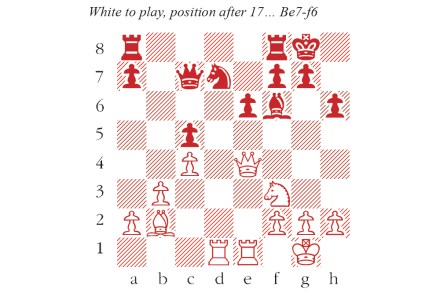
White to play. Another variation from McShane – Carlsen, London Chess Classic 2012 (in case of 32…Qf6-f5) Carlsen avoided this position, since he had spotted a winning move for White. What was it? Answers should be emailed to chess@spectator.co.uk by Monday 29 May. There is a prize of £20 for the first correct answer out of a hat. Please include a postal address and allow six weeks for prize delivery. Last week’s solution 1 Qxd4! wins. 1...Rxd4 2 Bxe6+ Kh8 3 Rf8# or 1...

The morning after

Aspirin, a greasy fry-up, even hair of the dog – all are popular options when nursing a hangover. The last thing you would choose to do is play a long game of chess, but that’s exactly the pickle in which Magnus Carlsen found himself during the first round of the 2012 London Chess Classic. The world number one had celebrated his 22nd birthday the night before, but dinner and bowling ‘turned into something else’ as he shared on the Norwegian podcast Sjakksnakk a few weeks ago. Carlsen shambled into a wretched position, but was granted a lifeline after one poor move from his opponent in the middlegame: ‘All of a sudden I felt like my whole hangover just got cured.’ The rejuvenated Carlsen decided it would be ‘epic’ if he managed to win the game.

No. 752

White to play. Shirov-Wedberg, Lundin Memorial, Stockholm 1990. Black has just played Rh6-h5, attacking the e5 pawn, but Shirov found a powerful response. What did he play? Answers should be emailed to chess@spectator.co.uk by Monday 22 May. There is a prize of £20 for the first correct answer out of a hat. Please include a postal address and allow six weeks for prize delivery. Last week’s solution 1 Qh3! Qxh3+ 2 Kg5. When the d6 pawn falls, the d5 pawn will decide.

Four Nations Chess League

The Four Nations Chess League (4NCL) season concluded last month in a resounding victory for Chess.com Manx Liberty. The team from the Isle of Man won all eleven matches, thanks to narrow 4.5-3.5 victories against both of their closest rivals, Chessable White Rose 1 and Cheddleton. On the final weekend, the Manx squad was boosted by the inclusion of veteran elite grandmaster Alexei Shirov, who won the only decisive game in the match against White Rose. Shirov conjured a firestorm of tactics against Jose Camacho Collados, the 2022 Welsh champion who is a lecturer in computer science at Cardiff University. Alexei Shirov (Chess.

No. 751

Moehring-Kaikamdzozov, Elekes Memorial, Zamardi 1978. White avoided perpetual check and won the game. Which move did he play? Email answers to chess@spectator.co.uk by Monday 15 May. There is a prize of £20 for the first correct answer out of a hat. Please include a postal address and allow six weeks for prize delivery. Last week’s solution 1 Ne4!, e.g.

Picking up the pieces

Seconds before resigning the decisive game of the world championship, Ian Nepomniachtchi’s hand, trembling with emotion, involuntarily toppled the captured pieces at the side of the board. It was a crushing disappointment to lose a match in which he had taken the lead on three separate occasions, and come agonisingly close to an almost unassailable lead in game 12 (of 14). Days after the match ended, ‘Nepo’ posted a splendidly ambiguous tweet: ‘Although blind chance sometimes decides the fate of a particular game, it can hardly prevent you from becoming the strongest chess player’ – followed by an emoji of a man in the lotus position. I still can’t decide what he meant. Was it a bullish assertion about the future?

No. 750

White to play and mate in two moves. Composed by Henri Gerard Marie Weenink in The Good Companion (1919). Answers should be emailed to chess@spectator.co.uk by Tuesday 9 May. There is a prize of £20 for the first correct answer out of a hat. Please include a postal address and allow six weeks for prize delivery. Last week’s solution 1 Nd5! locks the knight on a8. 1…b4 2 f6 b3 3 f7 b2 4 Nc3 and wins.

Ding wins

Ding Liren from China has become the 17th world champion, defeating the Russian Ian Nepomniachtchi in Astana. The 14-game classical match saw triumph and tragedy on both sides, with six decisive games. But with honours shared at 7-7, the classical world championship was to be decided in a four-game rapid tiebreak, just as it was in 2006, 2012, 2016 and 2018. The first three were drawn, and the fourth game looked bound for the same result, which would have led to a play-off at even faster time limits. But with both players down to their last minutes, Ding took an unexpected decision to prolong the fight instead of acceding to a draw.

No. 749

White to play. Grandelius-Aabling Thomsen, Xtracon Open 2018. White has just one winning move. What did he play? Answers should be emailed to chess@spectator.co.uk by Monday 1 May. There is a prize of £20 for the first correct answer out of a hat. Please include a postal address and allow six weeks for prize delivery. Last week’s solution 1 Bd5+. Depending on Black’s reply, it’s 2 Qc6# or 2 Qd2#.

Reykjavik Open

This year’s Reykjavik Open attracted a record turnout of more than 400 players. The Icelanders’ affinity for chess is well established, and the Harpa Conference Centre is a beautiful playing hall looking over the waterfront. At the top of the seedings was Ukrainian luminary Vasyl Ivanchuk, but first place went to the affable Swedish grandmaster Nils Grandelius. He took the lead in the penultimate round. Abhijeet Gupta-Nils GrandeliusReykjavik Open, April 2023 53…Kf4 is tempting, but 54 Nb7 e4 55 Nc5 Bf5 56 Nxe4! secures a draw as the bishop can never force White’s king out from the a1-corner. In what follows, the sacrifice of knight for e-pawn is carefully avoided. 53…Bd5!