Luke McShane

Luke McShane is chess columnist for The Spectator.

No. 748

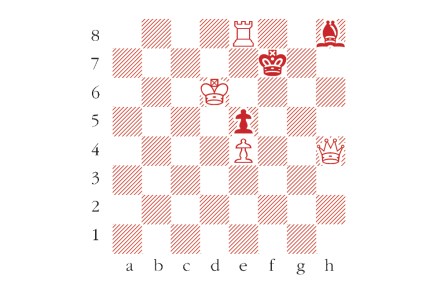
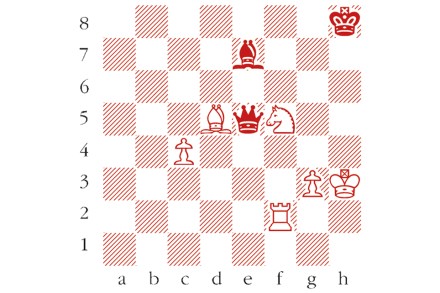
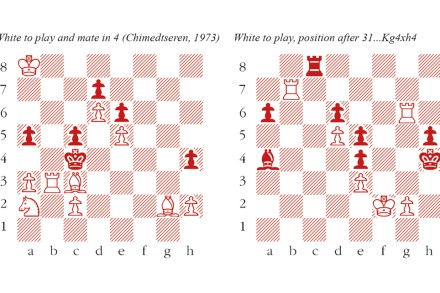
White to play and mate in two moves. Composed by Sam Loyd, The Musical World, 1859. Email answers to chess@spectator.co.uk by Monday 24 April. There is a prize of £20 for the first correct answer out of a hat. Please include a postal address and allow six weeks for prize delivery. Last week’s solution 1 R1xd4! cxd4 2 Be6+ and 3 Qxg7 mate. But not 1 Be6+ Nxe6! or 1 Rxg7+ Kxg7 2 Bh5+ Kh8 3 Bxe8 Ne2+ Last week’s winner George Katsugias, Bradford, W.

Drama in Astana

As I write, six of 14 games of the world championship match between Ian Nepomniachtchi and Ding Liren have been played in Astana, Kazakhstan, with the score tied 3-3. By the time you read this, events will have moved on, so any prognosis would be futile. One ought, so to speak, to wait until the bread has risen. But the games in Astana have been so compelling that a quick peek is irresistible. Four out of six have been decisive – an extraordinary volume of bloodshed by the standards of recent world championships. Initially, Ding looked listless, as if overwhelmed by the occasion. ‘Nepo’ won game two, but by game four Ding had pulled himself together, when an elegant exchange sacrifice helped level the score. Nepomniachtchi looks stronger since his defeat against Carlsen in Dubai.

No. 747

White to play. Volokitin-Kallai, Hungarian Team Ch 2018. Volokitin’s next move was a crushing blow. What did he play? Be careful – there are a couple of false trails here. Email answers to chess@spectator.co.uk by Monday 17 April. There is a prize of £20 for the first correct answer out of a hat. Please include a postal address and allow six weeks for prize delivery. Last week’s solution 1… Rxf2+! 2 Kxf2 Qh2+ 3 Kf1 Bh3+ 4 Ke1 Qg1#.

Question of sport

Is chess a sport? Naively, I once considered that to be a philosophical question. Physical strength or dexterity – nope. Feeling of exertion and elevated heart rate – yes, at least if you’re doing it with soul. Global competition and recognition – yes, emphatically. It was no accident that Louis Vuitton’s ad campaign last year pictured Messi and Ronaldo playing chess. A better question would be ‘Does chess deserve government funding?’ For a game with obvious cognitive, educational and cultural benefits, the answer ought to be an unequivocal yes, and in a great many countries, including within western Europe, the game does indeed receive meaningful government support. Alas, in the UK chess is left to fend for itself.

No. 746

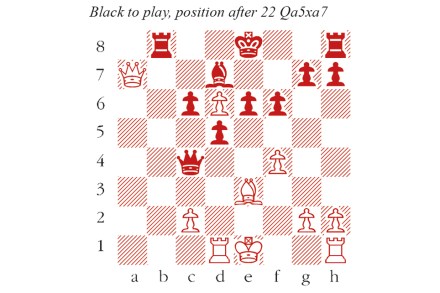
Black to play. A variation from the game Ding–Nepomniachtchi, shown above. Only one move crowns the attack here. Which move should Black play? Answers should be emailed to chess@spectator.co.uk by Monday 10 April. There is a prize of £20 for the first correct answer out of a hat. Please include a postal address and allow six weeks for prize delivery. Last week’s solution 1 Nd5! intending 1…h3 2 Nf4 h2 3 Nh5!

World championship

The forthcoming world championship match, which begins in Astana on 9 April, was described by Garry Kasparov as an ‘amputated event’. The abdication of Magnus Carlsen, who remains the world’s strongest player, is of course a disappointment. But the 14 game match between the world number 2 and 3, respectively Ian Nepomniachtchi from Russian and Ding Liren from China, remains a gripping prospect. Nepomniachtchi is the more aggressive and ambitious player, but his results are more volatile. In an interview in January, Carlsen stated that he considers Ding Liren to be ‘a little bit better’. In my view, Ding stands out for his capacity to endure tension for longer than his opponents, a quality which manifests in subtle ways.

No. 745

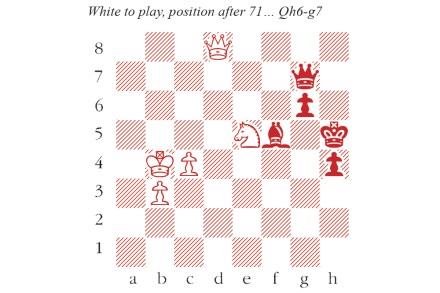
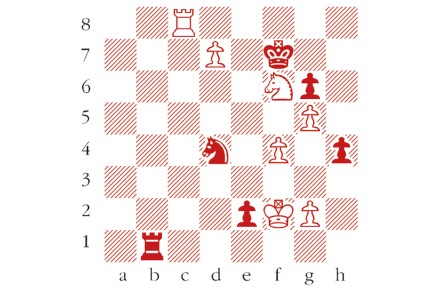
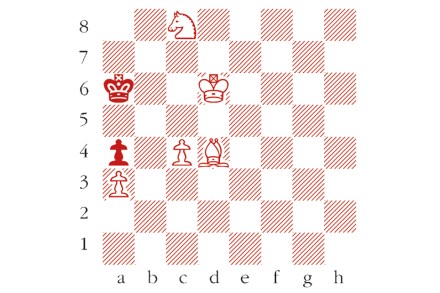
White to play and draw. Composed by A. Lifanov, 2002. The pawn on h4 looks unstoppable, but the draw is still within reach with an accurate sequence. What should White’s first move be? Email answers to chess@spectator.co.uk by Monday 3 April. There is a prize of £20 for the first correct answer out of a hat. Please include a postal address and allow six weeks for prize delivery. Last week’s solution 1…Qxd2+!

The American Cup

An uncharacteristic blunder from Wesley So handed tournament victory to Hikaru Nakamura at the American Cup, which finished at the St Louis Chess Club last weekend. The event was held with an unusual ‘double elimination knockout’ format, in which players who lost a match would continue playing in the ‘elimination bracket’, and only a second loss would see them exit the tournament. Nakamura won their first encounter, which shunted So into the elimination bracket. But since So triumphed in the elimination bracket, he was resurrected to face Nakamura in the final, where he took his revenge. Each player having lost one match, they were left to fight it out one more time.

No. 744

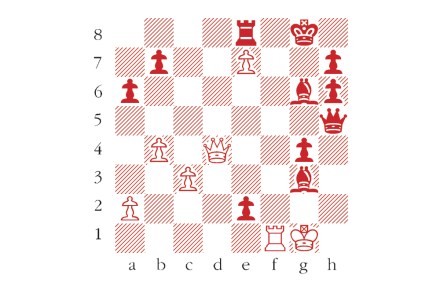
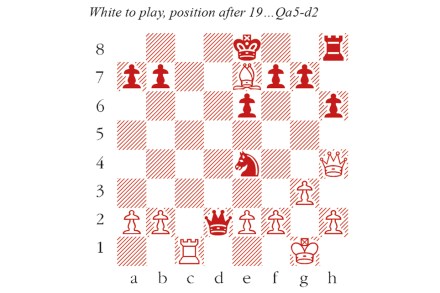
Black to play. Kobalia-Shevchenko, Serbia 2023. How did Black respond strongly to the attack on his queen? Answers should be emailed to chess@spectator.co.uk by Monday 27 March. There is a prize of £20 for the first correct answer out of a hat. Please include a postal address and allow six weeks for prize delivery. Last week’s solution 1…Na4! 2 bxa4 Rb4+! 3 cxb4 Qb2#. White tried 2 Qd2 Nxc3+ 3 Kc2 Qxa2+ 4 Kd3 Qxb3 and resigned soon after.

Redrawing the map

In the world of chess politics, the map has been redrawn. Russia is now officially in Asia, and no longer in Europe. The move was formalised at the end of February, when the Asian Chess Federation voted to admit the Russian Chess Federation by an overwhelming margin. Russia’s pivot to Asia was in the pipeline for some time, since the European Chess Union (ECU) suspended the federations of Russia and Belarus just a couple of weeks after Russia invaded Ukraine. The international federation Fide followed suit soon after, so those teams were absent from the Fide Olympiad in Chennai last year. In Europe, the impact was lessened by the fact that the ECU’s biennial European Team Championship, is not due until November 2023 in Montenegro.

No. 743

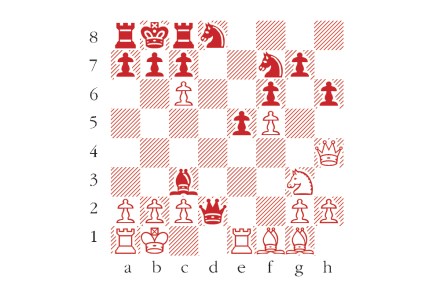
Black to play. Ponomariov-Dragnev, Serbia 2023. Which move allowed Black to seize his chance on the queenside? Answers should be emailed to chess@spectator.co.uk by Monday 20 March. There is a prize of £20 for the first correct answer out of a hat. Please include a postal address and allow six weeks for prize delivery. Last week’s solution 1 Rf8+ Kxf8 (or 1…Kg7 2 Rf7+) 2 Bh6+ Ke7 3 Bg5+ with a perpetual check.

Varsity match

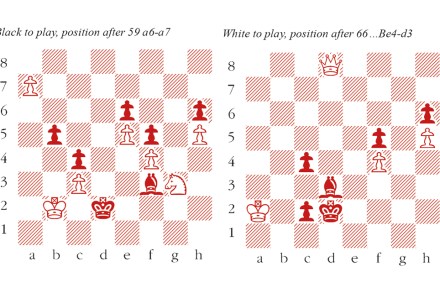
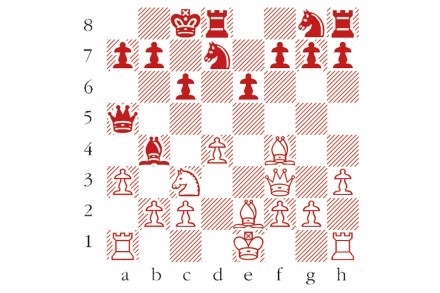
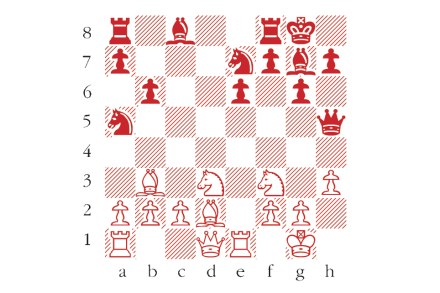
The great tradition of the Varsity match rolls on, ringing in the 141st edition earlier this month at the Royal Automobile Club in Pall Mall, London. Oxford were slight favourites, but the match finished on a knife edge. The game on board 2 was particularly hard-fought, with both sides having winning chances at different stages. This diagram shows the position after the advance 56 f4-f5, with Jan Petr (Cambridge) playing White. Striving to win the game, he has advanced his pawn to f5 instead of capturing the pawn on d3 (which led to a straightforward draw). Jan Petr (Cambridge)-Emil Powierski (Oxford) Varsity Chess Match, March 2023(See left diagram) White’s move would be justified by 56…a3 57 fxe6 a2 58 e7 a1=Q 59 e8=Q, with an easy win with the extra knight.

Chess puzzle No. 742

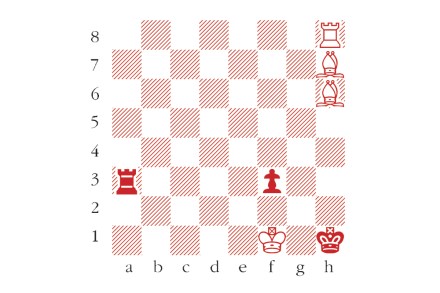
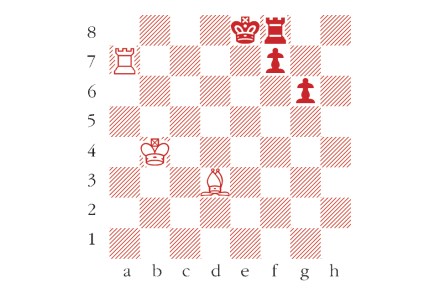
White to play. Iskandarov-Babazade, Azerbaijan2003. Which move allowed White to save the draw? Answers should be emailed to chess@spectator.co.uk by Monday 13 March. There is a prize of £20 for the first correct answer out of a hat. Please include a postal address and allow six weeks for prize delivery. Last week’s solution 1 Ke6! wins, e.g. 1…Bh5 2 Rh8+ Kg6 3 e8=Q+. Not 1 Rh8+?, as Black could simply play 1…Kxh8 2 Kxg6+ Rxe5.

Blood in the water

‘The greatest pleasure? When you break his ego.’ So said Bobby Fischer on the Dick Cavett Show in 1971. He was right, of course – experienced players can sense that moment of mental despair in the opponent, which may arrive well before the outstretched hand of resignation. In fact, getting an accurate read on the opponent’s mood can be valuable at any stage of the game. Body language clues are the most obvious, but there’s plenty to be gleaned from the moves alone. Perhaps the game reaches an obvious junction, where the opponent can choose between a safe, solid option, and something more adventurous. The choice itself speaks volumes, and the time spent on the decision can be no less significant.

No. 741

White to play. Vallejo Pons-Santos Latasa, Leon 2018. The choice is between 1 Ke6 and 1 Rh8+. White calmly played the wrong one and Black resigned immediately! But which move wins the game? Email answers to chess@spectator.co.uk by Monday 6 March. There is a prize of £20 for the first correct answer out of a hat. Please include an address and allow six weeks for prize delivery.

Bot moves

Can ChatGPT play chess? A few weeks ago, when the AI chatbot was making headlines, someone had the cute idea of getting it to play a game against the popular chess engine Stockfish. At the start, it followed a standard line of the Ruy Lopez opening. But soon the illegal moves began – ChatGPT tried to castle before its bishop was out of the way. Later, it added pieces to the board from nowhere, queens jumped over knights, and rooks teleported magically around the board. I repeated this experiment myself, with similar phantasmagorical results, all while the bot supplied nonsensical explanations for its moves. Indeed, ChatGPT cannot play chess, and it was fun to watch its collapsing facade of cogency. Teehee, silly computer!

No. 740

White to play. A variation from Roberson-Adams, Cambridge International Open 2023. Which move allows White to salvage a draw from this desperate situation? Answers should be emailed to chess@spectator.co.uk by Monday 27 February. There is a prize of £20 for the first correct answer out of a hat. Please include a postal address and allow six weeks for prize delivery. Last week’s solution 1… Rxa6!

Cambridge International Open

The Cambridge International Open, held last week in fine surroundings at the University Arms Hotel in the city centre, is a valuable addition to the UK tournament scene. Organised by the English Chess Federation, demand for this debut event was strong and registrations had to close early at around 120 participants, when the capacity of the playing hall was reached. Nine grandmasters took part in the open tournament, including England’s top player Michael Adams. Despite being a huge favourite in his first round game, he drifted into serious trouble in the early middlegame. Seeing the storm clouds gathering, he wisely ventured a draw offer, which was accepted – that being a tremendous achievement for his teenage opponent and namesake Henry Adams.

No. 739

Black to play. Yakubboev-Kramnik, Airthings Masters 2023. White’s last move, Re7-e6, was a blunder, allowing Kramnik to land a decisive tactic. What did he play? Email answers to chess@spectator.co.uk by Monday 20 February. There is a prize of £20 for the first correct answer out of a hat. Please include a postal address and allow six weeks for prize delivery. Last week’s solution 1 Rhg7!

Bidding one’s time

If a series of chess games is drawn, how do you split the tie? One answer is to play two more games (one of each colour) at a faster time limit, to boost the odds of a decisive result. But that might take a while. When the games get too brisk, the tiebreak feels divorced from the original contest. The drawbacks of playing just one game are obvious – the white player get an unfair edge, and the game might end up drawn anyway. So the Armageddon game was invented – the chess equivalent of a penalty shoot-out. In this, a drawn game results in a win for the black player. On its own, that’s a chunky advantage, so a time handicap is used to even out the chances. What time handicap yields a fair contest?