Luke McShane

Luke McShane is chess columnist for The Spectator.

Cambridge International Open

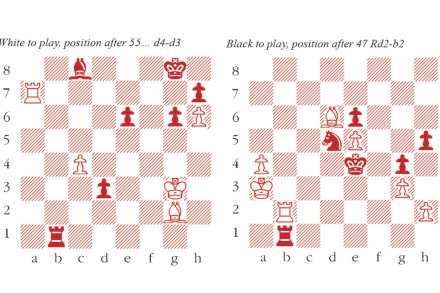
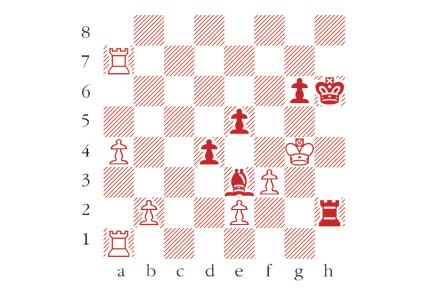
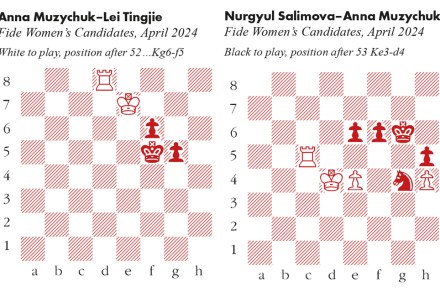
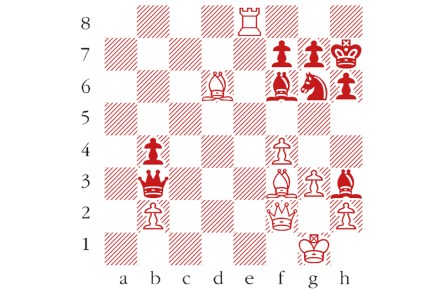
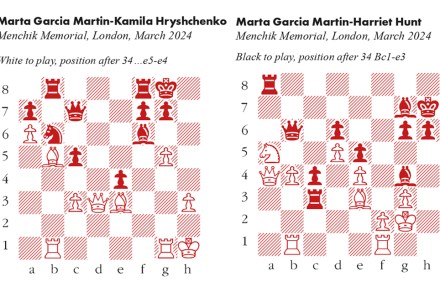
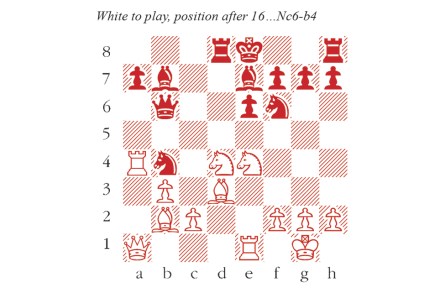
In February the Cambridge International Open returned to the University Arms Hotel. In the penultimate round, the experienced Dutch grandmaster Sergei Tiviakov was half a point clear of a strong field, and looked to be coasting towards victory against his Danish opponent. Playing White in the position below, his bishop and two passed pawns outweigh Haubro’s extra rook. Sergei Tiviakov-Martin Haubro Cambridge International Open, February 2024 (see left diagram) Tiviakov, co-author of Rock Solid Chess (New In Chess, 2023) is the epitome of a safe pair of hands at the chessboard. His position is characteristically tidy, in that every unit is protected by something else. But the most efficient path to victory involves some precise tactics: that is 40 Rxb8!

No. 790

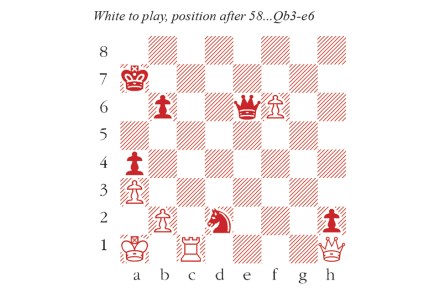
White to play. Borsos-Nawalaniec, Cambridge International Open, 2024. White found a devastating tactical shot. What did he play? Email answers to chess@spectator.co.uk by Monday 4 March. There is a prize of £20 for the first correct answer out of a hat. Please include a postal address and allow six weeks for prize delivery. Last week’s solution 1 Qe1!

It’s a knockout

‘Chess is a sea in which a gnat may drink and an elephant may bathe.’ I’m fond of that adage, which speaks to the depth of the game in a way that numbers cannot. But how many possible games of chess are there? The mathematician Claude Shannon wrote a paper in 1949: ‘Progamming a Computer for Playing Chess’, in which he estimated that there are at least 10120 (i.e. 1 with 120 zeros) possible games of chess. He noted that with such an astronomically large number, a perfect solution by brute force was infeasible. The reasoning is straightforward. The Dutch psychologist Adriaan De Groot (a contemporary of Shannon) estimated that a typical position may have 30 legal moves, so one move for each side makes for approximately 900 possibilities. Call it 1,000 (i.e.

No. 789

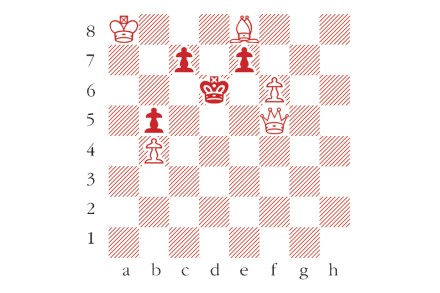
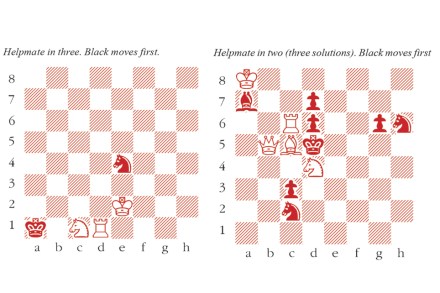
White to play and mate in two moves. Composed by M. Lokker, Shakhmatnaya Moskva, 1967 Answers should be emailed to chess@spectator.co.uk by Monday 26 February. There is a prize of £20 for the first correct answer out of a hat. Please include a postal address and allow six weeks for prize delivery. Last week’s solution 1 Bd3! Bxd3 2 Qd2# or 1…Rxd3 2 Qb1#.

Young contenders

Popular wisdom has it that the smartphone has shrivelled teenagers’ attention spans. But they are getting better at chess, and there is no doubt that technology is the main driver. Chess knowledge is more widely accessible than ever before, with any number of sparring partners, courses and coaches (like me!) available online. Chess engines, such as the famous ‘Stockfish’ program, are far more useful as training tools than they were 20 years ago, when they were tactically unbeatable but strategically patchy. These days their suggestions are invariably sound, and can harnessed for post-game feedback after playing human opponents. For promising young players, with the right guidance, there is no end of opportunity.

No. 788

White to play and mate in two moves. Composed by V. Antipov, Kudesnik, 1998. Email answers to chess@spectator.co.uk by Monday 19 February. There is a prize of £20 for the first correct answer out of a hat. Please include a postal address and allow six weeks for prize delivery. Last week’s solution 1 Qg5+! Kf7 (1…Kh7 is similar) 2 Qf5+ Qxf5 3 Kxf5 wins, e.g. 3…Kg7 4 Kg5!

Fearless teens

A trio of teenagers dominated the Tata Steel Challengers event, which took place in Wijk aan Zee last month alongside the elite Masters event. Their fearless chess helped them get the better of many more experienced grandmasters. India’s Leon Luke Mendonca, 17, took first place with 9.5/13, and will receive an invitation to the Masters event next year. Joint second on 9/13 were the reigning World Junior Champion Marc’Andria Maurizzi from France (16) and Daniel Dardha (18) from Belgium. These games from the latter two are simply electrifying.

No. 787

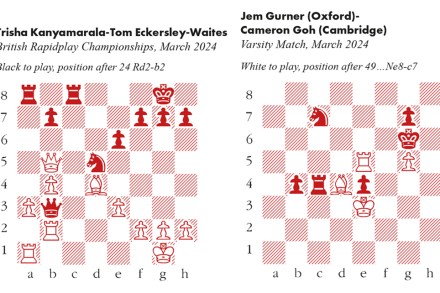
White to play. Salem-Vrolijk, Tata Steel Challengers 2024. Black’s last move, Qf2-c2, was a fatal error in an otherwise drawn endgame. Which queen check won White the game? Email answers to chess@spectator.co.uk by Monday 12 February. There is a prize of £20 for the first correct answer out of a hat. Please include a postal address and allow six weeks for prize delivery. Last week’s solution 1 Rc8! Qxc8 2 Nb6+ wins, or 1…Qh7+ 2 f5 and the pawn promotes.

Tata for now

Wei Yi had just won a riveting game in round 11 of the Tata Steel Masters event (see puzzle no. 786). His post-game interview ended with the question: ‘With two rounds to go, do you still have energy?’ ‘No,’ replied Wei, smiling. And yet China’s second strongest grandmaster (after the world champion Ding Liren), somehow rallied himself to win the final two games. His opponents must have been running on empty too. I was present in the playing hall on the final day, when apart from the matter at hand, the players also had to contend with a persistent tooting noise made by climate change protestors outside the playing hall.

No. 786

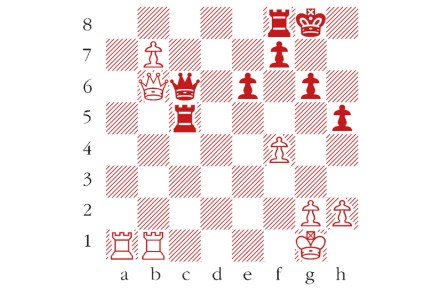
White to play. Maghsoodloo-Warmerdam, Tata Steel Masters 2024. Maghsoodloo’s situation looks desperate, but he found a surprise winning move here. What did he play? Email answers to chess@spectator.co.uk by Monday 5 February. There is a prize of £20 for the first correct answer out of a hat. Please include a postal address and allow six weeks for prize delivery. Last week’s solution 1 Rxd7! Qxh4 2 Rxd8+ Kh7 3 Rcc8. Black resigned, e.g.

The Candidates line up

Lobbing brickbats at Fide, the International Chess Federation, is always in fashion. The organisation celebrates its centenary this year, but Russia’s top player Nepomniachtchi tweeted a bitter New Year greeting: ‘Let 2024 bring Fide everything that it lacks: transparency, integrity, clear rules, unified standards, wise judges, attentive organisers, recognisable sponsors!’ To that litany of gripes, one could add that a democratic deficit is woven into the fabric of the organisation. Member countries, no matter how few constituent players they have, each get one vote, which inevitably distorts the incentives at election time. Fide’s current president, Arkady Dvorkovich, is a former deputy prime minister of Russia, which is ‘problematic’, as the modern euphemism goes.

No. 785

White to play. Blübaum-Pavlidis, Bundesliga 2024. Which move won the game for Blübaum? Email answers to chess@spectator.co.uk by Monday 29 January. There is a prize of £20 for the first correct answer out of a hat. Please include a postaladdress and allow six weeks for prize delivery. Last week’s solution 1 Re8! Rxe8 (or 1…Nxe8 2 f8=Q+) 2 Qxf6+!! Black resigned since Rxf6 3 fxe8=N+!

A new queen

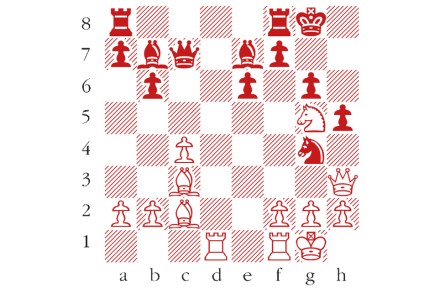
Promoting a pawn is a moonshot on the chessboard. A new queen is a literal game-changer, so when a humble pawn becomes far advanced, it is worth moving heaven and earth to get it over the line. Ditching a rook or a bishop is a small price to pay for a coronation. One game from the World Rapid Championship, held in Samarkand in December, saw the kitchen sink hurled with enviable force. White has just played 28 f2-f3, supporting the e-pawn and thereby preparing Bg2-f1. Now the prosaic 28…b4 29 axb4 Bxb4 30 Kf2 a3 31 bxa3 Bxa3 32 Rb2 b2 33 Bf1, would give White reasonable chances of a successful defence. Iljiushenok found a far stronger breakthrough. Teimour Radjabov-Ilia Iljiushenok World Rapid Championship, Samarkand 2023 (see left diagram) 28…Bxa3!!

No. 784

White to play. Cheparinov-Rapport, World Rapid Championship 2023. White found an elegant combination to make use of the passed pawn on f7. What did he play? Email answers to chess@spectator.co.uk by Monday 22 January. There is a prize of £20 for the first correct answer out of a hat. Please include a postal address and allow six weeks for prize delivery. Last week’s solution 1 c8=N+ Kd7 2 b8=N mate!

Horsing around

In 2021, Magnus Carlsen and Hikaru Nakamura caused a stir with their ‘Double Bongcloud’ opening, in an online game which began 1 e4 e5 2 Ke2 Ke7, soon agreed drawn. Their act of flippancy, clearly spontaneous, drew a mixed response of laughter and tutting, but that game was unofficial and had no competitive significance. Similarly, at the World Blitz Championship, held in Samarkand in December, a game between Daniel Dubov and Ian Nepomniachtchi saw the players agree to a draw after White’s 13th move. So far, so unremarkable, and many games at the tournament were concluded even faster. (Some events forbid early draws by agreement, but not in Samarkand). The joke was that not a single pawn was moved.

No. 783

White to play and mate in two moves. Composed by Ivar Godal, Ideal-Mate Review, 1983 Email answers to chess@spectator.co.uk by Monday 15 January. There is a prize of £20 for the first correct answer out of a hat. Please include a postal address and allow six weeks for prize delivery. Last week’s solution 1 Bxe5! fxe5 (or 1…Rxh7 2 Rxf6!) 2 Rxe6!

No. 782

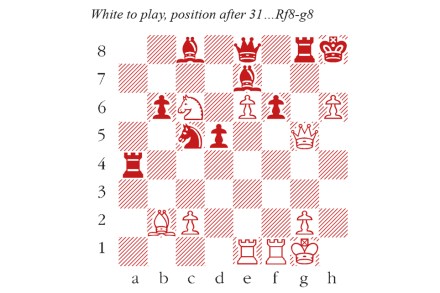
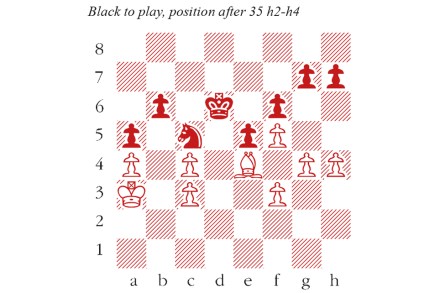
White to play. Mateusz Bartel-Jules Moussard, London Chess Classic 2023. Bartel’s next move yielded a crushing advantage. What did he play? Email answers to chess@spectator.co.uk by Monday 8 January. There is a prize of £20 for the first correct answer out of a hat. Please include a postal address and allow six weeks for prize delivery. Last week’s solution 1 Ne5!, e.g.

London Classic

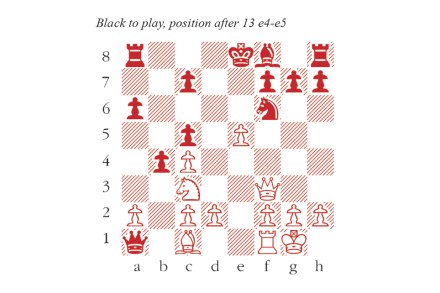
Michael Adams described his victory at last month’s London Chess Classic as ‘probably my best ever result’. Rated fourth in the world in his prime, Adams has won countless tournaments, but was delighted that, at the age of 52, he could still triumph against a much younger field. The top seed was the Indian teenager Gukesh, who reached the world top ten earlier this year. Adams scored two early wins in his trademark positional style against Amin Tabatabaei from Iran and Mateusz Bartel from Poland. But he got a lucky break in the sixth round, where the French grandmaster Jules Moussard’s exemplary play unravelled after a moment of carelessness. White’s bishop outshines its counterpart on f6, and Moussard decided it was time to strike.

No. 781

White to play and mate in two moves. Composed by Edith Baird, Illustrated Sporting and DramaticNews, 1890. Email answers to chess@spectator.co.uk by Wednesday 27 December. There is a prizeof £20 for the first correct answer out of a hat. Please include a postal address and allow six weeks for prize delivery.

Twelve questions for Christmas

1 One top player, besides admiring his trainer’s creativity, noted that they had a shared appreciation of 1980s music. Who was the player and his trainer? 2 How to Win at Chess is a new book for novice players, which became a New York Times bestseller. Which popular YouTuber wrote it? 3 One episode of the TV spy drama series Slow Horses made reference to a chess game played in 1851. Who were the original players? 4 ‘In chess, like tennis, you get lost for a moment and the game has already turned. In this aspect they are two quite similar disciplines.’ Which tennis player described how chess helps him train? 5 ‘Each life is a game of chess that went to hell on the seventh move…’ Which author, who died in 2023, wrote those words?