Luke McShane

Luke McShane is chess columnist for The Spectator.

World Seniors

If you visit the English Chess Federation’s website hoping to become a member, you will be confronted with a comprehension test. You will scroll past walls of text before appraising your membership options. Would you like to be a Supporter, Bronze, Gold, or Platinum member? Perhaps you are eligible for Junior Bronze, Free Junior Bronze, Junior Gold, Free Junior Gold, or Free Student Gold? Like the intricacies of the tax system, there must be reasons for this befuddlement of detail. The free tiers, for example, are intended as an inducement for members in their first year. But the initial impression is baffling: a simple table would go a long way to clarify the differences. As for the benefits of membership, the ECF’s monthly online magazine ChessMoves deserves greater prominence.

No. 810

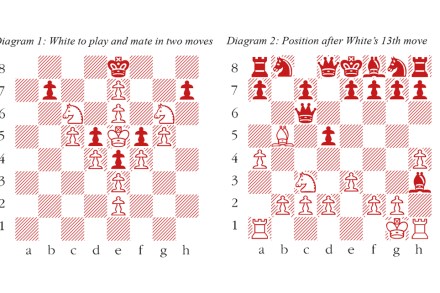
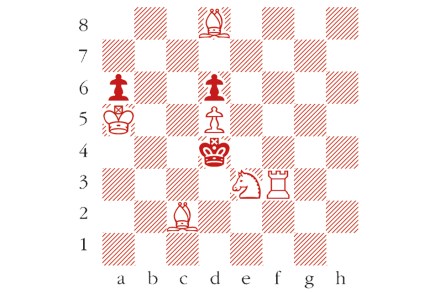
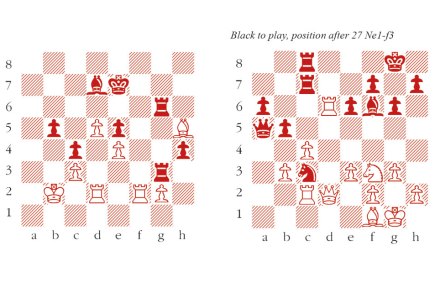
White has just played Kf3-e3. Which response showed this to be a decisive mistake? Email answers to chess@spectator.co.uk by Monday 22 July. There is a prize of £20 for the first correct answer out of a hat. Please include a postal address and allow six weeks for prize delivery. Last week’s solution 1 Bd3! e.g. 1…Ne7 2 Qh8# or 1…c5 2 Qh1# or 1…Nb5 2 Rb1#.

Classical chess

Garry Kasparov endorsed the slower time control which was used at the Superbet Chess Classic. That event, which concluded this month in Bucharest, was the latest leg of the Grand Chess Tour, the annual series of events for elite players which comprises a mix of faster and slower formats. In the words of the former world champion: ‘The preservation of classical chess… is very important for helping players to realise their full potential, to put on display what they can do.’ He compared the format to ‘modern opera’, in contrast to rapid and blitz events where the action is faster, but the play is less refined. At its best, classical chess contains ambitious, unusual ideas, such as the pawn sacrifice played by Firouzja in the game below.

No. 809

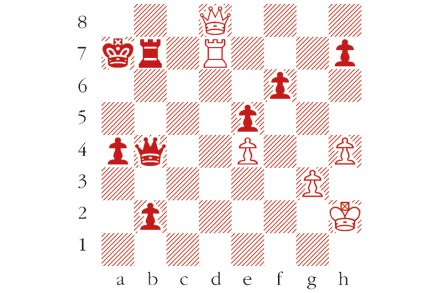
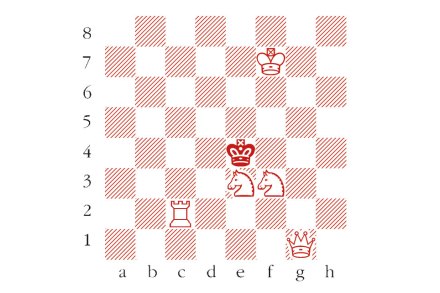
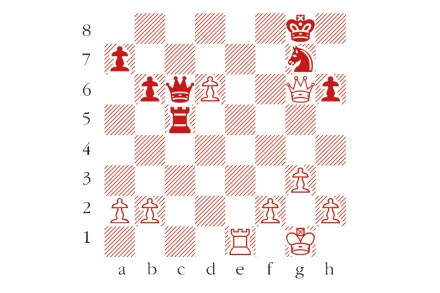
White to play and mate in two moves. Composed by Philip Hamilton Williams, The Chess Amateur, 1914. Email answers to chess@spectator.co.uk by Monday 15 July. There is a prize of £20 for the first correct answer out of a hat. Please include a postal address and allow six weeks for prize delivery. Last week’s solution 1 Qh6! wins, since 1…gxh6 2 gxf3 skewers the queen, and 2…Qxg1+ 3 Kxg1 gives White a decisive material advantage.

Hidden links

There is a sublime satisfaction in a good detective thriller. We will, of course, have accessed the same facts as our sharp-witted sleuth. The fleck of yellow paint on the raincoat meant little to us, as did the creaking door and the page missing from the notebook. But at last the alibi is dismantled, and from the tangle of contradictions emerges an elegant, coherent thread. Genius, they say, is seeing what everyone else sees and thinking what no one else has thought. On the chessboard, we also agree on many of the facts: this rook enjoys an open file, that bishop is pinning the knight. And much tactical reasoning is straightforward: ‘The queen is guarding against the mate, so let’s try to deflect it.

No. 808

White to play. This is a variation from Gelbmann--Gyimesi, Hungary 1996. Black threatens mate with …Qh4 or …Qh3. How does White turn the tables? Email answers to chess@spectator.co.uk by Monday 6 July. There is a prize of £20 for the first correct answer out of a hat. Please include a postal address. Last week’s solution 1 Re1! (idea Ne5-c4+) Re8 2 Bxd6+ (not 2 Nc4+?

English Championships

The English Championships concluded last weekend in two dramatic playoff matches. In the open event, Gawain Jones defeated last year’s winner Michael Adams by 1.5-0.5. The first game saw Adams pressing in a complex queen endgame, but he lost after an astonishing oversight which allowed mate in one move. Though Adams pushed hard for a win in the second game, patient defence from Jones secured the draw and the title. In the women’s championship, last year’s winner Katarzyna Toma faced Elmira Mirzoeva, the formerly Russian woman grandmaster who transferred her federation to England earlier this year. In the rapid playoff games, Mirzoeva took the lead with a convincing victory, but the second game saw Toma turn the tables with an unlikely counterattack in a lost position.

No. 807

White to play. Banerjee-Carroll, English Championship 2024. Ten-year old Banerjee found the only move to exploit the awkwardly pinned rookon d6. What did he play? Email answers to chess@-spectator.co.uk by Monday 1 July. There is a prize of £20 for the first correct answer out of a hat. Please include a postal address and allow six weeks for prize delivery.

When accusations fly

‘OK, there is a body with a knife there, and the police come and say nothing happened… You have to find who, why, what, but it happened, don’t pretend that it didn’t happen!’ Vladimir Kramnik deployed that analogy about the world of online chess, which he sees as riddled with cheating. Cheating happens. Once in a while, I get demolished in a casual online game in a manner that leaves no room for doubt that my opponent’s moves were silicon-assisted. Chess.com, the platform that hosts the biggest online events, has a dedicated Fair Play team to monitor cheating, and their checks have led to over a million account closures in 2023 (0.6% of the total number). Nevertheless, Kramnik clearly believes that Chess.

No. 606

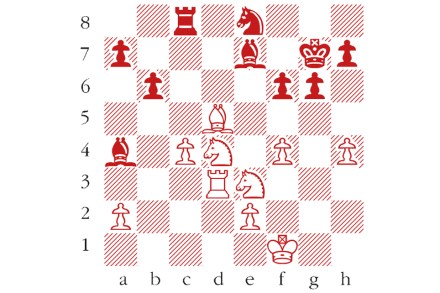
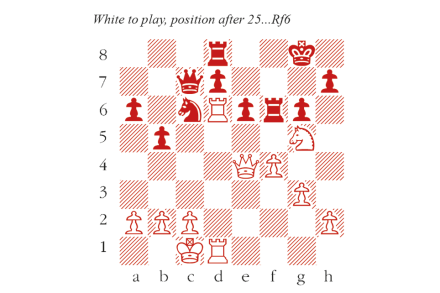
White to play. Magnus Carlsen-Ding Liren, Norway Chess 2024. Ding’s last move, 29…Rb6-b2 was a blunder allowing a quick checkmate. What did Carlsen play? Email answers to chess@spectator.co.uk by Monday 24 June. There is a prize of £20 for the first correct answer out of a hat. Please include a postal address. Last week’s solution 1 g3! Kh8 2 g4 Kg8 3 g5 Kh8 4 g6 hxg6 5 hxg6 Kg8 6 g7 wins.

Triangles

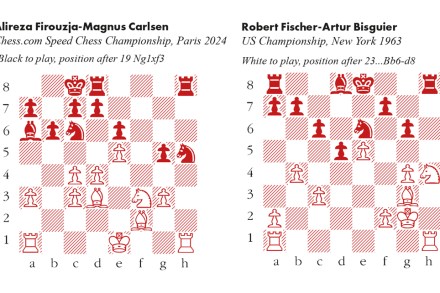
Lawyers in a courtroom, it is said, should not ask questions to which they do not already know the answer. Chess players are well advised to adopt a similar attitude to pawn endgames – steer clear unless you can anticipate the outcome with certainty. In endgames with more wood on the board, overlooking a nuance need not be catastrophic. In pawn endgames, nothing is minor, and any oversight can be decisive. Yet their apparent simplicity has the lure of a siren song. Grandmasters are usually more circumspect, so I was gobsmacked by Alireza Firouzja’s endgame howler in the recent Norway Chess tournament.

No. 805

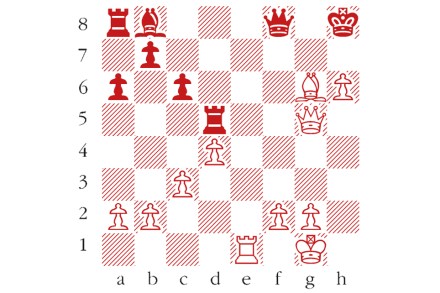
White to play. Adapted from an example in Capablanca’s classic manual Chess Fundamentals. Only one move leads to a win for White. Which? Email answers to chess@spectator.co.uk by Monday 17 June. There is a prize of £20 for the first correct answer out of a hat. Please include a postal address and allow six weeks for prize delivery. Last week’s solution 1 Rd6! Rd2 2 Qb1# or 1…Rxd4 2 Rxd4#. Lateral rook moves are met by 2 Bc3# or 2 Be3#.

Play it again, Amin

‘Back to the Future with Casablanca Chess’ was the tagline for the elite rapid tournament held in Morocco last month. The intriguing premise was that games would begin from positions taken from the opening phase of famous historical games. The four guinea pigs for this experiment – dubbed the Casablanca Chess Variant – were Magnus Carlsen, Viswanathan Anand, Hikaru Nakamura and Bassem Amin; the latter grandmaster from Egypt is rated in the world’s top 50. Other strong grandmasters selected the positions from historical world championship matches. Most allowed the players considerable creative scope, and all were balanced according to engine evaluations, so players might be happy to play with either colour. Well, one man’s meat is another man’s poison.

No. 804

White to play and mate in two moves. Composed by Michael Lipton, Deutsche Schachzeitung, 1970. Email answers to chess@spectator.co.uk by Monday 10 June 2024. There is a prize of £20 for the first correct answer out of a hat. Please include a postal address and allow six weeks for prize delivery. Last week’s solution 1...Be4! threatens mate on g2 and the rook on b7, while 2 Qxe4 Qxe4 3 Rxe4 Rd1+ leads to mate.

Sharjah Masters

The top Emirati grandmaster Salem Saleh is an imaginative, dynamic player whose games are a treat to watch. But his win at the recent Sharjah Masters against Vladimir Fedoseev (formerly Russian, but now representing Slovenia) was surely the artistic highlight of his career. The combination which ends the game is dazzling, but both players deserve credit for energetic play in the earlier part of the middlegame. Vladimir Fedoseev-Salem SalehSharjah Masters, May 2024 1 d4 Nf6 2 c4 g6 3 h4 A modern extravagance, mainly used by players who wish to avoid the combative Grünfeld defence which would arise after 3.Nc3 d5. If Black stubbornly insists on a Grünfeld-style approach with 3… Bg7 4.Nc3 d5, then 5.h5 poses serious problems.

No. 803

Black to play. Elisabeth Paehtz-Michael Adams, Salamanca Masters, May 2024. With his next move, Adams induced immediate resignation. What did he play? Email answers to chess@-spectator.co.uk by Monday 3 June. There is a prize of £20 for the first correct answer out of a hat. Please include a postal address and allow six weeks for prize delivery. Last week’s solution 1…Ne3! and White resigned, in view of 2 fxe3 Qxg2 mate or 2 f3 Rxg2+ 3 Kh1 Qxf3 wins.

European Seniors

England teams brought home an Aladdin’s cave of medals from the European Senior Team Championship, which concluded in Slovenia last week. Their victory in the over-65 section was particularly convincing. The team of John Nunn (reigning world senior champion 65+), Tony Kosten, Peter Large, Chris Baker and Nigel Povah lost just two games out of 36, and picked up four individual board medals, including gold for Chris Baker. Peter Large demolished a Finnish grandmaster in the following game.

No. 802

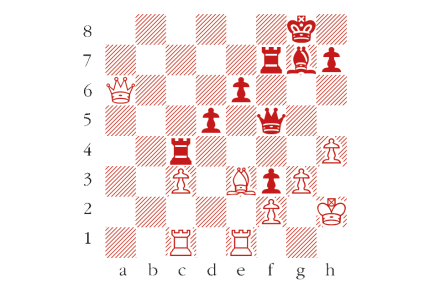
Black to play. Rocco-Ghasi, 4NCL, May 2024. White’s last move Rd1-a1 was a mistake, and with his next move Ghasi provoked instant resignation. What did he play? Email answers to chess@spectator.co.uk by Monday 27 May. There is a prize of £20 for the first correct answer out of a hat. Please include a postal address and allow six weeks for prize delivery. Last week’s solution 1…Qf2+!!

Four Nations

The Four Nations Chess League (4NCL) enjoyed a captivating finale over the early May bank holiday. As the final round commenced, three teams remained in close contention to win the title, each with nine wins out of ten matches, and each entering their final match as strong favourite. That meant the league would likely be decided on board points, so every half-point would count. The surprise contenders were the Sharks, who had fielded consistently strong squads but with only a couple of grandmasters. Beating Cheddleton by 5-3 in the final round was another good result, but not the big one they needed. Manx Liberty, who won the event last year, had the strongest lineup on paper, led by the veteran elite grandmaster Alexei Shirov.

No. 801

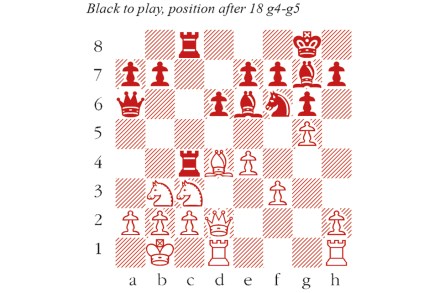
Black to play. A variation from Rasmus Svane-Samuel Chow, 4NCL, May 2024. In the game, Svane avoided the capture of a bishop on d7 which would have allowed this position to occur. Which winning move for Black had he foreseen? Email answers to chess@spectator.co.uk by Monday 20 May. There is a prize of £20 for the first correct answer out of a hat. Please include an address. Last week’s solution 1…Bf2! 2 f4 e4!