Luke McShane

Luke McShane is chess columnist for The Spectator.

Candidates debate

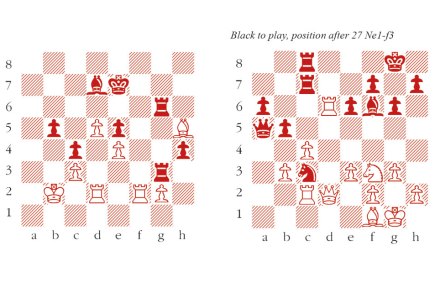
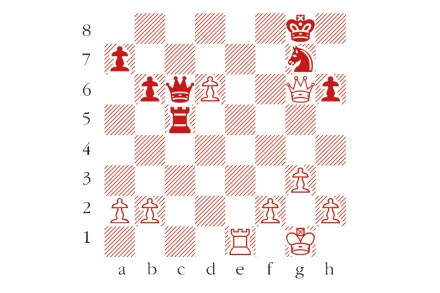
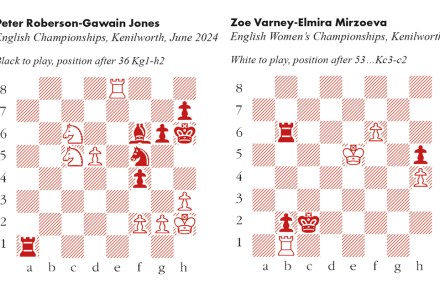
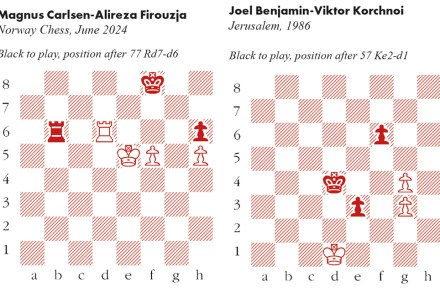
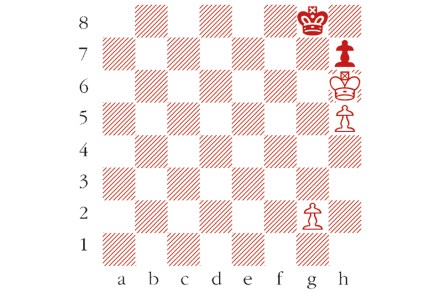
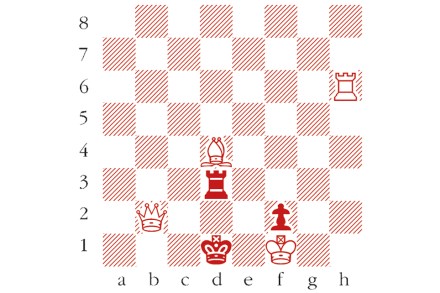
The grace of a snowflake lies in its outward simplicity, which on closer inspection reveals a sublime complexity. Chess endgames beguile me in much the same spirit. The examples below both occurred at the Fide Women’s Candidates tournament, which is currently approaching its conclusion in Toronto. Just a few moves earlier, Anna Muzychuk had an extra pawn in a rook endgame, which was being patiently guided to victory. Lei Tingjie has sacrificed her rook to reach the diagram position, pinning her hopes on the passed g-pawn to salvage a draw. Crucially, her king can shepherd the pawn while also impeding the approach of the White king. Time is of the essence. Anna Muzychuk–Lei Tingjie Fide Women’s Candidates, April 2024 53 Rd5+? This natural move throws away the win.

No. 797

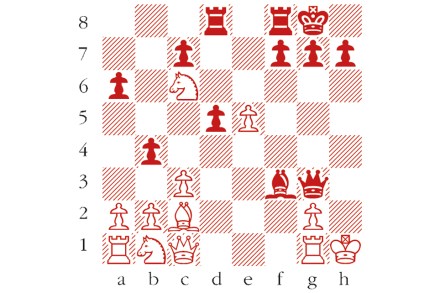
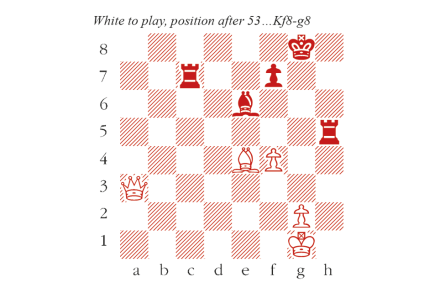
White to play. Makkar-Cherniaev, 4NCL Spring GM, March 2024. White is a pawn down, but his pieces are well placed. How did he strike a decisive blow? Answers should be emailed to chess@spectator.co.uk by Monday 22 April. There is a prize of £20 for the first correct answer out of a hat. Please include a postal address and allow six weeks for prize delivery. Last week’s solution …Bd4! wins a bishop by force: 2 Qxd4 Qxf3 3 Qf2 Qd1+ 4 Re1 Qxd6 and Black went on to win comfortably.

The event of the year

Every time I type out Candidates Tournament, I want to adorn it with an apostrophe, as with Parents’ Evening or Residents’ Association. Hear me out: Women’s Tournament sounds natural whereas Women Tournament sounds clumsy; the word is possessive rather than attributive. Be that as it may, the prevailing wind has swept the apostrophe away. Anyway, the greatest chess event of the year has begun in Toronto, and in an important sense it does belong to the players. Its legitimacy depends on the fact that qualifying spots are awarded not by invitation, but fiercely contested in elite events throughout the previous year. In the Candidates Tournament, the favourites are Ian Nepomniachtchi (who has won the previous two events), Fabiano Caruana and Hikaru Nakamura, the world no.

No.796

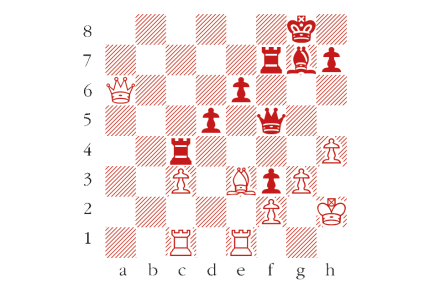
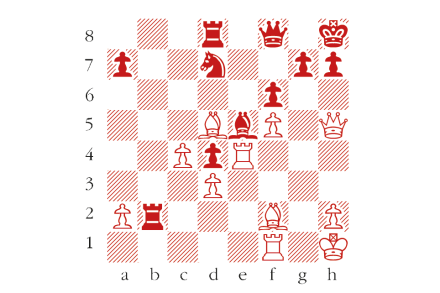
Black to play. Abdusattorov-Praggnanandhaa, Prague Masters, March 2024. White has a rook for a knight. Which move allowed Black to turn the tables and gain a decisive advantage? Email answers to chess@spectator.co.uk by Monday 15 April. There is a prize of £20 for the first correct answer out of a hat. Please include a postal address and allow six weeks for prize delivery. Last week’s solution 1 Rd7! Qxd7 2 Qxh5 gxh5 3 Bh7#. But 1 Qxh5? runs into a countershot: 1...

Menchik Memorial

Vera Menchik was 38 when she was killed by a German V1 flying bomb that landed on her home in Clapham. Born in Moscow in 1906 to a Czech father and an English mother, she was in her teens when her family settled in England. Aged 21, she won the first women’s world championship, and defended the title six times in the 1930s; she had two wins against Max Euwe a few years before he became world champion in 1935. Her sister Olga was another accomplished player; both sisters, along with their mother, were killed by the bomb. The Menchik Memorial was held last week at the Mindsports Centre in Hammersmith, to mark the 80th anniversary of Menchik’s death in 1944.

No. 795

White to play. Menchik-Graf, Women’s World Championship, Semmering 1937. Which brilliantmove provoked instant resignation? Beware: there is a tempting option which falls short. Email answers to chess@spectator.co.uk by Monday 8 April. There is a prize of £20 for the first correct answer out of a hat. Please include a postal address and allow six weeks for prize delivery. Last week’s solution 1 Qh7!

No. 794

White to play and mate in two moves. Composed by Sam Loyd, Baltimore Herald 1880. Email answers to chess@spectator.co.uk by Monday 1 April. There is a prize of £20 for the first correct answer out of a hat. Please include a postal address and allow six weeks for prize delivery. Last week’s solution 1 Rf3!

Game without end

It is just over a week since Elon Musk’s company Neuralink livestreamed an interview with Noland Arbaugh, who was paralysed from the shoulders down in a diving accident eight years ago. Following the implanting by Neuralink of a chip in his brain, he is now able to control a mouse cursor on the screen by thought alone. The 29-year-old described his joy in being able to stay up all night playing the computer game Civilization VI, for which he would previously have needed human support. (As a former Civ fanatic, I know how fast those hours go by!) Noland showed off his new ability by playing a game of online chess as he chatted. It was the perfect way to demonstrate the technology’s potential to enrich his life.

Helpmates

Chess, to state the obvious, is different from painting, or dance, or poetry. There is artistry in it, and yet the game stands apart. When we admire a sequence of moves, they only make sense viewed through the filter of an imagined adversarial contest. Sacrifices and combinations sparkle according to the obstacles that are overcome. The finest chess compositions display dazzling ideas from both sides before the denouement. And yet there is a celebrated genre of chess problem which dispenses with that premise. I’m thinking of the helpmate, in which both sides conspire to achieve mate on the board as quickly as possible. This is chess as choreography.

No. 793

White to play and mate in two moves. One of the conventional problems from the same Winton British Chess Solving Championship, composed by Huibrecht van Beek, 1899. Email answers to chess@spectator.co.uk by Monday 25 March. There is a prize of £20 for the first correct answer out of a hat. Please include a postal address and allow six weeks for prize delivery. Last week’s solution 1 Ba3! Qa2 2 Bc4 traps the queen, then 2…Bd4+ 3 Kh1 Qf2 4 Qxd4 wins a bishop.

Dropping the golden apple

Find the best move! Once upon a time, I sincerely believed that was my overriding goal during a game of chess. Naive, but nowadays I know better. The truth is that dodging banana skins is more fruitful, so to speak, than the pursuit of golden apples. In part, this is a simple story about experience and humility. After making enough bad moves, one comes to realise that there are always more lurking around the corner. But really, it’s not about me. The past decade or so has seen a fundamental shift in the way that games of chess are perceived, for which the near-omniscient chess computer has been the driving force. The moves of the world’s best players used to be held in awe.

No. 792

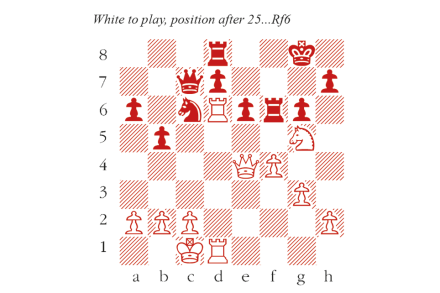
White to play. Brkic-Shengelia, Bundesliga, February 2024. White’s pieces coordinate far better than Black’s. Which move cashes in? Email answers to chess@spectator.co.uk by Monday 18 March. There is a prize of £20 for the first correct answer out of a hat. Please include a postal address and allow six weeks for prize delivery.

Two poisoned pawns

They say the best way to really know a subject is to write about it. I speculate it worked for the English grandmaster Danny Gormally, whose forthcoming book Tournament Battle Plan (Thinkers Publishing) perhaps inspired him to victory at the British Rapidplay Championships held in Peterborough earlier this month. It must be said that Gormally was also the top seed. He won the title in a blitz playoff, after his winning score of 9/11 in the main event was matched by the Irish teenager Trisha Kanyamarala, who was awarded the title of British Women’s Rapidplay champion. (The event was open to Irish citizens.) Her patient and tactically alert play allowed her to far outshine her tournament seeding.

No. 791

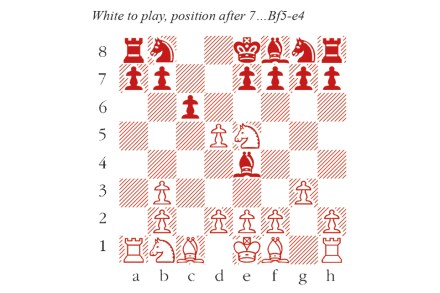
Black to play. Royal-Gormally, British Rapidplay Championship, 2024. White’s last move, 26 f2-f3, was a fatal mistake. How did Gormally respond? Email answers to chess@spectator.co.uk by Monday 11 March. There is a prize of £20 for the first correct answer out of a hat. Please include a postal address and allow six weeks for prize delivery. Last week’s solution 1 Rxe4! Black resigned. 1…dxe4 2 Qxf7+ (2 Nxf7+ Qf6 is less clear) Kh8 3 Qxe8+! Rxe8 4 Nf7+ Kg8 5 Nxg5 h6 6 Nxe4 Rxe4 7 Rd1 with a winning endgame.

Cambridge International Open

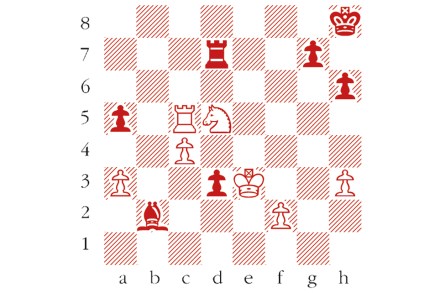
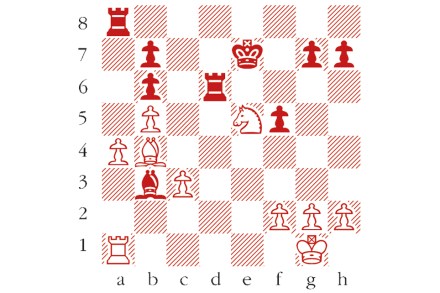
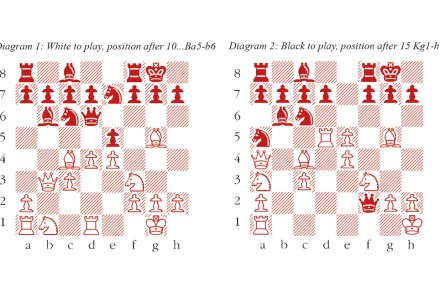
In February the Cambridge International Open returned to the University Arms Hotel. In the penultimate round, the experienced Dutch grandmaster Sergei Tiviakov was half a point clear of a strong field, and looked to be coasting towards victory against his Danish opponent. Playing White in the position below, his bishop and two passed pawns outweigh Haubro’s extra rook. Sergei Tiviakov-Martin Haubro Cambridge International Open, February 2024 (see left diagram) Tiviakov, co-author of Rock Solid Chess (New In Chess, 2023) is the epitome of a safe pair of hands at the chessboard. His position is characteristically tidy, in that every unit is protected by something else. But the most efficient path to victory involves some precise tactics: that is 40 Rxb8!

No. 790

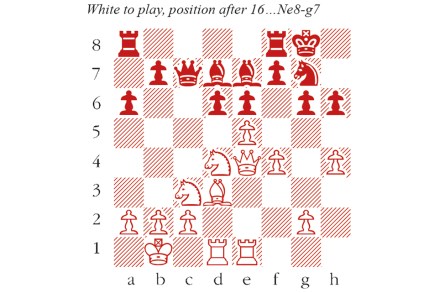
White to play. Borsos-Nawalaniec, Cambridge International Open, 2024. White found a devastating tactical shot. What did he play? Email answers to chess@spectator.co.uk by Monday 4 March. There is a prize of £20 for the first correct answer out of a hat. Please include a postal address and allow six weeks for prize delivery. Last week’s solution 1 Qe1!

It’s a knockout

‘Chess is a sea in which a gnat may drink and an elephant may bathe.’ I’m fond of that adage, which speaks to the depth of the game in a way that numbers cannot. But how many possible games of chess are there? The mathematician Claude Shannon wrote a paper in 1949: ‘Progamming a Computer for Playing Chess’, in which he estimated that there are at least 10120 (i.e. 1 with 120 zeros) possible games of chess. He noted that with such an astronomically large number, a perfect solution by brute force was infeasible. The reasoning is straightforward. The Dutch psychologist Adriaan De Groot (a contemporary of Shannon) estimated that a typical position may have 30 legal moves, so one move for each side makes for approximately 900 possibilities. Call it 1,000 (i.e.

No. 789

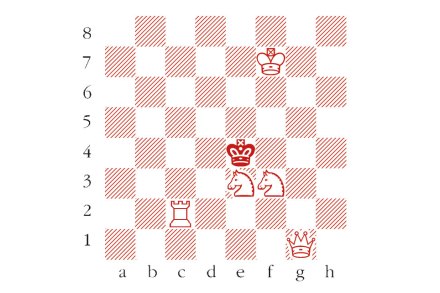
White to play and mate in two moves. Composed by M. Lokker, Shakhmatnaya Moskva, 1967 Answers should be emailed to chess@spectator.co.uk by Monday 26 February. There is a prize of £20 for the first correct answer out of a hat. Please include a postal address and allow six weeks for prize delivery. Last week’s solution 1 Bd3! Bxd3 2 Qd2# or 1…Rxd3 2 Qb1#.

Young contenders

Popular wisdom has it that the smartphone has shrivelled teenagers’ attention spans. But they are getting better at chess, and there is no doubt that technology is the main driver. Chess knowledge is more widely accessible than ever before, with any number of sparring partners, courses and coaches (like me!) available online. Chess engines, such as the famous ‘Stockfish’ program, are far more useful as training tools than they were 20 years ago, when they were tactically unbeatable but strategically patchy. These days their suggestions are invariably sound, and can harnessed for post-game feedback after playing human opponents. For promising young players, with the right guidance, there is no end of opportunity.

No. 788

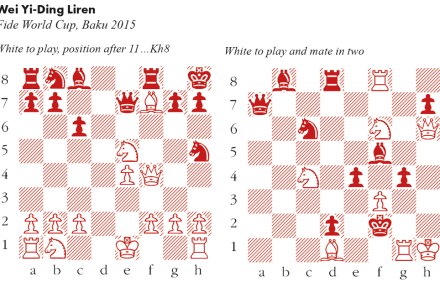
White to play and mate in two moves. Composed by V. Antipov, Kudesnik, 1998. Email answers to chess@spectator.co.uk by Monday 19 February. There is a prize of £20 for the first correct answer out of a hat. Please include a postal address and allow six weeks for prize delivery. Last week’s solution 1 Qg5+! Kf7 (1…Kh7 is similar) 2 Qf5+ Qxf5 3 Kxf5 wins, e.g. 3…Kg7 4 Kg5!