Lloyd Evans

Lloyd Evans

Lloyd Evans is The Spectator's sketch-writer and theatre critic

State of play

Writers and producers have shown little appetite for putting the coalition on stage. Several reasons suggest themselves. In 2010 wise pundits assured us all that the Rose Garden duo would squabble and part long before the five-year term expired, and theatre folk were persuaded not to gamble on a ship that might sail at any moment. And the conduct of parliamentarians has been pretty unhelpful to dramatists. Chastened by the expenses scandal, MPs have reinvented themselves as models of probity and self-restraint. The Commons has been all but free of sin. Eric Joyce cracked a few skulls. Nadine Dorries bunked off for a fortnight in the jungle. The occasional ex-minister has been caught hustling undercover hacks for a day or two’s work. Even the cabinet have behaved like nuns.

Losing the plot | 30 April 2015

Enter Rufus Norris. The new National Theatre boss is perfectly on-message with this debut effort by Caryl Churchill. Her 1976 play about inequality screams, ‘Vote Ed’ at triple-klaxon volume. Not that anyone in the audience was won over. They’d made up their minds long ago. Which is just as well because the play is hopelessly ineffective on every level. Churchill must be the most over-rated writer the English theatre has produced. She has virtually no dramatic skills. She can knock out humourless preachy rhetoric by the yard but as for the rest of it she hasn’t a clue. She can’t write a plot. She can’t create a human individual or differentiate one character from another with quirks of thought, word or deed.

Stage fright

The smash hit Matilda, based on a Roald Dahl story, has spawned a copycat effort, The Twits. Charm, sweetness and mystery aren’t Dahl’s strong points. He specialises in suburban grotesques who commit infantile barbarities. But his prose is sensational. No ‘style’ at all, just the simplicity and clarity of a master copywriter. He’s as good as Orwell. Mr and Mrs Twit are a pair of malignant outcasts who enjoy tormenting innocents. They keep a family of monkeys in a cage and they glue birds to trees and shoot them. You can read the story in about 20 minutes. It probably took Dahl a bit longer than that to write. And Enda Walsh’s essay-crisis adaptation may have delayed him for a day or two.

Death by politics

Dead Sheep is a curious dramatic half-breed that examines Geoffrey Howe’s troubled relationship with Margaret Thatcher. Structurally it’s a Mexican bean. It leaps all over the 1980s and it keeps shifting genre from cabaret to tragedy via cheesy political satire. Some actors are impersonators, some are caricaturists, some are neither. James Wilby’s study of Howe avoids his personal mannerisms, the pensive shabbiness, the punctilious, worried eyes, and the soft beguiling purr of his vocal chords. Instead Wilby presents him as a bewildered monk tiptoeing around a lion’s den. Steve Nallon does Mrs Thatcher as a drag-queen which looks pretty odd next to Wilby’s straightforward Howe but Nallon is a master vocalist.

Ayckbourn again

Experts are concerned that Alan Ayckbourn’s plays may soon face extinction. Fewer than 80 of these precious beasts still exist in their natural habitat, so theatre-goers will be cheered to know that the National Theatre has created a genetically identical replica and released it into the wild. Rules for Living, fashioned by Sam Holcroft from the Acykbourn blueprint, is a bourgeois natter-fest in which bickering couples meet for a fractious Christmas summit. The characters are a bit nice and a bit nasty. Stephen Mangan plays a failed cricket star married to a soak in a frock. They have an only child who suffers from this year’s must-have mental disorder.

In a seven-way debate, the truth-evaders can wriggle free

They won’t do that again. Seven leaders lined up like skittles all nervously fingering their plastic lecterns. In charge was Julie Etchingham who’d spent many hours in wardrobe creating a fetishistic look. Severe blonde hair. A spotless high-necked tunic as white as sharks fangs. Heavy black-rimmed specs. She looked like the gorgeous physics genius who works for James Bond’s arch-enemy. During the debate she lacked authority. When candidates shouted at each other she joined in and tried to harry them or close them down. More coolness needed. And she was glued to a lectern like the speakers. Roaming among them with a single portable microphone, she might have umpired more effectively. Leanne Wood of Plaid Cymru almost wept during her overture.

Bad Jews at the Arts Theatre reviewed: strange, raw, obsessive and brilliant

Bad Jews has completed its long trek from a smallish out-of-town venue to a full-scale West End berth. Billed as a ‘hilarious’ family comedy it opens on a low-key note in a New York apartment where three cousins have gathered for grandpa’s funeral. Daphna is a puritanical vegan Jewess, training as a rabbi, who wants to move to Israel, marry a soldier and serve in the IDF. She’s insanely jealous of Jonah and Shlomo, whose parents have bought them a flat before either has found a job. Shlomo (who calls himself Liam) is a ‘bad Jew’ obsessed with Japanese culture who intends to marry out.

Shrapnel at the Arcola works for the slayers, not the slain

Quite a hit factory these days, the Hampstead Theatre. The latest candidate for West End glory is Hugh Whitemore’s bio-drama about Stevie Smith. Not an obvious choice. The script, from the 1970s, recreates the atmosphere of Stevie’s life with effortless accuracy. Her vocabulary, her taste in clothes, her habits of thought and expression appear by magic as if drawn from the evidence of intimate friends. Yet Whitemore never met his subject. Zoë Wanamaker plays her as an adorable suburban eccentric, whose razor-sharp intellect peeps out from behind a façade of emerald pinafores and sherry decanters. Stevie (Florence Margaret Smith) was born in Hull in 1902 and lived nearly all her life in Palmers Green.

PMQs sketch: Oily backbenchers, superwonks wrong-footed and a Tory wall of noise

Cameron expected to walk into a firestorm of mockery at PMQs following his retirement bombshell. Quitter. Lame duck. Get yer pipe-‘n’-slippers. But barely an audible jibe was flung from the Labour benches. The Tories on the other hand greeted Ed Miliband with a roar that scared the pigeons in Parliament Square. Miliband and his superwonks had conceived a brilliant plan. Well, brilliant if you’re a superwonk. All available questions would be used to amass a Great Pyramid of Betrayals out of the PM’s broken promises over five years. Pointless really. Strictly for the bubble. No hope of making ‘the Six’. And Cameron wrong-footed Miliband. Asked to promise not to hike VAT, the PM assented, ‘Yes’.

The Heckler: Why I’m allergic to Stephen Sondheim

I came out in a rash when I heard that Emma Thompson was to star in Stephen Sondheim’s Sweeney Todd at the Coliseum. Sondheim has that effect on me. And it’s an allergy I bear with pride. I’ve been the victim of a Sondheim evening only once in my life and I emerged feeling as if I’d been shrieked at for three hours by a gorilla with rabies. The show, Sunday in the Park with George, was conceived as an exercise in ‘musical pointillism’ to honour the painter Georges Seurat. Musical pointillism? Come on. Sondheim has supporters that I admire, like Michael Grandage, and I would put the following questions to these deluded fanatics.

Radiant Vermin at the Soho Theatre reviewed: a barmy little sketch posing as a revolutionary satire

Philip Ridley is best known as the screenwriter of The Krays, in which Gary and Martin Kemp played Ronnie and Reggie as a pair of tanned and lisping choirboys. Ridley loves to bang his own gong. And he’s got enough gongs to raise quite a racket. The Smarties Prize, the W.H. Smith Mind-Boggling Book Award, the George Sadoul prize, the best director award at the Porto Film Festival. His action-packed CV even features trophies he nearly won but didn’t: the London Fringe Best Play Award (nominated); the Carnegie Medal (shortlisted). And no London writer has shown more literary potential than Ridley. He remains the only earthling ever to receive the Evening Standard’s ‘most promising’ award in both film and stage categories. How are those promises shaping up?

Budget Sketch: Penny-pinchers like me can rejoice

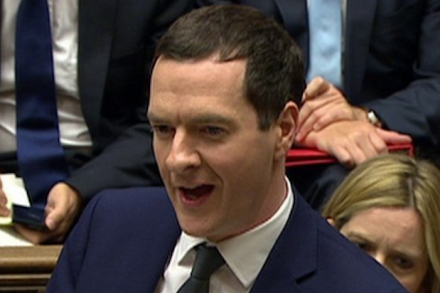
That was a motto-blaster of a budget. George Osborne deployed half a dozen chewy new Tory slogans during this afternoon’s statement. ‘Britain walking tall again. … a country built on savings not debt … ten pounds off a tank under the Tories … Britain – the comeback country …’ It’s unclear whether: a) Lynton Crosby feeds him these soundbites b) Osborne auditions them on a freelance basis hoping to catch the great auteur’s ear. He repeatedly called the country ‘one United Kingdom’ as well, bolstering Conservative claims that Labour is ready to sell Great Britain for dog-meat in a traitor’s deal with the SNP. He doled out good news on every side.

The Armour at Langham Hotel reviewed: three new playlets that never get going

One of last year’s unexpected treasures was a novelty show by Defibrillator that took three neglected Tennessee Williams plays, all set in hotel rooms, and staged them in suites at a five-star dosshouse in central London. The Langham Hotel, an antique hulk of marble and glass overlooking Broadcasting House, is justly proud of its raffish literary history. Arthur Conan Doyle once met Oscar Wilde there for a chinwag and a cup of tea and by the time the bill arrived they’d conceived a fictional detective named Holmes. The Langham’s management is keen for Defibrillator to repeat last year’s success but how? Search the archive for more plays set in hotels? Dramatise a short story with a hotel location? Commission some brand-new inn-based drama?

PMQs sketch: Miliband could have lost the election today

Was this the day Ed Miliband lost the election? Only two PMQs remain before polling day and the Labour leader used all six questions to ask David Cameron one thing: when might he ask him more questions? Nothing on policy. Nothing on convictions. Just questions about questions. He meant questions outside the House, of course. On telly. That’s the difference, according to Labour. A televised head-to-head debate is nothing like parliament. Except that PMQs is a televised head-to-head debate. To quiz the PM about quizzing the PM is hardly the tactic of a confident popular leader about to sweep to power. But Miliband had made a calculation. Previously, Cameron had offered unequivocally to take on the Labour leader at any time. Now he’s changed his mind.

Why George Bernard Shaw was an overrated babbler

When I was a kid, I was taught by a kindly old Jesuit whose youth had been beguiled by George Bernard Shaw. The provocative ironies of ‘GBS’ were quoted everywhere and he was, for several decades, the world’s leading public intellectual. But as a schoolboy I found it hard to assent to the infatuations of my elders and though I relished Shaw’s aphorisms (‘we learn from history that we learn nothing from history’) I conceived a suspicion that he was smug and overrated. A babbler. Perhaps even a bore. Man and Superman, rarely revived at full length, offers us GBS with all the taps running. Imagine Fry, Brand and Norton rolled into one and given a bushel of coke to snort.

PMQs Sketch: Cameron’s ducking and diving

Dodge and shimmy. Duck and weave. Cameron was at it again today. Ed Miliband asked if he’d care to join him for a spot of cut and thrust on TV. One to one. He had a date, 30 April, pencilled in for the gig. Kettle crisps and a glass of merlot on the PM’s rider. Tricky. Cameron would rather knight Rolf Harris, ennoble Gary Glitter and grant Myra Hindley a posthumous pardon than grapple with his main foe on live TV. So his course was clear. Dodge without appearing to dodge. Miliband pressed the question and forced his quarry onto the defensive but Cam’s camera-phobia won’t achieve cut-through with the public. Much harder to duck on immigration.

Muswell Hill reviewed: a guide on how to sock it to London trendies

Torben Betts is much admired by his near-namesake Quentin Letts for socking it to London trendies. Letts is one of the few individuals who enjoys the twin blessings of a Critics’ Circle membership card and a functioning brain so his views deserve serious attention. The title of Betts’s 2012 play Muswell Hill shifts its target into the cross hairs with no subtlety whatsoever. Curtain up. Married couple, Jess and Mat, are nervily tidying their yuppie dream home in expectation of supper guests. Jess is a sex-bomb accountant. Mat is a blankly handsome scribbler whose debut novel keeps getting rejected. Then a missile strikes. Mat casually mentions his acquaintanceship with an Australian electrician whom Jess has been secretly entertaining. Tense silence. The doorbell rings.

PMQs sketch: A jam for Cam but the greased piglet escaped again!

That was a close one. Miliband set two traps for the PM today. One was visible. The other, far more dangerous, was hidden until the very last moment. Miliband wants Tories to vote against a bill that will forbid serving MPs from acting as company directors. This connects sweetly with his  ‘Thatcherite swine gobbling at the Westminster trough’ motif. The Labour leader asked Cameron if he minded MPs having two jobs. ‘He has a chance to vote for change tonight.’ Cameron blithely objected that the new bill excludes directors of family businesses but not ‘paid trade union officials.’ Miliband pounced.

How to Hold Your Breath, Royal Court, review: yet more state-funded misanthropy

‘We hate the system and we want the system to pay us to say we hate the system.’ The oratorio of subsidised theatre rises, in triumphant blast, at the Royal Court whose current empress Vicky Featherstone has chosen to direct an interesting new play by Zinnie Harris. I’d call it a quasi-symbolist extraterrestrial tragicomic chicklit road-movie spoof with Chomsky-esque anti-corporate neo-collectivist socioeconomic textual underpinning but I fear this may lend it a clarity of purpose, and a firmness of character, which it doesn’t quite possess. We start with Dana, a chippy frump on the last lap of her sex life, bedding a UN drudge named Jarron who claims to be ‘a demon, a devil, a god’.

A tatty new theatre offers up a comic gem that’s sure to be snapped up by the BBC

New venue. New enticement. In the undercroft of a vast but disregarded Bloomsbury church nestles the Museum of Comedy. The below-stairs space wears the heavy oaken lineaments of Victorian piety but the flagstones have been smothered with prim suburban carpeting, wall-to-wall. There’s a bar in one corner. Yes, a bar in a church. With prices high enough to make you take the pledge. The ecclesiastical shelves are crammed with books, magazines, scripts and photographs that summon up the ghosts of our comedy heroes. A big carved pew, centrally plonked, invites the worshipper to sit and read, let us say, the autobiography of Clive Dunn or the diaries of Kenneth Williams. The sheer incongruity of this arrangement causes palpitations in the brain.