Lloyd Evans

Lloyd Evans

Lloyd Evans is The Spectator's sketch-writer and theatre critic

Corbyn’s team are trying – and failing – to turn him into a famous wit

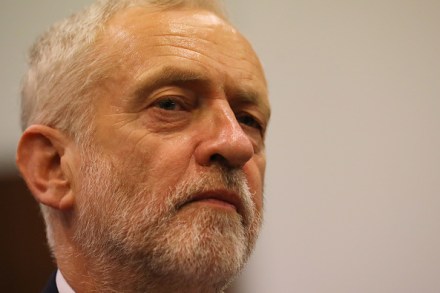
Poor grey sad Mr Corbyn. So angry. So useless. And so weird as a visual spectacle. His sharp-featured head looks, from a certain viewpoint, like an anvil pebble-dashed with porridge oats. But guess what? Today he scored a victory against Mrs May. And guess what? He blew it. First he revealed his team’s latest attempt to turn him into a famous wit. He claimed that Mrs May had yesterday marginalised parliament while claiming to restore its primacy. Then the pay-off. ‘Not so much the Iron Lady as the Irony Lady.’ Why is that a lousy gag? Bad mouth-feel. No punchy consonants. But it looks deceptively good on the page so Mr Corbyn’s comedy apprentices must have hoped it would fly. Then, perhaps accidentally, he skewered her.

Drama queen

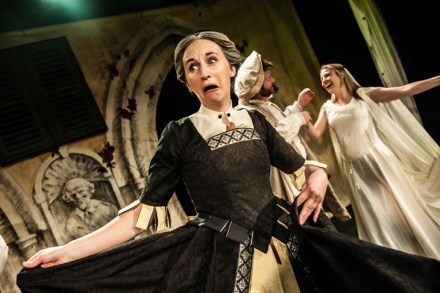
God, what a dusty old chatterbox Schiller is. Like Bernard Shaw, he can’t put a character on stage without churning out endless screeds of cerebral rhetoric. But unlike Shaw, he has no sense of humour, nor any instinct for the quirks and grace notes that create a personality. Mary Stuart is a psychological drama with a single issue. How soon, and with what political consequences, can Elizabeth execute her treacherous cousin Mary? Schiller’s characters sound and feel identical: super-brainy, highly confident know-alls who treat each problem like a gang of Chancery briefs discussing a particularly knotty insolvency case. Director Robert Icke’s regimented production imposes high-street fashions on England in the 1560s.

Jeremy Corbyn can’t beat the robot May at PMQs

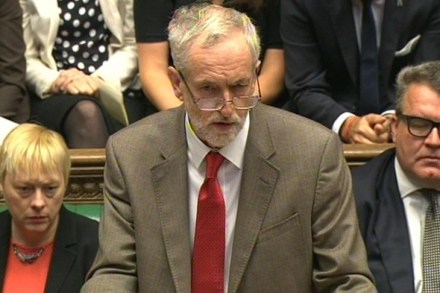
‘Nice to get such a warm welcome,’ said Jeremy Corbyn as jeers and hoots greeted him at PMQs. Ironic applause, as Corbyn knows. His enemies love him and his colleagues can’t stand him. ‘And a happy new year,’ he added. He could do with one of those himself. Yesterday, even before the dawn had broken, he managed to sink his own re-launch. On Radio 4’s morning show he hinted that he might favour unlimited fines for anyone earning a penny more than himself. A few hours later, having noted that fat-cat council leaders and millionaire trade unionists had failed to endorse this policy, he dropped it and talked about pay differentials instead. Corbyn focused on the latest outbreak of misery in the NHS.

Hedda Garbler

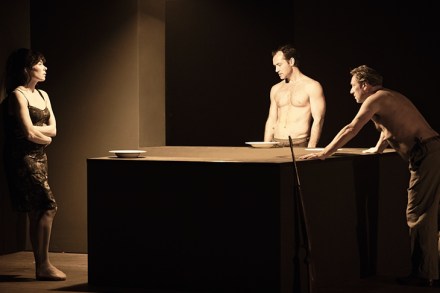
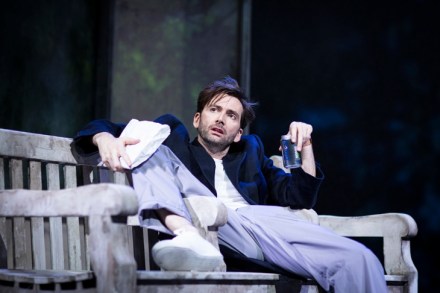
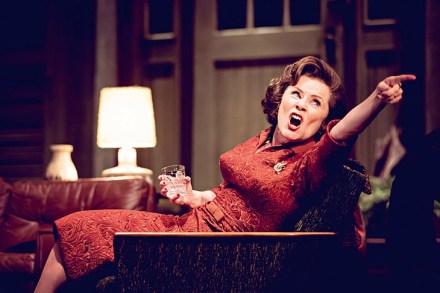
Hedda Gabler is one of the most influential plays ever written. It not merely illuminated an injustice, the enslavement of women within marriage, it fomented the revolutionary achievements of feminism. It deserves to be done as Ibsen intended. This updated version from Ivo van Hove locates Hedda in one of those posh urban dream homes that resemble an art gallery. Stage left, buckets filled with flowers. Centre, an abandoned plinky-plonk piano. At the rear, a lamp the size of a traffic bollard. Scruffy off-white masterpieces deck the walls. Everything looks chic and scaled-up. Tesman is a penniless American academic married to tetchy Hedda who pads about barefoot, in her nightie, grousing. Effortful gestures abound.

Deplorable entertainment

Buried Child is a typical Sam Shepard play. The main character, Dodge, is a brain-damaged alcoholic cripple stuck in a Midwest shack with a half-witted xenophobic wife shrieking at him from the coal cellar. The wife makes an early speech about her son who ‘married a Catholic whore’ and got stabbed to death by her on his honeymoon. This sets the tone for the play. Every character is a shrill, chippy barbarian and every speech is an exercise in tragicomic one-upmanship. The audience for Shepard’s work consists of social voyeurs who want to gawp at the underclass from a safe distance. The play purports to be a mystery but the family secret is revealed in the title. Even so, Shepard proceeds as if there were a puzzle to solve. He keeps offering us ‘clues’.

PMQs sketch: Confident Corbyn tries to cook up a Christmas crisis

Corbyn’s improvement continues. He thumped away at a single issue today – social care – in a determined attempt to corner Teresa May and stick the word ‘crisis’ on her jacket, like a brooch. A crisis for the elderly, he said. A crisis for families. A crisis for the NHS. ‘A crisis made in Downing Street.’ His delivery still havers and wavers a lot but the drum-machine technique, banging out identical noises in a hypnotic rhythm, was effective. She met his assault with verbal trinkets composed by back-room smart Alecs in Westminster: the future Osbornes and Camerons. Rejecting the word ‘crisis’ she called it 'short-term pressure'. She also mentioned ‘sustainability’, ‘integration’ and ‘reassurance’.

Angst and cant

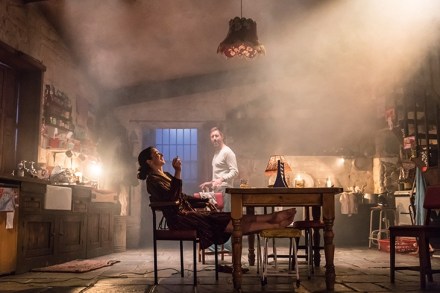
What if? is the engine of every great story. What if the toys came to life when their owner left the room? What if the prince’s uncle killed the king, seduced the queen, and stole the crown? Lucy Kirkwood asks: what if an elderly atomic physicist volunteered to take charge of the team decommissioning a stricken nuclear power plant in order to spare the lives of younger workers? Quite a complicated set-up. The play takes an hour to reach its starting point. First it feels like an oldies love triangle with a post-apocalyptic twist. We’re in a farmhouse near the site of a nuclear disaster. Rose, a wrinkly beauty, arrives unexpectedly and is greeted by fun-loving Hazel. Both are retired physicists who worked at the plant but haven’t met for 38 years.

Emily Thornberry’s PMQs performance should worry Jeremy Corbyn

The PM is abroad. Her vacant throne was occupied by David Lidington, the agreeably lightweight Leader of the House. He’s confident, fast-talking, well-briefed but glib and untidy-looking. He doesn’t improvise well. Physically he’s an unrestful presence. He hops and twitches and pecks and dabs like a pigeon attacking a box of Chicken McNuggets. For comic effect he likes to turn sideways with both arms outstretched as if entreating somebody in the wings. A speaking coach would tell him to calm down, put his hands in his pockets and stop head-butting imaginary bees. He made no errors today. He didn’t exactly shine. Bumptious competence was his level. Opposite him was Emily Thornberry whose warm buttery voice, like melting fudge, belies her forensic acuity.

Of ice and men

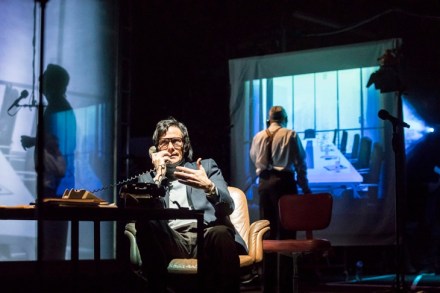
An ice floe. Two anglers. Months to kill. That’s the premise of Nice Fish by Mark Rylance and Louis Jenkins. The off-beat script is full of bleak and quirky insights. Rylance, who stars as the bungling Ron, admits that sometimes he gets so bored he bangs nails through frozen bananas. His pal compares dogs with wolves by observing that wolves are pessimists, jaws low to the ground, like homeless scavengers, whereas dogs are chin-up go-getters, natural corporate players, keen to win promotion in a worldwide enterprise called ‘Man’s Best Friend’. There’s a piece of obsessively nerdy rhetoric about 36-hour fishing permits which sounds like Peter Cook at his best. These treats appear early on.

PMQs Sketch: Striking attitudes in the Chamber

Sometimes PMQs is about policy. Sometimes it’s about posturing. Today everyone was striking attitudes like mad. Jeremy Corbyn over-stated the levels of suffering in the country. He painted a picture of workhouse Britain where ‘four million children’ live ‘in poverty’. He means ‘relative poverty’, an elastic term, which covers every child in the land, including those of David Cameron who are ‘poor’ relative to the children of Bill Gates. God-squad veteran, Chris Bryant, argued that the state shouldn’t just improve our lives but our deaths as well. He took us back to a funeral he once conducted during an adolescent phase when he thought he was a vicar. ‘Everyone was in tears,’ he boasted.

Precious metal

Who could resist School of Rock? For me it was a chance to see a heavy-metal musical written by the best-known headbanger in the House of Lords, Julian Fellowes. The movie features Jack Black as a failed rock guitarist who bluffs his way into a private school and turns a class of robotic snoots into a prize-winning band. It’s one of the most joyous stories ever filmed. This version, faithfully scripted by his lordship, rises to the same level and delivers a night of sheer rapture. The thing is like a drug. Every performance sends skyrockets of happiness zinging up and down your spine. David Flynn has an echo of Jack Black about him but he brings added stores of charm and humour to Dewey. Preeya Kalidas is wonderfully nasty as Ned’s hideous girlfriend, Patty.

PMQs sketch: Does peace in Syria depend on the World Cup?

Corbyn did quite well today. He got all frothed-up about the NHS and put some real oratorical venom into his closing attack. It began as an incomprehensible ‘battle of the budgets’ between the Labour leader and Mrs May. They were like a pair of drunken sailors comparing scars. The PM claims to have added a £2 bn premium to the NHS’s requested total of £8 bn. No you haven’t, said Corbyn, you cut it by £4.5 bn. The full tally of reductions, according to him, stands at £22bn. Mrs May upped the stakes and said half a trillion (£0.5 trn) was being spent on health during the lifetime of the parliament.

Space oddity

One of David Bowie’s last works, Lazarus, is a musical based on Walter Tevis’s novel The Man Who Fell to Earth. Enda Walsh has written the script. The lead character, Newton, is a derelict celebrity addicted to gin who occupies a big brown apartment full of bickering attendants. It’s unclear who or what Newton is. Human or alien? Something in between? His ontological status is a further puzzle. He may be alive, dead, half-dead, non-dead, half-undead or semi-not-quite-half-unalive. This is a problem, dramatically. A character who exists outside the mortal realm can’t make choices or perform actions that affect himself and others. He’s not a personality, therefore, just a puzzle wearing some clothes. Beige clothes in this case.

Jeremy Corbyn flops again at PMQs

People say Corbyn’s getting better. I wonder. He seemed out of touch today. Soaring employment, falling inflation, the booming stock-market, the Trump ascendancy, the implosion of Isis, the Aleppo siege? He ignored the lot. He brought up the exiled Chagos Islanders whose right to return has been denied for decades. Having mentioned them, and enjoyed a flush of reflected sanctity, he dropped the issue entirely. Poor old Chagos. Its scattered natives are used to being abandoned by false-friend statesmen but this seemed particularly cynical. Corbyn’s main brainwave today was to deploy all his rhetorical skill, all his mastery of the political arts, to lure Mrs May into accidentally disclosing her red-lines on Brexit. Every one of them. In full. But inadvertently.

Angry bird

Dynastic affairs and international relations were once a seamless continuum. Royal weddings accompanied peace treaties. An heirless realm was vulnerable to invasion. Botched successions led to war. This is the political context of King Lear but Deborah Warner sets the play in modern times, which muddles everything. Britain in the Dark Ages is represented by a scout hut or a therapy suite. Plain walls, bleached flooring, a semi-circle of blue plastic chairs. Enter the king’s court led by a crownless Glenda Jackson (Lear), sporting a black ensemble topped by a chic scarlet cardigan. Is this a brutal tyrant on the brink of a psychotic meltdown? Nope. It looks like Granny wearing ‘something special’ for her 80th at the care home.

Just kidding

Amadeus by Peter Shaffer is haunted by its own antecedents. Viewers are apt to feel that a new production lacks the beauties they’ve seen, or believe they’ve seen, in previous versions. Director Michael Longhurst opens with a fusion of time zones. The courtiers are attired in silk curtains like proper 18th-century toffs, while the musicians on stage wear the baggy subfusc of a contemporary orchestra. Electronic cries of ‘Salieri, Salieri’ are broadcast through a Tannoy as if the tardy Kapellmeister were being chivvied from his dressing-room by an irate stage hand. Early on we get the famous ‘voice of an obscene child’ speech, which is perhaps the most sublime piece of English prose ever written on the subject of music.

PMQs Sketch: Flabby Corbyn flounders with potent weapons

Early bloopers at PMQs. The session began with Theresa May offering Jeremy Corbyn her congratulations on becoming a grandfather. A mistake. The tribute was due elsewhere. But the improvised hilarities that accompanied this blunder burned up several minutes. Corbyn chose to attack on welfare. Over the last week Labour’s sound-bite factory has supplied their leader with some decent phrases. ‘Institutional barbarity’ is their name for giving a timetable to welfare claimants. Changes to invalidity payments are called ‘imposing poverty on the most vulnerable.’ But flabby Corbyn floundered with these potent weapons and failed to deploy them effectively. A bit like his tie.

Sweet and sour | 27 October 2016

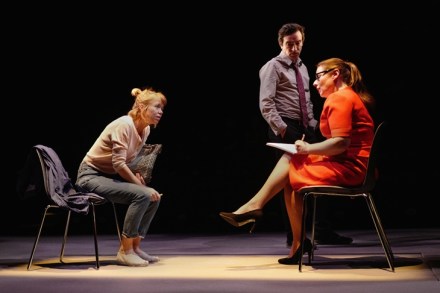
Great subject, terminal illness. Popular dramas like Love Story, Terms of Endearment and My Night With Reg handle the issue with tact and artistry by presenting us with a single victim and a narrative focus that reveals as much about the survivors as about the patient. Crucially, the disease is omitted from the title for fear of discouraging the punters from mentioning the work in conversation. A Pacifist’s Guide to the War on Cancer violates all these strictures. Half a dozen characters seated in a hospital ward shout at us about their failing health. These disjointed gobbets of testimony are interspersed with repetitive zombie dances and noisy songs with lyrics like ‘fuck cancer’. Snatches of insulting dialogue reinforce the mood of chippy sourness.

PMQs Sketch: Why Jeremy Corbyn is a lousy politician

Today it became clear why Corbyn is a lousy politician. He’s too interesting. The variety of life is simply too fascinating for him to prosper on the public stage. In a word, he’s not dull enough to be a statesman. A key attribute of leadership is the readiness to bore oneself, and everyone else, by repeating the same phrase over and over again. Successful politicians are happy to recite their favourite soundbites day in day out knowing that only at the thousandth repetition will the vital syllables grind their way into the public consciousness. Mr Corbyn has a great soundbite -- shambolic Tory Brexit -- which he needs to reiterate all the time. His advisers have no doubt nagged him about this. He should say it when he wakes up and when he falls asleep.

Ziggurat of bilge

Ella Hickson’s new play analyses our relationship with oil using the sketch format. First, there’s a candlelit soap opera set in Cornwall, in 1889, with a lot of ooh-arr bumpkins firing witless insults at each other. Next, a bizarre Persian scene, set in 1908, where a Scottish footman (who uses the celebrated Edwardian colloquialism ‘OK’) rescues a ditzy waitress from a sex-maniac serving in the British army. Then we move to Hampstead, in 1970, where a female oil magnate is visited by a Libyan diplomat seeking to nationalise her wells by waving documents at her, in her kitchen, while teenage kids pop in and out performing oral sex on each other. (This is one of the most disorganised pieces of stage writing I’ve ever witnessed.