Lloyd Evans

Lloyd Evans

Lloyd Evans is The Spectator's sketch-writer and theatre critic

LA story

BREAKING NEWS: ‘Enjoyable play found at Royal Court.’ Generally, the Court likes to send its customers home feeling depressed, guilty, frightened or suicidal. And, generally, it succeeds. The Kid Stays in the Picture is based on the memoirs of Hollywood super-mogul Robert Evans. Director Simon McBurney uses artful lighting and complex staging effects to disguise the fact that this is just a glorified book-reading of the kind broadcast by Radio 4 every day of the week. The performers are concealed by deep shadows or behind screens and this threatens to break a basic rule of live theatre: an actor who can’t be seen can’t be heard. But the performers are audible enough and one of them, Danny Huston, has a wonderfully gnarled and leathery voice.

Jeremy Corbyn looks lost at the despatch box

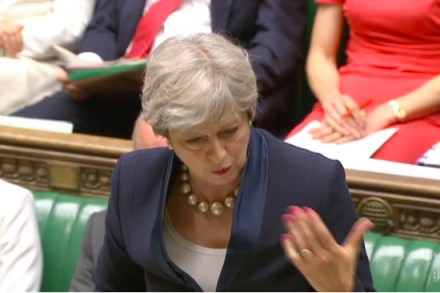
Tactics! At long last. Jeremy Corbyn actually used tactics at today’s PMQs. For the first time ever he divided his six questions into two three-ball overs. He spent the initial trio on last week’s terror attacks. Then, after an unsettling delay, he used three more on Mrs May’s fibs about school budgets. She says they’ve been ‘protected’. He says they’ve been ‘cut’. Protected. Cut. Cut. Protected. On it went. Mr Corbyn had a superb ally in the Public Accounts Committee which seems to support his view. The exchange might have been tricky for Mrs May but Mr Corbyn still can’t ram home a simple advantage. Rather than forcing her to repudiate the committee and its grandees he brought in a new, and far weaker, witness.

Royal prerogative

No one should complain that My Country; a work in progress is a grim night out. It’s rare for a good play to be written by royal command. The co-authors are the Queen’s personal minstrel, Carol Ann Duffy, and the director of her Royal National Theatre, Rufus Norris. These inspiring artistes have sent their vassals beyond the security of London to annotate ‘the words of people across the UK’ in the hope of understanding a humanitarian disaster: Brexit. The show makes its prejudices clear by dedicating the script to a Remain voter, Jo Cox, who was murdered by a Leave supporter. And it promotes the view, common among Remainers, that Brexit is a crisis caused by thick proles.

PMQs sketch: Come on Eileen, says Corbyn

A bizarre exercise in diplomacy from Jeremy Corbyn at PMQs. He manoeuvred the PM into a tricky corner and then stepped gallantly in to disperse the trouble he’d arranged. She’d been caught violating a manifesto commitment to protect school funding. The statistics proved it too. Corbyn’s back-room elves had devised a clever way to summarise the difficulty. Averaging out the cuts will mean, in effect, that every primary school loses two teachers and every secondary loses six. It was good stuff. Danger for the PM. But Corbyn, for some unfathomable reason, decided not to pursue his advantage and he proceeded to flannel his way out of his opponent’s problem. He dithered and waffled and found himself stranded in one of his platform speeches.

Ersatz erudition

Harry Potter, who uses the stage name Daniel Radcliffe, is a producer’s delight. By now it’s becoming clear that the four-eyed wizard lacks distinction as an actor. He’s not a comedian, certainly not a leading man or a heart-throb, and he hasn’t the ugliness or eccentricity to be a villain. But this Polyfilla quality means he can be dropped into anything without harming the fabric. His presence in Rosencrantz and Guildenstern Are Dead — a difficult and at times flimsy exhibition of varsity wit — is an insurance policy that will guarantee brisk business at the box office.

Scottish MPs don’t want to lead Britain. They want to sabotage it

Corbyn flunked it. Yet again. And his failure to skewer the government left the field open to the SNP. Speaker Bercow seemed to collude with this arrangement and he gave the Nats six opportunities to quiz the prime minister. Angus Robertson appeared to relish the battle. His great grey face was already brimming with fury as he demanded that Mrs May reach ‘an agreement’ with Holyrood before triggering Article 50. By ‘agreement’ he meant that Scotland must stay within the single market while the rest of Britain gets out. Which is hardly sensible. Like putting a zebra-crossing on a runway. But the SNP isn’t interested in good sense or compromise. Disharmony and strife are its objectives.

Changing of the Bard

Hamlet was probably written sometime between 1599 and 1602. The Almeida’s new version opens with a couple of security guards watching surveillance footage taken in a corridor. Well, of course it does. Nothing says ‘late medieval Denmark’ like closed-circuit television. Hamlet (Andrew Scott) appears. His black shirt and matching trousers suggest a snooker pro at the Crucible or a steward on a Virgin train. Scott is known as a ‘character actor’ (code for ‘baddie’) rather than a leading man.

Jeremy Corbyn’s torrent of miserabilism sums up the party’s woes

Would it take much to turn Philip Hammond into Dracula? He’s got the gaunt bearing, the unsettling gaze, the greedy overbite and the louring stature of the blood-sucking count. Add an opera cape and a dab of mascara and the costume would be complete. So it’s strange to see this vampiric figure delivering a budget full of happy tidings. Our economy is growing, he grinned, faster than America’s or Japan’s. Tax revenues are up. Employment has reached a new zenith. Joblessness has dwindled to 11-year lows. And he didn’t even mention London. A lot of the best data comes from the midlands and the north. He’ll probably never have an easier ride in the Commons.   The jokes were good too. Rapier Phil has a sharp tongue and an expert delivery.

All that jazz | 2 March 2017

It’s every impresario’s dream. Buy a little off-West End venue to try out stuff for fun. Andrew Lloyd Webber has snaffled up the St James Theatre (rebranded The Other Palace), which he intends to run as a warm-up track for new musicals. First off the blocks The Wild Party, a New York import set in the 1920s. We meet a couple of vaudeville veterans, Queenie and Burrs, whose romance has hit the rocks. To rekindle the flame they invite everyone they know around for a party. Hang on. A party? Booze, drugs, flirtation, seduction: the recipe for destroying a romance, not salvaging it. But never mind. The guests have started to arrive, direct from the Scott and Zelda Tribute Society. Everyone is talented, sophisticated and glamorously tragic.

What’s next for Jeremy Corbyn?

Got a daff pinned to your lapel? I haven’t. St David’s Day caused a predictable outbreak of Taffy-fondling in the House. Little yellow flowers winked gamely from the suits of several MPs, though many seem to be about as Welsh as Bombay Duck. What good is served by this annual flashing of custard-coloured flora? A 24-hour act of genuflection simply reminds members of a minority that the other 364 days are dedicated to those with enough power and wealth not to need a ‘Day’ with a capital letter. The passing of Gerald Kaufman drew heart-felt tributes from all sides. His death turns Kenneth Clarke into the Father of the House. It’s rare for a man in his seventies to become a new dad. Perhaps he should get honorary membership of the Rolling Stones as well.

Let’s talk about sex | 23 February 2017

What does it take to become a prostitute? Youth, beauty, courage, sexual allure, a love of money, a need for hard drugs, an addiction to risk? None of these, according to this fascinating show written and performed by London sex workers. What prostitutes need is the right mindset: humane, adaptable, tolerant, altruistic. Sex work is one of the caring professions. And it attracts operatives of any age, creed or physical configuration. An elegant 67-year-old rent boy explains, with touching humour, that his clients tend to be married men who just happen to be interested in fellatio. ‘Will you put your penis inside my body?’ a shy punter once asked him. ‘Yes, that’s more or less what I do.’ He works in the afternoons. In the mornings he has a cleaning job.

Jeremy Corbyn challenges Labour to a race to the bottom

The so-called leader of the so-called opposition gave another so-called performance today. Jeremy Corbyn seems to have challenged the Labour party to a slalom race. Target: rock bottom. Go Corbo! his enemies cheer as they watch his hapless figure slithering and shimmying down the ice-floes of public contempt. Today he came to the Commons with grounds for hope. Which, for Corbo, means a bulletin of despair issued by a public body with a fancy title and some embossed note-paper. The Marie Curie Foundation worries that nurses are struggling to care for dying patients. And the British Medical Association complains that 15,000 beds have been trundled out of NHS wards and left to rust on the scrap-heap. Extra money is the answer. Corbo had more.

Stuffed but dissatisfied

Sandi Toksvig’s new play opens in a Gravesend care home where five grannies and a temporary nurse are threatened by rising floodwaters. In Act One the ladies prepare for a rescue party that fails to materialise. In Act Two they build a life raft out of plastic bottles. There’s a bizarre sequence involving a silly young burglar who gets beaten up and flung through a window by a woman of 71. The ending is more of a petering out than a conclusion. All the characters feel interchangeable apart from the nurse, who claims to come from Cheltenham. Her name, Hope Daly, prompts one of the old dears to quip. ‘My life in a nutshell.’ Later Hope admits, ‘I’m from Croydon, OK? I don’t tell people because I don’t need the pity.

Timeless and dated

Tennessee Williams’s breakthrough play is a portrait of his dysfunctional family. A young writer, Tom (Williams’s real name), lives with his effusively domineering mother and his painfully coy sister, Laura. Mother, once a famous beauty, gets Tom to find an eligible chap for Laura. Tough call. Beautiful Laura has a deformed ankle and she’s just flunked out of secretarial college after suffering the embarrassment of vomiting over her type-writer. She now pines away at home forming sterile friendships with a colony of animal statuettes lodged in a glass case. This set-up has the delicious simplicity of a comedy sketch. The conflict between the unstoppable mother and the self-effacing daughter promises fun galore.

Jeremy Corbyn blows a golden chance to roast Theresa May

How to sabotage a deadly ambush. This was Jeremy Corbyn’s contribution to the political play-book today. He came to Parliament lethally armed. A cache of secret messages apparently between a Government wonk and the leader of Surrey County Council suggest some very shady goings-on. Mr Corbyn’s task was simple. Read out the intercepts and watch Mrs May squirm. He duly recited the incriminating information. And it was astonishing. It was unanswerable. The PM was accused of conspiracy. How would she plead? Well, she didn’t. She couldn’t say a word because Mr Corbyn was busy wittering on, muddling the issue, and giving his foe a priceless gift. Time. Time to think. Time to escape.

Playing dead

It could be the nuttiest idea ever. The protagonist of this American musical is Death, who secretly reprieves a beautiful Italian princess, Grazia, and spends the weekend at her father’s palace where a house party is in full swing. The dad knows the gatecrasher’s identity. But Death introduces himself to the others as a suave Russian duke. All the womenfolk promptly fall in love with him, including Grazia, who sets out to bag the mysterious foreigner. Where can this strange plot go next? Nowhere. Once Grazia learns that Death has come to terminate her existence the story will end. So the script is padded out with additional entanglements between a sprawling crew of sub-personalities.

Jeremy Corbyn offers up another dismal showing at PMQs

Mrs May has spent the week meeting naughty presidents. Today she was made to pay for it. Parliamentarians were queuing up to scold her for missing a great opportunity to bleat, pout, whine and nag on the world stage. She’s been to America where she failed to lecture Donald Trump on his meanness to Muslims and his impatience with climate change dogma. She was also supposed to bring up his waterboarding habit and his rapacity with women. Then she went to Turkey where her haranguing of President Erdogan was insufficiently shrill. Labour MPs seem to want the PM to traverse the globe like an irascible fitness instructor, bull-horn in hand, barging into presidential suites and ordering programmes of moral correction. This kind of poison ivy diplomacy wouldn’t work.

Amphibious assault

David Spicer’s farce Raising Martha opens with a skeleton being disinterred on a frog farm by animal-rights activists. They hope to force the frog farmer, an ageing dope fiend, to set his amphibious livestock free. Got all that? It’s complicated. And there’s more. The skeleton turns out to be the long-dead mother of the farmer, who alerts his shifty brother and calls in the cops as well. A loquacious twerp, Inspector Clout, arrives to investigate and the tangled narrative starts to unfold. This is an uneven play but the good bits are excellent. Stephen Boxer is amusingly deranged as the hallucinating frog man. The animal-rights activists are wittily portrayed as misanthropic nuisances.

PMQs sketch: In which Jeremy Corbyn rebrands the plan to make Britain ‘an offshore tax haven’

Mr Corbyn has spent a week shuddering at goblins that don’t exist. At least outside his head. But he wants his posse of demons to exist in our heads too. So he keeps conjuring them up. He says Mrs May is about to turn Britain into ‘an offshore tax haven.’ Being a Puritan he hasn’t noticed that this has an attractive, Hefner-ish feel. It suggests white sands and azure waves, the tinkling of steel-drums, and bottles of Red Stripe being served at ten cents a time by pouting lovelies straining out of their bra-cups. To be fair, Corbyn’s team of wordsmiths have spotted the problem. So the boss has been given a tastier version which he deployed at PMQs. Mrs May is about to make us ‘a bargain basement tax haven off the shores of Europe.

Remembrance of things past

The Kite Runner, a novel by Khaled Hosseini, has sold more than 30 million copies worldwide. Now it arrives on the West End stage, a doggedly efficient piece that somehow lacks true dazzle. The narrative style involves thick wodges of plot being delivered at the audience like news bulletins on the half-hour. The emotional range is limited and the characters never challenge our expectations. The setting is Kabul in the 1970s. We meet nice Amir, a personable everyman, whose family have foreseen the rise of theocratic despotism and are plotting to escape. We hope they do. We’re attracted to Amir’s garrulous, whisky-drinking dad. ‘All crime is a form of theft,’ he philosophises. We find the psychotic street bully Assef utterly appalling.