Lloyd Evans

Lloyd Evans

Lloyd Evans is The Spectator's sketch-writer and theatre critic

Perishable goods

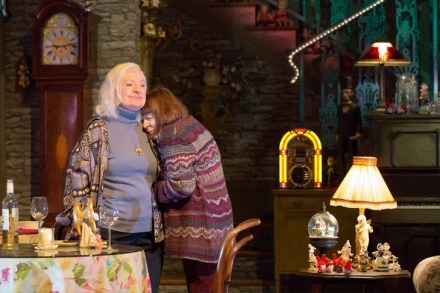
  Labour of Love is the new play by James Graham, the poet laureate of politics. We’re in a derelict colliery town in the East Midlands where the new MP is a malleable Blairite greaser, David Lyons. He arrives to find the office in crisis. The constituency agent, Jean, has handed in her notice but David is smitten by her acerbic tongue and her brisk management style so he asks her to stay. She agrees, reluctantly, and they settle into a bickering rivalry underpinned by affection. But is there more? Possibly, yes, but both are held back by their natural reticence and by fate. Secret declarations of love go astray. One letter is sent to the wrong person and another, written in code, makes sense only when read backwards. These contrivances aren’t entirely satisfying.

Theresa May has yet another bad day at the office

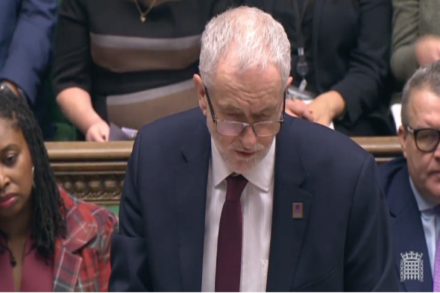
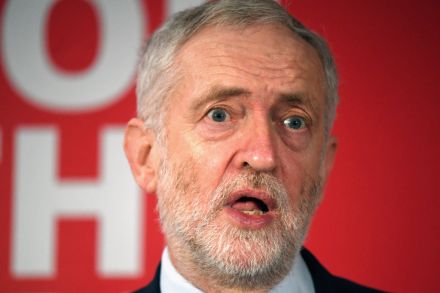
Theresa May needed to play a blinder today. But she left herself looking heartless and complacent. Jeremy Corbyn attacked her on the Universal Credit system which seems as useful as a windmill on the moon. He said UC was leading to ‘debt, poverty and homelessness.’ Mrs May replied that tremendous improvements had been achieved since January. Only 20 per cent of initial payments are late, she trumpeted, (although she used the formula '80 percent are on time’). Corbyn asked about delays twice more, and Mrs May’s patience dissolved. She did a little pantomime of being bored. Her eyes glazed over. Her chin tilted upwards. Her focus went into the middle-distance. A short breath was sucked in over her lower teeth.

Verbal diarrhoea

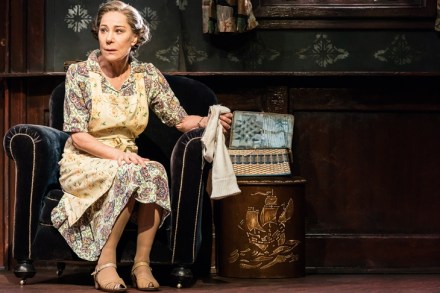
In Beckett’s Happy Days a prattling Irish granny is buried waist-deep, and later neck-deep, in a refuse tip whose detritus inspires a rambling 90-minute monologue. ‘An avalanche of tosh’ was the Daily Mail’s succinct summary. Wings is similar but worse. Mrs Stilson (Juliet Stevenson), an American pensioner sheathed in white, hovers over the stage on ropes and talks non-stop gibberish. ‘Three times happened maybe globbidged, rubbidged uff to nothing there try again window up!’ Thus begins her battle with intelligibility. ‘And vinkled I,’ she goes on, ‘commenshed to uh-oh where’s it gone to somewhere flubbished what?

Bloody minded

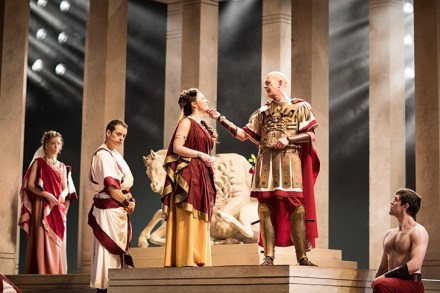
Tristan Bernays loves Hollywood blockbusters. His new play, Boudica, is an attempt to put the blood-and-guts vibe of the action flick on the Globe’s stage. The pacy plotting works well. Boudica revolts against the Romans who have stolen her kingdom. The queen is imprisoned and flogged while her two maiden daughters are savagely violated. Vowing revenge, she allies herself with the reluctant Belgics and they attack and destroy Camulodunum (Colchester). The first half is a rip-roaring crowd-pleaser. After the interval, an anticlimax. London is sacked but the Romans cling to power and when Boudica dies, her bickering daughters fight rather tediously over the succession. What counts here are the externals: the costumes, the accents, the fights, the stunts.

Speech therapy

Oslo opened in the spring of 2016 at a modest venue in New York. It moved to Broadway and this imported version has arrived at the National on its way to a prebooked run at the Harold Pinter Theatre. It’s bound to be a hit because it’s good fun, it gives a knotty political theme a thorough examination, and it’s aimed squarely at the ignorant. In the early 1990s Norwegian diplomats set up ‘back-channel’ talks between the PLO and Israel. The play follows that process and it treats geopolitics like a flat-share comedy. The bickering partners are hauled in by the lordly Norwegians and forced to hammer out their differences around the table. Play-goers need have no prior knowledge of Israel and its fraught relationship with the Palestinians.

Age concern | 14 September 2017

Stephen Sondheim’s Follies takes a huge leap into the past. It’s 1971 and we meet two middle-aged couples who knew each other three decades earlier at a New York music hall. The building faces demolition and the owner is throwing a party for his old dancing-girls. Dominic Cooke’s lavish production of this vintage musical boasts 58 performers, 160 costumes and 200 production staff. Yet it’s a curiously small show that could be performed, with a few cuts, in a pub theatre. There are four main characters and a smattering of cameos. Phyllis and Ben are rich New York grandees, unhappily married. Their chums Bud and Sally are also wealthy and disappointed with life.

PMQs Sketch: Policy pay, child poverty, and Brexit

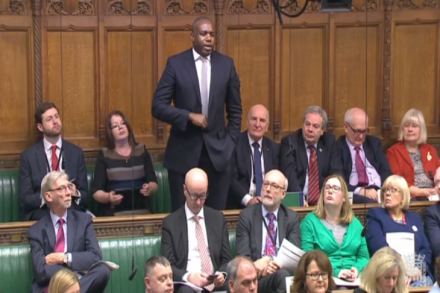
The news was bad at PMQs today. Gosh, it was terrible. Layla Moran started by announcing that Brexit would jeopardise thousands of jobs in Abingdon and wreck the local economy. Theresa May told her to stop spooking the voters with imaginary pessimism. ‘It’s what they’re telling me!’ shouted Ms Moran. Daniel Zeichner said the scourge of Brexit had now reached Cambridge. Migrants are fleeing in droves. University kitchens are without staff. Pubs are closing for lack of barmaids. Awful isn’t it? No hot dinners for dons. No tankards of goodly ale foaming in the city’s taverns. Mrs May urged him to ask businesses to train new staff. Mr Corbyn joined in.

Keeping it in the family

A new orthodoxy governs the casting process in Hollywood. An actor’s ethnicity must match the character’s. If you extend this decree to Shakespeare, you need Macbeth to be played by a Highlander, Shylock by a Venetian Jew, Richard III by an English hunchback and Cleopatra by an Egyptian who has slept with her brother. As for Hamlet, the play can only be entrusted to a family of incestuous Scandinavians. Gyles Brandreth (whose name means ‘firebrand’ or ‘sword’ in old Norse) has anticipated the trend by staging a production alongside his son and his daughter-in-law. Benet Brandreth plays the Dane while his wife, Kosha, plays Ophelia, Gertrude, Rosencrantz, Laertes and Horatio. Brandreth Snr takes the older roles.

PMQs Sketch: Theresa May and Jeremy Corbyn are back in control

Mrs May was back to her former self today. Cool, brusque, snappy and effective. Electoral disaster has served her well. Is it possible she planned this all along? Having brilliantly sacrificed her majority, she’s now indispensable to her weakened party. Her lack of defences defends her. Just one Commons defeat and Corbyn could walk into Number 10. The Labour leader was transformed too. The vegan diet appears to have drawn a circle of spiritual detachment around him. He didn’t get narked today. He wasn’t petulant or hoity-toity. He didn’t rant or snarl. The wheedling note of the dentist’s drill never entered his voice. He seemed measured and in control. Smooth, even.

Animal or vegetable?

Against by Christopher Shinn sets out to unlock the secrets of America’s spiritual malaise. Two main settings represent the wealthy and the dispossessed. At a university campus, an inquisitive Jesus-freak named Luke interrogates people about their experiences of violence. At an online retailer, oppressed wage slaves toil for hours and mate fleetingly during their tea breaks. Shinn’s characters also fall into two categories. The rich are eloquent, idealistic and disingenuous. The poor are earthy, impulsive and honest. The play is built around a series of formalised conversations, recorded interviews, writing tutorials, a Q&A session at a town hall, a stilted reunion between two old school-friends, and so on.

Hit and miss | 24 August 2017

Truman Capote should have been called Truman Persons. His father, Archulus, abbreviated his first name and introduced himself as Arch Persons. ‘And that,’ scoffed his son, ‘sounded like a flock of bishops.’ The young scribbler was thrilled when his divorced mother married a rich Cuban, Joseph Capote, whose zippy and eccentric name he gladly adopted. He got a job at the New Yorker and found the magazine’s celebrated wits, including Dorothy Parker and James Thurber, were embittered molluscs who hated each other. Capote’s literary life, as related by Bob Kingdom, is a parade of inspired bitchiness. He had the knack of getting to a character’s core problem. For Gore Vidal it was the knowledge that he had never written a masterpiece.

The many sides of satire

Brexit the Musical is a peppy satire written by Chris Bryant (not the MP, he’s a lawyer). Musically the show is excellent and the impressions of Boris and Dave are amusing enough, but the storyline doesn’t work and the script moves in for the kill with blunted weapons. Everyone is forgiven as soon as they enter. Boris swans around Bunterishly, Dave oozes charm, Theresa May frowns and pouts in her leather trousers, and nice Michael Gove tries terribly hard to be terribly friendly. Andrea Leadsom, known to the public as a furtive and calculating blonde, is played by a sensational actress who belts out soul numbers while tap-dancing in high heels and a pencil skirt. Was there ever a kinder portrait of a cabinet minister?

London calling | 10 August 2017

What is the Edinburgh Fringe? It’s a sabbatical, a pit stop, a pause-and-check-the-map opportunity for actors who don’t quite know where to go next. Alison Skilbeck has written a ‘serio-comic celebration’ of Shakespeare and her performance attracts a decent crowd for a show that starts at noon. She plays a fruity-voiced thesp, Artemis Turret, who delivers lectures about the Bard’s older females to groups of layabout pensioners gathered in a scout hut. It’s pure Joyce Grenfell. Good fun, too, but without much potential beyond the fringe. Dominic Holland’s show, Eclipsed, is about his life as a fallen comedy god. In the 1990s he was on telly all the time and he accepted the royal command to perform at Prince Charles’s 50th birthday party.

Ukip’s interim leader on Nigel Farage, Brexit and his party’s death spiral

‘Some wine? How about a beer? Shall we settle into a good old pub?’ I make these suggestions to Ukip’s interim leader, Steve Crowther, as we meet in central London, but he opts for a quiet bistro where he orders a cup of tea. He has a dapper suit, a ruddy, forceful face and a white beard of neatly trimmed bristles. His rat-a-tat laugh resounds across the bar like a well-oiled machine gun. Our intended subject is the Ukip leadership election (hustings this month, results on 30 September), but the n-word elbows its way through and claims our attention. The negotiations.

Whither Ukip?

‘Some wine? How about a beer? Shall we settle into a good old pub?’ I make these suggestions to Ukip’s interim leader, Steve Crowther, as we meet in central London, but he opts for a quiet bistro where he orders a cup of tea. He has a dapper suit, a ruddy, forceful face and a white beard of neatly trimmed bristles. His rat-a-tat laugh resounds across the bar like a well-oiled machine gun. Our intended subject is the Ukip leadership election (hustings this month, results on 30 September), but the n-word elbows its way through and claims our attention. The negotiations.

Starting block

Conor McPherson’s new play is set in dust-bowl Minnesota in 1934. We’re in a fly-blown boarding house owned by skint, kindly Nick who has designs on a sexy widow with a big inheritance coming. Good opening. Roll the story. But there’s more. Nick’s useless son is a depressed novelist entangled with a beautiful governess betrothed to a rich man she doesn’t love. An even better opening. Roll the story. But wait. Nick has a black maid called Marianne whom he rescued as a baby and raised as one of the family. An interesting complication. Roll the story. No wait. Marianne claims to be pregnant but declines to reveal whether the father is a rapist or an honourable suitor. And local gossips whisper that her baby bump is fictional. Fascinating.

Show up and show off

The Edinburgh Festival was founded as a response to war. The inaugural event, held in 1947, was the brainchild of Rudolf Bing, the manager of Glyndebourne Opera, and Henry Harvey Wood, a British Council grandee. Both were convinced that a festival of music and theatre was needed to restore the artistic heritage of Europe after six years of devastation. Edinburgh recommended itself as the host city because of its cultural prestige, its picturesque location (to rival Salzburg), and its ample store of theatres and hotels that could accommodate hundreds of performers and thousands of visitors. That the Luftwaffe hadn’t flattened the city was a significant mark in its favour. The festival set out to ‘provide a platform for the flowering of the human spirit’.

Heavy-handed

Oliver Cotton is an RSC stalwart who looks like a man born to greatness. Google him. He has the fearless jawline of Napoleon, the diabolical stare of Heathcliff, the tumultuous eyebrows of Michelangelo and the streamlined quiff of Liberace. And there’s something richly corny about his appearance too, as if he were Bill Nighy done up as a 1970s porn baron. When he isn’t treading the boards, Cotton writes contemporary thrillers and his latest effort, Dessert, is directed by Trevor Nunn. We’re in a London mansion where smug billionaire Hugh Fennell and his gem-encrusted wife are showing off their latest toy, a Renaissance oil painting, to a pair of rich American idlers. A gunman bursts in and takes all four of them hostage.

Out of sorts at the RSC

The RSC’s summer blockbuster is about Queen Anne. It’s called Queen Anne. It opens at the Inns of Court where drunken wags are satirising the royals with a naughty sketch about boobs and beer guts. Everyone on stage pretended this was hilarious. A few audience members did too, out of politeness. The principal characters arrive with their dramatic goals on display. Queen Anne wants to rule wisely. Her general, Marlborough, wants to conquer widely. His wife, Sarah, wants to help her monarch to rule wisely and her husband to conquer widely. And Sarah’s scheming cousin, Abigail, wants to befriend the Queen so that she can marry a steady salary. These characters are neither very admirable nor very wicked and their objectives don’t cohere into a single narrative.

Theresa May’s bickering Cabinet united to ambush Corbyn at PMQs

Tories are worried. The holiday season is here. And the last time their leader took a break – in Snowdonia – she came back with a brilliant plan to replace her comfortable majority with a coalition of rudderless squabblers. She seemed aware of this today and her costume exuded Tory vitality. She was power-dressed in a shoulder-padded tunic of eye-dazzling blue. A lightning-bolt of pure Thatcher. She was helped by her cabinet. The message about discipline seems to have got through to the conspirators and they laid on a theatrical ambush for Jeremy Corbyn. As soon as the Labour leader mentioned ‘bickering ministers’ the entire front bench erupted in a pantomime of animated conversation. Corbyn didn’t know how to react to this.