Lloyd Evans

Lloyd Evans

Lloyd Evans is The Spectator's sketch-writer and theatre critic

‘We will never return, there is no going back’: the Brexit Day party, as it happened

Remainers were there too. The first people I met at the Brexit Day festivities were opposed to the whole idea. I found them on Westminster Bridge, a man and his wife, posing with an EU flag. When the man spoke his voice faltered as if his pet spaniel had just died. ‘I married a German woman. I’ve been brought up to tolerate other cultures and lifestyles.’ I asked which of the many crises outlined by Project Fear would strike us first. ‘Economic slump,’ he said. Will Britain ever re-join? ‘Maybe in two generations.’ A couple with a toddler spotted the EU flag and joined us for a chat. They’d planned to enlist in a Remain Fightback Demo and were dismayed by the poor turnout.

Strong performances in a slightly wonky production: Uncle Vanya reviewed

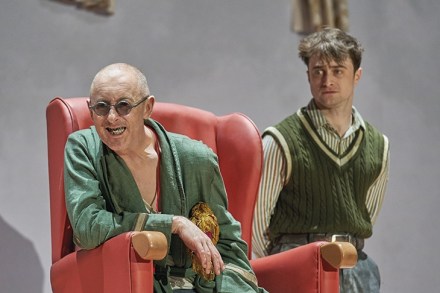
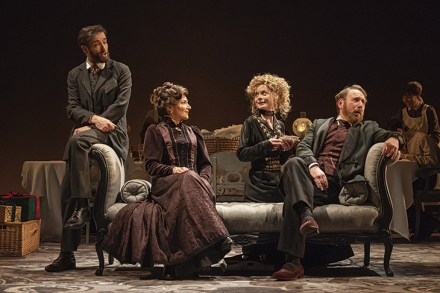
Uncle Vanya opens with a puzzle. Is the action set in the early 20th century or right now? The furnishings might be modern purchases or inherited antiques, and the costumes are also styled ambiguously. It soon becomes clear from Conor McPherson’s script, which uses colloquialisms like ‘wanging on’, that this is a contemporary version. It’s always a risk to update Chekhov and the director Ian Rickson pulls it off. Never once did I wonder why these chattering idlers didn’t have broadband or mobile phones. But the casting is awry. Vanya is a middle-aged Hamlet, a thinker, an observer, whose dreams are smashed to pieces in the course of the action.

PMQs: Boris relishes his new-found power

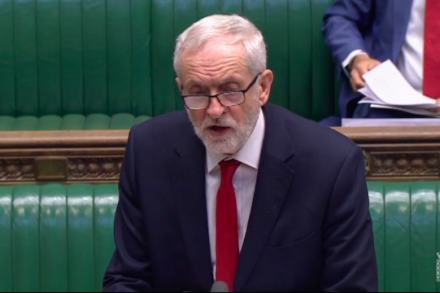
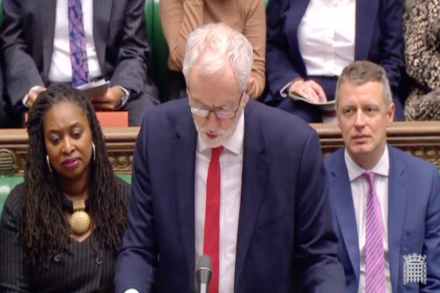
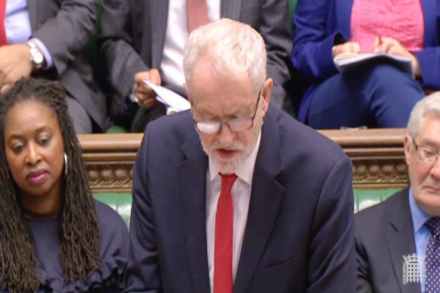
Jeremy Corbyn has stopped asking questions at PMQs. The lecture-circuit now looms for the Labour leader, so he uses the Wednesday sessions to practise the Grand Orations he will soon be making to drowsy socialists in overheated conference-halls around the world. He’s unlikely to match the fees commanded by the world’s top lecture-stars, Tony Blair and Barack Obama. His performance lacks bounce or crackle. He’s incapable channelling either passion or excitement and he simply recites his bullet-points like a sleep-deprived Bingo-caller. And his jokes misfire. Today he opened with a gag about the presenter of Just A Minute who died yesterday, aged 96. ‘Mr Speaker,’ said Corbyn, ‘can we take a minute to pay tribute to Nicholas Parsons.

Sweeping, sod-you comedy – irresistible: Billionaire Boy reviewed

Falling In Love Again features two of the 20th century’s best-known sex athletes. Ron Elisha’s drama covers a long drunken night spent by Marlene Dietrich and Edward VIII at Fort Belvedere, near Windsor, on the eve of Edward’s abdication in December 1936. It sounds like a contrived premise for a play but Elisha, who researches his material thoroughly, says this encounter actually took place. Marlene (played by Ramona von Pusch as an enigmatic adventuress in green lipstick) claims to have fled the Savoy where Rudolf Hess is bombarding her with flowers in the hope of luring her home to make films for the Third Reich. Marlene refuses because she can’t stand Hitler.

Blackford’s bid to skewer Boris falls flat at PMQs

PMQs began with a tussle over Universal Credit. Jeremy Corbyn’s team of wordsmiths and brainstormers had spent the morning ransacking a thesaurus for words meaning ‘destructive’. They found ‘broken, damaging, dangerous, callous, cruel, punitive and vicious.’ They added ‘very cruel’ for good measure. These were the labels Corbyn applied to Universal Credit. ‘It should go,’ he urged. As for ‘very cruel’, he spoke of ‘the very cruel and callous two-child limit which caps benefits for larger families.’ Now that Britain’s parents have received this warning, they can avoid the ‘very cruel’ cap by capping their fecundity.

Why John Bercow blames Jo Swinson for thwarting the plot to stop Brexit

What’s John Bercow up to these days? The ex-Speaker is enjoying the limelight, of course, but he isn’t necessarily cashing in. Last Friday, he did a solo gig at a community centre in Holland Park where his appearance raised thousands of pounds for a local charity. He charged no fee. And he spent time before and after his speech chatting happily to anyone who approached him. But then Bercow has always liked to talk. His parents, who noticed their son’s verbosity, said: ‘John, generally speaking, is generally speaking.’ He made this joke against himself during his hour-long speech. It wasn’t his only essay in self-mockery: ‘We may be short,’ he said, on behalf of smaller people everywhere, ‘but we’re environmentally friendly.

People expecting punishment won’t be disappointed: Almeida’s Duchess of Malfi reviewed

The Duchess of Malfi is one of those classics that everyone knows by name but not many have witnessed on stage. So a production is likely to attract theatre-goers who feel they ‘ought to’ see it rather than ‘want to’. This may have affected the Almeida’s version which is opaque and almost impossible to follow. Yet audience members who are expecting punishment rather than entertainment will not be disappointed. The play by John Webster was first presented in London in 1613 (or possibly a year later), and it relies on events that occurred in Italy more than a century earlier between 1508 and 1513. So even the original London audience would have had to work hard to follow the unfamiliar plot which traces the elopement of an Italian duchess with her steward.

Jeremy Corbyn cuts a sorry figure at PMQs

Jeremy Corbyn now cuts the sorriest figure in Westminster. The crackle has gone out of his cornflakes. The chain is rusty, the tyres are flat, the mechanism can barely move. Like Big Ben itself, this old bell has lost its clapper. The Labour leader still inspires a vocal greeting at PMQs but it’s the sort of semi-ironic ovation that might greet a fat schoolkid as he completes the 100m in just under two minutes. When Corbyn speaks he recites his questions in a zestless drone. And yet a great opportunity is being missed. Labour’s leadership candidates should take turns to spar with Boris as part of the contest. But no. We’re stuck with a man who wouldn’t even pass an audition to play himself.

Corbyn’s Stop the War protest speech was his worst yet

About a hundred Stop the War activists gathered outside BBC Broadcasting House on Saturday to protest against a possible conflict with Iran. They were the usual ragbag of idlers, dreamers, misfits and malcontents. Many of these people are unable to grasp the illogicality of their political positions. A chap selling the Socialist declined to give me a copy for free. ‘In future everything will be shared,’ I said, ‘so start with this paper.’ ‘I’ll share it with you,’ he smiled, ‘after you’ve shared your pound with me.’ I paid up and pointed out that the transaction had merely strengthened capitalism. ‘No, it’s building a system that will overthrow capitalism.

Redneck twaddle: Young Vic’s Fairview reviewed

Fairview by Jackie Sibblies Drury won last year’s Pulitzer Prize. It deserves additional awards for promoting racial disharmony and entrenching false, divisive and outdated stereotypes. The title is a pun. ‘Fair’ means ‘white’ and ‘view’ means ‘world outlook’ or ‘prejudice’. Really it ought to be called Honky Bias. The script declares its fascination with antique hatreds in its opening line which is a stage direction: ‘Lights up on a negro.’ No one talks like that any more. I attended the December press night where the play began as a moderately amusing TV-level comedy about a rich black family preparing for a birthday. This opening scene was followed by 30 minutes of confusing absurdity.

Lindsay Hoyle was a breath of fresh air at PMQs

New year. New parliament. New speaker of the House of Commons. The change was palpable immediately. Former speaker John Bercow found it impossible to say nothing even when he had nothing to say, which was most of the time. His successor Lindsay Hoyle has the contrary virtue of terseness. He got through the session without uttering a word, other than to state the name of each MP as he called them. Jeremy Corbyn, newly elected member for Tehran South, fretted about the legality of Qassem Soleimani’s assassination. ‘Not our operation,’ said Boris. He noted that Corbyn had failed to condemn any of Soleimani’s military operations, even though ‘that man had the blood of British troops on his hands.

Lily Allen to Newsnight: The 41 most annoying things in 2019

Lily Allen. Lights! Camera! Hanky! It’s been a vintage year for Twitter’s comedy genius. The needy pub-bore grumblings of Tony Blair. Ditto John Major. Ant and Dec. Even after the drunken prang it’s impossible to tell them apart. The panicky new jargon of weather forecasters, (old version in brackets). Flood warning. (Drizzle). Drought warning. (Drizzle clearing). Zero visibility. (Overcast). Threat to life. (Hail). Hypothermia alert. (Frost). Blizzards expected with a wind-chill of minus 50. (Easterly breezes). Susanna Reid. Why does she let the bloke with the big head do all the talking? The minor Johnsons. One is acceptable but do we need the others?

Full of fascinating data and excellent comedy: Messiah at Stratford Circus reviewed

I’ve joined the Black Panthers. At least I think I have. I took part in an induction ceremony at the start of Messiah at Stratford Circus. ‘Stand up,’ said the actor Shaq B. Grant to the predominantly white crowd. ‘Raise your right fist and repeat after me: “I am a revolutionary.”’ Everyone obeyed and chanted his mantra, some with more sincerity than others. Then the show began. The subject is a notorious police raid on a Panther hideout in Chicago in 1969 which resulted in the death of Fred Hampton, a 21-year-old activist nicknamed ‘the Black Messiah’. The police alleged that the Panthers opened fire first. The Panthers claimed that Hampton sustained survivable wounds during the raid and was later executed by unnamed police officers.

All the world’s a stage: this election has echoes of Shakespeare and Dickens

The Christmas election has unfolded like a series of mini-dramas from panto, Dickens and other popular classics. Boris has come across as a Dick Whittington figure, already twice mayor of London, and hoping to establish his seat in the capital on a more permanent footing. Jeremy Corbyn resembles Mother Goose flinging sugary treats at gullible children. And Jo Swinson has clearly been reading Cinderella (and believing every word of it). Swinson positioned herself as the long-suffering drudge who must tidy away the mess left by the Ugly Sisters, namely the Tory and Labour parties. In the story, Cinderella ends up as a princess (‘I’m standing to be your next prime minister’). The snag is that elections rarely turn out like fairy tales.

Magic Grandpa to Free Stuff: The A to Z of the 2019 general election

A is for Alliance. All across the country voting pacts and tactical deals are being fixed. These arrangements are helpful to cash-strapped smaller parties who can save money and present their thrift as a statesmanlike decision to ‘withdraw for the good of the country.’ For activists, voting pacts may be problematic. The deals rely heavily on opinion polls. And opinion polls are heavily influenced by false answers given by the kind of activists who arrange voting pacts. B is for Balance or ‘fair reporting’. The Beeb gets it right every time by interviewing a fixed number of Remainers and an identical number of Leavers who have switched to Remain. C is for Climate crisis.

A flimsy tale of self-pity and thwarted ambition: Hunger at the Arcola reviewed

Oh my God. The Nazis have invaded the Arcola Theatre. Norwegian novelist Knut Hamsen won the Nobel Prize in 1920 and later became such an ardent fan of Hitler that he sent his Nobel gong to Goebbels as a token of his admiration. The Arcola admits these demerits in the programme notes. What it overlooks is the intriguing fact that some commentators credit Hamsen with inventing the stream of consciousness technique developed by James Joyce in Ulysses. His breakthrough novel, Hunger, published in 1890, recounts his experiences as a penniless scribbler seeking work in the Norwegian capital. The protagonist in Fay Lomas’s engaging production is an archetype whom any professional writer will recognise: the unpublished hack who thinks he’s a genius.

Punk spirit underpinned by darkness and horror: Richard III at the Sam Wanamaker Theatre reviewed

The history plays are different. In dramas like Othello, Hamlet and Much Ado, Shakespeare laid out the plot with great clarity because the stories were new, or newish, to his audiences. But Richard III belonged to the recent past. The wonky monarch’s death predated the play’s debut by just over a century, so Richard’s era stood at the same distance from the Elizabethans as we stand from the Edwardian age. However, few modern playgoers know the dynastic complexities that drive the storyline so it’s worth mugging up in advance. This modern-dress production (co-directed by Sean Holmes and Ilinca Radulian) has been cast without regard to race, gender or age.

An astonishing treat: Dear Evan Hansen at the Noël Coward Theatre reviewed

Dear Evan Hansen, by Steven Levenson, opens as a standard American teen-angst musical. Evan is a sweaty geek with a crush on Zoe Murphy whose rebellious brother, Connor, is so disturbed that he styles his hair to suggest ‘school-shooter chic’. Evan tries to befriend Connor but gets shoved to the ground. Then, a bombshell. Connor kills himself. By an amazing but credible coincidence Connor’s parents start to believe that Evan was good pals with their deceased son. And Evan exaggerates the depth of the friendship in order to help the family, and especially the mother, cope with their grief. He even fabricates an exchange of emails in which Connor appears to speak warmly about his parents and to express hopes for the future.

Riveting and beautifully staged analysis of totalitarianism: Arcola’s #WeAreArrested reviewed

When the RSC does modern drama it usually lays on an ultra-worthy yarn with a huge cast, dozens of fancy costumes and a three-hour running time. Miraculously, its new co-production with the Arcola avoids these faults and delivers a terse, gripping 75-minute documentary drama based on the prison diary of Turkish journalist, Can Dundar. In 2015 Dundar received proof that his country’s intelligence service was attempting to supply arms to Syrian rebels. He knew that if he released the material he might face jail but he published it anyway and was threatened with life imprisonment. Peter Hamilton Dyer, well known for impersonating journalists, plays Dundar as a loveably cerebral type determined to stick to his principles.

Prince Andrew’s Newsnight interview was a career-defining calamity

Hats off to Newsnight. BBC 2’s flagship political show bagged itself an almighty royal scoop. Emily Maitlis was given an hour to quiz Prince Andrew about his friendship with Jeffrey Epstein, the convicted sex-offender who was found dead in his jail cell in August. The first bombshell of the night was the news that months of negotiation had led up to this stage-managed encounter in a Buckingham Palace drawing room. ‘Normally we’d be discussing your work,’ opened Maitlis, as if her main ambition in life is to cover the potterings of minor royals.