John Keiger

John Keiger

John Keiger is a former Research Director at the University of Cambridge and author of the biography of French president Raymond Poincaré

Why are so many dictators former doctors?

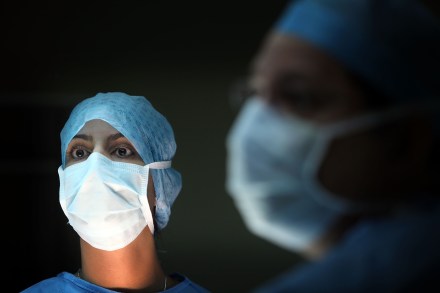
Are we increasingly living under a ‘doctatorship’? The influence of the medical profession over our everyday lives – from personal freedom, to how our children are schooled, to the economy – has soared since the pandemic. But is this a good thing? Or are democratically elected governments in danger of allowing medics to have undue say over how things are done? It’s hard to deny that Covid-19 has dramatically increased the influence of medics. When their advice is not taken, medics sometimes resort to the media to pressure our elected politicians to conform to their views, even when they disagree amongst themselves.
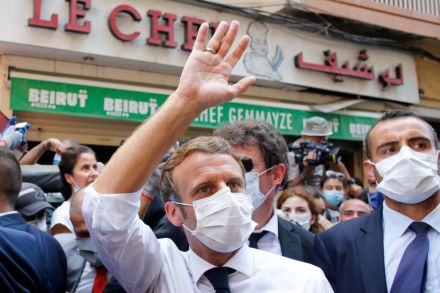
What’s up with Macron’s Lawrence of Arabia stunt?

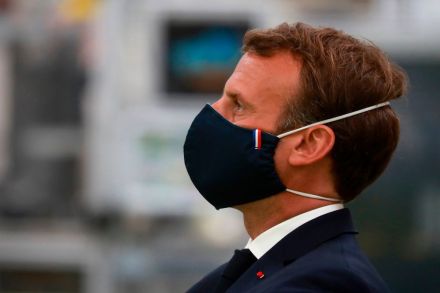
President Macron neither lacks chutzpah nor a lust for drama. His walkabout yesterday amid the devastation of Lebanon’s Beirut, following the massive chemical explosion that killed over 150, wounded 5000 and razed a whole section of the city, evoked David Lean’s Lawrence of Arabia with Macron as the strutting Peter O’Toole denouncing the factionalism that had thwarted the unity of the Arab peoples.  ‘I am here… to launch a new political initiative’ Macron intoned before shell-shocked crowds baying for a change of regime. ‘I expect clear answers from the Lebanese authorities about their commitments.

Covid-19 and the twilight of Britain and France

Is Covid accelerating the eclipse of France and the UK as ‘great powers’? For over two centuries Paris and London have been seated at the top table in world affairs. The essential element of their power has been economic, allowing both states to maintain powerful defence budgets, pursue active foreign policies and in the last resort, to wage war. Since 1945, although their power has in relative terms continued to decline, they have remained great power players as two of the five permanent members of the UN Security Council, and as two of the five official nuclear powers able to project force to all regions of the globe by dint of nuclear armed navies, notably submarines. This continues to be possible as long as they remain the fifth and sixth largest world economies.

Has France been naive in its handling of Huawei?

The controversy over the UK’s use of Huawei equipment in its 5G network has not abated, despite the government’s announcement that the Chinese manufacturer’s equipment will be stripped from the network by 2027. Conservative MPs continue to be unsatisfied by this half-way house, claiming that Britain will remain vulnerable to ‘back-door’ espionage by the Chinese state. They carry on threatening the government with an embarrassing, albeit symbolic, rebellion. But it is no secret that the real pressure to abandon Huawei equipment comes principally, and forcefully, from the UK’s ‘Five Eyes’ partners. The ‘Five Eyes’ network dates back to the Second World War and comprises the UK, the USA, Canada, Australia and New Zealand.

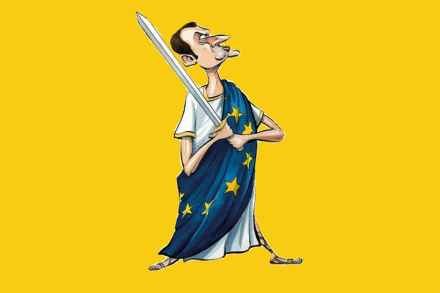
Macron’s Faustian pact with the EU

On Wednesday, the new French Prime Minister Jean Castex made his general policy statement to the National Assembly. We know things are getting serious in France because the new Prime Minister was wearing a proper suit: charcoal-grey, well-cut, elegant. No more of the boyband blue drainpipe little numbers sported by his predecessor, tailored to Macron’s foppish programme of France as a ‘start-up nation’. Castex’s audience of face-masked députés – including the communists to the left of him, wearing bright red face coverings – barracked him throughout.

Meet Macron’s politically incorrect justice minister

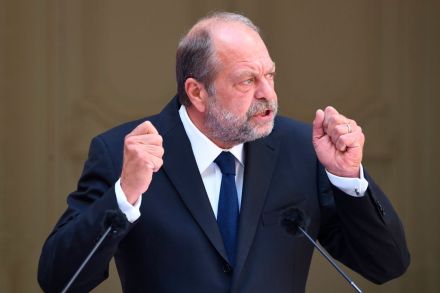
Picture the greatest French criminal barrister of his generation with the physique and cantankerousness of Rumpole-of-the-Bailey and the media-strutting ‘blokishness’ of Nigel Farage. Just imagine this 59-year-old son of an Italian cleaning-lady, great orator, defender of all-comers – including in his own words ‘the gypsy who has just disembowelled an old lady to steal her 40 euros’ – as one of the most outspoken and fiercest critics of France’s highly politicised and insulated caste of judges and examining magistrates. Meet then, the new French minister of justice.

Can Macron’s ‘Swiss army knife’ save his presidency?

His name is unknown, but resonates like that of a character from Astérix the Gaul. Jean Castex is France’s new prime minister, with a government reshuffle to follow. In ridding himself of the stolid and popular Edouard Philippe, Emmanuel Macron is playing his last hand in the presidential poker game to reset his troubled presidency. In fact Macron has appointed Edouard Philippe’s double. Castex, like his predecessor when first appointed to Matignon is unknown among the public, but an enarque, technocrat, top civil servant, member of the conservative Parti Républicain, with a foot in local mayoralty.

Macron has 500 days to save himself

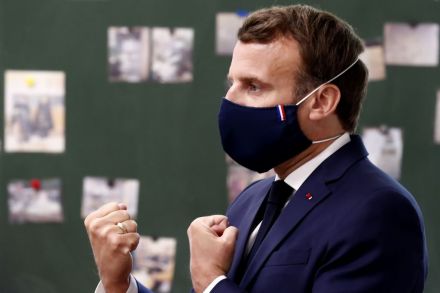
The clock is ticking for Emmanuel Macron. He has under two years of his presidential mandate to carry out his programme, much of which has been in suspended animation since before even Covid. In reality, it is much less than two years if one subtracts campaigning for the presidentials in May-June 2022, or even the regional and departmental elections in March 2021.  With a forelock tipped to Napoleon, the media are calling it his ‘500 days’, or more cerebrally In Search of Lost Time. Never in the history of the 5th Republic has one of its eight presidents spent so much time crisis managing. With two thirds of his mandate gone and half of that spent fire-fighting (yellow-vests, pension strikes, coronavirus) time is his most precious commodity.

Macron is trying to bathe in de Gaulle’s glory. It won’t work

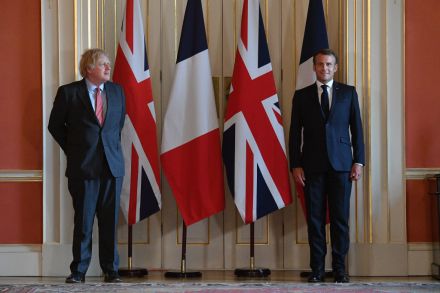
Emmanuel Macron never misses an historical opportunity to emblazon his banner. One is reminded of the nineteenth century diplomat Talleyrand whose ulterior motives were so notorious that on learning of the Frenchman’s death the Austrian statesman Metternich enquired nervously ‘What did he mean by that?’  Tomorrow, president Macron will be in London – exempted of quarantine – hosted by Prince Charles for the 80th anniversary of General de Gaulle’s appel du 18 juin that began resistance against Nazi occupation and Marshal Pétain’s collaborationist government. Why in the teeth of the Covid epidemic has the French president, who has cancelled all foreign visits since February, chosen to fly to London to award the city the Legion of Honour?

French statue-topplers make Brits look like a bunch of amateurs

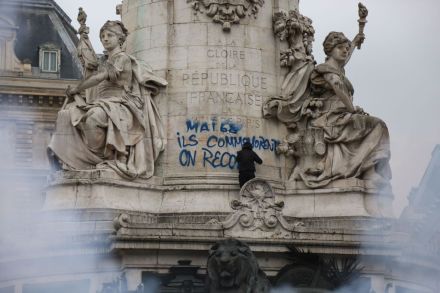
Toppling statues is relatively novel in the ‘Anglo-Saxon’ world, for whom revolutions, coup d’etats and regime change are a rarity. That is why the Anglosphere is taken by surprise when statue toppling happens, why they do it so childishly and with so little historical maturity. But for the French who have been doing it for centuries it is akin to a national sport. That is why they are more experienced and adult about it and why unspoken rules apply. The French Revolution was by no means the beginning of the French people’s experience of political iconoclasm, but it taught them its excesses and how subsequently to manage it.

The EU’s ‘Hamilton moment’ looks set to backfire

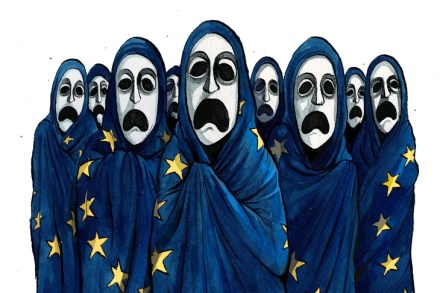
The European Union has always been quintessentially risk averse. What a surprise therefore to see it jeopardising its very existence by playing a high-stakes multi-handed poker game involving debt mutualisation, financial reflation and constitutional law against a backdrop of anti-EU sentiment. The founding fathers of the European project championed progress towards an ever-closer union by evolution not revolution. Opportunistically the European Commission – guardians of the treaties – seized on important international moments to widen and deepen European integration, as with the end of the Cold War and German reunification to extend state membership, pass the Maastricht treaty and institute the euro.

Macron is facing an economic disaster

Last week the New York Times praised President Macron’s management of Covid-19 and asked why the French were not impressed. None were more surprised by the article than the French media, who were at least pleased by the external praise. Perhaps the Times’s off-beam musings can be put down to its internecine distractions, for the French picture is very different on serious inspection. Other than the publicly acknowledged failings of inadequate preparation in terms of masks, ventilators, emergency beds and testing, there is the crucial issue of the economic impact, which the NYT didn’t even discuss. With media attention focused on the economic effects of Covid-19 on Italian and Spanish debt levels, France’s economy is often overlooked.

Inside the final act of the Brexit drama

The fourth round of official Brexit negotiations resumed on Tuesday, screen-to-screen. They will determine whether the stalemate can be broken and a trade deal sealed by the end of the transition date of 31 December. By mid-June, a high-level 'stock-take' between Boris Johnson and Commission President Ursula von der Leyen will assess whether sufficient progress has been made to continue negotiations.  Such is not the case thus far, according to recent public utterances from Michel Barnier and David Frost, who has claimed 'very little progress'. Just like in Endgame, Samuel Beckett’s tragicomedy, a sense of hopelessness pervades the final scene of the drama. In the play – as with Brexit – the characters await deliverance while nothing, in fact, happens.

A no-deal Brexit is now all but inevitable

Coronavirus is obscuring much about the future of the EU – and Britain’s relationship with it. Not everyone is joining the dots, but business is. And this means the decision for a no-deal Brexit is being taken outside of the official negotiations. Nissan unveiled its global restructuring this week after making a £5 billion net loss in the last financial year. It will close its Barcelona factory with a loss of 2,800 jobs while the Spanish government has said this was the end of Nissan’s manufacturing in Europe. And so it is if Europe means the EU. For Nissan also announced that the future of its UK plant in Sunderland was secure. Why is this significant?

France’s bid to tame the German giant

Why does president Macron want European debt mutualisation? Why has France become the spokesman for the ‘southern states’ on a European rescue package? Why did the French finance minister punch the air on learning that 500 billion euros (£440bn) EU funding had been agreed on 9 April? There are three reasons. First because France's soaring national debt, its floundering economy and its remarkably generous coronavirus rescue package are lining France up for an Italian style sovereign debt crisis.  Second, because ideologically Macron believes that Europe must integrate further or shrivel.

Covid statistics are just politics by other means

Statistics is the continuation of politics by other means, to misquote Clausewitz. One hundred and fifty years after the crushing of the revolutionary Paris Commune, historians still clash aggressively about the death toll. Was it as high as 40,000 or as low as 10,000? It matters because the Paris Commune is a shibboleth, a great left-wing site of memory and martyrdom, made famous by Karl Marx’s pamphlet The Civil War in France. He presented the Paris Commune as the first great experiment in communist government. Its crushing by the army of the conservative Adolphe Thiers is depicted in left-wing folk memory as the ‘reactionary, repressive forces of capitalism’ ending an idyllic experiment in socialism.

It’s a mistake to compare our Covid death toll with Spain and France

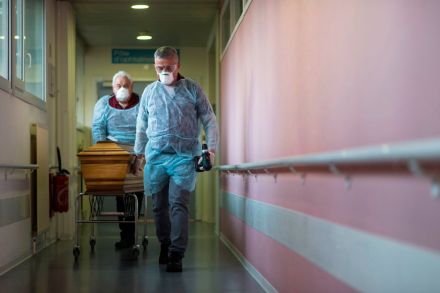
Covid statistics are like complex machinery; if you don’t read the instructions you won’t operate them properly. Which is why the claim by some media outlets that the UK now has the second highest number of Covid deaths in Europe, should be handled with caution. It is true that on Wednesday the official UK Covid-19 death toll increased by 4,419 to 26,097 after the government included deaths outside hospitals for the first time. The figures were revised respectively by Public Health England since the first UK death in March. According to the Guardian, ‘The change comes after weeks of criticism of the way that the UK had been reporting its coronavirus death toll, which made effective comparisons with other European countries impossible.

Don’t bank on a V-shaped recovery

Last week, Britain and France were treated to an avalanche of financial statistics jostling with the macabre daily litany of Covid casualty numbers. All are premised on a V-shaped recovery in which the severity and rapidity of the Covid recession is matched by a rapid bounce back. But the French above all should be aware of a historical parallel that suggests caution regarding the V-shaped recovery. But first the size of the problem. In Britain, the Office for Budget Responsibility produced the most pessimistic scenario for the British economy compared to those of KPMG, Morgan Stanley and the OECD. Based on a three-month lockdown it projects a 2020/21 budget deficit of 14 per cent falling back to a 2.

Meet the Frenchman who has shaped the world’s response to coronavirus

Projecting the fight against Covid as a war on a virus – like the war on terror – tells us more about the politician than about the strategy. But in the struggle to halt and extinguish the disease, it is war that has provided us with tools to manage the present crisis. Take ambulances, field hospitals and triage, for instance. All are the products of war, one war in particular and one man in all: Baron Dominique-Jean Larrey, the French surgeon who in the Revolutionary and Napoleonic wars pioneered battlefield medicine and its associated logistics. President Macron wisely abandoned his martial tone and bid to emulate France’s great war leader Georges Clemenceau in his most recent TV broadcast to the French nation.

Britain should brace itself for a new world order after coronavirus

How will states perceive themselves and each other after the pandemic? This is not just a matter of narcissism; it is fundamental to international politics. Such 'soft power' is, as Joseph Nye argues, crucial to the clout of countries on the world stage; it allows them to convince rather than coerce in achieving their objectives. Whether it be the British model of democracy, French culture or good governance, these values complement a state’s hard power of armies, bombs and bullets. In today’s information age it is not ‘whose army wins, but whose story wins.’ States may claim that they dealt effectively with coronavirus domestically or internationally, but when this is all over there will be clear winners and losers.