James Forsyth

James Forsyth

James Forsyth is former political editor of The Spectator.

The tension’s rising inside the coalition

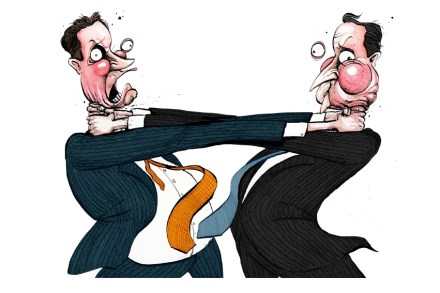
Talking to a Downing Street adviser earlier this week, I was struck when they observed that a ‘2014 election wouldn’t be too bad really. David would have done his best, Nick would have done his best. But they just couldn’t make it work anymore.’   The Tories have spent some time recently contemplating the possibility that the coalition might not run for the full length of the parliament. At a recent Chequers away day, the prospect of the Liberal Democrats walking out in 2014 was openly discussed.   That this possibility is even being talked about is revealing of the mood inside the coalition, which is the subject of my piece in the magazine this week. Things are becoming increasingly tense.
Miliband revels in his NHS attack

Today’s PMQs was a reminder that whenever Ed Miliband goes on the NHS he is guaranteed a result. Indeed, I don’t think I’ve ever seen Miliband enjoying himself as much in the chamber as he was today. When Andrew Lansley leaned over to try and tell Cameron the answer to a question, Miliband mockingly remarked ‘Let me say to the Health Secretary, I don’t think the PM wants advice from you’. As Cameron’s assaults became more direct, Miliband did not — as he often does — go into his shell. As he sat down at the end of it all, the Labour leader had to push down on his knee to disguise the adrenalin shakes he was having.

A taxing problem for George Osborne

Today’s FT reports that additional council tax bands are being considered as part of the Budget process. But there are several problems with introducing new council tax bands. First, this would require a wider revaluation, something that the coalition has ruled out explicitly and that would almost certainly drive up council tax for most people.   A revaluation, as a parliamentary question from George Osborne’s former chief of staff Matt Hancock established, would cost around £200 million. It would also take two to three years to complete, meaning revenues from any new band wouldn’t start accruing until either very close to, or even after, the next election.

50p tax rate is raising less than expected

The Telegraph this evening has news that the 50p tax rate is, predictably, raising less than expected. A report from the HMRC on the effectiveness of the 50p rate should accompany the Budget. If that report indicates that a lower rate would raise more revenue, then it will be a real test of the coalition. Will they leave the rate in place for symbolic reasons or will they reduce it? The defence of the 50p rate has always been that it was necessary to maintain public support for deficit reduction. But it sends out an awful signal about Britain’s approach to success. Rewards for failure are—clearly—a bad thing, but rewards for success are a necessary part of a proper market economy. Obviously, lowering the 50p rate would have to be part of a wider tax reform programme.

The Tories desert Cable in the Commons

When a Secretary of State is in trouble, it is traditional that his governmental colleagues rally to his side. But as Vince Cable defended overruling the Business Select Committee’s objections to Les Ebdon, there was but one Tory Cabinet minister on the front bench. This despite Cable having rung round private offices in search of support, as Patrick Wintour reports. In total there were three Tories on the front bench for most of the statement, Cable’s junior minister Mark Prisk, the whip Mark Francois and the Leader of the House Sir George Young in his normal seat. The absence of Tory ministers combined with 13 hostile questions from Tory backbenchers shows just how uncomfortable the Tories are with this appointment. By contrast, the Lib Dems are delighted.

The depressing appointment of Les Ebdon

Today brings confirmation that No.10 has not stood in the way of Vince Cable appointing Les Ebdon as the new director of fair access. Ebdon’s appointment is depressing for several reasons. First, Cable has ridden roughshod over the objections of the BIS select committee to his choice. So much for all of the coalition’s talk about respecting parliament — this is executive arrogance at its worst. Second, Ebdon represents the mindset that has done so much damage to British education in the past 50 years. It is worrying that he does not seem to appreciate that the biggest ‘root cause’ of poorer pupils not getting into top universities is the quality of state schooling in deprived areas.

Tory Ministers need to back the Health Bill

Tomorrow’s Downing Street meeting on the implementation of the health reforms is meant to send the message that the bill is definitely going ahead. Number 10 is keen to shore up the bill ahead of Liberal Democrat Spring Conference following the uncertainty caused by Rachel Sylvester's column and Conservative Home’s call for the bill to be dropped. Indeed, I understand that at the Quad dinner on Monday night, Nick Clegg and Danny Alexander made the basic political point that the Liberal Democrats would feel absolved of the need to support the bill if any Tory minister came out publicly against it. But Tory ministers still need to muster more public enthusiasm for the bill.

The green squeeze

Bjorn Lomborg’s article on why Germany is cutting back on its support for solar power is well worth reading and has clear implication for this country’s debate about energy policy. As Lomborg argues: ‘there is a fundamental problem with subsidizing inefficient green technology: it is affordable only if it is done in tiny, tokenistic amounts. Using the government’s generous subsidies, Germans installed 7.5 gigawatts of photovoltaic (PV) capacity last year, more than double what the government had deemed “acceptable.” It is estimated that this increase alone will lead to a $260 hike in the average consumer’s annual power bill.

Politics: Britain’s new gang of four

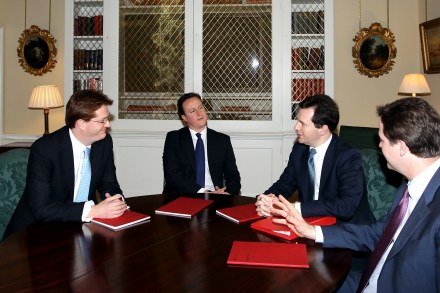
We have a new system of rule in Britain: Quad government. The coalition has not, as is often claimed, restored Cabinet government after 30 years of personality-charged premierships. But the Quad, which consists of the Prime Minister, the Deputy Prime Minister, the Chancellor and the Chief Secretary to the Treasury, plays the Cabinet’s traditional role. It decides all major matters of policy, inviting other ministers along where necessary. The Quad will determine the contents of the Budget. It has already met twice to discuss its priorities for the statement on 21 March. As its members will proudly tell you, the Quad doesn’t have its meetings in the Prime Minister’s den. This is not, they stress, sofa government.

Cameron’s ECHR problems won’t end with a Qatada deal

The news that Theresa May will fly to Jordan to continue talks about Abu Qatada shows how close the government thinks it is to a deal with the Jordanians that might satisfy the European Court of Human Rights and allow his deportation. One government source explained to me earlier that the problem is the Jordanians are offended by being asked to provide these guarantees about a fair trial and no evidence being obtained by torture. For this reason, there needs to be a fair amount of diplomatic stroking. A deal with Jordan on Abu Qatada is becoming increasingly necessary if Cameron is get out of this bind on the ECHR, with the Lib Dems on one side and the Tory right on the other.

Cameron’s plan to protect the Union

‘When the referendum on independence is over, I am open to looking at how the devolved settlement can be improved further. And yes, that means considering what further powers could be devolved.’ These words in David Cameron’s speech today, which follow on from what the Scottish Secretary Michael Moore said at the weekend, make clear what the Unionist campaign’s message will be. They’ll say to the Scottish electorate ‘Vote no to independence and then we can talk about devo-max’. This strategy will probably ensure victory in the referendum. But there are risks to it. First, more constitutional debate will create more uncertainty.

The steady erosion of Greek democracy

The longer this Greek crisis goes on, the clearer the various agendas at play are becoming. As the Greek finance minister said earlier, the actions of the Eurozone’s northern faction — led by Germany — do suggest that it wants Greece out of the euro. As I’ve blogged previously, the Germans believe that with Monti in charge of Italy and a new centre-right government in Spain, the effects of Greece leaving the euro could be contained. But this is a big risk. After all, Lehman Brothers was allowed to go bust because it was believed that it was safe to do so. Certainly, the other eurozone countries are no longer even pretending to respect Greek democracy.

Inflation falls as the VAT rise drops out

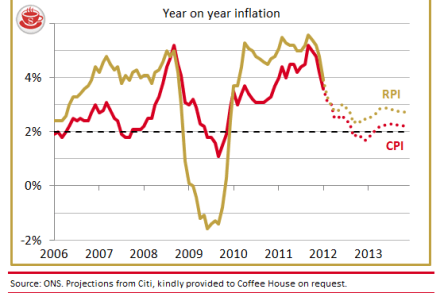
Late last year, the Tory party’s brains trust found that the inflation numbers corresponded directly to whether or not people thought that the economy was on the right track. When inflation was going up double-quick, the ‘wrong track’ numbers went up. But when the pace of inflation slowed, the ‘right track’ numbers increased. It is for this reason that the Tories are quietly confident that this year will see an uptick in economic confidence. They expect the inflation rate to fall steadily throughout the year as the VAT rise drops its way out of the calculation and the effects of the oil shock recede.

Will Germany let Greece stay in the euro?

The German government is split on the biggest policy question of the day, according to the FT’s German edition. As Open Europe points out, the paper has a senior member of the CDU/CSU group in the Bundestag saying that finance minister Wolfgang Schäuble ‘supports the bankruptcy of Greece, Merkel wants to strictly avoid it… It goes back and forth, which is not very helpful.’ If true, this is a remarkable story. The British Foreign Office has been convinced since the beginning of the year that the Germans are keen to kick the Greeks out of the euro.

Warming up for the Budget

The Budget negotiations within government are now underway. The quad of Cameron, Clegg, Osborne and Alexander held a meeting last week to discuss their priorities for the Budget on March 21st. They’ll continue this conversation over a working dinner tomorrow night. Already, we know that the Liberal Democrats main priority will be to get the personal allowance as close to £10,000 as possible. As The Sunday Times reports, they’re suggesting paying for this by taking away various reliefs for higher-rate taxpayers and closing some of the loopholes in the tax system. I also understand from Liberal Democrats close to Clegg that they’re also interested in some new green taxes.

Westminster’s attention heads north again

The debate over the referendum on Scottish independence will take centre stage next week. Michael Moore, the Scottish Secretary, will see Alex Salmond in Edinburgh on Monday and then Cameron will head north a few days later. It appears that the coalition is ready to give way to Salmond on the date of the referendum but not on the fact that it must be a straight yes or no vote. Moore tells The Times (£) that ‘There absolutely must only be one question.’ Quite what the coalition will do if Salmond goes ahead with his own refrendum on devo max remains to be seen. I suspect that Salmond's ideal result would be the surpeme court in London stopping a Scottish referendum.

Politics: Cameron cannot escape a verdict on Strasbourg

‘I don’t really worry about David and the European Court of Human Rights,’ one right-wing member of the then shadow cabinet told me months before the last election. After a fortifying mouthful of steak, he continued: ‘The truth is that, whatever the policy is now, as soon as the court tells him he can’t deport some terrorist and the papers start giving it to him in the neck, he’ll go absolutely mental and insist on reform.’ The moment has arrived. Abu Qatada — believed to have been the intellectual inspiration for several terrorist groups and, at one point, Osama bin Laden’s ambassador in Europe — is to be freed on bail because of a ruling by the court in Strasbourg. The government is trying to appeal against the verdict.

Greece needs to quit the eurozone

The Greek people are being crucified on a cross of euros. Unemployment there is 21 per cent and rising fast and the austerity pact that its politicians have cobbled together to try and receive the next tranche of bailout cash will make things far worse. It is in the interests of the Greek people for the country to default and devalue but this, obviously, isn’t possible with Greece inside the eurozone. There are elections in Greece in April and it is to be hoped that one of the main parties there has the courage to break from the view that Greece must stay in the eurozone regardless of the cost.

One for the Tories’ manifesto in 2015

David Cameron’s comments today that he finds a Swedish-scheme that offers tax breaks for employing domestic workers ‘very interesting’ and would ‘want to look at further’ are, predictably, being attacked by Labour. They are claiming that they are proof that he is ‘out of touch’. But it is, actually, a thoroughly sensible idea.   As I wrote back in October, the Cameroons have long been interested in the idea of trying to make childcare tax deductible. The appeal of this policy is that it would make it far more attractive for many highly-skilled — and high-earning — people to return to the workforce.

The BIS select committee makes its presence felt

We will soon find out whether the coalition meant what it said about empowering parliament. The BIS select committee has rejected the government’s preferred candidate for the post of the head of the Office of Fair Access. The committee concluded that it was ‘unable to endorse the appointment of Professor Ebdon as the Director of OFFA and we recommend that the Department conduct a new recruitment exercise.’ But Vince Cable, the business secretary, is said to be keen to override the committee’s verdict. Number 10, which has never been keen on Ebdon, is opposed. As I said on Sunday, the circumstances behind Ebdon’s name going forward are straight from The Thick Of It.