Isabel Hardman

Isabel Hardman

Isabel Hardman is assistant editor of The Spectator and author of Why We Get the Wrong Politicians. She also presents Radio 4’s Week in Westminster.

Spring Statement or ‘Emergency Budget’?

12 min listen

The question that everyone in Westminster wants answered is what will actually be included in next week’s Spring Statement. Previously, the Spring Statement wasn’t looking like much to write home about – little more than an update. But with the economy taking a turn for the worse and her fiscal headroom narrowing, it has taken on renewed importance for Rachel Reeves, with the opposition trying their best to brand it as an ‘Emergency Budget’. What does Reeves need to do to calm the markets? Also on the podcast, Pensions Minister Torsten Bell gave an interesting interview to Newsnight last night, defending the government’s welfare reforms. Where are we with the fallout from Liz Kendall’s benefit crackdown? James Heale speaks to Isabel Hardman and Katy Balls.

Badenoch caught Starmer out at PMQs

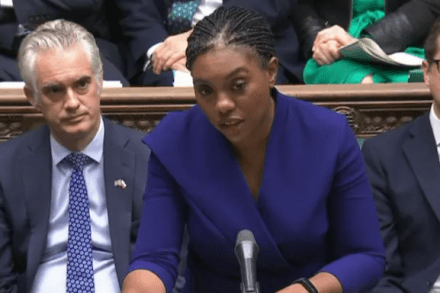
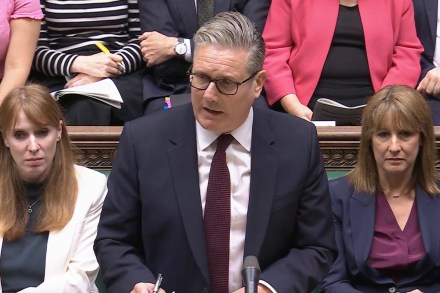
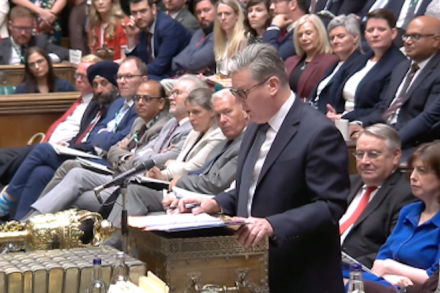
Keir Starmer didn’t have to defend his welfare cuts until later in the session at today’s Prime Minister’s Questions, because Kemi Badenoch decided to focus on the looming increase to employers’ national insurance contributions. She was right to do so ahead of the spring statement, and her attacks were, for the second week running, much better than they have been previously. Starmer and his whips had clearly anticipated that tax and welfare would be the two hot topics of the session, and they’d found a Labour backbencher sufficiently loyal and self-loathing to ask a totally pointless question just before Badenoch.

Will Labour MPs stomach Liz Kendall’s benefits crackdown?

To underline that there was government agreement on the welfare cuts and reforms she was announcing, Liz Kendall had Keir Starmer, Angela Rayner, Ed Miliband and a slew of other cabinet and senior ministers sitting behind her in the Commons. The Work and Pensions Secretary announced ‘decisive action’ on the benefits system, which she said was ‘failing the very people it is supposed to help and holding our country back’. That ‘decisive action’ was a reform package that Kendall said was expected to save over £5 billion in 2029/30. It included restricting the eligibility for the Personal Independence Payment (PIP) so that only those who have the highest level of disability can claim the benefit.

Do Labour know what they want from welfare reform?

Liz Kendall and her ministerial colleagues were forced to offer an hour's worth of holding statements about the government's welfare reforms this afternoon when they appeared at Work and Pensions Questions in the Commons. Those reforms are supposed to be coming in a green paper this week, probably tomorrow, but the Work and Pensions Secretary ended up dodging questions on whether she even had collective agreement from her colleagues. Those questions came from Kendall's shadow Helen Whately in the topical section. When Whately asked whether there had been collective agreement, Kendall replied that the shadow minister would have to 'show a little patience', before mocking the Conservatives for having no plans on welfare reform of their own.

What is the point of abolishing NHS England?

What does Wes Streeting think the government will achieve by abolishing NHS England? The Health Secretary gave a statement to MPs this afternoon in which he confirmed that the health service will no longer be operationally independent from the government. As Streeting made clear to the Commons, the NHS was given operational independence by the Conservatives, who regretted doing so for years. The Tories reversed many of the Andrew Lansley reforms in their Health and Care Act 2022, but the NHS remained independent, even though ministers were the ones answering for its performance and mistakes.

Is Kemi Badenoch finally getting the hang of PMQs?

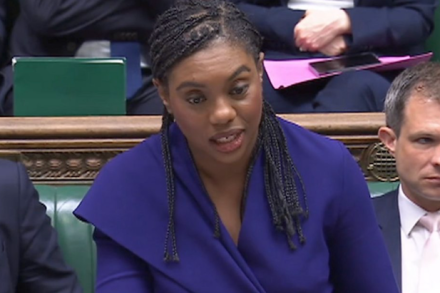
Kemi Badenoch made some changes to her strategy at Prime Minister’s Questions today and had a much better time of it. She stuck to one topic, rather than performing handbrake turns from one matter to another, and she didn’t accuse Keir Starmer of not answering the question. Instead, she claimed the Prime Minister was ‘out of touch’ and had no idea ‘what is happening out there’. The Tory leader’s focus was on the national insurance increase, which comes into effect next month. She asked first about job losses caused by the rise in employers’ contributions, and responded curtly that Starmer ‘needs to get out more’ when he argued that Labour had created thousands of new jobs and more investment since coming to office.

Starmer avoids criticising Trump at PMQs

Keir Starmer has clearly decided that the only way to disagree with Donald Trump and his administration without angering the US President is to make statements that contradict him without ever mentioning him or J.D. Vance by name. Today he opened Prime Minister’s Questions by paying tribute to six young British soldiers who were killed 13 years ago tomorrow in Afghanistan, and a soldier who was killed 18 years ago today in Helmand. He added: These men fought and died for their country, our country, and across the wars in Afghanistan and Iraq, 643 individuals died fighting for Britain alongside our allies. Many more were wounded.

Starmer: Zelensky is a ‘hero’

Keir Starmer was careful in his Commons statement about Ukraine to distance himself from what happened in the Oval Office on Friday, while also insisting that Britain needs to maintain a strong relationship with the US. He told MPs that Friday’s public spat between Volodymyr Zelensky, Donald Trump and JD Vance was ‘something nobody in this house wants to see’, but added: ‘I do want to be crystal clear, we must strengthen our relationship with America – for our security, for our technology, for our trade and investment’. He also repeatedly disagreed with any MP who suggested drawing back from the relationship with Trump.

Starmer has his work cut out bringing peace to Ukraine

Keir Starmer today attempted to make the debate about Ukraine’s future one primarily held by Ukraine and European countries. This came after Donald Trump had suggested at the end of last week that it was for the US and Russia to decide. In his press conference after the summit of European leaders in London, the Prime Minister said work was now beginning on a deal to end the war with Russia, led by European countries to then be discussed with the US to ‘take it forward together’.  He also dismissed suggestions that the US was an ‘unreliable ally’, and suggested that America was at least not opposed outright to the UK leading work on a plan for peace.

Starmer’s press conference with Trump was a triumph

Keir Starmer could not have dreamed of a better press conference with Donald Trump. Much of its success was not down to luck, either: the Prime Minister has meticulously prepared for these talks both in terms of substance and (very important) superficialities such as flattering the President. But instead of appearing to be a sycophant who just says whatever Trump wants to hear, Starmer ended up looking as though he was the one in control of the relationship. The President came into the press conference telling journalists that Starmer is a ‘very tough negotiator, however I’m not sure I like that, but that’s OK’.

Why is Kemi struggling at PMQs?

12 min listen

For the second week in a row, the leader of the opposition seemed to struggle at Prime Minister's Questions, ending up accusing Keir Starmer of being 'patronising' after having a couple of her questions rebuffed. Cindy Yu talks to James Heale and Isabel Hardman. Produced by Cindy Yu.

Badenoch accuses Starmer of ‘patronising’ her

It is getting rather repetitive writing that Kemi Badenoch had an uncomfortable Prime Minister’s Questions, so how about this: today’s PMQs showed that Keir Starmer does not regard the Conservative leader as any kind of political threat. He openly ridiculed her in his answers – perhaps too openly to appear statesmanlike.  The question that invited that ridicule followed a fairly benign one on ensuring that Ukraine be at the negotiating table in talks on the country’s future. Badenoch told the Commons she would then turn to the details of the defence spending announcement, saying: Over the weekend, I suggested to the Prime Minister that he cut the aid budget, and I am pleased that he accepted my advice. It’s the fastest response I’ve ever had from the Prime Minister.

Amanda Pritchard resigns as NHS boss

Amanda Pritchard is resigning as chief executive of NHS England, after three years in the job. Pritchard's announcement, in the last few minutes, is not a huge surprise given there had not been a great deal of confidence among ministers and aides in the leadership of the NHS – though it is worth pointing out that this lack of confidence was not solely focused on Pritchard. Pritchard's departure leaves Streeting and colleagues more exposed Pritchard had been very anxious to show that she was ready and willing to implement the reforms that Labour wanted to introduce, particularly the shift from acute, hospital-based care to preventive and community services.

Was that Kemi Badenoch’s worst PMQs?

14 min listen

Today was the final PMQs before recess, and Kemi Badenoch had been hoping to leave on a high before the break. She started promisingly, opening with the case of a family from Gaza being granted asylum in the UK under the scheme designed for Ukrainians. Starmer replied to say he disagreed with the decision of the courts and that the Home Secretary was already looking at how to close the ‘legal loophole’ enabling that decision. But Badenoch seemingly hadn't prepared for his rebuttal, exposing once again the weakness of her own technique. Does she risk being outshone by her own backbenchers? Also on the podcast, Kim Leadbeater is having to duck suggestions that she has watered down the safeguards in the Assisted Dying Bill by removing the need for a High Court judge.

Tory backbenchers are outshining Kemi Badenoch at PMQs

Prime Minister’s Questions is rapidly becoming a challenge for Kemi Badenoch to come up with a topic that the Tories aren’t vulnerable on so she has a decent chance of attacking Keir Starmer. Given things aren’t exactly going swimmingly for the Labour government, it shows how very weak the Conservatives are that Starmer can get through entire sessions of the most dramatic point of the parliamentary week without sustaining even a light scratch. Today, though, the weakness of Badenoch’s attack was not in the topic, but in her own technique. The Tory leader ended up on the defensive instead of the man she was supposed to be questioning.

Why has Labour dropped so many NHS targets?

Does the Labour government still care about mental health? Recently, it dropped its NHS targets for mental health, along with other targets on dementia diagnoses and women’s health. Today at Health questions in the Commons, ministers were confronted about whether they were still committed to improving treatment for mental illness, given the targets are now gone. Stephen Kinnock argued:  ‘What we know about targets is that if you try and overload a system with too many targets, it causes confusion, and you end up with, as she rightly says, perverse outcomes. And so we are very clear that we want to not have a system which is based on just making policy by press release, as was the case under the previous government, putting out press announcements, loads of them, for more targets.

Where Kemi Badenoch keeps going wrong at PMQs

Kemi Badenoch may well have been right in the points that she made at Prime Minister’s Questions, but she managed to go about making them in the wrong way. The Tory leader focused on the many contradictions between the government’s focus on economic growth and its policies, but her phrasing of her questions and her attempts to defend the Conservative legacy made it easy for Keir Starmer to ridicule the questions, rather than answer them. The Prime Minister had also set up a planted question before his exchanges with Badenoch which meant he was already developing a theme about the Tories and the state pension before the leader of the opposition had even stood up.

Rachel Reeves tries to reverse Labour’s economic gloom

As expected, Rachel Reeves used her big – and long – growth speech this morning to back the expansion of Heathrow and argue that Britain was taking too long to make decisions on building infrastructure, let alone getting it done. The Chancellor did devote large passages of her speech to criticising the ‘structural problems in our economy’, and to blaming the Conservatives, but she was clearly trying not to make the whole thing about what her predecessors had got wrong. This speech had to be about how Labour was going to grow the economy, after months of criticism that Reeves and Keir Starmer are taking the wrong approach.

The NHS isn’t solely to blame for its failure to reform

Can the NHS reform itself? MPs on the powerful Public Accounts Committee (PAC) say it doesn’t know how to. It has published a stinging report this morning, accusing both NHS England (NHSE) and the department of Health and Social Care (DHSC) of ‘complacency’ and blaming external factors for the poor financial position of the health service. In return, the NHS has lashed out at what it calls a ‘flawed’ report which contains ‘basic factual inaccuracies’.  The select committee report complains that the health service is relying on overly optimistic projections of the improvements to productivity that it can achieve, and that it ‘was unable to convince us that it has a detailed plan to achieve the promised productivity gains’.

Ministers are clearly concerned about school reform row

You could tell from this afternoon’s Education Questions in the Commons that ministers are worried about the row over their school reforms: they’d planted loyal questions from backbenchers to help them fend off criticism. Even before the Conservatives had raised the latest concerns about the Children’s Wellbeing and Schools Bill, Labour backbencher Luke Akehurst had popped up to ask Bridget Phillipson about child protection. The Education Secretary seized the opportunity to describe the Bill as ‘the single biggest piece of child protection legislation in a generation’, adding: ‘That’s why it’s a shame that the Conservative government – the Conservative opposition – have played silly games on this subject.