Isabel Hardman

Isabel Hardman

Isabel Hardman is assistant editor of The Spectator and author of Why We Get the Wrong Politicians. She also presents Radio 4’s Week in Westminster.

Boris Johnson’s confusing election stance

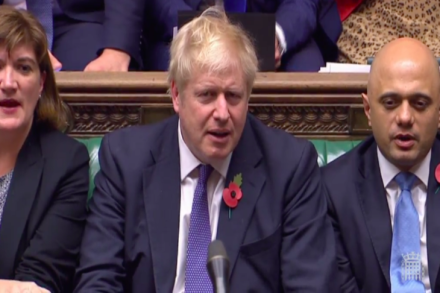
Does Boris Johnson want an election or does he not want an election? He managed to make both claims this afternoon at Prime Minister's Questions, accusing Jeremy Corbyn of being a 'chlorinated chicken' for not wanting an election, while also continuing to insist that he didn't want one either. He then – apparently accidentally – told the Chamber that he did want an election. The whole effect was rather chaotic, and Johnson's demeanour wasn't particularly prime ministerial. He even said 's***' in the Chamber, which might have been designed to get all the attention in a session where Corbyn unusually had the upper hand. When someone takes on the highest office, their stature often appears to grow a little.

Boris tries to charm Tory MPs in Commons tearoom

The Tory rebels on tonight's motion are in the process of losing the party whip. There were many more than the whips had expected, but this may well be seen by those around Boris Johnson as being a way of getting rid of the sort of MPs who would always be a thorn in the Prime Minister's flesh. There is little point in having an election to get a majority if that majority turns out to be hollow, with a large group of backbenchers who won't actually back the government on the key issue of the day. All this might be true, but the Conservative party tonight is in a state of shock.

Phillip Lee joins the Lib Dems – and Boris loses his majority

Phillip Lee, a Tory MP, has just left the party in the most dramatic way possible. He crossed the floor of the House of Commons while Boris Johnson was speaking. For a few seconds the House didn’t realise what was happening, then, as Lee took his new seat next to Liberal Democrat leader Jo Swinson, cheers broke out, drowning out Johnson. The Prime Minister's statement was, at this stage, largely about the rainforests and conservation, which seemed rather at odds with what was going on politically. The government has just lost its working majority. Lee has been on defection watch for months. It is not a huge surprise that he has defected, as he had originally been named as one of the Tories likely to join the Independent Group. He has now joined the Lib Dems.

Election on 14 October if government loses no-deal vote

There will be a general election on 14 October if MPs defeat the government tomorrow on no-deal Brexit legislation. Number 10 will publish a motion tomorrow which says that if MPs do take control of the Order Paper and pass legislation for an extension to the Brexit deadline, there will be a general election. Senior government sources have just briefed that they do not want an election, but that this motion will show MPs that they are voting for one if they back the legislation. The sentiments offered at this bullish briefing were much stronger than the ones given by Johnson. The official said: 'If you're an MP, you don't get to cancel Brexit in this way.' He also argued that Tory MPs who back the legislation will merely be handing control of the Brexit negotiations to Jeremy Corbyn.

Will Labour MPs really back a general election?

There's an assumption in Westminster that the Labour Party would have to back a snap general election if Boris Johnson called one this week. Jeremy Corbyn has said that 'an election is the democratic way forward', while his Shadow Brexit minister Jenny Chapman said Labour would vote against one that came after 31 October, adding that 'having a general election becomes one of the few ways that we are able to prevent no deal'. But that doesn't necessarily mean that Labour will provide the numbers to approve an election motion in the Commons. I have been speaking to MPs in the upper echelons of the party and on the backbenches and many of them privately say they would vote against the motion, even if whipped to do so.

Is Boris Johnson about to go for an election?

Things are moving fast in Westminster this afternoon, with speculation mounting that Boris Johnson might be about to call an election. The Cabinet is meeting this afternoon, and there will be a reception of Tory MPs in Downing Street this evening, too. Those involved are definitely discussing an early general election as one possibility. The reason this is under consideration is that Number 10 expects MPs to win their bid tomorrow to take control of the order paper, which would mean that Johnson is pitched into eight weeks of being Prime Minister but with no power. He will have lost around a dozen Tory MPs, meaning he has no majority. In these circumstances, he could argue, the only right thing to do is to ask the country what sort of parliament it wants in another general election.

Boris’s game of chicken with Tory rebels

Is Boris Johnson playing a game of chicken with anti-no-deal Tory MPs? The two sides are locked in a furious standoff over the threat from the Prime Minister that MPs will lose the Tory whip and be prevented from standing for the party at the next election if they back this week's rebel legislation blocking no deal. That threat, first reported by James Forsyth, might have caused one or two MPs to back down, but it has made others, including Rory Stewart and David Gauke, more defiant. They are insisting that they will vote for the extension legislation this week, even if it means they stop being Conservatives. The point of a game of chicken is that at some point, the loser veers away.

A guide to the different sorts of chaos looming over Westminster

What is going to happen next week in parliament? Most anti-no-deal rebels see it as their last opportunity to block Britain leaving the European Union without a deal, but what they haven't yet agreed on is how best to do it. There are a number of likely scenarios, some of which intertwine with one another, and to show how chaotic the next few days are likely to be, I've drawn up a flowchart of how things might pan out (you can click on the image to view a larger version of the chaos): The most likely parliamentary route is through an emergency debate under Standing Order 24, which the rebels hope they can use to seize control of the order paper. But that route alone is fraught with difficulty.

What will the Tory and Labour election campaigns look like?

We know that the Conservatives are gearing up for an election in the next few months. Their official line is that they don't want one, largely because it will appear better if they are apparently pushed into a poll, but that doesn't mean that preparations aren't well underway. One of the main benefits of proroguing parliament is that it allows the Tories to produce an election manifesto before there is an election, using the Queen's Speech. In today's Guardian, I've written about what's going to be in that manifesto/Queen's Speech: the focus will be on education and crime.

Taking pride in household chores really can ease depression

There are many books about what it’s like to live with mental illness and the aftermath of child sexual abuse. Most of them, though, fall into that deeply off-putting category of ‘misery memoir’: greyscale covers and cloying titles such as ‘The Child Who Everyone Hurt’ and ‘When the Darkness Never Lifts’. You’re unlikely to want to read 300-odd pages of pain porn when healthy, let alone find yourself looking forward to the next page if, like me, you end up reading the book when you’re depressed too. I Never Said I Loved You isn’t like that. It’s funny.

Will the no-deal opponents finally get their act together?

So what now for the opponents of no deal? Boris Johnson has dramatically called their bluff, and as Mr Steerpike reports, not all of them are taking this particularly well. Both proponents and opponents of Britain leaving without a deal are engaged in a political wrestling match, with all the theatrics that entails. Both are working out which parliamentary mechanisms will suit them best. Both are also accusing the other of blocking democracy, pretending not to notice the similarities in their tactics. Neither will admit that the other side has a right to do what it has chosen to, instead preferring to call it a 'constitutional outrage'. The problem for those trying to stop no-deal is that their team isn't working as well as Boris Johnson's.

Johnson confirms he will prorogue parliament

Downing Street has just confirmed that the Prime Minister will be asking the Queen to prorogue parliament ahead of a new Queen’s Speech on 14 October. In a letter sent to MPs this morning, Boris Johnson claims that this is a move designed to put a fresh domestic programme before Parliament, writing: 'I therefore intend to bring forward a new bold and ambitious domestic legislative agenda for the renewal of our country after Brexit. There will be a significant Brexit legislative programme to get through but that should be no excuse for a lack of ambition!' The focus in the letter and in briefings from No.10 is on domestic policy, with Johnson explicitly criticising the lack of action from Theresa May.

Is the Chancellor’s cancelled speech another sign an early election is looming?

Sajid Javid has this afternoon cancelled a speech he was due to give tomorrow, and brought forward the one-year spending review to early September. It was due to take place later in the autumn. A statement from the Treasury said 'the forthcoming Spending Round will instead be brought forward in early September and will cover the themes and priorities he was due to outline'. This isn't a surprise for any of those in government who had been working on the spending review. Secretaries of State have been returning to Whitehall today, ready for meetings with the Treasury this week about their spending envelopes.

Jeremy Corbyn capitulates in cross-party Brexit talks

Jeremy Corbyn's cross-party talks to stop a no-deal Brexit have broken up, with opposition leaders and MPs releasing a statement saying they 'agreed on the urgency to act together to find practical ways to prevent no deal, including the possibility of passing legislation and a vote of no confidence'. The Labour leader opened the meeting by saying he would prioritise legislation, rather than a vote of no confidence, which will be kept as a last resort. Calling a vote of no confidence in the first few days of Parliament sitting next week might have been a dramatic way of Corbyn trying to show that he was serious about stopping a no-deal exit and that he does really want a general election, but it is also very unlikely to have succeeded.

Stop thinking Merkel will save us, Dominic Cummings warns

Is Boris Johnson more likely to get a Brexit deal after his meetings with Angela Merkel and Emmanuel Macron? The Prime Minister today tried to dampen hopes, saying that while the 'mood music' had been 'very good' during his meetings with the two leaders this week, it was still going to be hard to persuade the EU to give way. Speaking during a visit to Devon, Johnson said: 'This is not going to be a cinch, this is not going to be easy. We will have to work very hard to get this thing done.' Much of the week has been spent trying to work out what various comments and bits of body language really mean. Was Johnson celebrating successful talks or just having a stretch when he arrived back in Downing Street after his meetings?

France says no deal now the most likely Brexit outcome. But why now?

Why would French government officials brief that they think it most likely Britain will leave the European Union without a deal? Boris Johnson hasn't even made it as far as his meeting with French President Emmanuel Macron, and is only just being welcomed by German Chancellor Angela Merkel. So why brief that out now, before the leaders have even spoken? The comments appear to be part of the briefing war between European leaders and the British government, with neither side wanting to take the blame for any fallout from a no-deal Brexit.

No. 10 hits back in the backstop blame game

The stand-off between Downing Street and the European Union over Boris Johnson's latest proposal for the backstop boils down to a disagreement over whether the British government really cares about getting a Brexit deal at all. When Donald Tusk rejected Johnson's plan today, he all but accused him of being set on a no-deal exit, saying: 'The backstop is an insurance to avoid a hard border on the island of Ireland unless and until an alternative is found. Those against the backstop and not proposing realistic alternatives in fact support re-establishing a border. Even if they do not admit it.

Social media is making it harder to hear legitimate criticism

When was the last time you were in a Twitter mob? We know these maelstroms of anger so well now, and even remember the names of some of the people randomly caught up in them over the years too. There was Justine Sacco, who lost her job after tweeting a joke about AIDS, and Jon Ronson, who ended up getting it in the neck for writing about her. There was the beautician who tweeted about 'barraco barner' and ended up being called a 'stupid cow' and an 'oxygen thief' for what she admitted was a 'ditzy moment'. There are MPs, journalists and plenty of far more normal people who have suddenly found themselves getting death threats and days' worth of furious messages after one misjudged comment.

Telling anti-vaxxers they’re idiots won’t work

Boris Johnson declaring war on anti-vaxxers is the sort of thing that no-one will disagree with unless, of course, they are the ones peddling dangerous myths about the effects of these preventative treatments on children. The Prime Minister today announced a crackdown on misleading claims about vaccinations, with plans for a summit with social media firms on how to stop vaccine myths spreading on their networks, and a push for GPs to promote catch-up vaccinations for children who've missed out. The phenomenon of parents refusing to allow their children to be inoculated against deadly diseases has unfortunately become so widespread that the UK is now no longer measles-free. But how can the government change this?

Jeremy Corbyn’s no-deal plan is unusually smart politics

On the surface, Jeremy Corbyn's pitch to become caretaker prime minister of a government of national unity after overthrowing Boris Johnson looks like a messy failure. The Liberal Democrats have said they won't back him, two of the Tories who he wrote to have backed away too, and the Independent Group for Change (which he didn't write to) have said this evening that they will 'not support nor facilitate any government led by Jeremy Corbyn'. Instead, everyone is talking about the possibility of a government led by Ken Clarke. The former Tory chancellor today said he wouldn't object to taking over if it was 'the only way' to stop a no-deal Brexit.