Isabel Hardman

Isabel Hardman

Isabel Hardman is assistant editor of The Spectator and author of Why We Get the Wrong Politicians. She also presents Radio 4’s Week in Westminster.

Can Lindsay Hoyle survive as Speaker?

Lindsay Hoyle’s justification for tearing up convention on the Gaza vote was that he had become worried for MPs’ safety and was trying to give members the widest range of options to express their view. It didn’t work out that way, as he acknowledged last night, and the Speaker will spend today in private meetings with the individuals concerned. Some of them showed signs of wanting to dampen the row down: Commons leader Penny Mordaunt, for instance, said she was grateful that he was reflecting on what had happened, adding: ‘You are our Speaker and we wish you to defend the rights of all Members of this House.

Lindsay Hoyle apologises amid Commons chaos

The Commons has gone into meltdown this evening over the Speaker’s handling of the Gaza ceasefire motion, with the Speaker expressing ‘regret’ for the way the debate ended up. SNP and Tory MPs stormed out at one point, and MPs voted on whether to close the chamber to the press and public as part of the row about the selection of two amendments to the SNP motion calling for a ceasefire in Gaza. It was defeated with just 20 MPs voting in favour. The vote was delayed because Tory MPs staged a sit-in in the No lobby. The motion as amended by Labour was then passed on the nod, without a vote on the SNP motion as originally tabled, but even that is now being disputed. The government had withdrawn its own amendment in protest at the Speaker’s decision.

Has Lindsay Hoyle overstepped?

12 min listen

Sir Keir Starmer can breathe a sigh of relief this afternoon, thanks to Lindsay Hoyle. The Speaker has selected Labour’s amendment on a Gaza ceasefire, which means that a likely mass rebellion from Labour MPs will be averted. SNP and Tory MPs are furious at Hoyle, and say that he has tried to rewrite the rules. What's going on? Katy Balls speaks to James Heale and Isabel Hardman. Produced by Cindy Yu.

Why is Labour going after Kemi Badenoch?

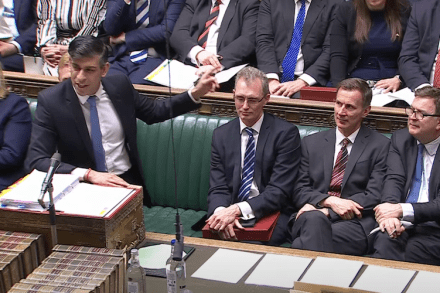
One person dominated Prime Minister’s Questions, and it wasn’t Rishi Sunak or Keir Starmer. It was Kemi Badenoch, who appears to be going deeper into her battle with former Post Office chair Henry Staunton. Starmer decided to deepen the row further today, while Sunak notably didn’t make all that much effort to defend Badenoch beyond what was absolutely necessary. The Labour leader made the focus of his questions about Badenoch, only widening it to the compensation payments for victims of the infected blood scandal towards the end.

Why are the Tories, Labour and the SNP changing their tune on Gaza?

The government has now tabled its own amendment to the SNP motion calling for a ceasefire in Gaza. This change to the text calls for ‘negotiations to agree an immediate humanitarian pause as the best way to stop the fighting’, and then ‘moves towards a permanent sustainable ceasefire’. It also says that a ceasefire requires all hostages to be released, the formation of a new Palestinian government and – crucially – ‘Hamas to be unable to launch further attacks and no longer in charge of Gaza, and a credible pathway to a two-state solution’. It’s worth remembering that this is an Opposition Day debate, which is not binding on the government at all, and thus far the pressure has been on Labour, rather than Conservative, MPs.

Starmer moves to quell ceasefire rebellion

10 min listen

Today Keir Starmer has moved his party’s position on a ceasefire in Gaza as he seeks to quell what could the biggest rebellion of his leadership. MPs will vote on an immediate ceasefire in Gaza with Labour set to add its own amendment to the SNP motion tomorrow. For the first time, Labour is calling for an ‘immediate humanitarian ceasefire’, but is this really such a big change in Labour's position?  James Heale speaks to Katy Balls and Isabel Hardman.  Produced by Cindy Yu and Oscar Edmondson.

Is Starmer changing his mind on Gaza?

Labour has significantly shifted its language on Israel’s conflict with Hamas over the past 24 hours. But has it changed its position? Yesterday Keir Starmer gave a speech to Scottish Labour conference in which he called for ‘a ceasefire that lasts’, adding: ‘That is what must happen now. The fighting must stop now.’ His aides have clarified that this is not a call for a ceasefire now, but a sustainable one, which means Hamas stopping its attacks on Israel and releasing hostages. But this morning, Shadow Health Secretary Wes Streeting told Times Radio that ‘objectively, Israel has gone too far’ and that ‘what we have seen are actions that go beyond reasonable self-defence’.

Kemi Badenoch is a one-woman attack unit

Kemi Badenoch has been launching a few more grenades into the Post Office row, with a bullish statement in the House of Commons dismissing the allegations made at the weekend by Henry Staunton. The former Post Office chair had claimed an official had asked him to slow compensation payments to victims of the Horizon scandal until after the next election, and that the Business Secretary had told him ‘someone’s got to take the rap for this’ when she sacked him, and that he had been sacked because he had opposed a government attempt to install a Whitehall insider onto the board.  But Badenoch told MPs this afternoon that ‘these allegations are completely false’, including that she refused to apologise to him for the way he learned about his dismissal from Sky News.

Labour triumphs in by-election brace

12 min listen

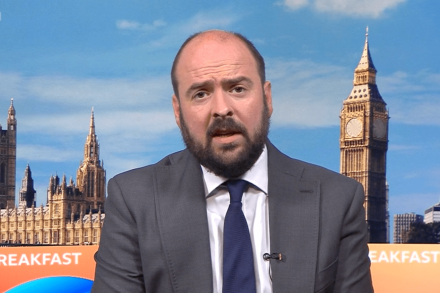
Labour has the won two by-elections in Wellingborough and Kingswood, overturning big Conservative majorities in the process. Party chairman Richard Holden has brushed the results off as typical midterm by-elections where voters what to give the government a kicking. Does this argument stack up? And what can Reform take from the results? Isabel Hardman speaks to James Heale and pollster John Curtice.

Who could object to the Windrush line?

Sadiq Khan has announced six new names for the previously boringly-named Overground. The practical point of it is that the Overground goes everywhere and is quite confusing to navigate if you’re an occasional visitor. Breaking up the orange (which only stayed that way because Boris Johnson liked it being the same colour when he was shown a draft map) isn’t particularly disputed, but what has excited interest is the choice of names. Lioness, Mildmay, Windrush, Weaver, Suffragette and Liberty have a certain progressive ring to them. They’ve been received in some quarters as names that are seeking a reaction rather than just reflecting London’s heritage.

Starmer suspends second Labour candidate

Labour has now suspended Graham Jones as a parliamentary candidate after a recording emerged of him allegedly saying that Britons who travel to Israel to fight for the IDF should be ‘locked up’. The former MP, who is standing again in Hyndburn, was taped appearing to refer to ‘f***ing Israel’, and saying it was ‘illegal’ for Britons to fight for Israel. It isn’t – the UK recognises the right of dual nationals to join ‘legitimately recognised armed forces’, but it is a point that has been debated within politics, and suggests that Keir Starmer is lowering the bar following the fallout from his Rochdale decision. Starmer has made a real mess of the Rochdale situation.

David Cameron is taking a harsher line on Israel

Lord Cameron has shown again this afternoon how much the government’s tone on the conflict in Gaza has changed recently. The Foreign Secretary was taking questions in the Lords and heavily laboured the point that Israel should think twice before going into Rafah. He repeated his regular argument that there had been too many Palestinian deaths. Cameron also said he had personally challenged the Israeli government over certain incidents, and urged it once again to abide by humanitarian law. This is a shift from the previous line where ministers said Israel must follow the law, but refused to offer any criticism or indication that they thought the IDF might be sailing close to the wind.

Can Starmer stamp out Labour’s antisemitism?

10 min listen

Labour faces another antisemitism battle as their candidate for the Rochdale by-election said that Israel allowed the October 7th attacks as a pretext to invade Gaza. Azhar Ali has since apologised for his comments and Labour has allowed him remain the candidate for Rochdale. Natasha Feroze speaks to James Heale and Isabel Hardman about Keir Starmer's challenge to stamp out antisemitism and take a look ahead at another challenging week for Rishi Sunak.

Who’s to blame for Labour’s green U-turn?

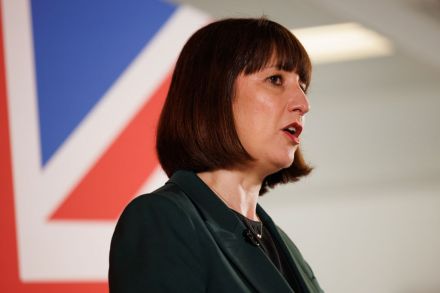
Who to blame for the demise of Labour’s £28 billion annual green investment pledge? According to Keir Starmer, it’s the Conservatives. He said this afternoon: ‘What would be really irresponsible is to know the damage done to the economy by this failed government and ignore that and pretend it didn’t happen.’ The party briefing is that because the Conservatives have crashed the economy and Jeremy Hunt plans to ‘max out’ the country’s credit card, the £28 billion is now unaffordable.  A quick way to set fire to voters’ trust in you is to drop your fiscal rules as soon as they don’t feel very fun. Within the party, there is a debate about whether Ed Miliband or Rachel Reeves is to blame.

Sunak should apologise, says Brianna Ghey’s father

Brianna Ghey’s father has called on Rishi Sunak to apologise for his ‘degrading’ comments at Prime Minister’s Questions. Peter Spooner told Sky News: For the Prime Minister of our country to come out with degrading comments like he did, regardless of them being in relation to discussions in parliament, they are absolutely dehumanising. Identities of people should not be used in that manner, and I personally feel shocked by his comments and feel he should apologise for his remarks. As reported earlier, Sunak didn’t edit his oft-used script about the number of things Keir Starmer has flip-flopped on at PMQs today, despite having just heard that Brianna Ghey’s mother Esther would be in the public gallery.

In praise of Elliot Colburn

All power to Elliot Colburn, who used today’s Prime Minister’s Questions to talk about surviving a suicide attempt in 2021. The Carshalton and Wallington MP told the chamber: In recent years, something like 6,500 people in the UK die due to suicide. And in 2021, I was nearly one of them. Luckily, my attempt failed, I was found by family members quickly, I received amazing care at St Helier and Springfield Hospitals, it didn’t do any permanent damage, and I was well looked after by the NHS in the months that followed. And I wanted to take this chance to say thank you to everyone who saved me, and sorry to my family and loved ones who I put through such an awful ordeal.

Sunak makes ill-judged gender jibe at PMQs

Rishi Sunak’s £1,000 bet with Piers Morgan continues to cost him more than the wager itself. It dominated today’s PMQs, with both Keir Starmer and Stephen Flynn attacking him on it. The Labour leader also gave a striking retort to one of Sunak’s regular lines mocking him on not knowing what a woman is. When the PM trotted out that claim again, Starmer reacted with outrage, reminding the chamber that he had opened with a tribute to the murdered transgender teenager Brianna Ghey’s mother Esther, who was in parliament. He said: ‘Of all the weeks to say that, with Brianna’s mother in the gallery. Shame. Parading as a man of integrity.’ He added that everyone should be able to feel safe and respected.

Nicola Sturgeon’s torrid time at the Covid Inquiry

Nicola Sturgeon’s afternoon at the Covid Inquiry was pretty brutal. She was subjected to a difficult round of questioning on whether she used the pandemic to advance the case for Scottish independence. Funnily enough, the former first minister didn’t agree with that analysis.  In fact, her memory was that she had never thought ‘less’ about politics than during the pandemic. She became quite fixated upon the purity of her motives in dealing with Covid, to the extent that her evidence started to resemble Tony Blair’s lengthy ruminations during the Chilcot Inquiry.

Sturgeon paints herself as perfect at Covid Inquiry

10 min listen

Nicola Sturgeon became emotional during her evidence at the Covid inquiry today – a highly anticipated part of the inquiry given the issue of deleted Whatsapp messages. How did the former first minister come across today? And what else can the evidence tell us about how the Scottish government operated? Katy Balls speaks to Isabel Hardman and Michael Simmons.

Starmer and Sunak argue about a man called Phil

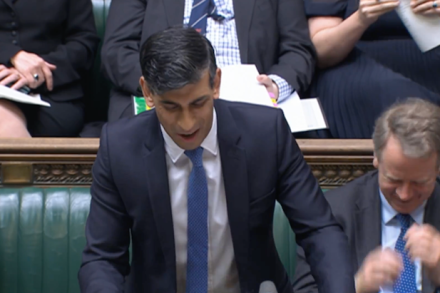
Keir Starmer opened PMQs by describing ‘the plight of the Member for Mid Norfolk’, whose mortgage had gone up by £1,200 a month and had to ‘quit his dream job to pay for it’. That Substack post from Tory MP George Freeman isn’t quite as potent as a note left on a Treasury desk, but it allowed the Labour leader to attack Sunak by saying ‘a Tory MP counting the cost of Tory chaos after 14 years, and we finally discovered what they meant when they said ‘we’re all in this together”.’ Rishi Sunak’s response was to accuse Labour of not having a plan, and to quibble the figures about the rise in mortgage costs.