Isabel Hardman

Isabel Hardman

Isabel Hardman is assistant editor of The Spectator and author of Why We Get the Wrong Politicians. She also presents Radio 4’s Week in Westminster.

Philip Hammond: No 2nd Syria vote ‘unless the circumstances change very significantly’

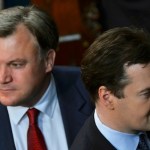
Defence Questions this afternoon was, as you might expect, a rather chippy affair. It seemed that whenever Philip Hammond rose to answer a question, he answered it by reminding the Labour MP asking it of their party's decision to oppose the government's motion on Syria. Nowhere was this more the case than in the Defence Secretary's exchange with Jim Murphy, where both men set out some interesting wriggle room in their party positions on a second vote.

No 10: Absolutely no plans for a second vote on Syria. Labour: We could consider it

Will there be a second vote on Syria? As you might expect, that question dominated today's lobby briefing with the Prime Minister's official spokesman. He told journalists that 'there has been no change' in the Prime Minister's view since Thursday's vote and that 'parliament has spoken: that's why the government has absolutely no plans to go back to Parliament'. As I said this morning, the only way in which you'd be at all safe putting money on another vote on this matter would be if Ed Miliband came back to Cameron and pledged his support. And on this, Labour is being rather less equivocal than the government.

Nick Clegg: We won’t ask Parliament the same question on Syria

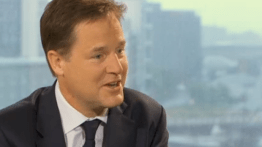
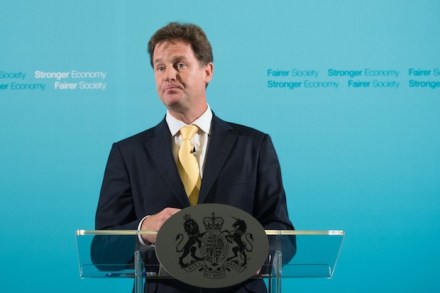
Nick Clegg has this morning added his own voice to those at the top of the Coalition saying they won't go back to Parliament for another vote on Syria. The Deputy Prime Minister was careful to be clear that he and his colleagues respected parliament's verdict, and didn't want to push MPs when they had already made their views clear: 'We're not going to keep asking the same question of Parliament again and again. We live in a democracy, the executive cannot act in a way which clearly is not welcome to Parliament or the British people, so we're not proposing to do so... I can't foresee any circumstances where we would go back to Parliament on the same question, on the same issue.' Coincidentally, it is Defence Questions in the House of Commons this afternoon.

The second vote that MPs really should hold on Syria

Even though George Osborne did everything he could yesterday to kill talk of a second vote in the House of Commons on action in Syria, speculation about that vote still makes the front pages this morning. There are probably safer bets to place. But one of the failings of Parliament last week - amidst all the cheering for a boost for democracy that is apparently characterised by ministers getting stuck in soundproofed rooms and missing key votes - was that in failing to pass either the government motion or the Labour amendment, Parliament failed to even condemn the use of chemical weapons against the Syrian people.

Could there be a second UK vote on Syria?

After the special relationship was found still breathing this afternoon, is there a chance UK involvement in Syria action might have life in it yet? If Congress does not debate and vote on action until 9 September, there is time for the UN weapons inspectors to report and the UN Security Council to vote. This assumes Congress does approve action (and Obama said he was confident he would get the support, hopefully based on better intelligence than that which led Cameron to be equally confident at the start of this week). But if all of those conditions are met, would the Labour party support action?

Obama follows Cameron by seeking Congressional approval for Syria strike

As he licks his wounds after this week's Commons defeat on Syria, David Cameron will have been given a huge boost this evening to hear that President Obama has decided to seek approval from Congress before starting any strikes. Obama said: 'Over the last several days, we've heard from several members of Congress who want their voices to be heard. I absolutely agree.' This suggests that those who tried to certify the special relationship dead probably need a refresher course in vital signs as it clearly isn't headed for the mortuary, rather an acute unit (and Fraser explained why that assessment was wrong this morning). Perhaps it shows that Obama is aware of the trouble the US caused Cameron in initially setting out a tight timetable for strikes.

Cameron and Obama: our relationship is still special

David Cameron and Barack Obama spoke this evening about their special relationship. Normally when people start talking a lot about their relationships in public, it's because something is wrong (or they've just started out and like to hold loud and impressive conversations about whether to cook the salmon or the homemade ravioli in front of as many people as possible). So the fact that the importance of the special relationship was not just raised in the call, but included in the Number 10 readout suggests the pair were calling in the marriage counsellors. A No 10 spokesperson said: 'The President stressed his appreciation of his strong friendship with the Prime Minister and of the strength, durability and depth of the special relationship between our two countries.

MPs didn’t want to kick Cameron, but they didn’t want to trust him either

One of the lines doing the rounds this morning in the post-mortem of what this means for David Cameron's leadership is that it shows yet again that backbenchers do not trust the Prime Minister. This is true, but it is worth being as specific as possible. This rebellion was not like the other revolts over Europe and House of Lords reform, where it was as much about sticking two fingers to the leadership for not listening to MPs as it was about the issues at stake, serious though they are. The number of conversations I've held with backbenchers in the run-up to and aftermath of those votes made it quite clear that if they didn't hate Cameron so much, they might have calmed down. But this rebellion stuck more closely to principle than politics.

George Osborne: We’re not trying to make a fetish of division

When will today's politicians be able to stop wrestling with Tony Blair's ghost? Not for a while it seems - partly because they don't want to. George Osborne decided to use the Kind of Spin as a means of spinning last night's terrible defeat for the Coalition government on Syria when he appeared on the Today programme. As well as referring to the shadow Blair and Iraq cast over the debate, yesterday, the Chancellor made clear that the Prime Minister had tried to shake off that shadow by conducting things 'in a different approach'. he said: 'The shadow of Iraq pervaded the whole debate yesterday both on the media and in Parliament and at times MPs on both sides of the argument actually by mistake used Saddam Hussein's name instead of Assad's name.

The PM is preparing for another coalition. His colleagues have other plans

Conservatives have been returning to their Westminster offices this week to find the wind behind them. Something suddenly seems to be going right: there’s good news on the economy, jobs and immigration and Labour seems to be in gentle meltdown. The idea of an outright majority in a 2015 election suddenly seems a lot more plausible. Which is why ministers and advisers are so dismayed at reports last week that David Cameron was planning for a second coalition after 2015. Just when a Tory election victory seemed possible, the Prime Minister has been mulling over a change in party rules so that MPs could vote on a new coalition agreement.

Government LOSES Syria vote

In a surprise result this evening, the government lost its motion on Syria, with 272 MPs voting for and 285 voting against. The Prime Minister responded to the vote in the Chamber, with MPs on the Labour benches shouting 'resign!'. He said: 'Let me say the House has not voted for either motion tonight, I strongly believe in the need for a tough response to the use of chemical weapons, but I also believe in respecting the will of this House of Commons. It is very clear tonight that while the House has not passed a motion, it is clear to me that the British parliament reflecting the views of the British people, does not want to see British military action. I get that and the government will act accordingly.

Labour frontbencher resigns over Syria

Labour MP Jim Fitzpatrick has tonight resigned from his party's frontbench over the Syria vote, his party confirmed. The shadow transport minister told the Commons this evening that he felt his party's amendment was still too open to military intervention. He said: 'I have problems - for the honourable gentleman's information - both with the Government motion and the Opposition amendment. I do not believe either is ultimately able to achieve the honourable ends that both sides of this house are trying to achieve. I'm opposed to military intervention in Syria, full stop. And to be honest with myself, and to be consistent on both questions, I will be voting in the 'no' lobby against the Government motion and against the Opposition amendment.

Number 10 under fire for ‘succour’ comments

There are currently two debates raging in Parliament at the moment. One is a reasonably measured (and lengthy) exchange in the House of Commons chamber about the merits of intervening in Syria, and the merits of today's government motion and Labour amendment on Syria. The other is in the corridors of the Palace of Westminster, around the coffee tables of Portcullis House and on MPs' smartphones as Labour rages about the suggestion from a Number 10 source this afternoon that Ed Miliband had his colleagues are giving succour to the Assad regime. After the leaders had spoken in the Commons, a Downing Street source was asked by journalists whether Miliband was giving succour to the Assad regime. The source replied: 'Yes.

David Cameron attacks Blair’s ghost in Syria debate

Tony Blair would have had less of a presence in today's Commons debate on Syria if he'd actually turned up to it. The former Prime Minister was threaded throughout the speeches, and no more so than in David Cameron's address to MPs. Cameron was keen to emphasise at every opportunity the difference between the government's response to the current situation and the Blair government's handling of the Iraq war. He was quick to refer to it, saying 'I am deeply mindful of the lessons of previous conflicts', and later said that Iraq 'poisoned the well' of public trust on military intervention.

Number 10: Ed Miliband wants to divide the nation on Syria

Even if you were wavering over whether Ed Miliband's decision yesterday to reject the government's motion on Syria (before it was published) was a political stunt, it's a little more difficult to see why the Labour leader plans to continue to oppose the rewritten motion when it comes to a vote in the Commons this evening. You can read the full motion here. Number 10 is in no doubt that Labour now opposes this motion on political grounds rather than out of principle. A senior source says: 'That just proves they are playing politics with this incredibly serious matter. They want to divide the nation on this matter and divide the House of Commons. 'Ed Miliband is playing politics when he should be thinking about the national interest and global security.

Labour to vote against government motion on Syria

Ed Miliband has now confirmed that he will table a Labour amendment to the government's motion on Syria, demanding that the Prime Minister return to the Commons once the UN weapons inspectors have reported, thereby delaying the main vote on intervention. And Labour will vote against the government's motion. Whether you think this is a wise move from Miliband depends partly on whether you think he's as worried as some in the Conservative party are about the case for intervention, the lack of evidence and the legality of it, or whether you suspect that this is more about the problems supporting intervention outright would have caused a party still haunted by Iraq, and the lack of public support for military action.

How will the Tory whips handle tomorrow’s Syria vote?

The government has yet to compose the motion that MPs will debate and vote on in tomorrow's Commons debate on Syria. And while some MPs are making clear that they are very nervous about the prospect of intervention, many others are yet to make up their minds. This means that as they return to Parliament today and tomorrow ahead of the debate (which starts at 2.30pm), they are sitting targets for the whips. There are some MPs like John Baron who are clear that they do not support intervention. Then there are a number of independently-minded MPs like Douglas Carswell and Sarah Wollaston who aren't worth much of a whip's time: it won't make any difference to how they cast their vote.

Audio: Cameron, Clegg and Miliband on Syria and what their statements tell us

David Cameron, Nick Clegg and Ed Miliband this afternoon gave statements on Britain's response to the use of chemical weapons in Syria. There were important similarities between the statements which are worth examining. Here is what we learned: 1. The action must be legal. Miliband told the cameras after the meeting that 'when I saw the Prime Minister this afternoon I said to him that we the Labour party would consider supporting international action, but only on the basis that it was legal'. Meanwhile Clegg and Cameron both insisted that the measures being considered were legal. Clegg said: 'Any steps we will take will have to be legal. This Government, this Coalition Government, of course is not going to act outside the remit of international law'. 2. The action must be proportionate.