Giannandrea Poesio

On the ropes

‘Aerial’ ballets were all the rage in late-Victorian London. It mattered little that they were more circus acts than actual ballets; their female stars, swinging from either a trapeze or sturdy ropes, were worshipped on a par with the greatest ballerinas — as in Angela Carter’s novel Nights at the Circus. I often wonder what those people would think of their postmodern successors, as performing with ropes seems to be a growing trend within contemporary dance-making. Take Ilona’s Jäntti’s Handspun, which opened the Exposure: Dance programme at the Linbury Studio Theatre last week.
Star turn

At first sight, the new Royal Ballet double bill might come across as an odd coupling: Ashton’s sparkling The Dream on one side, MacMillan’s metaphorically sombre Song of the Earth on the other. Yet the two works are complementary in that they show two distinctive and historically significant facets of 20th-century British dance-making. On the opening night, an impressive roster of stars appeared in MacMillan’s reading of Mahler’s Das Lied von der Erde. The refined artistry of Tamara Rojo, Sarah Lamb, Lauren Cuthbertson, Carlos Acosta and Rupert Pennefather turned the performance into one of the best I have seen. Stars populated The Dream, too.

Saved by the Bel

Anne Teresa De Keersmaeker’s and Jérôme Bel’s 3Abschied is the latest addition to a long and historically well-established series of choreographic works set to music by Gustav Mahler. There are still those, however, who cringe at the idea of dancing to the notes of this revered composer — as Keersmaeker points out in her initial monologue where she recounts her encounter with the conductor supremo Daniel Barenboim. Barenboim’s words linger menacingly through most of the performance. When Keersmaeker first dances to the ‘Abschied’, from Das Lied von der Erde (in a Schoenberg transcription), played live on stage by the superb Ictus ensemble, one can hear the words ‘I told you so’ ringing eerily in the dark.

Original sin

Nothing beats the buzz that precedes the debut of a rising star in a big, known role. Double it and you’ll get an idea of what last Tuesday felt like, as not one but two Royal Ballet principals, Lauren Cuthbertson and Sergei Polunin, took the main roles in Kenneth MacMillan’s 1974 Manon for the first time. As an artist, Cuthberston frequently makes bold choices when approaching big parts. Her Manon is no exception, as there is no trace of corrupted innocence at the beginning of her disastrously rapid and morally debatable ascent through Parisian society. The much romanticised image of the hapless lamb is thus replaced with that of a youthful minx who has decided to sleep her way up the social ladder.

High hopes

For more than 40 years, Scottish Ballet has been one of the most vibrant and interesting companies on the UK dance scene. It is a ballet company born of a well considered vision and the desire to prove that there can be good ballet without grandiose spectacle. Indeed, for many years it has been notable for its almost ‘chamber’-like choreographic repertoire, which has included intelligent adaptations of the great classics. Now a new chapter is about to start, as Christopher Hampson takes over the company’s artistic directorship, succeeding Ashley Page and an impressively illustrious roster of equally enlightened directors.

Mixing it

The term ‘fusion’ is a trendy one, which hints at the interaction of ingredients from different backgrounds in many areas of today’s culture. In dance, it often refers to the pairing of different genres, such as modern dance or hip-hop and ballet, or to the coupling of a distinctively western choreographic idiom with an equally distinctive non-western one. In Rian, the award-winning choreographer and performance-maker Michael Keegan-Dolan has opted for a more intricate game of combinations by weaving together Liam Ó Maonlaí’s splendid music — itself a powerful mix of influences and quotations — with dancing that draws upon a diversity of backgrounds and styles.

Birmingham Royal Ballet

Contrary to general belief, there is little glamour in the professional life of a dance critic. What there is, though, is a considerable amount of time spent confronting painfully unsuccessful attempts at making art or, at least, making something worth seeing. What makes one digest those endless stretches of choreographic drabness is the promise — sometimes the mirage — of rare moments of pure bliss. Which is what I experienced last week when, for the first time in years, I struck it lucky and sat through three superb performances in a row. Signs that the Birmingham Royal Ballet’s brief run at Sadler’s Wells was going to be a hit were evident from the moment the curtain went up on its Autumn Glory programme.

The Royal Ballet

In its latest triple bill, the Royal Ballet pays tribute to three dance-makers who have marked distinctive epochs in its performance history. Its centrepiece is Frederick Ashton’s 1963 Marguerite and Armand. Created as a showcase for the now legendary partnership of Fonteyn/Nureyev, this one-acter highlights his unique talent for succinct storytelling, as Alexandre Dumas’ Lady of the Camellias is narrated through a rapid series of salient episodes. Ashton’s dance drama has none of the grandeur traditionally associated with either Verdi’s La traviata, or the cinematic works based on by the same text, such as Garbo’s memorable Camille. Here the story is treated as an intimate drama relived in the memory of dying Marguerite.

Personal touch

In 2004 Jérôme Bel, one of the most provocative performance makers of our time, created Véronique Doisneau, a solo for a Paris Opera Ballet artist who was about to retire. On the immense empty stage of Palais Garnier in Paris, Doisneau, in practice clothes, shared with the public reflections on her career, her favourite ballet moments and her thwarted dreams. The performance ended with a stroke of theatrical genius, when Doisneau highlighted the drabness of the corps de ballet’s lot by engaging, alone, in what the 32 swans do while framing the two principals in Swan Lake’s first duet. The solo, available on video and on YouTube, provided the blueprint for similar works, such as the more recent Cédric Andrieux (2009).

Triple triumph

There is no better way to kick off a new ballet season than with a choreographic triple whammy. Which is what the Royal Ballet did last week, reopening with a sparkling performance of Jewels, Balanchine’s triptych. The last time I saw the company engage with the same three-part work, I lamented its far too poised and somewhat lacking-in-drive approach to Balanchine’s choreography. Things seem to have improved, though, as last week the dancing stood out for its vibrant attack and attention to detail — paramount qualities for the rendition of a work made up of three choreographically and musically different compositions.

Sheer magic | 20 August 2011

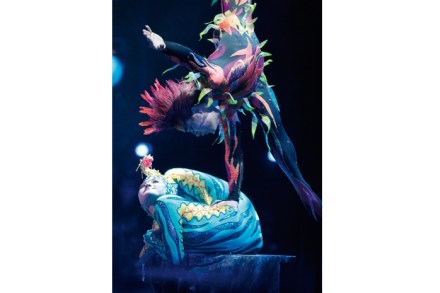
The term ‘circus’ is used in the ballet world with disparaging intentions to criticise any excessive display of technical bravura. The term ‘circus’ is used in the ballet world with disparaging intentions to criticise any excessive display of technical bravura. Yet in the appropriate context, dazzling acrobatics can be high art, as the Guangdong Acrobatic Troupe of China demonstrated last week. I would never have thought that I would have raved about a version of the immortal Swan Lake in which the ballerina swivels on point while balancing either on her partner’s bicep or on his head. But there I was, gasping with surprise like a six-year-old.

Mariinsky Ballet | 13 August 2011

It’s somewhat surprising that there are many people who are still amazed by the Mariinsky Ballet’s sparkling response to the choreography of George Balanchine. After all, it is well known that the father of modern American ballet, born Georgi Melitonovic Balanchivadze, had been trained at the Imperial Ballet School, from which developed the artistic principles that have long informed the Mariinsky Ballet’s tradition. It is true that once in the United States Balanchine reworked those principles with movement ideas that were typical of the Americana he felt so attracted by. Yet all his creations remained unmistakably rooted in the old Russian school.

Mariinsky Ballet

It is 50 years since what was formerly known as the Kirov Ballet — now Mariinsky Ballet — paid its first, legendary visit to London. Thanks to the commendable efforts of Viktor Hochhauser, the impresario who made that first visit possible, the company has become a familiar focal point of the London summer dance season. This year is no exception, with a rich programme of both classical and modern ballets. For its opening last week, the celebrated Russian company chose the work it is traditionally associated with: Swan Lake. Konstantin Sergeyev’s 1950 production might not be everyone’s cup of tea, but it remains a classic in the ballet’s performance history.

Past the postmodernist

According to a superstition shared by several Mediterranean countries, the frantic buzz of a fly trapped in a room spells the arrival of unpleasant news. I wonder whether the controversial and multitalented Catalan artist Sol Picó knows that, for in her 2009 El Llac de les Mosques (The Lake of the Flies) the annoying sound is used like a mini-overture. Yet it would not be fair to dismiss as ‘bad news’ this one-hour-long mix of extreme physicality, live music and funny, cheesy theatrical stunts. After all, many in the audience seemed to enjoy the deafening blasts of guitar, percussion and sax, as well as the apparently inconsequential series of puzzling, amusing and even touching images.

Shock and awe | 18 June 2011

Two weeks ago, the unsettling proximity of a perfectly sculpted naked male butt with my nose made me think again about the critic/artist relationship. I am talking, of course, about Dave St Pierre’s much talked about performance of Un peu de tendresse bordel de merde! at Sadler’s Wells, the raunchiness of which attracted and dominated the interest of various media for a few days. Chastely translated into ‘a little tenderness, for crying out loud’ — although a more appropriate translation would be ‘a little tenderness, for fuck’s sake!’ — the 2006 work, like many other examples of modern day dance- theatre, relies considerably on shock values, although it also includes some excellent choreography.

Triple thrill

After a few thematically uneven mixed programmes, the Royal Ballet takes its summer leave from the Royal Opera House with a nearly ideal triptych of works. Central to it are stunning examples of 20th-century choreography, which highlight the role that British ballet played in both making and consolidating the Western modern ballet tradition. As such, this triple bill comes across as more connoisseur-oriented than a flashy crowd pleaser. Balletomanes still get their fair share of starry dancing, though, for each work provides the principals with plenty of chances to shine. At the first performance, Lauren Cuthbertson and Sergei Polunin thrilled in Frederick Ashton’s Scènes de Ballet.

Incomparable Verdi

Call me biased, but I believe that my illustrious compatriot Giuseppe Verdi composed ballet music like no one else. It is a pity he never felt like penning a full ballet score, and limited himself to composing balletic interludes for his glorious operas. As demonstrated by the work of eminent scholars, he possessed the unique ability to mentally choreograph a ballet. His approach to ballet music thus started with a detailed visualisation of the action, which fed into the unique innovative fluidity of his balletic compositions. Take, for instance, the complex Peregrina ballet, composed for the Paris Opéra staging of Don Carlos. The demands of creating a work that would suit the hierarchy of the corps de ballet — i.e.

Turning point

One of the intriguing components of The Most Incredible Thing, Javier De Frutos’s latest creation, is its structure. One of the intriguing components of The Most Incredible Thing, Javier De Frutos’s latest creation, is its structure. Intentionally steering away from the aesthetic developments that informed theatre dance for more than a century, De Frutos has opted instead to revive and revisit the compositional formulae of the late 19th-century three-act ballet. Bold and risky as that sounds, such a decision fits perfectly with the kaleidoscopic score which the Pet Shop Boys’ Neil Tennant and Chris Lowe have been working on since 2008 and the storyline, derived from the tale by Hans Christian Andersen.

Three’s a crowd

According to some sources, the legendary impresario Sergei Diaghilev invented the mixed-bill formula for ballet. Whether or not this is true, there are times when one wishes he hadn’t. One century later, they increasingly come across as hurriedly and/or inharmoniously put together. Take, for instance, the most recent Royal Ballet triple bill. Frederick Ashton’s 1980 Rhapsody was created for the Queen Mother’s 80th birthday and as a vehicle for the megastar Mikhail Baryshnikov. Although the work has many subtle layers, it retains much of its original ‘party piece’ essence, which calls for grandeur and sparkle. Alas, the redesigned sets and costumes do not provide either, nor did the corps de ballet’s dancing on the opening night.

To cut a long story short

Christopher Wheeldon’s Alice’s Adventures in Wonderland is to ballet what Pixar and DreamWorks movies are to cinema. Christopher Wheeldon’s Alice’s Adventures in Wonderland is to ballet what Pixar and DreamWorks movies are to cinema. It takes a well-known children’s story and peppers it with references for an adult audience. And, like the Shrek saga or the recent Tangled, it combines storybook conventions with the latest performing trends, such as stunning visual effects and that episodic structure most musicals thrive on. Indeed, there were many moments when I expected characters to warble. Alas, they did not, even though singing would have been an ideal complement to the razzle-dazzle of the performance.