Giannandrea Poesio

Gusto galore from Boston Ballet

Those who lament sluggishness in contemporary stagings of Balanchine’s ballets — and those who are responsible for it — should have seen and learnt from Boston Ballet last week. Forget the funereal tempi we, in the old world, are forced to accept because of the killjoy aesthetics favoured by artistically challenged ballet directors and teachers. Boston Ballet’s Serenade had all one would wish for: quick, sparkling tempi, a splendid use of the space, majestic flow and gusto galore. It’s true that precision might have gone astray now and then, but never in a major way; besides, real artistry has always had little to do with precision.

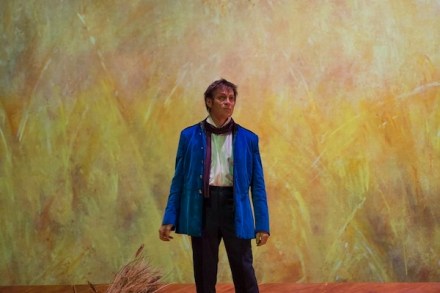
Dance: William Forsythe’s new work is choreographic narcissism

As someone who once raved about William Forsythe’s innovative approach to ballet and fondly admired his groundbreaking choreographic explorations, I felt let down by last week’s performance by his company at Sadler’s Wells. Things did not start badly, though. The way gestural solutions unfold and develop in a crescendo of movement variables, variants, similes and opposites in N.N.N.N. (2002) is rather engaging. The game of quick interaction between four male dancers moves rapidly from the simplest hand movement to demanding acts of powerful physicality; there are humorous moments and tense ones, as well affectionate references to the neoclassical oeuvre of George Balanchine — whom Forsythe has often referred to as a major source of inspiration.

Dance review: Raven Girl, Symphony in C

Last Friday, ballet’s overcrowded aviary welcomed a new addition: Raven Girl.  Sexy, sleek, troubled and troublesome, she is the creation of the bestselling author Audrey Niffenegger and Royal Ballet’s resident choreographer Wayne McGregor.  Expectations were high, as McGregor is not a choreographer one would normally associate with balletic storytelling. The work, with stunning designs by Vicki Mortimer, splendid lighting by Lucy Carter, great video design by Ravi Deepres and a lusciously seductive score by Gabriel Yared, enthrals the senses and sits perfectly with McGregor’s vision of a creatively synergetic unity of the arts. It’s a pity that neither the choreo-graphy nor the dramaturgy were as impressive.

Dance: Hansel and Gretel

As far as memory serves, in my 46 years of being both in and at the ballet I have encountered only seven ballet adaptations of the Grimm Brothers’ Hansel and Gretel. Alas, each was less memorable than the one before. Happily, the new version by the Royal Ballet’s first artist-in-residence, Liam Scarlett, which had its première last week, has dispensed with the dance numbers for cuddly forest animals and cute gingerbread men that turned the versions of his predecessors into laughable creations. Instead, he has opted to exploit the dark tones of the Grimms’ narrative — abandoned children, cannibalism, a hyperbolic excess of unhealthily sugary food, etc.

Mixed blessings | 21 February 2013

Last week, Sergei Polunin’s powerful entrance in Marguerite and Armand was saluted with a wave of electrically charged silence: not a cough, not a sound, all eyes glued to the stage. Whether viewers held their breath because they were waiting to see if the star who stormed out of the Royal Ballet still had it, or because they were genuinely impressed, is difficult to say. Personally, I was struck by that first appearance, as it confirmed that since leaving the company amid accusations, allegations and gossip Polunin has refined his already exceptional interpretative and technical skills. His charismatic Armand is the perfect reading of the role for today.

From Russia with love | 7 February 2013

If you want to know what’s so great about John Cranko’s choreography, look at the opening phrase of the final duet in Onegin (1965). The male dancer encircles the ballerina in an embrace that is not reciprocated, and then falls at her feet; she lunges forward to walk away from him, but her motion is counteracted by the downward and backward pull he performs while crouching on the stage behind her. It is sheer simplicity and sheer genius. The basic game of opposition and the use of gravity — at odds with ballet’s traditional aerial nature — encompass a unique range of emotions.

Bourne again | 3 January 2013

While most theatres brace themselves for the annual invasion of prancing Nutcrackers and flying snowmen, Sadler’s Wells offers something that is mercifully not as sugary. Never-ending love and magic kisses might be at the core of Matthew Bourne’s long-awaited take on Sleeping Beauty — aptly subtitled ‘ A Gothic Romance’ — but there are also bites of the Twilight saga genre, demonic creatures and a fair amount of gender-bending. Odd as it may sound, it all works to absolute perfection, contrary to what some Jurassic highbrows might like to think.

Captivating kaleidoscope

When Philippe Decouflé first introduced the idea of sheer fun into the deadly serious business of postmodern dance-making, sceptics predicted that his comic strip and animated movie-like ideas would soon start to wear off. Almost 30 years later, his stuff is still as provocatively entertaining, and his work holds a special place in the history of choreography. Panorama is a cleverly woven look at some of his past and much-acclaimed creations. Yet the performance has very little in common with trendy, pompously celebratory and unbearably lifeless choreographic retrospectives. Structured as a sort of music-hall review and compèred like one by the most unlikely of MCs, Panoroma is a kaleidoscope of choreographic and theatrical ideas that amuse, intrigue and captivate.

Mixed bag | 1 November 2012

Last year I raved about Birmingham Royal Ballet, their artistic drive, their freshness, their impeccable artistic eclecticism and, not least, their superb dancing. It was with such memories that I went to Sadler’s Wells last week, only to leave both programmes with reservations and mixed feelings. Neither programme stood out for being particularly well constructed; one, titled Opposites Attract, lacked contrast and shadings, while the other suffered from excessive stylistic idiosyncrasy. David Bintley’s Take Five, to Dave Brubeck’s luscious jazz, strived to add sparkle, but did not succeed — surprisingly, one might add, given that it has all the right ingredients to be a success.

Twin peaks

According to an old ballet commonplace, no one can beat the Russians when it comes to Swan Lake. Biased and historically inaccurate as this may be, the generalisation has a grain of truth. Russian ballerinas have always looked at ease with the popular classic. It matters little that it was created for an Italian star and partly choreographed by a French ballet master; Swan Lake is as Russian as vodka and comes magically to life when left in the hands — and legs — of Russian interpreters. Which is what happened last week with the international superstar Natalia Osipova’s debut with the Royal Ballet. Osipova’s rise to fame started only recently, and many in this country still remember her dazzling rendition of Don Quixote.

American beauty | 19 September 2012

Tragically, the number of ballet directors who can orchestrate good programmes and good openings is dwindling these days. Helgi Tómasson, of San Francisco Ballet, is one of the few who are still in the know, judging by the terrific bang with which his company opened last week in London.  Divertimento No.15 might not be one of George Balanchine’s greatest works, but it remains a delectable compendium of all the distinctive traits dance-goers love in Balanchine’s composition. Craftily entwined with and within Mozart’s music, the 1956 dance is one of the choreographer’s many tributes to the grand old era of the Imperial Russian Ballet — whence he came.

Grim realities

It was somewhat weird that Pina Bausch’s Palermo Palermo opened on the same night as Spain’s victory over Italy in the Euro 2012 final. After all, the Sicilian capital was long dominated by the Spaniards. Yet in Bausch’s Tanztheater vision of Palermo there are no references to such history, bar a few Spanish-looking steps set to the Spanish-influenced Sicilian music in part one’s frenzied finale. What one gets instead are more or less explicit flashes of the city’s more contemporary and often grim realities: from the mafia ritual of kissing the boss’s hands, to garbage piling up in streets, via evocations of Sicilian mourning, immigration and emigration.

New world order

When World Cities 2012 — better known as the current Pina Bausch season — was first presented, questions were raised about the apparently random order of the various pieces. Yet a chronologically structured retrospective would have deprived the event of the theatrically stimulating game of juxtapositions that the reordered version possesses. As with her non city-specific works, Bausch’s city-specific creations can be grouped in two categories: the more and the less danced pieces. The pendulum swung dramatically throughout the four decades in which Bausch worked, though not frequently. So a chronologically structured retrospective would have suffered from clumps of similarly formulated compositions. A vibrant chiaroscuro is key to the success of the current season.

Tales of the city | 16 June 2012

Last Wednesday two of the three live pooches that appeared in Pina Bausch’s Viktor did onstage what most dogs do when in a state of arousal. The incident, which elicited a great deal of audience laughter and repressed giggles on stage, would have amused the late Bausch. First seen in 1986, Viktor was the first of the many city-specific works that Bausch created and on which the current World Cities 2012 retrospective (at Sadler’s Wells and the Barbican) focuses. Viktor’s rhapsodic and episodic narrative comes from the theatricalisation of memories each member of the Tanztheater Wuppertal had of their experiences in a particular location. Viktor is about Rome, though not the Rome one sees in travel books, postcards or holiday snaps.

Unconditional love

Not many dance-makers have had their art celebrated in major, award-winning feature films. Pina Bausch has. Wim Wenders’s 2011 Pina and Rainer Hoffmann’s/Anna Linsel’s 2010 Dancing Dreams offered unique insights into her creative genius, facilitating the posthumous popularisation of a dance-specific phenomenon. Yet no film, no documentary and certainly none of the countless writings that popped up after the choreographer’s untimely death has managed to draw an exhaustive picture of Bausch or dispel the vagueness that surrounds what her Tanztheater was and still is about. Three years after her demise, Bausch and her work remain shrouded in mystery, resisting and eluding scholarly labelling or convenient pigeonholing.

Me and my shadows

Shadows and reflections have always triggered all sorts of fantasies. Theatre itself, in the words of many playwrights and theorists, is nothing but a game of shadows. Today, filmic and computer-generated or manipulated projections have taken the place of what was once cleverly done with candles and mirrors. Indeed, projections seem to have become a distinctive and annoyingly trendy trademark of contemporary theatre, for they seem to pop up everywhere, more or less appropriately. Tired of images that detract and distract from both the music and the meaningful or expressive physicality of dance performances, I, like many, believe that using projections to add an aura of pseudo-cultural gravitas to a piece is the main indicator of poor creativity.

Celebrating identity

Last year, when I reviewed The Sum of Parts, the community-oriented piece produced by Connect, Sadler’s Wells Creative Learning department, I thought it wouldn’t be possible to do any better. Well, I was wrong, as this year’s Compass was an even more breathtaking experience. The new project, which involves more than 100 non-professional performers and a unique roster of artists, has been conceived at a time when World Cities 2012, Pina Bausch’s retrospective of works devoted to cities and cultures from around the world, is imminent. Compass, however, focuses only on London, which is a vibrant melting pot of diverse and complementary cultures.

Magic chemistry

Artifact was the first work that the groundbreaking dance-maker William Forsythe created in 1984 for the legendary Ballet Frankfurt. It is, therefore, pure ‘vintage’ Forsythe, even though it is as aggressively and engagingly provocative today as it was 28 years ago. It therefore comes across as a theatrically vibrant reminder of where it all started. Central are the quirky postmodern challenges that Forsythe first laid down to both the ballet canons and the set rules of traditional theatre-going. Hence the curtain coming down and going up more or less unexpectedly and/or arbitrarily, an idea aimed at questioning the way audiences used to watch — and still do — a ballet, which was to become Steptext’s main feature one year later, in 1985.

Triple triumph | 24 March 2012

Not many ballet companies convey young love as credibly as Birmingham Royal Ballet. And I am not talking about select soloists, but the company as a whole, for youth, freshness and vibrancy are its most distinctive traits. Add to that a slick sense of style, impeccable technique and co-ordination and you have the perfect ballet experience. Which is what I had last week with each of the three titles presented at the London Coliseum: Daphnis et Chloë, The Two Pigeons and Coppélia. Created in 1961, The Two Pigeons is Frederick Ashton’s own take on one of those late 19th-century works that belong to what is commonly considered to be a period of decline in the history of French ballet.

Succulent pleasures

It was about time a dance-maker exacted revenge on dance academics. In Alexander Ekman’s 2010 Cacti, a voiceover explains the alleged semantics of the choreography by resorting to theoretical clichés and the known modes of that mental self-pleasuring that many academics indulge in. As the vacuously pompous words bear little or no relation to the quirky actions, the contrast between the taped voice and the dancing becomes explosively comic. Later on, recorded voices are also used to let viewers peep into the minds of two dancers performing a duet, humorously highlighting the kind of artistically detached thinking performers frequently engage in while dancing.