Gavin Mortimer

Gavin Mortimer

Gavin Mortimer is a British author who lives in Burgundy after many years in Paris. He writes about French politics, terrorism and sport.

The symbolism of Notre Dame’s destruction won’t be lost on Macron

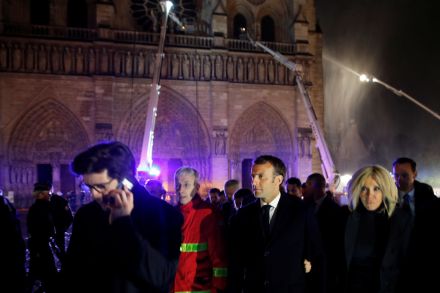
The timing of the burning of Notre Dame could not have been worse for Emmanuel Macron. The spire of the 850-year-old cathedral collapsed into the flames at 8pm, the time scheduled for his televised address to the nation. The president had planned to tell his people in the broadcast what measures would be taken after the three months of Grand Debate, the consultation launched at the start of the year in response to the Yellow Vest protest movement. Instead, Macron rushed to Notre Dame and looked on as the inferno consumed the country's most historic monument. "Notre-Dame is aflame," tweeted the president. "Great emotion for the whole nation. Our thoughts go out to all Catholics and to the French people.
Winston Churchill and the plot to smear Britain’s great men

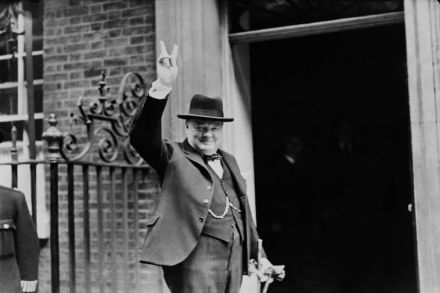
The concerted attempt by left-wing figures to smear Winston Churchill last week is no surprise. In fact, it is another instance of a phenomenon I identified on these pages last November when I wrote about the cultural appropriation of the first world war. That process began in the early 1960s, with the myth of 'Lions led by Donkeys', but the liberal intelligentsia soon began to broaden their cultural appropriation of British history by impugning the reputation of its great men. In September 1967 the Sunday Times published an article by Len Deighton in which he accused David Stirling, the founder of the SAS, of imperilling the lives of his men during operations in the second world war through careless talk at cocktail parties.

What Macron’s spat with Italy is really about

Who needs the Comédie-Française when there is Emmanuel Macron in the Élysée? France's recall last week of its ambassador from Italy for consultation was pure theatre on the part of the president. And it was a decision more for the benefit of his domestic audience than for the coalition government in Rome. In a statement explaining why Christian Masset had been ordered home, the foreign office said that for several months France has been subjected to outrageous statements that have created a 'serious situation which is raising questions about the Italian government’s intentions towards France.' France blamed the recall on Luigi Di Maio, the Italian deputy prime minster, who flew to Paris last week to meet members of the Yellow Vest protest movement.

France’s dilemma: what to do with jihadists who say sorry

Patrick Jardin lost his daughter when Islamist terrorists attacked the Bataclan in November 2015. Nathalie was one of 130 people killed that evening in Paris and her father still pays her mobile phone charges so that he can hear her voice on her answer message. For Jardin, time has healed nothing. He spearheaded a successful campaign to prevent the controversial rapper Medine from appearing at the Bataclan last year. And in the interviews he gives, such as this one to Liberation, he directs his anger in many directions. Some of it against himself, for failing to "protect" his daughter, some against the killers, but most is channelled into a visceral loathing for the political class, which he accuses of being the real assassins.

France’s dilemma: what to do with jihadists who say sorry | 6 February 2019

Patrick Jardin lost his daughter when Islamist terrorists attacked the Bataclan in November 2015. Nathalie was one of 130 people killed that evening in Paris and her father still pays her mobile phone charges so that he can hear her voice on her answer message. For Jardin, time has healed nothing. He spearheaded a successful campaign to prevent the controversial rapper Medine from appearing at the Bataclan last year. And in the interviews he gives, such as this one to Liberation, he directs his anger in many directions. Some of it against himself, for failing to "protect" his daughter, some against the killers, but most is channelled into a visceral loathing for the political class, which he accuses of being the real assassins.

Why the Yellow Vests haven’t received any celebrity endorsements

When the actor Jared Leto won the Oscar for best supporting actor in 2014 he used his acceptance speech to send a message to those people protesting against poverty. 'To all the dreamers out there around the world watching this tonight, in places like the Ukraine and Venezuela, I want to say we are here,' declared the American. 'And as you struggle to make your dreams happen, to live the impossible, we're thinking of you.' Leto wasn't alone in thinking of the thousands of brave Venezuelans who for weeks had been demonstrating on the streets against social inequality. Madonna, Kevin Spacey (in the days when he was still a beacon of righteousness) and Rihanna were among those who also spoke up for the students and middle-class demonstrators.

Is France on the verge of class war between Yellow Vests and Red Scarves?

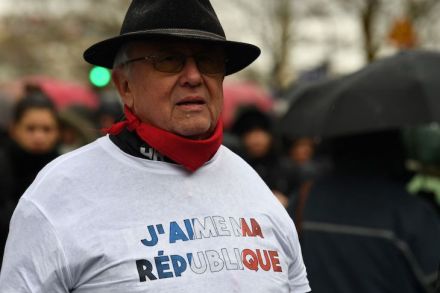
The first thing that struck me when I emerged from the metro station onto the Place de la Nation was the amount of corduroy. It was without doubt the trouser material of choice for the middle-aged men participating in Sunday's inaugural Red Scarf (Foulard Rouge) rally in support of the Republic and its institutions. As I meandered through the crowd, which numbered only half of the 20,000 hoped for by the organisers, I was also surprised by the number of blue and gold flags. Some demonstrators were waving the EU banner and others were wrapped in it, like football fans on their way to a World Cup match. I spied a woman sheltering from the driving rain under an EU umbrella and thought she would be a good person to start talking to.

Is France on the verge of class war between Yellow Vests and Red Scarves? | 28 January 2019

The first thing that struck me when I emerged from the metro station onto the Place de la Nation was the amount of corduroy. It was without doubt the trouser material of choice for the middle-aged men participating in Sunday's inaugural Red Scarf (Foulard Rouge) rally in support of the Republic and its institutions. As I meandered through the crowd, which numbered only half of the 20,000 hoped for by the organisers, I was also surprised by the number of blue and gold flags. Some demonstrators were waving the EU banner and others were wrapped in it, like football fans on their way to a World Cup match. I spied a woman sheltering from the driving rain under an EU umbrella and thought she would be a good person to start talking to.

Are the Yellow Vests just a bunch of middle class whiners?

On two Sundays this month there have been Yellow Vest demonstrations in France organised by women. As one of the leaders explained to the media, they're not 'feminist' demonstrations but 'feminine', a chance for women to have their voices heard in a movement that, since its formation, has been predominantly patriarchal. These women don't want their movement to be hijacked by bourgeois Parisian feminists, those who care more about making French a gender-neutral language than reducing childcare costs for single mums struggling to make ends meet. Changing grammatical rules so that the masculine form of a noun no longer takes precedence over the female is probably not the issue that preoccupies the million working women living below the poverty line.

Emmanuel Macron’s fear of Frexit is bad news for Britain

Emmanuel Macron launched his Big Debate on Tuesday and for the next two months the French people will have the chance to air their grievances in meetings and online. The consultation, in response to the Yellow Vest protest movement, has captured the media's attention but nonetheless it was knocked off the top of the news agenda temporarily by events in Westminster. There is an undoubtedly a touch of schadenfreude in the Élysée Palace at the Brexit farrago, a relief that another world leader is in torment. Macron learned that parliament had rejected Theresa May’s Brexit deal on Tuesday evening, as he was nearing the end of a seven hour debate in a Normandy town hall.

The yellow vests are at the vanguard of a politically incorrect uprising

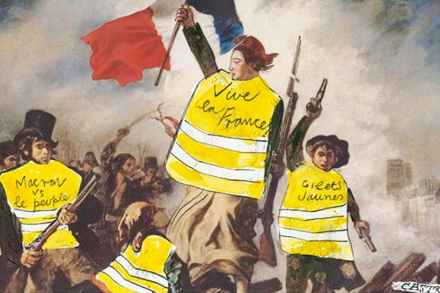
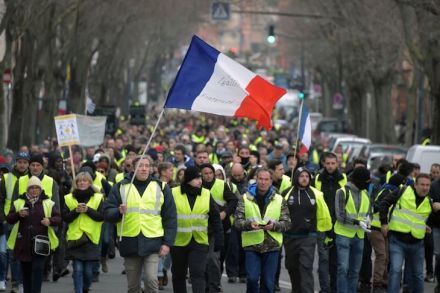
The ninth weekend of the gilet jaune protest movement was a mixed result for Emmanuel Macron. The nationwide demonstrations were relatively peaceful with only minor skirmishes between protestors and police, but numbers were up, with a total of 84,000 taking to the streets, 34,000 more than the previous Saturday. This is an impressive figure given that we are in the depth of the northern hemisphere winter, but what are rain, sleet and sub-zero temperatures when the future of one's country is at stake? With that in mind Macron launches his Big Debate on Tuesday in the hope that consultation will supplant confrontation and a consensus can be reached behind which the country can unite and move forward. The odds of that happening appear to be slim.

Macron’s prophet

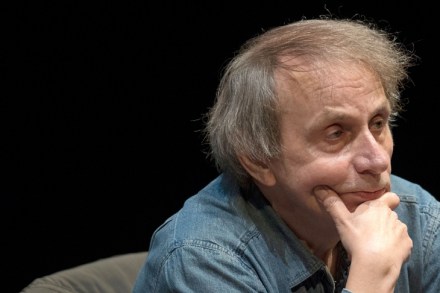
France’s literary event of the year took place this week with the publication of Michel Houellebecq’s new novel, Serotonin. Named after the brain chemical that regulates mood, his seventh novel has been described by one French newspaper as ‘prophesying the yellow vest movement’. The critics have lavished praise and the public are plucking it from the shelves. The initial print run was 320,000, which is quite something given that the average run for a novel in France is 5,000 copies. And it’s selling so fast that I haven’t been able to obtain a copy from the booksellers close to where I live in Paris. It’s a similar story in Germany, where the print run of 80,000 is virtually unheard of for a foreign author, and Spain.

Why Isis is a bigger threat to France than the yellow vests

Where ever one looks in France at the start of 2019 one sees only ominous signs. In his New Year's message to his people Emmanuel Macron issued a robust warning to the gilets jaunes, elements of which he described as 'a hate-filled crowd'. Accusing them of having attacked the police, the media, Jews and homosexuals, the president vowed that 'Republican order will be ensured with no leniency'. That drew a swift retort from one of the self-styled yellow vest movement leaders, Maxime Nicolle, who in a facebook post, predicted an 'armed uprising', adding that 'a lot of people are ready to lose their lives in the hope of a better future'.

Where did it all go wrong for Emmanuel Macron?

Twelve months ago Le Journal du Dimanche published an opinion poll in which Emmanuel Macron had an approval rating of 52 per cent. A fortnight ago the same paper ran a poll in which the president's popularity stood at 23 per cent. Where has it gone so wrong for the man once likened among sections of the French press to a cross between Jupiter and Christ? More to the point how could The Spectator get it so wrong in running a piece last December entitled 'Macron is becoming the darling of the Deplorables'? I can only assume that when I wrote that article, in particular the line about Macron having 'a wise head on those young political shoulders', I had come from a long Christmas lunch. In my defence I would like to point out that I did temper my praise with some cautious prognosis.

Why does Britain have to shut down for Christmas?

Christmas in Britain means misery not merriment. It's why I prefer France, which doesn't shut down lock, stock and bauble. This year I'll be in Aveyron, as profonde as La France profonde can be, and the highlight will be the Quine – that's Bingo to Brits – which starts at 4pm on Christmas Day in the village hall. It's an annual event organised by the local rugby club and it pulls in punters from dozens of outlying villages, all desperate to win one of the prizes on offer. You know you're in France when the prize-winner who gets the most envious glares isn't the one who scoops the flat-screen TV but the lucky devil who makes off with the hind leg of ham.

The link between the gilet jaunes and the Strasbourg attack

There are conspiracy theories doing the rounds in France among some gilets jaunes that Tuesday's Islamist attack in Strasbourg was somehow fabricated by the government. It was cooked up, so the social media conspirators say, to deter demonstrators from launching a fifth weekend of protests. The various theories are all very far-fetched. The alleged gunman, Chérif Chekatt, who was shot dead by police on Thursday evening, had a history of violent crime and, more significantly, is believed to have been converted to Islamic extremism while in prison. It's a back story shared by several other Islamists who have carried out attacks in France in the last six and a half years. Nonetheless, there may well be a connection between the Strasbourg attack and the yellow vest movement.

Has Macron done enough to stop the yellow vest protests?

Emmanuel Macron spoke to the French people for thirteen minutes on Monday evening. It was an uncharacteristically sombre address from the president, one in which he admitted he had to take his 'share of responsibility' for the anger that provoked the yellow vest movement. As well as conceding he 'might have hurt people with my words', Macron also announced a series of measures that he hopes will defuse the discontent of his people and bring an end to the violent chaos across the country that has cost retailers alone upwards of €1b since it began on November 17. An additional €100 a month will be added to the minimum wage and pensioners receiving less than €2,000-a-month will be exempt from social security taxes scheduled to take effect next year.

How the Gilets jaunes movement could spread across Europe

The eminent historian Emmanuel Todd was on the radio in France last week. He had much to say, none of which would have made for easy listening at the Élysée Palace, particularly his warning that Emmanuel Macron is facing a coup d'etat that has been fomenting for years. Todd believes that fundamental to the rise of the Yellow Vest movement is what happened in 2005. That was the year France, in the words of the Guardian at the time, "decisively rejected the new European constitution". The 'non' votes were 54 per cent (out of an overall turnout of almost 70 per cent) and jubilant campaigners demanded the resignation of Jacques Chirac as they celebrated in the Place de la Bastille.

My Saturday with the Gilets jaunes in Paris

Not quite a ghost town, but when I emerged from the metro at Saint-Germain-des-Prés at midday central Paris was eerily calm for a Saturday in the festive season. I once lived in this district and December was always a nightmare for shoppers and tourists. Not today. Louis Vuitton was shut and boarded, so, too, Swarovski and a couple of banks and most cafes. I walked towards the Seine and on the Quai Voltaire I encountered my first riot police. They had a dozen Gilets Jaunes against the wall, frisking them in a courteous manner. Crossing the Pont des Arts I spotted a Father Christmas in a Yellow Vest walking briskly along the river path. Under the bridge and out of sight of the police, Santa Claus stripped.

Emmanuel Macron’s next fight could be his toughest yet

In normal circumstances, Emmanuel Macron would welcome a trip to Marrakech in December as an opportunity to escape cold Paris and enjoy some North African hospitality. But his date in the Moroccan city next week could not have come at a worse time. France is burning and Macron's presence on Monday at the United Nations intergovernmental conference in order to sign France up to the global compact for safe, orderly and regular migration could add to the conflagration. The United Nations states that the global compact "comprises 23 objectives for better managing migration at local, national, regional and global levels". The document has been more than two years in the making and its aim is to help the 258 million migrants around the world living outside their country of birth.