Fraser Nelson

Fraser Nelson

Fraser Nelson is a Times columnist and a former editor of The Spectator.

How to save Conservatism

From our UK edition

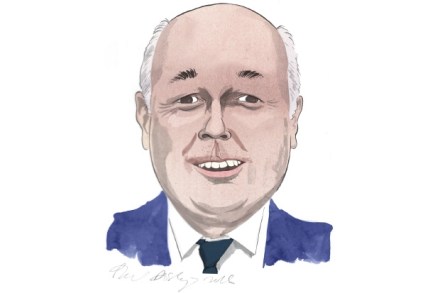
Iain Duncan Smith may have lost his job, but he has found a new whisky. It’s called Monkey Shoulder, and they became acquainted when he went to lie low in the Highlands after his resignation. When he went to buy a new bottle from Robertsons of Pitlochry he was told he’d have to wait a few days. ‘I told them not to worry, that I had more time on my hands. The man behind me said: “Yes, we know all about that — you were the talk of the town here for days.”’ It’s an example, he says, of how his resignation struck a far deeper chord than he imagined it would. ‘It has been very odd,’ he says. ‘There’s a huge number of letters and emails piling in, saying “thank you”.

The deceptions behind George Osborne’s Brexit report

From our UK edition

Sometimes, George Osborne’s dishonesty is simply breathtaking. Let's set aside the way he has positioned himself over the years (if he believed that leaving the European Union ‘would be the most extraordinary self-inflicted wound’ he might have told us – and his constituents – earlier, rather than proceeding with the farce of renegotiation). But it’s his maths, today, which shames his office – and his use of this maths to make the entirely false suggestion that the Treasury thinks Brexit would make you £4,300 worse off. For anyone who cares about honesty in politics, and the abuse (and reporting) of statistics, this is an interesting case study. His chosen date is 2030.

The truth about black teenagers, prison and university

From our UK edition

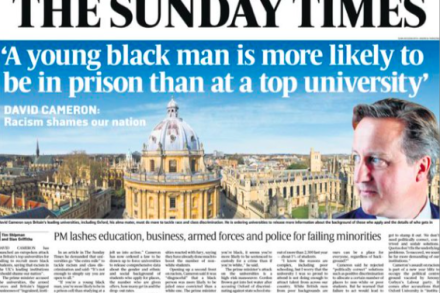
A few months ago, David Cameron made an incendiary claim that splashed the Sunday Times and set the news agenda for days: black boys, he said, were more likely to go to prison than university. It was a shocking statement, that quite rightly sparked much discussion. But there was one flaw: his claim was nonsense. I had to submit a Freedom of Information request to find the real story: black men are twice as likely to go to a top (i.e., Russell Group) university than to prison. Include women, and it’s five times as likely. Include all universities, and there’s no comparison – black teenagers have a higher university entry rate than white teenagers.

Culture Secretary John Whittingdale admits relationship with dominatrix

From our UK edition

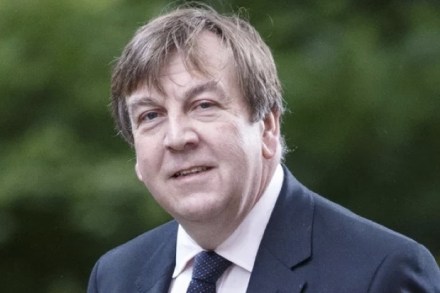
If match.com is missing an advertising strap line, how about saying "Where lonely cabinet members can meet lonely dominatrices?". According to John Whittingdale, the Culture Secretary, this is precisely what happened to him - a relationship that the press knew about, but decided not to publish on the grounds that he's single, is richly entitled to date whoever he likes and updating the public on his progress on match.com was not in the public interest. Bizarrely, the press regulation advocates Hacked Off is accusing the press of being too prudish and thinks it's a scandal that Whitto was not humiliated and mocked. A cover-up, it says. We haven't quite had Hugh Grant demanding that the press expose single men's liaisons with call girls, but that can't be far away.

David Cameron’s tax returns tell us nothing. So why did he publish them?

From our UK edition

It’s just as well that David Cameron abandoned his career in public relations because he seems to be comically (or, if you’re a journalist, deliciously) bad at crisis management. He has done absolutely nothing wrong, but is carrying on as if he’s Ken Dodd in 1989 - except Dodd handled it all more deftly. The Prime Minister has now released six years of his tax returns, which is odd because no one is asking questions about his income over the last six years. But still, he wants to tell us about the £100k annual rent he's getting form his Notting Hill flat and the £3,052 of bank interest (which suggests a balance of about £150k). And the other tax returns show about £200k of income since becoming PM.

David Cameron is guilty of bad spin – and nothing more

From our UK edition

At last! We can now see why David Cameron tried to keep this quiet. He sold his shares in January 2010 – just as the recovery was starting. What a dunce! His £31,500 would be worth a lot more by now if he’d held, and diversified his portfolio. So can you trust him with the nation’s finances? And this, as far as I can make out, is the limit of the scandal. All else is spin and smear. The spin, of course, matters. The Prime Minister has behaved as if he had something to hide when he didn’t. His carefully-worded highly-specific non-denial denials (‘In terms of my own financial affairs, I own no shares…’) were the equivalent of screaming ‘ATTENTION JOURNALISTS!!! HIDDEN STORY!!! LET THE GAME BEGIN!

One in six pensioners lives in a millionaire household

From our UK edition

The state pension has just risen by the highest amount in 15 years, and the Tory Party boasts that this is a result of the ‘difficult decisions’ it has taken. This is odd, because no one else is being told about dividends from such decisions. In fact, Osborne’s deficit is still massive so he can’t afford any other giveaways. As I say in my Daily Telegraph column, it’s just the latest clear sign of a kind of generational apartheid in the government’s fiscal policy: the cuts are being focused exclusively on the working age. And this is why Iain Duncan Smith resigned: not due to cuts to disability benefit (which he supported) but because he couldn’t justify writing ever-larger cheques to pensioners, while making ever-deeper cuts to welfare.

The Spectator’s Kids Company exposé named Scoop of the Year

From our UK edition

It’s a red-letter day here at 22 Old Queen St: Miles Goslett’s exposé of Kids Company has just been named Scoop of the Year. The awards, by the London Press Club, differ from the others in that you can’t nominate and you can’t pay to enter: the shortlist is drawn by a distinguished judging panel. It’s a huge credit to Miles that he won, and an even bigger compliment considering who he beat: the Sunday Times' Insight investigation into athletics doping, the Sun’s exposé of Lord Sewel’s cocaine habit, and the Daily Mirror’s scoop about how the diamond heist thieves got away with it.

How the Living Wage helps the rich more than the poor

From our UK edition

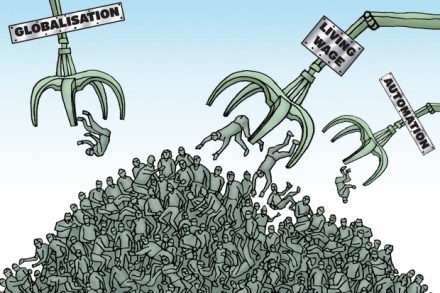
The biggest mistake in politics is to judge a policy by its intentions, not its ayesults. The Living Wage sounds like it's helping those at the bottom: the over-25s are on £7.20 as of today, up from £6.70 under the old minimum wage. Within four years, it will be over £9. So a massive pay rise for the poor! Except it's nothing of the kind. What a £9 minimum wage does is ensure that anyone whose skills are not worth £9 will be unemployed. How many people are we talking about? The OBR says 60,0000. Prof Ray Barrell, from Brunel University, fears it will be closer to 300,000. While the precise number is in doubt, the overall principle is not: higher unemployment is the price paid for a minimum wage.

The return of eugenics

From our UK edition

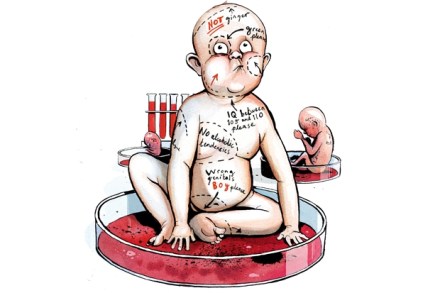
The only way of cutting off the constant stream of idiots and imbeciles and feeble-minded persons who help to fill our prisons and workhouses, reformatories, and asylums is to prevent those who are known to be mentally defective from producing offspring. Undoubtedly the best way of doing this is to place these defectives under control. Even if this were a hardship to the individual it would be necessary for the sake of protecting the race. — The Spectator, 25 May 1912   It’s comforting now to think of eugenics as an evil that sprang from the blackness of Nazi hearts. We’re familiar with the argument: some men are born great, some as weaklings, and both pass the traits on to their children.

Why is Gus O’Donnell misleading the public about the EU rules on Brexit?

From our UK edition

When Sir Gus O’Donnell was head of the civil service, those who worked under him would have prided themselves in the code that he was supposed to uphold: to be impartial, avoid politics and do their best to make sure the public is not misled. This morning, Sir Gus was involved in what can only be described as a systematic attempt to mislead the public about the EU and the terms in which Britain would leave. His point: that it would take more than two years to negotiate the terms of UK’s exit, and this deadline could only be prolonged with hard bargaining from hostile partners. "Obviously at the end of two years anything we haven't negotiated has to be extended by unanimity of a vote excluding us so that's a bit scary.

Would Brexit mean Boris as PM? If so, should we worry?

From our UK edition

This time last year, Matthew Parris was about the only commentator predicting that the Tories would win a majority. In his Times column today, he says he is now beginning to think that Britain will vote ‘out’ – and he looks at the consequences. Specifically, Cameron’s likely resignation and a summer Tory leadership campaign with Boris Johnson as the favourite. It all might feel a bit premature, but Matthew Parris is one of the most prescient writers in Britain (as Spectator readers know). If Britain does vote out and Cameron quits, then Boris would be the favourite (see graph, below). And then, gloves would come off.

If Scotland had gone independent today, it would be facing sado-austerity

From our UK edition

Today is Independence Day, the 24 March, the day Alex Salmond nominated as his ‘independence day’ following a Yes vote. Today’s edition of The National, the newspaper dedicated to the cause of Scottish independence, imagines what might have been. But one rather important story is missing. Yesterday, the Institute for Fiscal Studies updated its forecasts on what an independent Scotland would look like. The result: it’d have the worst deficit in the developed world (see graphic, below). In his official forecasts Alex Salmond envisaged raising up to £7.5 billion of oil revenue. This was before the oil price plunge. Last weeks' Budget revealed the actual amount: zero. (The graph, below, shows the changing picture). Hence the deficit.

Podcast: IDS, Ros Altmann and the return of Tory Wars

From our UK edition

Iain Duncan Smith has just given what James Forsyth refers to as a "bombshell interview" which turned into "a missile aimed at George Osborne". Ros Altmann, the pensions minister, released a statement last night that could be described as a missile aimed at Iain Duncan Smith. What's next? James Forsyth and I discuss in this podcast.

Ros Altmann is wrong: the IDS resignation was not about Europe. But it didn’t help

From our UK edition

In another extraordinary development the pensions minister, Ros Altmann, has released a statement attacking her former boss Iain Duncan Smith. She reinforces the No10 line that Iain Duncan Smith “championed the very package of reforms to disability benefits he now says is the reason he has resigned” and accuses him of being very hard to work for. Her reaction is odd in that she said nothing about his departure for 24 hours, then at 9pm last night released a series of tweets culminating in her statement saying his attacks on the government can be explained by his position as a Brexiteer. So was she encouraged by No10? Her statement is strikingly similar to No10's version of events.

David Cameron suspends disability benefit reform, after IDS resignation

From our UK edition

Well, that was quick. In his letter responding to Iain Duncan Smith's resignation, the Prime Minister has this to say:- "We collectively agreed - you, No10 and the Treasury - proposals which you and your Department then announced a week ago. Today, we agreed not to proceed with the policies in their current form and instead to work together to get these policies right over the coming months." It was the disability benefit cuts that triggered the IDS resignation (or, rather, their being used in the Budget to help finance cuts to the higher rate of tax). The £1.3 billion cut was stated as a fact in the Budget, and the money banked. Then it was downgraded to a "suggestion" by Nicky Morgan on Question Time last night.

Iain Duncan Smith resigns in protest at the Budget

From our UK edition

In the last few minutes, Iain Duncan Smith has released a letter of resignation from his post as Work & Pensions Secretary. The proximate cause is the Budget cuts to disability benefits. He knew about them, but had wanted a consultation paper to be published so the government could make the argument carefully, over many weeks, given that this is a hugely controversial topic. Instead, George Osborne presented the disability cuts as a £1.3 billion fait accompli in the Budget and these cuts to finance tax cuts for higher-rate earners and lowering capital gains tax. IDS said in his letter to David Cameron that this is ‘not defensible’. It was the juxtaposition, rather than the cuts on their own, that made him walk.

Save council-run schools! It’s time for local authorities to open free schools

From our UK edition

In part of his Budget manspreading this week, George Osborne stole Nicky Morgan’s announcement that councils will be forced to relinquish control of all schools, so every single one is an Academy. As Philip Collins says in the Times today, this doesn’t mean they’ll all get better – he rather scorns the idea. But his old boss, Tony Blair, had precisely the same idea: to (in effect) privatise every single state school, so each one is independent of the council and has a direct financial relationship with Whitehall, cutting out local authorities entirely. Blair was vetoed by Brown and had to settle for a few hundred Academies. But in this, as with so much else, the Tories are finishing what Blair started. Councils must get out of education by 2020.

If Wiltshire Tories regard George Osborne as a socialist, he has a problem

From our UK edition

BBC Newsnight sent a crew to North Wiltshire today, to interview voters about the budget. Gladys Pek Yue Macrae, a former Conservative Party branch chairman, said she is fed up because she expected Tory policies to be the result of a Tory majority. Instead, she said, “I find I have a socialist Chancellor. Conservatives are for small government and each individual being responsible for their own destiny. Why do we have a sugar tax? If people should not be eating sugar, then they should not eat sugar.” As her husband, Alan Macrae, put put it: “Surely Conservatism is all about freedom of choice? It’s not about the government telling you what you should and should not do.

Budget 2016, in eight graphs

From our UK edition

Chart 1: Growth downgraded. Not by much, but Osborne sails so close to the wind that every negative revision tends to knock him off course. Chart 2: So Osborne's new debt target is missed already. He said the debt/GDP ratio would fall every year: a target he took right to the limit in his Autumn Statement. The ratio is rising this year - again, not by much, but this is rather embarrassing for him as made such a fuss about this target. Chart 3: Deficit picture worsens. Again. Which happens pretty much every time Osborne stands up to make a financial statement. Here's his latest plan, versus his original.