Fraser Nelson

Fraser Nelson

Fraser Nelson is a Times columnist and a former editor of The Spectator.

Why Cameron was right about the regions

Given that Labour has put out a hilarious plea to discuss “issues” rather than personality (or lack thereof), I would like to rise to this challenge to discuss an excellent point raised by David Cameron on Friday: that the state spending/GDP ratio is far too high in many parts of the UK and needs to be lowered. Stating this utterly uncontroversial fact landed him in a bit of trouble, I suspect because of lack of understanding of the issues. So, in the spirit of Labour’s plea, here are some facts. Cameron told Paxo that: “In Northern Ireland, it is quite clear – and almost every party accepts this – that the size of the state has got too big. We need a bigger private sector.

Has the Lib Dem bubble burst?

Is this the end of the LibDem soufflé surge? Tomorrow's News of the World has an Ipsos-Mori poll – conducted the day after the second debate – putting things back to where they were pre-debates: Tories with a six point lead over Labour and the LibDems lagging seven points behind Labour, i.e. 36-30-23. This is broadly where Mori had them in March. The polls are in a state of flux, to be sure. But Ipsos did a full, 1,200 weighted sample, telephone poll. Even on this basis, Cameron would be 42 seats short of a majority. But this is the best news he's had since the first TV debate – and a sign that he might yet pull through with a majority. Yet other polls in tomorrow's Sundays suggest that there is still some rise in the LibDem soufflé.

The Tories must sell their most radical policy: the Gove schools plan

The Spectator’s endorsement of David Cameron started with his ‘free schools’ policy – and we could have ended there. We said that this is, in itself, enough reason to vote Conservative. This week’s Economist has produced one of the best explanations of this policy, and its potential.  This is important because this election campaign shows that, while the public are indeed minded to oust Gordon Brown, they’re not terribly excited by the Tory offering. The Gove schools plan is something which, if properly expressed, cannot fail to capture the imagination. In my limited experience of persuading people why they should vote, I find the schools policy always works.

No, Gordon, this recession hasn’t been milder than others

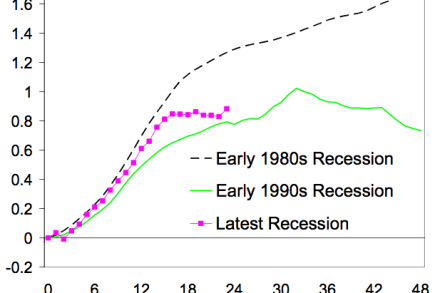
Today’s new economic data gives a handy piece of ammo to the Conservatives.  It is untrue that, as Gordon Brown says, this recession was somehow milder than others. The economy contracted by 6.3 percent this time – it was 3.8 percent in the 1980s recession and just 2.4 percent in the early 1990s recession. I feel confident that the Conservatives will get this point across clearly, next time that Brown boasts that this recession has been somehow milder, thanks to his decision to “intervene” (ie, double our national debt).

Cameron starts to pull the Tory campaign out of the fire

The headlines will be "score draw", but I’d say Cameron won – and comfortably. I write this as someone who could have happily have sunk a few pins into a voodoo doll of David Cameron earlier on this evening – for taking the Conservatives (and Britain) to this appalling point where he may yet lose the election. But he raised his game, substantially. At best, he spoke with passion and authenticity. This time, he looked like he was fighting for his political life, which (of course) he is. Things are looking up. Here’s my participant-by-participant verdict: Brown Brown was his normal automaton self. He does tend to mangle his words, and his attempts at simplification backfire.

Britain’s brain drain

Voting with one’s feet is always the most sincere sign of faith – or despair – in a country and its government. And for many the departure lounge, rather than the ballot box, is the surest route to better schools, lower tax and safer streets. The phrase “brain drain” was used in the 1970s and isn’t now – strange, because the emigration rate has doubled to 1,080 a day (ONS data here).  It’s not just Brits: over the years, even the immigrants who have lived here for long enough are scarpering. But because of our obsession with immigration, we haven’t really paid attention to those leaving. And incomers do outnumber emigrants by about 3-2.

Inflation is the price of Brown’s recklessness

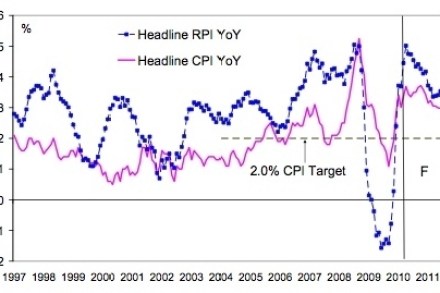
Who would have thunk it? Inflation has again “surprised” on the upside – 3.4 per cent against a 2.0 percent target. Why so high? Even the return of 17.5 percent VAT does not justify this bounce. Might it have something to do with all those bank notes which were being printed by the Bank of England? Might interest rates be going up now to control this inflation – and, if so, what impact would this have on a UK economy which is already the most indebted of any major economy in history? The March figures show Britain has, by some margin, the highest inflation of any major European economy: it’s way higher than that of France (1.7 percent) Spain (1.5 percent) Italy (1.4 percent) or Germany (1.2 percent). And in America, 1.1 percent.

How Whelan & Co. exploit Britain’s libel laws

The Charlie Whelan problem is intensifying for Labour, with more revelations in the Mail on Sunday today taking on from our cover story in this week’s magazine. Whelan’s behaviour may be no worse than that of Ed Balls and Gordon Brown – but he is more careless. Like McBride, he was actually caught: and his tactics documented in a formal seven-page report. Not the sort of document you want surfacing during a campaign. So it's little wonder why Whelan used Carter-Ruck to try and deter The Spectator from any further investigation in the bullying case: it threatens to expose Gordon Brown’s entire modus operandi and the methods which he uses to control the party. And, for that matter, run the country.

Cameron has a policy agenda to change Britain – he should tell us about it

Cameron has not, alas, broken free of the never-ending opinion poll bungee jump which is the story of his leadership of the Conservative Party. Cleggmania is a bubble – but the thing about bubbles is that one can never quite tell when they will burst. The Tories, who have lost the most votes due to this bubble, will have their needles out. But in my News of the World column today I suggest they focus on policy because they do have hard ideas that could radically change Britain. Cameron missed a trick by failing to mention his single best policy, Gove's school reform, last week.  On immigration, his plan for reducing it is the most radical promise on the market, and his linking it with welfare shows maturity and sophistication.

The novelty of Clegg wins it for him

“I agree with Nick”, said Brown – and, as it turned out, so did most of the people YouGov polled. Brown lived right down to expectations, Cameron lived up to them (but didn’t exceed them). Few would have had any expectations from Clegg: what we political pundits know to be his clichés will be heard for the first time in many living rooms tonight. Each used tactics we’re familiar with. Brown opened his verbal machine gun, and sought to mow down the audience (they surrendered early on). David Cameron was fluent, articulate – as anyone who has followed politics had come to expect. But dazzling? No. He was subdued, seemed to be biting his tongue at times. He didn’t attack Brown, which seemed to be deliberate.

How Charlie Whelan killed New Labour

Last summer, The Spectator received a letter from Charlie Whelan's solicitors complaining about this post - where we mention their client's spot of bother with his colleagues at Unite. Carter-Ruck were instructed on one of the no-win-no-fee deals: it cost Whelan nothing to sue, but could cost us £thousands to defend. So the lawyer's letter is, by itself, an effective form of intimidation. A magazine with a small budget obviously faces huge pressure to do what he wanted: apologise, pay up and (suspiciously) undertake not to pursue the story any further. Under the circumstances, The Spectator could do only one thing. Our full investigation into Charlie Whelan is the cover story of tomorrow's magazine (see image, left).

The Tories’ great manifesto launch

Battersea Power Station is chosen as an allegory for Britain – “a building in need of rejuvenation in a country in need of rejuvenation” says David Cameron. As for Cameron’s speech – great stuff. He delivered the ‘empowerment’ message and gave hard examples, and wrapped it up into a greatest hits of his best soundbites (none the worse for that). It was so up our street that, at times, I thought he was working his way through the leader in the current edition of The Spectator. I’ll save my full verdict on Cameron’s speech and positioning for the magazine this week.  But here’s the rest of the launch. The Tories went for an ensemble, with each of the Shadow Cabinet taking turns to read out the lines.

What Brown really offers Britain…

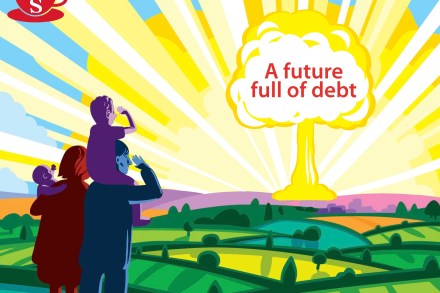
Labour's manifesto cover has been the cause of much merriment online - creating what the Americans call "subvertisments". ConservativeHome has already lined up some spoofs. We asked Carla Millar, who has done quite a bit of work for The Spectator, to do a version with a mushroom cloud of debt in the middle and the family shielding their eyes. This is the result.

What would you ask Cameron?

David Cameron takes a few journalists with him on each of his one-day tours, and it's my turn tomorrow: 6am start. I should be able to get  half an hour or so with him, to do an interview for The Spectator. As is customary, I'll try and ask him some questions on behalf of CoffeeHousers - so please add any thoughts as a comment below.

Even Cable can’t defend the Lib Dems’ misleading poster

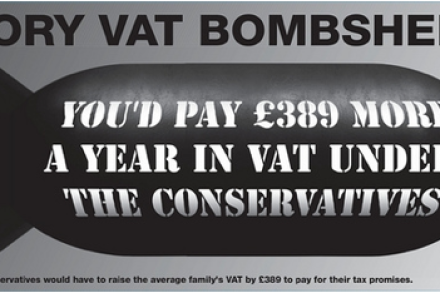
This poster by the LibDems is perhaps the most dishonest one of the campaign so far - and Vince Cable has pretty well admitted it to Jon Sopel on the Politics Show. Here's the exchange. Jon Sopel:  I mean let’s leave aside whether or whether not there is a black hole in the Tory’s finances. Leave that to one side. You don’t know factually, that they are going to raise VAT. That is your conjecture. St Vince Cable: It is a conjecture and it’s a reasonable assumption and I wouldn’t claim anymore than that. JS: And that £389 is a rough figure plucked... VC: "It’s a ball park estimate of what it would require in order to fill that gap, and it seems a reasonable way of expressing that argument.

An ICM marginals poll points to a hung parliament

The News of the World has its expensive and much-awaited ICM poll of the marginals tomorrow. There is some good news for Cameron, and some not-so-good news. First: 66 percent of voters in the marginals agree with the message "it's time for change". Bad news: a surprisingly large number think that Nick Clegg represents that change. A Lib Dem surge means that Tory swing is just 6 percent in the marginals, versus 5 percent nationally. Where is the Lord Ashcroft magic? In James's political column this week, he says the Tories had been so confident about the marginals that they reckon they need a 5-point lead nationally to win, rather than the 8-point lead previously assumed. The News of the World/ICM poll challenges that narrative.

The Times is wrong about the Tories’ marriage tax break

Since The Times moved its leaders on to page two, they've also taken on a new vitality. For years, they were the voice of solid good sense. It was pretty difficult to disagree with them. Now, they are more polemical, more risk-taking - and more wrong. But I'm not complaining: I far prefer reading a fiesty opinion with which I disagree, than boring opinion that I nod quietly along with. And I could not disagree more with the leader today denouncing Cameron's marriage tax break. Let's kick off: "This is surely no time to be giving money away so that people can just carry on doing what they are already doing, namely being married. In a long philosophical journey in Opposition, the Tories appear to have alighted on moral authoritarianism advanced by economic interventionism.

The case for voting Conservative

Why vote for Cameron? The reasons for voting against Gordon Brown are so numerous that the positive pro-Tory reasons for voting are often lost. This week's Spectator gives you all the ammo you need to win around wavering friends, colleagues and family. We have restricted ourselves to the ten most compelling points. I summarise them below: 1. School reform. In itself, it's enough reason to vote Tory. Gove has specifically promise that within four years of a Tory government everyone will have an independent school offering to educate their kid for free. This should have been a 1981 Tory proposal, but Keith Joseph lost a battle with the civil service (after he recruited a young Cambridge graduate named Oliver Letwin to help him fight it). 2.

Three lessons for the Tories on immigration

The witterings of Phil Woolas about immigration yesterday - where he accused The Spectator of contorting immigration figures and double-counting immigrants - have landed him in plenty trouble. Stephen Timms was on the Daily Politics today and conceded that Woolas was talking out of his hat. They weren't our figures, they were from the ONS - and compiled under orders from Eurostat with its Labour Force Survey (LFS) scheme. Andrew Neil has written it up in a blog here. The government is at sea because even ministers in charge of the relevant departments have no idea about the scale of immigration in Britain. This wee farrago brings three lessons for the Conservatives. 1. Honesty about immigration is crucial.

Woolas on the rack

Phil Woolas has just been confronted on Daily Politics about immigration figures which we uncovered on Coffee House yesterday, showing 99 percent of new jobs since 1997 are accounted for by immigration. His response is (unintentionally) hilarious. He is immigration minister, yet appears not to know what immigration figures mean. Here's the transcript: Phil Woolas: I think that the Spectator's analysis, perhaps not surprisingly, is confusing two completely separate things Andrew Neil: These are Office of National Statistics figures.which we checked this morning. Do you accept that there are 1.7 million new jobs for people of working age between 16 and 64, correct? PW: Yes AN: And according to the Labour Force Survey, compiled by the Office of National Statistics. 1.