
With Donald Trump’s threat that ‘a whole civilization will die… never to be brought back again’ looming on Tuesday night, a temporary two-week ceasefire between the United States and Iran was agreed. The arrangement, mediated by Pakistan’s Prime Minister Shehbaz Sharif, is fragile, but showed who the leading players in the current conflict are.
Starmer seems to have created an image of himself as an influential but essential eirenic figure on the world stage, a diplomatic heavyweight with invaluable convening power
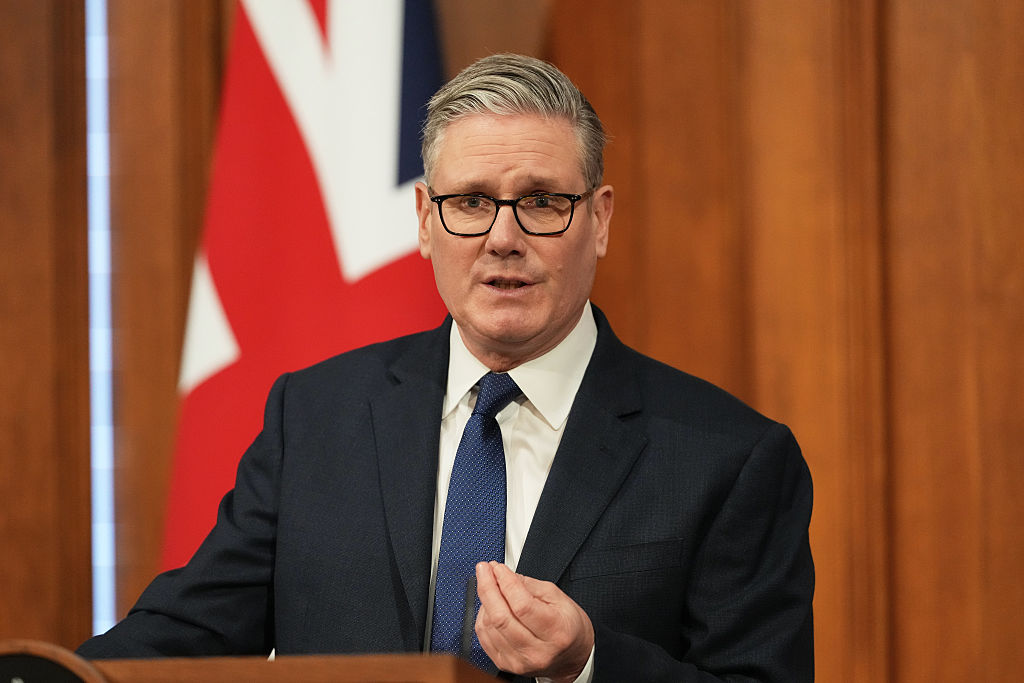
Sir Keir Starmer, by contrast, appeared to be confused about his own role in the conflict. On 1 April – perhaps an unfortunate date – the Prime Minister gave a press conference at Downing Street, in which he said:
‘Let me say once again: this is not our war. We will not be drawn into the conflict. That is not in our national interest.’
Only a day after his statement, Foreign Secretary Yvette Cooper convened a conference call of more than 40 nations from every continent as well as representatives of international organisations like the European Union and the International Maritime Organisation. The meeting discussed how to achieve ‘the immediate and unconditional reopening of the Strait and respect for the fundamental principles of freedom of navigation and the law of the sea.’
The Prime Minister and his colleagues were not wrong to regard the closure of the Strait of Hormuz as a very serious development, with a direct and adverse effect on Britain’s economic, commercial, political and military interests. As has now been well rehearsed across the media, the Strait of Hormuz is a critical maritime chokepoint through which flows around 20 per cent of the world’s oil and liquefied natural gas and a third of the global fertiliser trade. The restriction of shipping through the Strait over the past five weeks has already seen oil prices soar. From Britain’s point of view, we already have some of the highest energy prices in the world and the cost of living is an ongoing political battlefield. The last-minute agreement brokered by Pakistan on Tuesday, which will see the Strait reopen for the time being, does not have an air of permanence about it.
Yet Starmer seems to have created an image of himself as an influential but essential eirenic figure on the world stage, a diplomatic heavyweight with invaluable convening power. We all remember the ‘Coalition of the Willing’, the multinational alliance he and President Emmanuel Macron of France created to deploy an unspecified force of unspecified size to carry out an unspecified mission in Ukraine after a ceasefire is agreed with Russia (spoiler alert: the conflict in Ukraine is ongoing).
Now, with astonishing naïvety or chutzpah, this new collection of would-be partners is being dubbed another ‘coalition of the willing’. There were discussions about ‘a number of areas of possible collective, coordinated, action’ by the members of the coalition, including ‘send[ing] clear and co-ordinated messages to Iran to permit unimpeded transit passage through the Strait of Hormuz’, as if the problem were simply about a lack of clarity. The conditional ceasefire demonstrates the absurdity of that proposition.
If the Strait is closed again – and speaking more slowly and loudly to Tehran does not achieve its re-opening – the coalition says it could introduce ‘co-ordinated economic and political measures, such as sanctions’ and ‘joint arrangements to support greater market and operational confidence’. It does not read like a list of ingredients for a diplomatic coup which would astound Metternich with its brilliance or daring.
The coalition seems to acknowledge that not much can be done if the Persian Gulf reverts to a warzone. Yet that in itself points to fundamental weaknesses. It is abdicating responsibility until a permanent cessation of violence comes about, while knowing the coalition’s members have no power whatever to bring that cessation.
There is also a question of credibility. Recent weeks have mercilessly exposed Britain’s diminished military capabilities, particularly the projection of maritime force. Currently only one of the Royal Navy’s five Astute-class attack submarines, HMS Anson, is operationally available, and she was in Australia when the conflict erupted. Of the six sophisticated but temperamental Type 45 air defence destroyers, only two are available; it took three weeks to deploy HMS Dragon to Cyprus after Britain’s sovereign base areas on the island came under missile attack by Iran or Iranian proxies at the beginning of March. HMS Dragon has now been forced to put into port at an undisclosed location because of problems with her drinking water supply.
More directly shaming, given that Iran is believed to have mined at least parts of the Strait of Hormuz, the Royal Navy withdrew the last of its four Hunt-class minesweepers, HMS Middleton, from its base in Bahrain at the end of January. The final humiliation was that she had to be transported back to Britain rather than travelling under her own power as she could no longer be certified as seaworthy.
Britain’s maritime cupboard is virtually bare in terms of significant assets: the Royal Navy is already badly overstretched. We desperately desire peace but are unprepared for war. On what does the government’s claim to international leadership rest? It is not military might, nor is it financial heft. Donald Trump’s recent bad-tempered tirades against Starmer suggest our role as a bridge between Europe and the United States is in poor repair.
Perhaps Starmer and Cooper have embraced the very modern philosophy of ‘fake it till you make it’. Though it is hard to imagine the recent conference of the ‘coalition of the willing’ (maritime variant) caused much unease in Tehran. It felt much more like a desperate act of self-reassurance that Britain is playing an active and responsive role in trying to resolve the growing energy crisis, while we know that the power lies in Washington and Tehran.
All diplomacy has elements of play-acting, of pretend. Executing it well is genuinely a formidable skill, but I have a nagging feeling our government is trying to persuade itself that Britain still counts and has a role to play here. Political missteps and military weakness have undermined almost all our potential influence in this crisis.






Comments