Douglas Murray

Douglas Murray

Douglas Murray is associate editor of The Spectator and author of The War on the West: How to Prevail in the Age of Unreason, among other books.

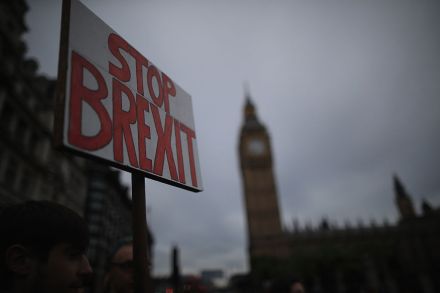
Are Tories fanatics? The New York Times thinks so

The New York Times’s strange jihad against post-Brexit Britain continues. Some readers may have missed the paper’s insistence that having only just finished eating mutton, the British public are currently stock-piling food and all but preparing to start eating each other (see here, here, and here just for starters).  But yesterday they have returned to the fray with the international edition of the paper carrying a front-page piece declaring ‘Extremists hijacked UK politics’.  The online version of the story is headlined ‘A fanatical sect has hijacked British politics’.

The confusing modern rules of telling a ‘joke’

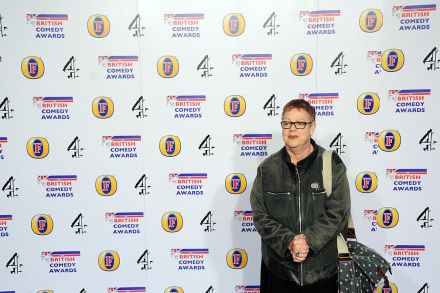
The pace of outrage is such these days that before anybody has thought through any one outrage we are all expected to have moved onto the next one. So while everyone is still trying to work out the precise etiquette when female protestors carry out an orchestrated protest at a black tie event, perhaps readers will indulge me if I return to a previous outrage. People with a long memory will remember the dispute from not much more than a week ago regarding the comedian Jo Brand and her comments on a BBC platform in which she jokily encouraged milkshake-throwers to upgrade to throwing acid at "unpleasant characters". Reasonable people divided in a number of ways over this.  Some people said that Jo Brand was inciting violence.

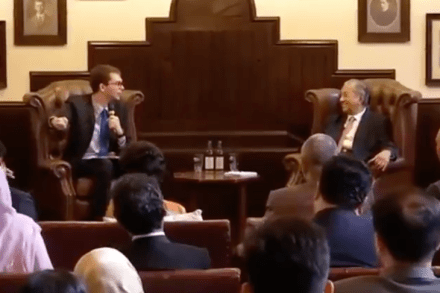
Mahathir Mohamad and the hypocrisy of Cambridge University

One of the most enjoyable videos to watch on YouTube features Colonel Gadafi. I am not referring to those snuff videos which cover the internet in which the Libyan leader is shown getting the sharp end of the Libyan peoples’ emotions. Rather I refer to the Colonel’s seminal, though too infrequently referenced, address to the academics and students of the London School of Economics in 2010. On that occasion the Libyan dictator was given a truly magnificently fawning, indeed rather flirtatious, introduction by a female academic. She also read out a message of support from the then-director of the LSE who made some joshing jokes about how good it would be if Gadafi could only bring some Libyan weather to London.

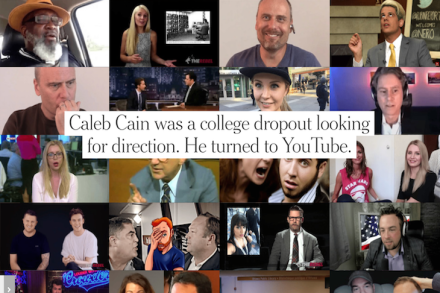
The New York Times and the problem with ‘radicalisation’

One of the words that has become increasingly useless over recent years is ‘radicalisation’. As more and more terrorist attacks took place across the West in recent years the word got trotted out with some utility. Al-Qaeda and Isis fighters were reported to have been ‘radicalised’. Soon a whole arm of dubious expertise grew, purporting to be able to trace the various ‘paths’ to radicalisation. But at some point in the present decade the word became used, not just as a term of faux-science, but as a way to dismiss almost any position against which a certain individual or group of individuals were opposed. Voters were said to have been ‘radicalised’ before putting a mark in the box beside the name of Donald Trump in 2016.

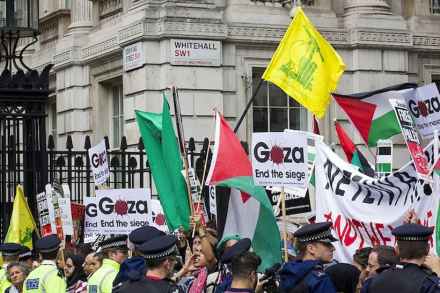
Why this year’s al-Quds Day march could be different

This weekend might provide an interesting spectacle. On Sunday the annual al-Quds Day march sets off in London from outside the Home Office. Of course al-Quds Day is the day inaugurated by the late bigot Ayatollah Khomeini, and his initiative allows peace-loving Khomeinists to stroll along the streets of London (among other capital cities) calling for the destruction of the Jewish state. Historically the event has always attracted controversy, not just because it is organised by the farcically misnamed ‘Islamic Human Rights Commission’ but because the speakers and organisers routinely make their intentions perfectly clear.

Why do some remainers think ageism is acceptable?

Doubtless there is little cross-over between the readership of The Spectator and that of the New European. Not just because sales figures show that almost nobody reads the strange paper set up after the 2016 Brexit vote, but because while The Spectator includes a wide array of different views, the business model of the New European appears to be based simply on whipping up as much prejudice, grievance and malice as it is possible among those who voted ‘Remain’ in 2016. When people talk about the ‘politics of hate’ such a publication must surely be what they have in mind? But occasionally the publication and its contributors do something so disgusting that it isn’t possible to completely ignore them.

The Scruton tapes

Sometimes a scandal is not just a scandal, but a biopsy of a society. So it is with the assault on Sir Roger Scruton, who in recent weeks has been smeared in the media, fired by the government and had his life’s work assailed. Scruton is the latest, though far from the first victim of the modern outrage mob. It is now four years since the Nobel prize-winning scientist Tim Hunt was fired by University College London (among other institutions who were lucky to have him). That happened after one member of the audience at a conference in Korea tweeted something he had said about working with women and professed outrage at the comment’s alleged sexism. None of the institutions which dropped Hunt asked if there was any case for the defence.

Notre Dame’s loss is too much to bear

Civilisation only ever hangs by a thread. Today one of those threads seems to have frayed, perhaps snapped. It is impossible to watch the footage coming out of Paris, all that can be done is to groan and turn away. It is not possible to watch the spire of Notre Dame collapse. It is not possible to watch the great cathedral consumed by fire. Evelyn Waugh once said that in the event of a fire in his house, if he was able only to save his children or his library, he would save his library because books were irreplaceable. Only at a moment such as this is it possible to concede the slightest truth in that remark. Almost anything could be borne rather than the loss of this building. There will be recriminations, of course.

Last rights | 17 April 2019

Four years ago, the Assisted Dying Bill was overwhelmingly defeated in parliament. The euthanasia debate hasn’t disappeared, however. One recent poll showed that 90 per cent of the UK’s population now support assisted dying for the terminally ill. So is a relaxation of the law inevitable? Would it represent progress? Or is it very dangerous? Our literary editor Sam Leith joined our associate editor Douglas Murray to discuss.   Sam: I find myself, possibly in accordance with my position as one of The Spectator’s hand-wringing liberals, in favour of assisted dying but I want to be clear on the narrowness of that position. The Assisted Dying Bill would not have allowed us to euthanise the incapable.

When will Roger Scruton’s detractors admit they were wrong?

In American law there is a concept called ‘the fruit of the poison tree’ which means that if the source of some alleged evidence is rotten, or has been wrongfully obtained, then everything coming from it is also recognised as tainted. After this past week I would suggest a similar concept enters the lexicon in British journalism. Perhaps we might call it ‘the fruit of the Eaton mess’. I refer of course to the ‘interview’ with Sir Roger Scruton that George Eaton – deputy editor of the New Statesman – published last week. The interview led not only to Scruton’s firing from an unpaid government-appointed position, but to a set of excruciatingly inaccurate pieces in the rest of the media.

Notre Dame’s loss is too much to bear | 15 April 2019

Civilisation only ever hangs by a thread. Today one of those threads seems to have frayed, perhaps snapped. It is impossible to watch the footage coming out of Paris, all that can be done is to groan and turn away. It is not possible to watch the spire of Notre Dame collapse. It is not possible to watch the great cathedral consumed by fire. Evelyn Waugh once said that in the event of a fire in his house, if he was able only to save his children or his library, he would save his library because books were irreplaceable. Only at a moment such as this is it possible to concede the slightest truth in that remark. Almost anything could be borne rather than the loss of this building. There will be recriminations, of course.

Roger Scruton’s sacking exposes the Tories’ cowardice

So the New Statesman decided to interview Sir Roger Scruton. Perhaps there are those who think that Scruton should not have agreed to be interviewed by the New Statesman, the left-wing magazine being unlikely to conduct a fair interview. But Scruton was the magazine’s wine columnist for many years, and under the editorship of Jason Cowley the magazine has been a slightly fairer and less battily leftwards publication than it was of old. But today the magazine’s deputy editor, George Eaton, took to social media to announce the results of what he is parading as a 'gotcha' interview. The interview – which Eaton conducted himself – was, he promised, positively crammed full with ‘a series of outrageous remarks’.

Capital punishment

Is now a good time to talk about Jews and money? The Jewish Museum in London thinks so, and perhaps it is right. Motifs of Jewish financial chicanery that have never really gone away are back. The internet age has allowed memes about Rothschilds, rootless financiers and other thinly veiled claims of Jewish duplicity to thrive as they haven’t for several generations. A film at the start of this new exhibition at the museum in Camden gives some context, with clips of recent anti-Jewish statements from the likes of Louis Farrakhan and other conspiracy theorists. It also includes Donald Trump talking about ‘elites’ draining power from America, which strikes me as an unfair overclaim about what the contents of this poisonous cauldron really are.

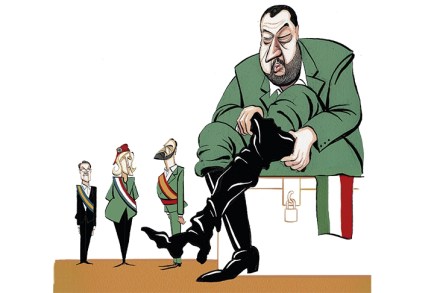
Salvini’s common touch

While Britain continues to try to struggle its way out of the EU, perhaps it is wise to consider what is happening inside the bloc itself, not just in Paris where the fumes from burning cars fill the apartments and approval ratings for Emmanuel Macron continue to slide as he engages in a national listening exercise (which actually consists of him delivering Chávez-length lectures to the French public). But over the border in Italy, where the tone of the era is being set. Being both interior minister and deputy prime minister is a tremendous position for Matteo Salvini to be in.

Donald Trump is right about Israel and the Golan Heights

Earlier this week President Trump made one of the most reasonable decisions of his Presidency. His administration formally recognised Israeli sovereignty over the Golan Heights. Inevitably the move has been welcomed in Israel, condemned in Europe and generally shrugged over in the Middle East. Of course various people have come up with their own explanations for why Trump made this decision. In the New York Times Thomas Friedman claims that Trump has done it only because he wishes ‘to get more campaign donations from far-right Jewish mega-donor Sheldon Adelson.’ I don’t know how Friedman knows this, nor how he has achieved such mega-access to the President’s head. My own guess is that Friedman just made it up.

Diary – 21 March 2019

It isn’t easy getting around the Gulf these days. The blockade on Qatar means no direct flights from most of its neighbours, so I spend hours of layover looking at the great mountain ranges of Muscat from the antiseptic tedium of my transfer terminal.     My main reason for coming to the region is to speak in Doha for the newly revived ‘Doha Debates’. After my speech, a more than usually aggressive interviewer demands to know why Britain and other European countries have not taken in more Syrian migrants. The Emir’s sister and others are in the audience and I cannot pass up the opportunity to poke my hosts in the eye. I ask how many Syrians have been made citizens by Qatar.

Who should we blame for the Christchurch atrocity?

A frequent complaint heard from Muslim communities in recent years has been irritation and anger over any suggestion that Muslims – as a whole – need to apologise for attacks carried out in the name of their religion. I have sympathy for this irritation, tying as it does innocent people to the actions of guilty ones. But since the attack in New Zealand was carried out by a non-Muslim who was targeting Muslims, whether or not it needs to be said still it should be said – indeed must be said – that non-Muslims abhor, are disgusted, outraged and sickened by somebody going into a place of worship and gunning down innocent people. We condemn it in the most fulsome and unreserved terms.

Who should we blame for the Christchurch atrocity? | 18 March 2019

A frequent complaint heard from Muslim communities in recent years has been irritation and anger over any suggestion that Muslims – as a whole – need to apologise for attacks carried out in the name of their religion. I have sympathy for this irritation, tying as it does innocent people to the actions of guilty ones. But since the attack in New Zealand was carried out by a non-Muslim who was targeting Muslims, whether or not it needs to be said still it should be said – indeed must be said – that non-Muslims abhor, are disgusted, outraged and sickened by somebody going into a place of worship and gunning down innocent people. We condemn it in the most fulsome and unreserved terms.

The false equivalence between ‘Islamophobia’ and anti-Semitism

I have been travelling in the Middle East for the last few weeks and slightly regret returning to the maelstrom of ancient animosities and unbridgeable sectarianism that is modern Britain. But in my absence I see that one of the worst tropes of our time has been stalking unhindered across the land. That is, of course, the latest push to make an equivalence between anti-Semitism and the crock term ‘Islamophobia’. It is not just in the UK that this play has been made. In America over recent days people have been able to follow the progress of the new Muslim congresswoman Ilhan Omar, with her supporters deciding to deflect attention from her expressions of anti-Semitism by claiming ‘Islamophobia’.

Bloody liar

It is more than 15 years since the Bloody Sunday soldiers last appeared in public. For months I sat in the room with them to watch their evidence at Lord Saville’s inquiry. And while Lionel Shriver is right that the sight of terrorists benefiting from an immunity denied to our soldiers is grotesque, there are competing qualms. Not only because British soldiers should be held to a higher standard than terrorists. But because, having watched all of the Bloody Sunday shooters testify, I can say with certainty that they include not only unapologetic killers, but unrelenting liars. As one soldier after another appeared before Lord Saville, it became clear that the soldiers of 1 Para were intent on spurning this last effort to get to the truth of what happened that day.