Deborah Ross

Deborah Ross is the chief film critic of The Spectator

Waiting for Godot – but with plot

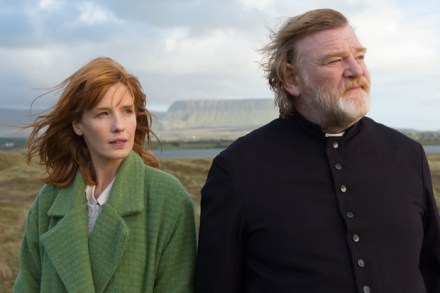
If the very first scene of Calvary doesn’t immediately draw you in there’s every chance there is something seriously wrong with you and I would urge you to book an appointment with your GP. It is a terrific opening and it takes place in Ireland, in a Catholic church, within the dark, intimacy of a confessional box, as Father James (Brendan Gleeson) listens to a voice from the other side of the partition recounting how he was repeatedly sexually abused by a priest when he was a child. This parishioner wants revenge, but as his abuser is now dead, he will kill Father James instead, in a week, on the beach. What better way, in fact, to get back at the Church than to murder a good priest, an innocent, and on a Sunday too?

The Double will stay in your mind, like a bit of food caught in a tooth

I should warn you that if you go see The Double it is one of those films that will trouble you long after the event. It will trouble you at breakfast and it will trouble you at lunch and it will trouble you as you go about your business, whatever that might be. Yes, a pain — haven’t I got enough troubles of my own? Haven’t I got enough to think about as it is? — but it is so singular and compelling, there is every chance it is worth it. It’s directed by Richard Ayoade, his second feature after the terrific Submarine, who is known to TV viewers as Moss from The IT Crowd as well as being a regular guest on those comedy panel games that have been told to include more women, like we don’t have better things to do.

What backing singers are really thinking behind the ‘ooh, ooh, oohs’

Have you ever looked at backing singers and thought: what is their story? Do they or have they ever prayed for their time to come? As they are going ‘ooh ooh, ooh ooh’ behind Kylie are they thinking, ‘I want to kill Kylie’? Do they mind that no one knows their name? Do they ever ponder why it’s so often white artists with black backing singers and never the other way round? I have often wondered about all this, and now realise if I’d stopped idling over such questions, got off the sofa and done some digging, I could now be in possession of an Oscar. I’m a fool to myself; I truly am.

These screen suicides deserve a nudge off the ledge

A Long Way Down is about four would-be suicides who meet for the first time on the top of a tall London building, intending to jump, but instead of jumping they decide to hang around and annoy the hell out of us for the next 90 minutes. Had I known what I know now, and had I also been on top of that tall building, I might well have given them all a hefty nudge. Based on the Nick Hornby novel, which, in itself, may not be the most successful of Hornby’s novels, it opens on New Year’s Eve on top of that building as our suicidal quartet truck up. Firstly, it is Pierce Brosnan as Martin Sharp, a former breakfast television star whose fling with a 15-year-old — ‘I thought she was 25!’ — led to a spell in prison and the end of his career and marriage.

Are you a lobotomised teenager? Then Need for Speed is for you

OK, Need for Speed, if we must, and we must because I sat through it (running time: 130 minutes) and do not see why you should be spared. Need for Speed is based on a video game and here is the plot synopsis: ‘Vroooooooooom! Vroooooooooom! Vrm, vrm, vrm...VROOOOOOOOOOM!’ And it’s the sort of ‘Vroooooooooom!’ which vibrates behind your forehead, making it feel as if it may blow it off, while also making it hard to doze or zone out mentally, which is a pain.

A film to enjoy with your eyes

The Grand Budapest Hotel is the latest Wes Anderson film and it is beautiful to look at, scrumptious, luscious, such a delicious confection I would have marched up to the screen and licked it if only, at the screening I attended, Mark Kermode had not been occupying the seat in front, and it would have meant scrambling over him, and maybe ruining his hair. (A quiff like that doesn’t hairdress itself, you know.) So I stayed put, feasting with my eyes — on the film, not the quiff — so it was sensually satisfying, but emotionally satisfying? Not so much, alas. Divine pastries, divine clothes, divine period trappings, but, as with most of Anderson’s films, I was never moved or understood what mattered, if any of it mattered.

I’m proud to say The Book Thief couldn’t pull my heartstrings

The Book Thief is based on Markus Zusak’s novel of the same name which, although written for young adults, appears beloved by many, judging from the readers’ reviews on the internet, and the frequent declarations of ‘it’s the best book I’ve ever read!’, and there is our first worrying clue, right there. Over the years, of which there have been more than enough — I am quite ready to shuffle off now — I have come to learn that when anyone declares a book ‘the best book I have ever read!’ it tends to be the only book they have ever read.

You may be the Only One Left Awake at Only Lovers Left Alive

Jim Jarmusch is the noted American ‘cult director’, and if you were to judge him solely on the basis of Only Lovers Left Alive you’d be minded to think the cult can keep him.  It’s a take on the vampire genre, which is fair enough, as who hasn’t had a go, but this is so lethargically meditative and so packed with pompous in-crowd references and such a monotonous yawn that if, by some miracle, you make it to the end, I should warn you there is every chance you will find yourself the Only One Left Awake. Poor you. Tom Hiddleston and Tilda Swinton star as Adam and Eve, which may mean they were the first people on the planet, or it may not mean that at all.

Dallas Buyers Club – Matthew McConaughey gives the best performance of anyone’s career

Although you’ll have heard that Dallas Buyers Club is fantastic and Matthew McConaughey gives the performance of his career, I know you won’t believe it unless you hear it directly from me so here you are: it is fantastic and Matthew McConaughey gives the performance of his career. In fact, it may be the best performance of anyone’s career. It’ll blow your tiny minds. It blew my tiny mind. ‘That blew my tiny mind,’ I even said afterwards, so it has to be true. Dallas Buyers Club is based on the real story of Ron Woodroof, a difficult hero. Ron, when we first encounter him, is attending a rodeo and having rushed, seedy sex with two women in one of the holding pens.

Can Lance Armstrong squirm? We don’t know because The Armstrong Lie doesn’t make him

Alex Gibney’s The Armstrong Lies is fascinating as far as it goes but it may not go as far as you would like, and may not ask the questions you would like. It’s a documentary portrait of the American cyclist Lance Armstrong: seven-time winner of the Tour de France, worldwide symbol of physical courage (having survived testicular cancer in his twenties), founder of the Livestrong Foundation, which has raised millions for cancer sufferers, and something else. It’ll come to me in a minute. Talk among yourselves. Oh, yes. Cheat. Also, liar. He lived a cheating lie, all day, every day, throughout his sporting career. He lived a cheating lie even as he is pulling on his socks or taking the rubbish out. But Gibney never gets to the heart of him.

August: Osage County? Why not make your own?

If you and your family are bored — if, for example, it’s one of those dull Sunday afternoons that seem to drag on for ever and it feels as if it’s never going to be time for The Antiques Road Show — you could gather together and play your own version of the family drama August: Osage County. Firstly, you will need to pretend it is hot, as this is August, in Osage County, Oklahoma, where it is not just hot, but Cat on a Hot Tin Roof hot, and so you will all have to repeatedly fan yourselves and say: ‘It’s so hot’ or ‘the heat!

Fists of cash, hookers and a candle in your bum palls after a while

Martin Scorsese’s The Wolf of Wall Street will set the cat among the pigeons as a number of films do. 12 Years A Slave set the cat among the pigeons with some critics claiming it was ‘torture porn’ and other people taking to the blah-blah-blah and jabber-jabber-jabber of the Twittersphere to say they had no intention of seeing anything ‘so harrowing’. (Luckily for them, I plan to open shortly a specialised cinema, The Comfort-Zone Cinema, possibly on the Finchley Road, which will never show anything upsetting, and Hello, Dolly! every other Tuesday.) This time out, the blah-blah jabber-jabber will, I imagine, take the following form: does Wolf exult in the excesses it intended to satirise? Does it get off on its own virulent misogyny rather than indict it?

Deborah Ross: 12 Years a Slave harrowed me to within an inch of my life

Steve McQueen’s 12 Years a Slave goes directly to the heart of American slavery without any shilly-shallying — unlike The Butler, say, or even Django Unchained — and is what I call a ‘Brace Yourself’ film, as you must brace yourself for horror after horror, injustice after injustice, shackles, muzzles, whippings, rapes, hangings. You will be harrowed to within an inch of your life, as perhaps is only right, given the subject matter, but you will not wish to flee your seat. You will recoil. You will flinch. You will say to yourself, ‘Oh no, not again.’ But the story will seize you with such a visceral power you will be rooted to the spot. I know I was and I’m not easy to root. Mind everywhere, usually.

‘Mandela: Long Walk to Freedom’ is a very, very long walk indeed

The biopic Mandela: The Long Walk to Freedom is a timely tribute, and an earnest and respectful and well-meaning one, but it does seem like a very, very long walk indeed. It’s a slog, a plod, a trudge uphill, and of all the things you may have wished to say to Nelson Mandela, given the opportunity, what you will find yourself saying here is: ‘Put your bloody skates on, man. We have homes to go to, and other fish to fry!’ This is not, I’m assuming, what you thought you’d ever most wish to say to Mandela, given the opportunity, but the fact is: you will never have wanted anyone to put their skates on quite so much in your entire life.

What it’s like to spend 90 minutes in the women’s loo of a thumping nightclub

Powder Room is a small British film all about women and starring only women — boo-hoo, men; my heart bleeds for you all — yet it is almost entirely set in a nightclub, so whether you enjoy this film may depend on how willing you are to spend 90 minutes in such a club along with all that thumping music and the flashing lights and the scrabbling to get to the bar. As a rule, this is how I’d feel about such a prospect: I’d rather shoot myself in the head. However, I accept this doesn’t hold true for everyone and, from what I’ve learned over the years, I suspect it doesn’t hold true for most Spectator readers, who are out clubbing until all hours most nights of the week.

Deborah Ross: If you don’t enjoy Saving Mr Banks, there’s something wrong with you

Saving Mr Banks tells ‘the untold true story’ of the making of the Disney classic Mary Poppins via the stand-offs between Walt and the book’s author, P.L. Travers, and it is not a taxing film. You always know where it’s going and, with its rather melodramatic flashbacks, there is no ambiguity as to where it is coming from, but neither matters as much as they should as there is just so much joy to be had otherwise. It stars both Tom Hanks and Emma Thompson (you spoil us, ambassador!

The Butler, about a black domestic in the White House, is too painfully obvious

The Butler tells the story of an African–American butler at the White House who served eight American presidents over three decades and it plays as a ‘greatest hits’ of the civil rights movement, along with whatever else they decided to throw in, like Vietnam, apartheid, and Lyndon B. Johnson on the can. (Actually, Lyndon B. Johnson on the can was rather the highlight.) It is heavy-handed, predictable, bland and so contrived in its sentimentality I sniggered at what should have been the moments of emotional impact. However, all was not lost, as I did have a nice little doze, which, as it was a morning screening, set me up quite nicely for the rest of the day. So there was that, but only that, alas.

Ryan Gosling couldn’t play Taki better than Taki

Seduced and Abandoned is both a satire on film-making and a love letter to film-making and a joy. A documentary made by the director and writer James Toback, in cahoots with his friend the actor Alec Baldwin, it follows the two as they work their way round the Cannes Film Festival, trying to raise financial backing for a film inspired by Last Tango in Paris. They schmooze. They lunch. They cajole. They beg. And in the process meet, among others, Martin Scorsese, Francis Ford Coppola, Bernardo Bertolucci and Ryan Gosling as well as the billionaire shipping heir and journalist Taki, who writes the High life column in this magazine, and whom they try to tap up for $20 million. Taki plays himself, but you know what? He’s so great, he may have a future in it.

The joy of cemeteries

The idea of writing Finding the Plot: 100 Graves to Visit Before You Die first came to Ann Treneman when she was chatting with Tony Wright, formerly Labour MP for Cannock Chase. They started talking about Birmingham and she happened to remark: ‘Did you know the man who invented Cluedo came from Bromsgrove?’ His name, rather marvellously, was Anthony E. Pratt, and she’d previously written about him for the Independent. Pratt had allowed the patent to lapse before the board game took off, and had died in obscurity (although with Alzheimer’s, in an old people’s home, rather than with lead piping, in the library).

Philomena is Dame Judi’s film

Philomena is based on the true story of an Irish woman searching for the son stolen from her by the Catholic Church 50 years earlier, and although, as a cinematic experience, it could so easily have felt as if you were being repeatedly slapped round the head by a copy of Woman’s Own, it is, thankfully, quite a few notches up from that. Indeed, as directed by Stephen Frears, it is quiet, restrained, unfussy, and has, at its heart, an injustice so grave it will make your blood boil. You will also cry. Seven minutes in, and I was already crying. Not proud, but it is a fact. Dame Judi Dench stars as Philomena, which is, of course, beyond wonderful, as any film starring Dame Judi Dench will be highly watchable, whatever.