Clarissa Tan

The Royal Wedding (extended expat version)

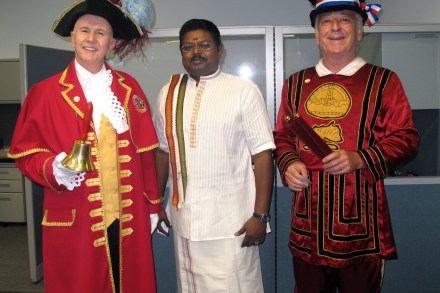
Last month, dressed as a town crier, the head of the British Club in Singapore, Sean Boyle, visited the offices of every major newspaper in the country. Accompanied by an entourage also in fancy dress, he declaimed that the British Club would be celebrating the nuptials of Prince William and Kate Middleton in a festival that would last 10 days. The reception to his announcement was warm. An editor of the Tamil Murasu, the newspaper that serves Singapore’s ethnic Indian population, left the newsroom to return dressed in traditional Indian costume, to pose for photos with Boyle (see above). The team at the Berita Harian, the Malay-language daily, gave the entourage a standing ovation.
The cost to a nation

When the West looks at Japan, it's strange that so much attention falls on the Japanese nuclear plants when the tsunami – water, mud and debris – was by far the greater killer. The picture of the tsunami damage is becoming clearer all the time. Here, from my vantage point of Singapore, is the latest summary: Deaths: 11,938 people are dead. More than 7,000 of them died in Miyagi prefecture, over 3,000 in Iwate and 1,000 in Fukushima. 15,478 people are missing. The death toll rises daily. Searches are on for orphans. Displacement: 164,200 people have been evacuated due to the tsunami and live in makeshift shelters. Only one-third of these are regularly served warm food, says a Mainichi survey.

China steps into the breach

Singapore China has lost little time pledging rescue help and aid to Japan, even though it is burying its own dead from the earthquake that shook Yunnan on Thursday. Beijing is keenly aware the world is watching it like never before – so its leaders are keen to make all the right noises. But dig deeper, and the reaction is more ambivalent, especially amongst ordinary Chinese, many of whom seem to have mixed feelings about Japan’s disaster. On sites such as Sina Weibo, China’s version of Twitter, some microbloggers have been snide – and some downright sadistic. (The Wall St Journal blog translates some here). It’s a reminder that Sino-Japanese enmity can run very deep. The war seems a long time ago for Europe, but not so in Asia.

The visit

I wish to write about a place of which I know everything yet nothing, where everything is familiar yet strange, a place where I feel I go too often, but never quite enough. This place is the same for everyone, only different. It is called, of course, Home — not the Home where you now live, but the Home where you were born and in which all things must start. I used to live in Kuala Lumpur. That is, until I was 15 and my mother rode the Ekspres Rakyat with me to Singapore, where I was to continue my studies. ‘Be careful,’ were her last words to me as she got ready to hop on the next train back to Malaysia. My mother asks you to be careful about everything. You could be sitting, quietly reading a book, and she would say: Be careful. Nowadays, I fly.