Christopher Howse

Christopher Howse is an assistant editor of the Daily Telegraph.

Low life and high style

In 1977, Roy Kerridge was a lavatory cleaner; in 1979 he was a well-known contributor to The Spectator. Yet this was no rags-to-riches discovery of a literary talent. Apart from anything else Kerridge had perfected a line in second-hand clothes — a short sheepskin coat, a brown Dunn’s suit, pastel shirts — that fitted his own style: out of fashion and down at heel. After a busy decade in the 1980s we began to hear little from Kerridge. Had his star burnt out? In 1984, a slice of Roy Kerridge’s life in the 1970s appeared in The Lone Conformist. But he had travelled the same road 20 years earlier, and now his trajectory in the late 1950s from unqualified school-leaver to a darling of the New Statesman is told in Raised on Skiffle.

The spur of the moment

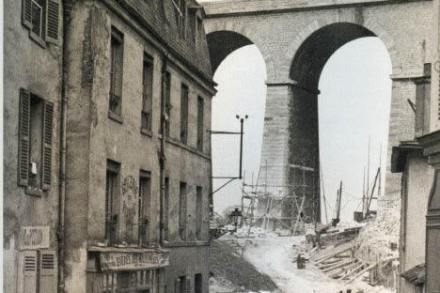
A memorable image by André Kertész shows a steam train passing over a high viaduct behind a row of peeling French houses next to a demolition site while a man in a suit and hat with his back to the train walks across the foreground, a mysterious painting-shaped item wrapped in newspaper under one arm. It is a moment caught. The viewer, naturally, tries to connect the disparate elements. And to us it is not merely a moment but a moment in a place, from the past — when steam trains chuffed and men wore hats with suits — in this case 1928 at Meudon, a Parisian suburb. In this way, photography attains the highest form of art to which painters aspired in post-Renaissance theory: that of history painting.

Heroes of the world of words

I should like to claim the credit for the Bloomsbury English Dictionary’s inclusion of the word carminative. It did not appear in the dictionary’s previous incarnation as the Encarta World English Dictionary in 1999, and I pointed out the omission at the time. Perhaps finding that the words Encarta and World English did not sell dictionaries, the publishers are now selling a second edition in Britain under this nice new name, with ENGLISH in big capitals on the spine instead of ENCARTA. Unfortunately, many of its absurdities and errors have been retained. I wasn’t the only one who laughed at the first edition. The reviewer for the TLS mocked its definition of Oxford Movement as ‘a movement ...

Sweeter than honey

The only thing I can remember about a Tesco advertisement on the television the other night is the line: ‘No rest for the wicked.’ It was meant ironically, of course. The only thing I can remember about a Tesco advertisement on the television the other night is the line: ‘No rest for the wicked.’ It was meant ironically, of course. The suggestion was not that wicked people alone shop at Tesco’s. Nor was the phrase intended as a pious invocation of the Bible, its source, Isaiah, 57:21. An anthropologist describing the clichés, or tropes, of Western cultures might form the idea that biblical religion played a lively part in daily discourse.

Jail birds

Next to his photographs of 40 women who have spent time in Low Newton prison, Adrian Clarke has juxtaposed short accounts from each of how she got there. Low Newton, near Durham, built in the 1960s and 1970s, holds 360 women, including lifers. Of the 85,000 in prison, 4,400 are women. Is there a face you can call a prison face, as some see in a single mother a pram face? Most look puffy, pale, older than their years and above all tired. Some look scared, a few defiant, none happy. Dazed and confused would cover them. Some are pictured with china figurines, cherubs embracing, or one of those dancing flowers — things that would be ‘nice’, if they weren’t in such a mess. It is not easy to guess the women’s stories from their portraits.

Suburban hymns

Arcade Fire’s third album The Suburbs is in a long, glorious tradition of pop lyricism inspired by everyday life, writes Christopher Howse Arcade Fire’s first album Funeral was not about a funeral. But, goodness, when we saw Régine Chassagne hammering away at her keyboard in red elbow-gloves with her husband Win Butler singing one of its tracks, ‘Power Out’, on Jools Holland’s show in 2005, we sat up and knew something had changed. Funeral was, in part, about the suburbs. Arcade Fire’s third album, The Suburbs, out this week, continues the interpretation of city life from the viewpoint of the ‘kids’, with particular reference to parents, and disaster. Not that the kids get off without criticism.

Limping to the holy presence

A 12th-century eyewitness at Sant- iago de Compostela described his fellow pilgrims: Some, such as the Greeks, hold the image of the cross in their hands; others distribute their possessions to the poor; some carry iron or lead for the construction of the basilica of the Apostle James; and others, who have been liberated by the Apostle from the prisons of the wicked, bear their shackles and manacles upon their shoulders. Conrad Rudolph bore neither iron nor shackles on his 1,000-mile walk from Le Puy through the Pyrenees to Santiago. His 20lb-pack held a light sleeping-bag, a bottle of water, a towel, soap, lip-balm, nail-clippers, a first-aid item called Second Skin for blisters, a pocket knife and plastic spoon.

Fathoming the wine-dark sea

Gladstone found something very strange indeed in Homer, but the world was treating the future prime minister warily when he published his findings. It was 1858, the year he sailed off to the Ionian Islands as ruling commissioner, to address his puzzled Italian-speaking subjects in classical Greek. But even if Gladstone really was mad, as his political opponents said, he was undeniably right in noting that Homer’s use of colour was deeply odd. It wasn’t just the ‘wine-dark sea’. That epithet oinops, ‘wine-looking’ (the version ‘wine-dark’ came from Andrew Lang’s later translation) was applied both to the sea and to oxen, and it was accompanied by other colours just as nonsensical.

So were the Noughties nice?

Outside my local pub it says in big letters ‘£500’, and underneath: ‘This is the fine if you take your drink out into the street.’ What law imposes this fine, no one knows. It could be something to do with 24-hour drinking legislation, or even anti-terror laws. The reason people want to take their drinks into the street is that they’d like a cigarette, which they cannot have in the pub, under another law. The pub now smells not of cigarette smoke but of cooking fat, drains and sweat.

The unknown and the famous

In 1950, Irving Penn, working for Vogue in Paris, set himself up in a glass-roofed attic and, between fashion assignments, began a series of full-length portraits of tradesmen, inspired by the street portraits of Eugène Atget 50 years before. Later that year he continued the project in a painter’s studio in Chelsea. Penn found that the working people of London responded to his invitation to be photographed differently from those in Paris. ‘In general, the Parisians doubted that we were doing exactly what we said we were doing. They felt there was something fishy going on, but they came to the studio more or less as directed — for the fee involved,’ he remembered. ‘But the Londoners were quite different from the French.

Foreign friends

From Bonbon to Cha-cha, edited by Andrew Delahunty On the spine of From Bonbon to Cha-cha shines the silhouette, in gold leaf, of a dancing couple, which makes the volume look a little vulgar on the shelf. This is no mistake. The Strictly Come Dancing triumph of celebrity over expertise is to be applied to marketing dictionaries. The first edition of this item was published in 1997 as The Oxford Dictionary of Foreign Words and Phrases. That’s too dull a menu to entice today’s drinkers of machiatto and chompers of ciabatta. Books on words are big business and there is a dictionary war between rivals. Oxford, with a history of subsidising lexicography, more or less willingly, now seeks to monetarise its computerised verbal capital.

Celebrity is not enough

Annie Leibovitz at Work, by Annie Leibovitz, edited from conversations with Sharon DeLano When Annie Leibovitz started out as a photographer in 1968 her heroes were Henri Cartier-Bresson and Robert Frank. Cartier-Bresson’s ‘decisive moment’ turned out to be the antithesis of the celebrity portraits that have defined her career — not only posed but contrived and stagey. Her recent picture of the Queen standing against dark trees is faked up, with the trees taken the day before, and the figure added digitally. ‘You set the stage for them,’ she says of her subjects. ‘It’s studied. A kind of performance art.

By so many, to so few

Eric Ringmar has only been blogging since last year, but has already been sacked from his job as a lecturer at the London School of Economics. What did he do wrong? Nothing, by his account. First I must say parenthetically, for those who take no cognisance of such things, that blogs are no more than diaries that people post up on their own websites, hoping that some desperate wanderer or other in cyberspace might like to read them. For the first few weeks that Ringmar blogged, not many people noticed he was blogging at all.

Recent books of photographs

In England by Don McCullin (Cape, £35) is, as might be expected, more gritty than pretty. Yet it is approachably humane compared with his famous war photography, where from Vietnam to Beirut the horrors are as terrible as Goya’s. McCullin escaped the London gangland of Finsbury Park by means of the photograph that forms the frontispiece of this book. It shows The Guvnors, a gang of young men with whom he had grown up, posing in the sun in their sharp Fifties Sunday suits and thin ties on the beams of a half demolished house. One of them was hanged after a policeman was knifed; McCullin sold his picture to the Observer, and set off into a wider world of war.

The pangolin and al-Qa’eda

Christopher Howse meets Mary Douglas, Britain’s foremost anthropologist, and learns the connection between ritual taboos and al-Qa’eda’s cells ‘It’s no good attacking enclaves,’ Mary Douglas said, dissecting a piece of guinea fowl on her plate. ‘It just makes them more firmly enclaves.’ When I had lunch with her, she sat upright in her chair, not leaning on its back, a slight woman of 86 now, her bright dark eyes set off by silver hair. She was talking about Islamist terrorists, as classified in her own cultural theory, for she is an anthropologist, the greatest anthropologist, some say, that Britain has produced in the past half century. She was made a dame in the New Year’s honours. Her sharp mind is still teeming with ideas.

The essence of Spain

Spain doesn’t smell the same any more. At the airport, the very first impression used to be of bitter black tobacco smoke, more acrid than Balkan Sobranie, a harbinger of stronger smells beyond Customs. That smoke would follow you wherever human activity was to be found. It was the cantus firmus in the polyphony of smells flying up from a culture being itself. On the station platform a drift of smoke would bind together the passengers waiting far too early, as is their habit, for a train: the conscript going back to his village on weekend leave or the countryman and his wife, a cardboard box knotted with string at their feet.

That old Bethlehem story

If you tell people there was no ox or ass in the stable where Jesus was born, they sometimes become quite irate, especially if they are convinced Christians. They believe in the marvellous Christmas story, and to deny the ox and ass seems tantamount to denying the Babe of Bethlehem. Of course, the ox and ass are not in fact mentioned in the Gospels. The artists painted them in, not just because Jesus lay in a manger, but on account of the words of the prophet Isaiah, ‘The ox knows its owner and the ass its master’s crib.’ Geza Vermes mentions these beasts as examples of extra-evangelical elements, along with the ‘three kings’, who are not called kings in the Gospels, but magi.

Diamonds and other best friends

Listing page content here Recent troubles in the Labour party were likened by more than one unsuccessful letter-writer to the Daily Telegraph to those of the army described by Petronius Arbiter nearly 2,000 years ago: We trained hard; but it seemed that every time we were beginning to form into teams we would be reorganised. I was to learn later in life that we tend to meet any new situation by reorganising; and a wonderful method it can be for creating the illusion of progress while producing confusion, inefficiency and demoralisation. That is not by Petronius, of course. It is a sort of urban thumbnail myth circulating with the help of the internet.

A tongue that still wags

Among the unexpected pieces of information in this enjoyable ramble among the picturesque ruins of the Latin language is the name of a good restaurant if you should find yourself at Larroque in Tarn. The advice comes under B, for Bonum vinum laetificat cor hominis, ‘good wine cheers the heart of man’, an adage written calligraphically on the wall of the Restaurant Le Roucanel. (The thought comes from Psalm 104, though Mr Gray doesn’t mention that.) No great Latinist myself, I was glad to find Long Live Latin to be the welcoming Hampton Court Flower Show of Latin; Chelsea gold medallists might no longer care to walk among such (to them) familiar blooms. But Long Live Latin is no bare seedsman’s catalogue.

A reasonable assumption

Anglicans in the United States believe it is a good idea for bishops to express their homosexual preferences genitally with long-stay companions. Some people will believe anything. Others find it hard to believe in the event commemorated each 15 August, the Assumption into Heaven of the Virgin Mary. I can't myself see it is any harder to believe than the substantial presence of Jesus Christ, body, blood, soul and divinity, in the Eucharist. But I think I know the reason people find the Assumption a credal crux. It is because they suppose the dogma was invented on 1 November 1950, when Good Pope Pius XII declared that 'the ever Virgin Mary, having completed the course of her earthly life, was assumed body and soul into heavenly glory'.