Christopher Howse

Christopher Howse is an assistant editor of the Daily Telegraph.

Spectator books of the year: Christopher Howse was sickened by Charles Saatchi’s collection of thoughts

Wonderful year for Pevsner, or rather for us who use the guides as we potter about. Four new vols: Bedfordshire, Somerset, Cornwall, Cambridgeshire, too big for the pocket, but a reasonable £28 a kick, thanks to Yale. A triumph of perseverance. Raymond Edwards’s biography Tolkien (Robert Hale, £25) is the best one could hope for while the letters and papers remain locked in the Bodleian. Tolkien embraced the northern theory of courage: ‘Defeat is no refutation.’ That was just as well, surrounded as he was by death, delay and failure. It was amazing that he wrote even The Lord of the Rings.

Charles Saatchi’s new book of photos makes me feel sick

Charles Saatchi, the gallery owner, has created his own Chamber of Horrors in this thick, square book, ‘inspired by striking photographs’. One of the most successful of these is a black and white image of male and female figures: ‘Gruesome and gaunt, they look like extras from an early piece of zombie cinema.’ They are, it soon becomes clear, oddments saved by firemen from a blaze at Madame Tussauds in 1925. Madame Tussaud, the author reminds us, ‘would ‘tiptoe through the piles of corpses behind the guillotine to discover the most illustrious of the heads, and would promptly make casts of them, her hands bathed in their blood’.

Floating bodies, seeing hands, rippling skies – is Jerry Uelsmann’s photomontage a tragic dead-end?

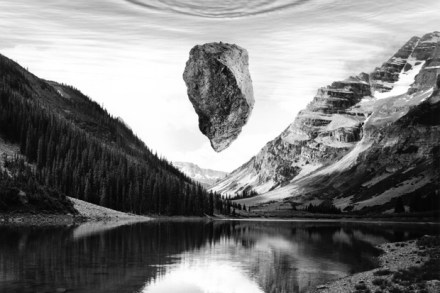
An untitled photograph by Jerry Uelsmann from 1991 shows a rock like Magritte’s floating in the sky between an Ansel Adams mountainside of conifers on one side and a bare mountain on the other; concentric ripples on a lake in the foreground are mirrored in the sky above. It will, I fear, remind readers of that BBC2 ident with Zen-ish sky-ripples. Each of Uelsmann’s photographs, always in black and white, is composed from three or five negatives meticulously aligned to make a single composite print. Naked female bodies float above water or clouds; anonymous silhouetted male figures observe from doorways; cupped hands grow from a tree stump. The connotations are surreal and Gurdjieffian.

Judge a critic by the quality of his mistakes

What the title promises is not found inside. It is a tease. John Sutherland says he has ‘been paid one way or another, to read books all my life’, yet he does not regard himself as well read in the genre of novels. With two million languishing in the British Library vaults, nobody could be, he insists. And although the publishers have given it the subtitle ‘A guide to 500 great novels and a handful of literary curiosities’, the author declares in his admirably succinct preface: ‘This book is not a guide.’ He’s right. It is an engaging game, or a compendium of games (as the Gamages Christmas catalogue used to describe a chess board with snakes and ladders on the back). I started off by seeing what the Prof thought of some of the books I like.

The right way to see Madrid

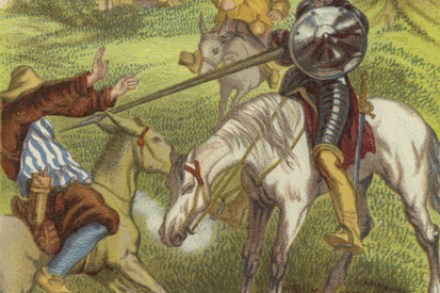
I got Madrid utterly wrong for quite a long time. It’s a lovely city to walk in, and I thought it was idealistic and innocent, like Don Quixote. But its strength is the easy-going tricksiness of a Sancho Panza. It is a little like Toledo or Seville in the picaresque 17th century. I’ve only been robbed once, not violently, but it should have been more, so foolishly trusting was I, leaving my bag unattended or my jacket on the back of a chair. Not that Madrid is dangerous. You can saunter southwards from the marvellous Museo Sorolla (the house of the striking Sargent-like painter, stuffed with his canvases) in Paseo Martínez Campos, through streets of non-chain shops, down to the latitude of the Prado.

The Christmas Quiz answers

Says who? 1. David Cameron. 2. The Archbishop of Canterbury, the Most Revd Justin Welby. 3. Nick Clegg. 4. Prince Harry. 5. Eddie Mair (to Boris Johnson). 6. Nigel Farage, the leader of Ukip, after its good showing in council elections. 7. Vladimir Putin, at the G8 summit, on the Syrian opposition. 8. Lord Howell of Guildford, talking of fracking. 9. Ed Miliband, in his Labour conference speech. 10. Bonnie Tyler, in Britain's Eurovision song entry, 'Believe in me'. Creature comforts 1. A squirrel. 2. Nawaz Sharif. 3. A walrus. 4. The camel. 5. Rabbit. 6. Phnom Penh. 7. Ecuador and Colombia. 8. A cow. 9. Noble false widow spiders. 10. Yeti. Royal flush 1. The Princess Royal. 2. Richard III's. 3. The Queen. 4. Lady Thatcher's. 5. The Duke of Edinburgh. 6. Willem-Alexander. 7. Spain. 8.

The Spectator’s Christmas Quiz

Says who? In 2013, who said: 1. ‘To me it’s not a marriage, it is, if you like, a Ronseal deal.’ 2. ‘Marriage is abolished, redefined and recreated, being different and unequal for different categories.’ 3. ‘It is the Conservatives who have decided to completely reinvent the wheel and tie the country up in knots.’ 4. ‘If there’s people trying to do bad stuff to our guys, then we’ll take them out of the game.’ 5. ‘You’re a nasty piece of work, aren’t you?’ 6. ‘Send in the clowns.’ 7. ‘People who not only kill their enemies, but open up their bodies, eat their entrails in public before the cameras. Are these the people you want to support?’ 8.

The answers

Weird world 1 Mark Rothko’s 2 George Washington 3 Nadine Dorries 4 The Duchess of Cornwall 5 Sakhalin 6 The 158th Oxford and Cambridge Boat Race 7 Harry Redknapp, when manager of Tottenham Hotspur 8 Hungary 9 David Cameron 10 Hitler   Tip of the tongue 1 Nadine Dorries 2 Boris Johnson 3 David Cameron 4 Dame Vivienne Westwood 5 Silvio Berlusconi 6 The Archbishop of Canterbury, Dr Rowan Williams 7 Francis Maude, the Cabinet Office minister 8 Rebekah Brooks 9 Boris Berezovsky: 10 Conrad, Lord Black of Crossharbour   Screen break 1 Skyfall 2 Martin Freeman 3 The Pirates! In an Adventure with Scientists!

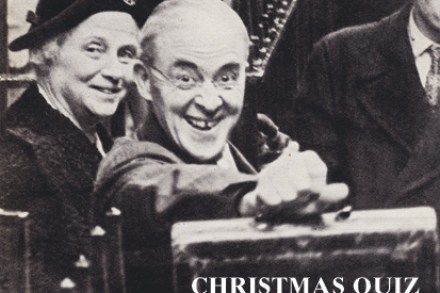
Christmas Quiz

It’s time for the immemorial Christmas custom in which the family gathers round the iPad, cracks another walnut, and sharpens its competitive claws on the Spectator’s traditional challenge to suppressed memories of unlikely events, political gaffes, terrible films, old books and the Olympic opening ceremony. Weird world In 2012: 1 On whose painting, ‘Black on Maroon’, in the Tate, did a man scrawl ‘A potential piece of Yellowism’? 2 A three-year-old chicken nugget from McDonald’s, Dakota City, Nebraska, said to resemble which US president, sold for $8,100? 3 Name the MP who consented to 3,000 cockroaches and 5,000 crickets being poured on to her in an underground crate.

What’s notable about ‘a lovely little old rectangular green French silver whittling knife’? 

In the reminiscences of Bertie Wooster we find this: As I sat in the bathtub, soaping a meditative foot and singing, if I remember correctly, ‘Pale Hands I Loved Beside the Shalimar’, it would be deceiving my public to say that I was feeling boomps-a-daisy. The sentence is quoted for its use of ‘meditative foot’, in the Winter 1973 issue of the learned journal Linguistic Inquiry, by Robert A. Hall in his ‘Transferred Epithet in P. G. Wodehouse’, now as well-thumbed as any article can be that is perused principally online. Stephen Fry is always citing it. Mark Forsyth, however, quotes the sentence as an example of litotes — affirming something by denying its opposite.

Charles Saatchi’s photo play

The game that Charles Saatchi plays in The Naked Eye is to find photographs of subjects that look surprisingly like something else. A stork in mid-flight seems to have a jet-trail streaming from it; an ant silhouetted on the rim of a cup seems to be the same size as a helicopter hovering in the sky next to it. An elephant, if you really suspend disbelief, looks as though it is balancing on outstretched trunk (but it was done, with the help of a taxidermist, by Daniel Firman, who wanted, for some reason, to show what an elephant might do in low enough gravity).

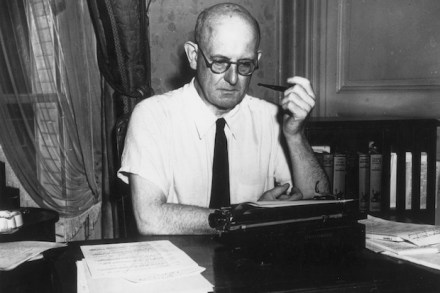
How much can you tell about E.E. Cummings from this photo?

Do you think you can tell things about writers from the way they look in a painting or photograph? A more demanding test: from their books can you predict how authors look? It sounds unlikely, yet, upon seeing a photograph of an author, we do find ourselves exclaiming: ‘That’s not how I thought he’d look!’ In Portrait of the Writer there are 250 photographs with a potted biography opposite each. ‘In the best instances,’ says Goffredo Fofi in the foreword, ‘we can see in the photograph that the writer (although not just the writer) has discovered something about himself or herself that he or she was unaware of or had not reflected upon sufficiently.’ Can we, though? Take E.E.

Notes on…London’s secondhand bookshops

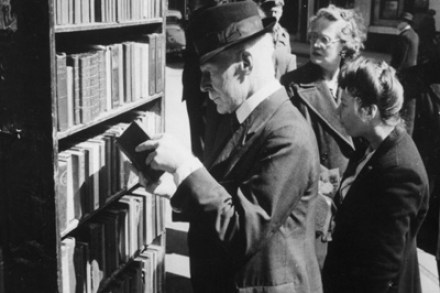
After seeing the Dalai Lama receive an award at St Paul’s Cathedral, I thought I’d look in at some secondhand bookshops around the British Museum on my walk home. They had all gone. Gone the neat shop in Museum Street where I bought David Knowles’s Great Historical Enterprises; gone the untidy shop in Coptic Street where I first bought a Cresset Press edition of Hogg’s Private Memoirs and Confessions of a Justified Sinner. Gone the smart end of the market, Frew Mackenzie (next to Cornelissen the artists’ colourmen) where two big folios of the beastly Bishop Burnet’s History of His Own Time, 1723, 1734, chipped at spine ends, was the equivalent of the bargain box.

The Serpent’s Promise, by Steve Jones – review

The weight of bacteria that each of us carries around is equal to that of our brain, a kilogram of the creatures, billions of them, ten times as many in the gut alone as the number of human cells in the body. There may be 10,000 distinct kinds, with a different community on the forehead from that on the sole. There are fewer kinds in the mouth or stomach than at the back of the knee, which has a more diverse population than any other part. This is surprising and interesting, and we would like to know more about this teeming personal nature reserve.

‘Ware’s Victorian Dictionary of Slang and Phrase’, by J. Redding Ware – review

James Redding Ware, with his idiosyncratic treatment of slang, plunges the reader straight into the late 19th-century Bartholomew Fair of undeserving paupers, loafers, Ally Slopers, theatrical types and demi-mondaines. He drew on his own Grub Street life for this discursive lexicon, from A.D. (‘a drink’) to Zulu Express (the nickname for a Great Western service), published, days before his death in 1909, as Passing English of the Victorian Era: A Dictionary of Heterodox English, Slang and Phrase. The Bodder has faked it up nicely in smudgy facsimile, with burgundy end-papers, a new title and an introduction by John Simpson of the OED, who devours dictionaries with his morning porridge.

The beating of heavenly wings

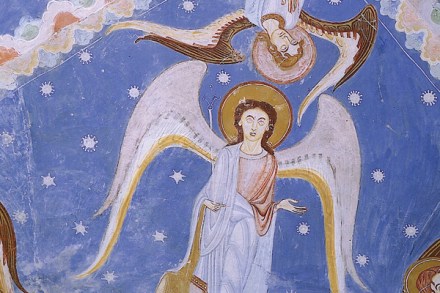
How did the cherubim, solemn figures of beaten gold in the Holy of Holies of the Hebrew Temple, become chubby toddlers (such as the pair in Raphael’s Sistine Madonna), popular on greetings cards? It was surprising in the first place that their graven images should be set up at all, with eyes cast down and wings spread out, shielding the cover of the Ark of the Covenant, where the very glory of the Lord, the shekinah, descended with dangerous power. For Philo of Alexandria, a Platonist interpreter of Jewish belief, they were the same cherubim that guarded the gates of Paradise (from which mankind had been banished).

Catalonia Notebook

We sang a hymn called ‘Poble en Marxa’ at the beginning of Mass in the working-class parish of Sant Blai. ‘Marxa’ was not a reference to the bearded prophet of revolution; it’s just the Catalan way of spelling marcha. People on the march. There was a lot of it about. In Barcelona, a million (the Catalans say two million) had marched to demand independence from an economically incompetent Madrid. In broke Madrid there were ten demonstrations in one day, with teachers and firemen being bused in to hold up banners and shout and blow whistles. The anarcho-syndicalists made a particularly brave showing. But that was all on the television. Here in Tortosa, in the parish of Sant Blai, there wasn’t much marching, just lots of hanging around.

Spanish Notebook

Round a bend in the mountain path, between the flowering rosemary and the wild box bushes, above the spine of bare rock that stretched like a dragon’s tail hundreds of feet down into the valley of the unseen river below, someone had sprayed in black letters on the unsuitable surface of the ground: ‘Catalunya is not Spain’. True enough, but where is? In the 700-mile railway journey I’ve been making over the past week from Montserrat in the east to La Coruña on the Atlantic, not many places. To Léonese nationalists, even the ancient Kingdom of Léon has its own language, though it sounds like good Castilian to me. And I can never see the monastery of Montserrat, long a symbol of Catalan civilisation, without thinking ‘Shangri-La’.

Landscapes of grief

The caption on the photograph (above) makes a difference: ‘A young boy grieves at the funeral of his father who died of Aids at Ndola, Zambia, 2000.’ There were two million Aids orphans in Zambia alone. ‘I care about not letting this tragedy go unseen,’ Don McCullin said. Shaped by War: Photographs by Don McCullin, at the Imperial War Museum (until 15 April 2012), shows 250 items from the long career of a man best known for his photojournalism, from Vietnam onwards. The boy at Ndola looks straight at the lens, if he is looking outwards and not into the empty future, or back into the life with his father that has gone. Light from one side catches tears that have coalesced in the valley by his left nostril.

What the eye don’t see

  Since I began to watch films on video and not so much in cinemas, I have found that I sometimes get the itch to rewind reality itself, in order to check on what I have seen. There must be many oddities in my way of seeing of which I am less aware. Julian Rothenstein, a one-man art movement, intends to expose some of them in The Redstone Book of the Eye, a collection of almost 300 full-page pictures with very little commentary. It’s about seeing, and the eye is secondary, really, even though we are drawn to others’ eyes in daily conversation. Or in some cases we avoid eye-contact. In British culture this may signify guilt; in Caribbean culture it may signify deference. It is a pity to mistake the one for the other.