Charles Moore

Charles Moore

Charles Moore is The Spectator’s chairman.

He is a former editor of the magazine, as well as the Sunday Telegraph and the Daily Telegraph. He became a non-affiliated peer in July 2020.

Perhaps we are all communists now

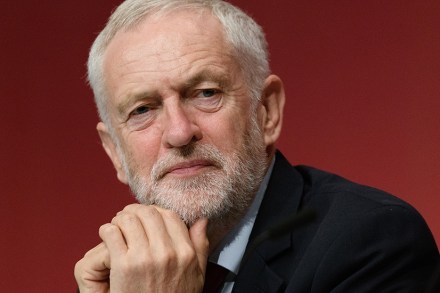
‘I am a columnist for the Daily Telegraph,’ I began a text message to an NHS executive last week. Due to predictive text, the word ‘columnist’ was replaced by ‘communist’. Luckily, I spotted it just in time to delete. But perhaps the error was accurate. Some say we have all come to see the virtue of massive state control. Perhaps we are all communists now, even on the Daily Telegraph, accepting Jeremy Corbyn’s self-assessment that he has been proved right. For a heady moment, it might seem to be the case, but the more one ponders Mr Corbyn’s claim, the odder it sounds. He seems to think that the policies now introduced because of Covid-19 would have been the right ones even if there had been no emergency at all.
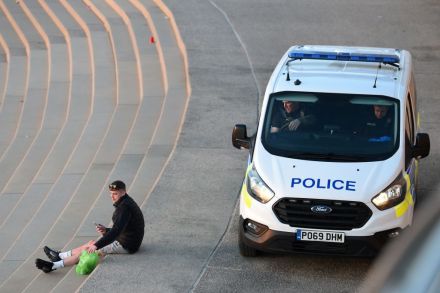
Police must be flexible when enforcing social distancing rules

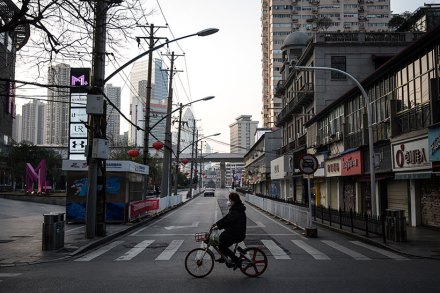
One recognises the need for firm rules about social distancing and other measures to control the coronavirus spread; but one should also recognise the need to keep things going. We rightly hail the NHS workers. We should also applaud the tremendously efficient businesses which continue to supply grocers’ shops and pharmacies. Given the difficulties and sudden demands, I am amazed by how well these markets are holding up. What on earth would Covid-19 have been like if it had arrived in pre-internet days? The authorities should themselves recognise difference of circumstances and adjust the rules accordingly as things change over the coming weeks.  Take the construction industry.

The psychological and economic dangers of enforced idleness

‘Lourdes shrine closes healing pools as precaution against coronavirus,’ says a discouraging headline in the Catholic Herald. Jesus ‘made the lame to run’ and ‘gave the blind their sight’, but Christians are not like Jesus, however much they may try to imitate him. We lack miraculous powers; and so, in matters of life and death (though not of the afterlife), we must defer to the civil power. On Tuesday, our neighbour rang for my wife, who is a churchwarden, and asked: ‘Shall I open the church as usual this morning?’ After some rummaging on the diocesan website, she found that the answer, following Boris Johnson’s broadcast the night before, was ‘No’. The same applies to the Catholic church I attend.

Blitz spirit won’t work against coronavirus

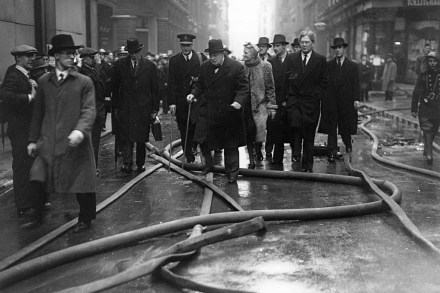
Boris Johnson gave a sort of permission for Mr Sunak’s policy when he said that he and the Chancellor were acting ‘like any wartime government’. Economically, that is surely right. Socially, however, the Blitz spirit won’t work this time.  In 1940, men were happy to gather in their clubs and pubs, as the bombs fell, to drink, gossip and enjoy one another’s company. Church congregations rose substantially. The war brought people together. The fight against the coronavirus unavoidably drives us apart.  This week, Boris effectively closed most drinking and eating places and the Archbishops of Canterbury and York suspended all services. Boarding and state schools have closed.

Coronavirus has even kept the sex-strikers at home

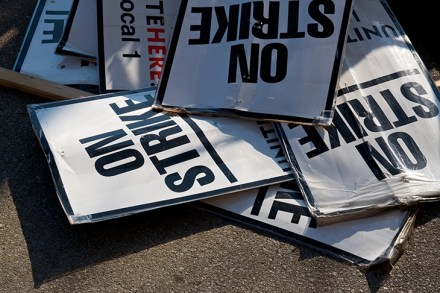
When we left this Britain on Thursday last week, life was almost as usual. Shops and restaurants were open. The Battle Observer was reporting that environmentalists, angry that East Sussex County Council’s pension funds are invested in fossil fuels, were organising a one-day protest demanding a ‘sex strike’. No one, they insisted, must have sexual intercourse with any of the county’s 50 elected councillors ‘until they agree to stop funding climate change’. As a campaign, this latter-day reworking of Lysistrata had the merit that most people would probably agree to its conditions, whatever their views on climate change. We returned home on Monday, however, to read that the protest had collapsed.

Coronavirus might not be all bad news for the stock market

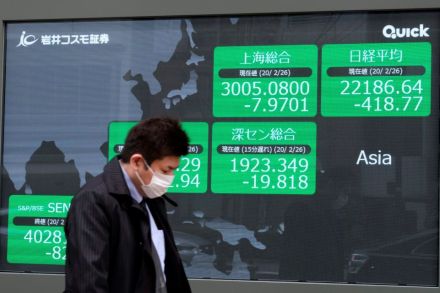
There cannot be many positive aspects to the coronavirus outbreak, but I wonder if it carries one for stock markets.  We had been told repeatedly, before all this, that the markets badly needed a ‘correction’ after their uniquely long bull run. If they were now sliding because of a banking or commercial event, confidence might collapse. If, however, they are falling because of a disease, will it also mean that confidence will recover more quickly once the disease is contained? This is an extract from Charles Moore's Spectator Notes, available in this week's magazine.

Coronavirus is a metaphor for our vulnerability over Huawei

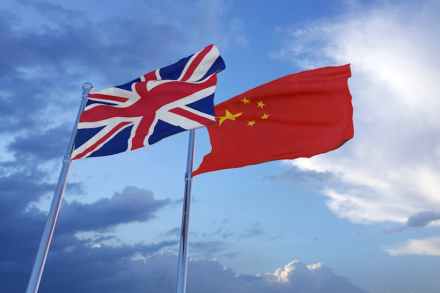
Monday night’s Commons rebellion over Huawei was on a surprisingly serious scale for a new government with a big mandate. The problem for the government is not just the actual danger of our security being breached by Huawei, real though that is. It is also strategic. The government is not treating the subject this way, but sees it as merely a matter for the Department for Digital, Culture, Media and Sport. This is a bad mistake. We have achieved Brexit. We are making our own way in the world. Our closest allies in terms of trust, language, cultural links, democratic values and shared interests are our four partner nations in the ‘Five Eyes’ deep intelligence partnership — the United States, Canada, Australia and New Zealand.

Coronavirus is a metaphor for Britain’s vulnerability over Huawei

From our US edition

Monday night’s House of Commons rebellion over Huawei was on a surprisingly serious scale for a new government with a big mandate. The problem for the UK government is not just the actual danger of our security being breached by Huawei, real though that is. It is also strategic. The government is not treating the subject this way, but sees it as merely a matter for the Department for Digital, Culture, Media and Sport. This is a bad mistake. We have achieved Brexit. We are making our own way in the world. Our closest allies in terms of trust, language, cultural links, democratic values and shared interests are our four partner nations in the ‘Five Eyes’ deep intelligence partnership — the United States, Canada, Australia and New Zealand.

huawei

The ugliness of carbon zero

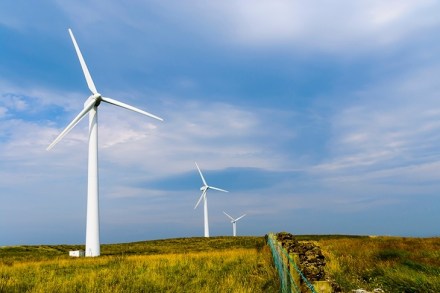
The government is trying to get onshore windfarms going again, defying the damage they do to unique environments. I am perplexed by how its zero-carbon policies can be reconciled with its wider economic aims of ‘levelling up’ or of fostering a beautiful environment. It is an odd fact that Greens can be extremely hostile to the natural world when it gets in their way. Announcing the above story, the BBC’s environment analyst, Roger Harrabin, informed listeners that the wind turbines could go on ‘empty moorland’ in Scotland and Ireland. Empty?

The ugliness of zero-carbon

The government is trying to get onshore windfarms going again, defying the damage they do to unique environments. I am perplexed by how its zero-carbon policies can be reconciled with its wider economic aims of ‘levelling up’ or of fostering a beautiful environment. It is an odd fact that Greens can be extremely hostile to the natural world when it gets in their way. Announcing the above story, the BBC’s environment analyst, Roger Harrabin, informed listeners that the wind turbines could go on ‘empty moorland’ in Scotland and Ireland. Empty?

Jean Vanier’s sad fall from grace

The fall from grace of Jean Vanier is truly a sad story. The founder of the L’Arche communities did extraordinary work, practical, intellectual and spiritual, to advance the idea that those suffering mental handicap had much to teach the rest of us. His was a radical idea about what community can be. Now, however, L’Arche has accepted a report that Vanier, who died last year, had sexual contact with six women from the 1970s onwards. There is no suggestion of any exploitation of the handicapped. Unlike so many claims in abuse cases, these ones seem to have been carefully investigated. The women (all adults) were his devoted followers. Vanier appears to have told them that by getting close to him they would also get closer to God.

The perils of owning an erotic Nazi toy

My parents told me that their wartime childhoods were punctuated by the expression: ‘Don’t you know there’s a war on?’ It was used as an excuse for not attending to something urgent. The modern equivalent is the phrase ‘climate emergency’ (leading to ‘extreme weather events’). This emergency is supposedly so great that billions have to be spent on it annually, leaving little time and money for actual emergencies, e.g. floods. The stupidity of XR digging up the lawn outside the gate of Trinity College, Cambridge, needs no further comment. The event does bring home our cultural change. Shortly before I went up to Trinity in the mid-1970s, a few young bloods drove some ducks up from the Backs at dawn.

Does anyone really think HS2 will be good for the country?

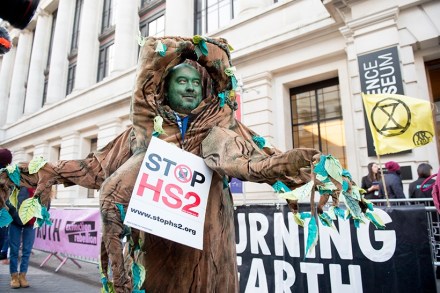
How depressed should one be about the HS2 go-ahead? The cost is stupefying. The offering to the north — considered so important politically — seems to be unappealing to plenty of northerners and, like a parody of British railway late arrivals, won’t reach its destination until the mid-2030s. Worse, perhaps, is the sense, especially when seen in conjunction with the Huawei go-ahead, that the government is already trapped by the past. It reminds me of Theresa May’s decision to review the Hinkley Point C programme and then let it go ahead after all. In that case, as in that of Huawei, the government reluctantly concluded it could not get out of a troubling China deal sealed in the Cameron/Osborne era.

Sinn Fein’s success doesn’t make a united Ireland more likely

It is obviously true that Sinn Fein’s success in the Irish Republic will increase nationalist pressure for a united Ireland. It does not automatically follow, however, that such pressure will make a united Ireland more likely. A powerful Sinn Fein in the South is a strong recruiter for Unionism in the North. The possibility of nationalists in the North winning a border poll has just receded.

The BBC’s big problem is its obsession with itself

One reason people are disillusioned with the BBC is its obsession with itself. Here is the text of a question asked by the corporation’s deputy political editor, Norman Smith, at a speech last week by the minister responsible for broadcasting, the Culture Secretary, Lady Morgan: ‘You say the BBC needs to adapt to the new streaming era…What I’m not clear about is why you think decriminalising or moving to a civil enforcement scheme in any way assists the BBC in meeting that challenge. Because the view within the corporation is that it weakens the BBC to the tune of £200 million a year, quite possibly more.

Sinn Fein’s success doesn’t make a united Ireland more likely

It is obviously true that Sinn Fein’s success in the Irish Republic will increase nationalist pressure for a united Ireland. It does not automatically follow, however, that such pressure will make a united Ireland more likely. A powerful Sinn Fein in the South is a strong recruiter for Unionism in the North. The possibility of nationalists in the North winning a border poll has just receded.

The real reason Glasgow’s UN climate summit will be a nightmare

Regardless of one’s views on climate change, one should welcome the fact that Boris Johnson removed Claire Perry O’Neill from her post as president of this year’s Conference of the Parties (COP 26), which will be held in Glasgow. He is at last trying to exercise the power of patronage. Ms Perry O’Neill is a George Osborne protegée, anti-Boris and anti-Brexit. She stood down at the end of the last parliament. She is also a keen self-publicist. Given that international climate conferences are chiefly forums in which governments strike attitudes, it was highly unwise to let her strike the Glasgow ones. She was almost bound to be disobliging to the government. With the election out of the way, the government recognised its mistake and acted just in time.

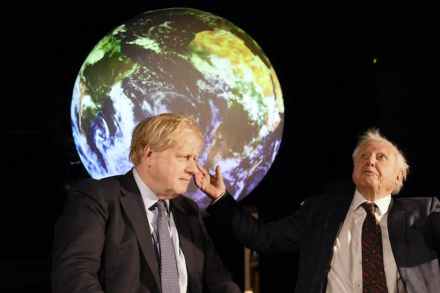
Boris has fallen into a trap by sucking up to David Attenborough

Regardless of one’s views on climate change, one should welcome the fact that Boris Johnson removed Claire Perry O’Neill from her post as president of this year’s Conference of the Parties (COP 26), which will be held in Glasgow. He is at last trying to exercise the power of patronage. Ms Perry O’Neill is a George Osborne protegée, anti-Boris and anti-Brexit. She stood down at the end of the last parliament. She is also a keen self-publicist. Given that international climate conferences are chiefly forums in which governments strike attitudes, it was highly unwise to let her strike the Glasgow ones. She was almost bound to be disobliging to the government. With the election out of the way, the government recognised its mistake and acted just in time.

Philip Pullman is right about the Oxford comma

It was with regret that I read that Albert, retired King of the Belgians, has finally had to admit, following litigation and then a DNA test, that an artist called Delphine Boël is his natural daughter. It is not that I wish to take sides in the dispute; it is simply that there is a soft spot in my heart for Albert, King of the Belgians. I am always interested in the drafting of constitutions, including their very first words. The US Constitution famously begins with the words ‘We, the people’. When the draft constitution of the European Union — later transmuted into the Lisbon treaty — was first published in 2004, I noticed that its first words were ‘Albert, King of the Belgians’.

The reason our civil service is soft on China

The creation of the National Security Council under David Cameron was supposed to join up parts of British government which had not previously had the right forum. We would now be able to survey all functions of security right across government. How odd it is that this coordination was not applied to the issue of Huawei years ago. Whatever may be said against great powers, they do have in their political bloodstream a constant sense of security threat, both external and internal, which helps them develop strategy. The United States and China both devote huge amounts of money and brainpower to the subject.