Andrew Lambirth

Wrestling with paint and demons

From our UK edition

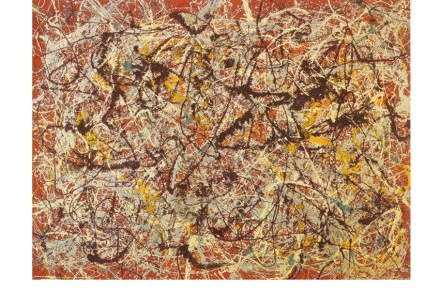
In his centenary year, the status of Jackson Pollock (1912–56) looks assured: a self-created American hero who is now accorded all the reverence due an Old Master. The most famous of the Abstract Expressionists, nicknamed Jack the Dripper because of his trademark style, his emphasis was on paint and process: the surface of the canvas was an arena in which the artist could externalise his feelings through action. Some have called Pollock the father of Performance Art, but his primary involvement was with pure painting — creating a complex abstract imagery that was intended to engage with Jungian archetypes and thus have access to deep meaning.

Rich rewards

From our UK edition

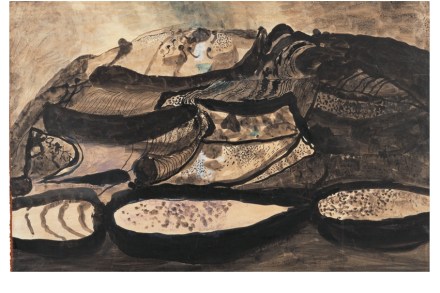
For as long as I’ve been interested in Modern British art, I’ve been fascinated and intrigued by the work of Graham Sutherland (1903–80). One of the first Cork Street exhibitions I went to as a schoolboy was of paintings, gouaches, watercolours and graphics by Sutherland from the collection of Douglas Cooper, held at the Redfern Gallery in the autumn of 1976. I was enormously impressed, particularly by the golden-eyed toad rampant, the thorny sentinel figures, a 1944 Welsh landscape and a gouache of bomb-damaged buildings from 1942. (My recall is not always quite so accurate: in fact, I have the fold-out card from the exhibition before me as I write.

Riding to the rescue

From our UK edition

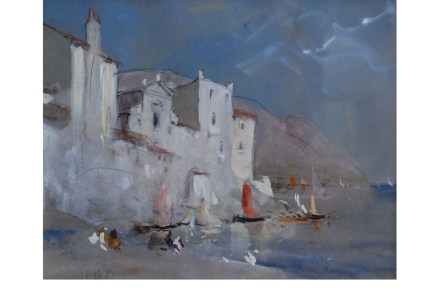
As cuts in government funding begin to bite, the innovative Tricycle Theatre in Kilburn finds itself short of £350,000 a year, and its long-serving artistic director, Nicolas Kent, is standing down as a result. Into the breach has stepped 89-year-old philanthropist and Tricycle devotee Al Weil. He is donating 37 paintings (including ‘The Gulf of Salerno’, above) by an artist he has collected since the 1960s, the distinguished Victorian watercolourist Hercules Brabazon Brabazon (1821–1906). Brabazon was a man of means who didn’t have to sell his work to survive, but nevertheless created a body of paintings and drawings of rare sensibility.

Pursuit of truth

From our UK edition

When R.B. Kitaj put together The Human Clay, his ground-breaking 1976 exhibition of figurative art at the Hayward Gallery, he wrote: ‘If you have a great subject, say, a person or people or a face or some complex theme, you have no right to be negligent about form or colour. Great themes demand the highest artistic qualities and ambitions.’ The current loan exhibition at the newly reopened Haunch of Venison gallery (with a handy new shopfront on Bond Street) is a splendid example of great themes articulated by the highest artistic qualities and ambitions.

Burra revealed

From our UK edition

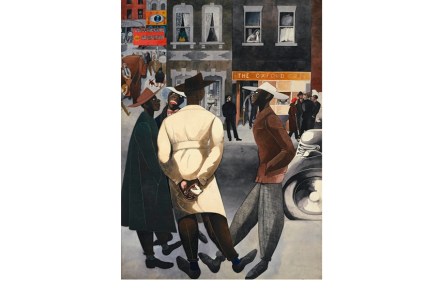
The last major show of paintings by Edward Burra (1905–76) was at the Hayward Gallery in 1985 and I remember visiting it with a painter friend who was rather critical of what she called Burra’s woodenness and lack of movement. At the time, I was impressed by her criticisms, but now they rather seem to miss the point. Burra made highly stylised images of people (often actually in movement) which are mostly about the darker side of humanity and the ways in which we distract and amuse ourselves in the face of despair.

A look ahead | 31 December 2011

From our UK edition

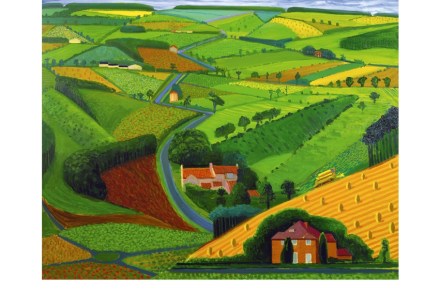
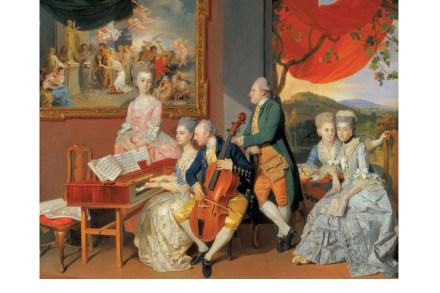
For those seeking refuge from the Olympics, Andrew Lambirth picks out the exhibition highlights of 2012: Freud, Hockney, Turner, Zoffany, Lely, Picasso... In the coming year, when the country will be besieged by all things Olympic, and many people of taste and discernment will (I am assured) be fleeing to spots less barbarous and sports-obsessed, there will still be a lifeline of art exhibitions to refresh those parts that physical activities cannot reach. Focusing on English artists, the main attractions will be shows dedicated to Lucian Freud (at the National Portrait Gallery), David Hockney (at the Royal Academy) and Damien Hirst (at Tate Modern).

An ideal Christmas

From our UK edition

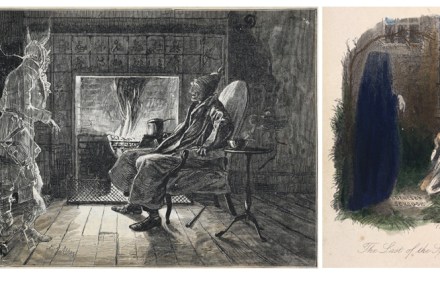
Andrew Lambirth on John Leech, artist friend and travelling companion of Dickens, whose pictures help illuminate the novelist’s work Christmas approaches, and my thoughts turn, with reassuring inevitability, to Dickens. As the nights draw in and the winter winds blast across the fields of East Anglia, the counter-urge is for the comfort of a good book, to be read preferably by the fireside in a snug armchair. Dickens is the high priest of cosiness, forever creating situations in which the fire and wine within are contrasted with the cold and storm without. In his novels, hearth and home are crucial images of goodness, comfort and continuance, and nowhere more so than in his first and greatest festive story, that indisputable classic, A Christmas Carol.

Pushing the boundaries | 10 December 2011

From our UK edition

When I was at school, I remember the art teacher returning incensed from a trip to London during which he’d taken a group of seniors to the Tate Gallery. The particular object of his ire was what he described as ‘a pile of blankets’ by Barry Flanagan. He could not accept that this was a legitimate work of art, and, in a state of raging mischief, he’d grouped his school party around the thing in question and surreptitiously changed the order of the blankets. This subversive act was intended not only to relieve his feelings but also to prove the falseness of the work. If it could be fundamentally changed without anyone noticing, it was — to his mind at least — undeniably bogus.

Mysterious ways | 3 December 2011

From our UK edition

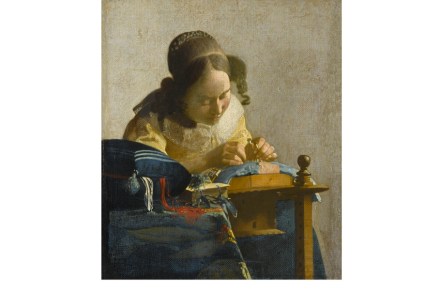
Among exhibition organisers, hyperbole is clearly the order of the day. The crowds are going wild over Leonardo at the National Gallery, expecting an exhibition packed with paintings (though only nine are by the master), and now the Fitzwilliam is hauling them in with a show called Vermeer’s Women that contains just four paintings by Vermeer. On the day I visited, the gallery was thronged, though the queues of which the management warned were thankfully not in evidence. I am frankly horrified by the volume of visitors to art galleries these days. I should perhaps be thankful that art is so popular, but the sheer numbers make the experience of viewing an exhibition increasingly disagreeable and unrewarding.

Buried treasure | 26 November 2011

From our UK edition

In recent years there has been a surge of interest in the treasures hidden in our public art collections, many of them rarely if ever on view. The Tate Gallery is perhaps the principal offender here, showing only a tiny percentage of its glorious and wide-ranging holdings of British art, but attention is now being directed towards our provincial galleries and museums. Since 2003 the Public Catalogue Foundation has been recording and publishing the oil paintings held in galleries and civic buildings, county by county, and issuing invaluable volumes of colour illustrations to show us what usually remains invisible. By its calculations, a shameful 80 per cent of these paintings are not on view.

Perfect harmony

From our UK edition

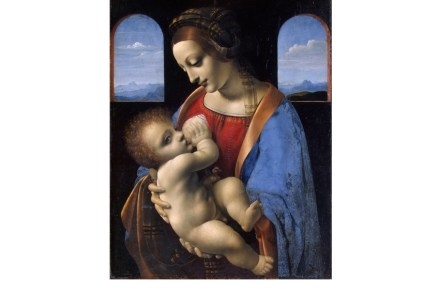
Andrew Lambirth finds paintings at the National Gallery’s Leonardo exhibition of such a singular and pure beauty as to take the breath away The great world is humming with an event of international importance at the National Gallery: the largest number of Leonardo da Vinci’s surviving paintings ever gathered together. To see anything by this extraordinary Renaissance genius is worth turning aside for, but in recent years there have been a fair few exhibitions, principally at the V&A in 2006, at the Royal Collection in 2003, and a provincial touring show in 2002. Admittedly, these displays have consisted of Leonardo’s drawings, but the prospective visitor should be aware that this new show at the NG is also largely composed of drawings.

Intelligent design | 12 November 2011

From our UK edition

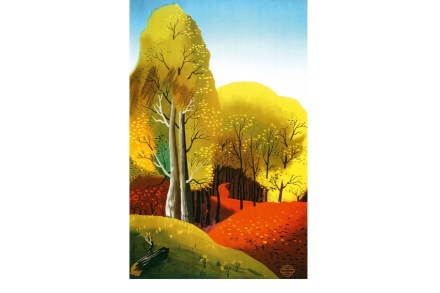
In 1935, Paul Nash observed that Edward McKnight Kauffer (1890–1954) was responsible for the change in attitude towards commercial art in this country. An American, Kauffer arrived in England in 1914 during a period of European study. He liked it and decided to stay, enabled to do so by his remarkable ability to design posters. In 1915 Frank Pick commissioned him to produce the first of what became a remarkable stream of some 140 posters for London Transport. Hugely impressed by Vorticism, Kauffer became a friend and ally of Wyndham Lewis and introduced the Modernist sensibility into commercial art.

Bird watching | 12 November 2011

From our UK edition

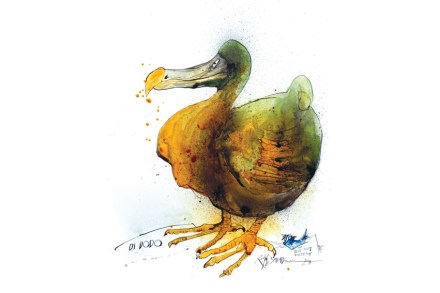
The setting is appropriate: Rochelle School is on Arnold Circus in Shoreditch, at the end of Club Row, once famous for its pet market, where, until it was closed down in 1983, you could buy caged birds from around the world. Now the school is hosting an exhibition entitled Ghosts of Gone Birds (till 23 November), a wide-ranging and stylistically eclectic show with a single emotive theme: extinct birds. More than 100 artists, musicians and writers, including Peter Blake, Margaret Atwood and Ralph Steadman, have made work in aid of BirdLife International’s Preventing Extinction scheme. Steadman did one picture and then found himself gripped by the theme, and went on to produce 100 witty, poignant and highly original bird portraits (‘Dodo’, above).

Sensation seeker

From our UK edition

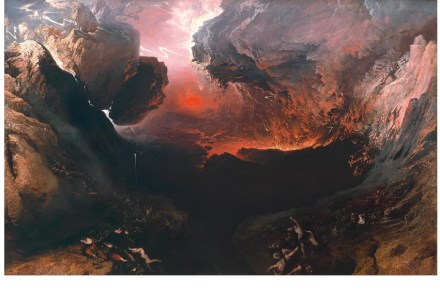
For far too long, John Martin (1789–1854) has been dismissed as ‘Mad’ Martin, the prophet of doom. In the eyes of many, this unacademic painter was a grotesque curiosity, producing colossal pictures of apocalyptic destruction, crude dramas of catastrophe and tumult, much to the delight of the populace. The mere fact that he was so popular an image-maker made him irredeemably vulgar (rather like Lowry today), and the cognoscenti looked for faults rather than appreciating his strengths. In fact, Martin was a reforming inventor as well as a painter, much concerned with draining the marshes around London and ensuring a pure water supply for the capital, simply because he wanted, as he says in his ‘autobiography’, to improve the condition of the people.

Bookends: Spirit of place

From our UK edition

A new book by Ronald Blythe is something of an event. In recent years the bard of Akenfield has mostly published collections of articles, which makes At the Yeoman’s House (Enitharmon £15) especially welcome. It’s an autobiographical meditation on an ancient dwelling-house set in flint-strewn fields: Bottengoms Farm on the Essex-Suffolk border, where Blythe lives. He inherited it from the artist John Nash, and now investigates its history in an enjoyably oblique and fragmentary fashion. In Cobbett’s definition a yeoman was above a farmer but lower than a gentleman, and Bottengoms has never been grand. It began when ‘a man roofed in a spring and dwelt beside it’, and in 1944 the stream still ran through the kitchen.

Postmodernism: Style and Subversion 1970–1990

From our UK edition

Postmodernism is a term with a surprisingly long history. It was first used in the 1870s and was subsequently employed by dazed or disaffected commentators with some regularity throughout the first two thirds of the 20th century, until it became de rigueur in the ghastly decade of the 1970s. The architect Charles Jencks pronounced the death of Modernism at 3.32 p.m. on 15 March 1972, and Post-Modernism (hereinafter known as PoMo) was fairly, or unfairly, upon us. But what actually is it? Essentially, it meant the end of all seriousness and the shunning of order, moderation and reason, the denial of a belief in the perfectibility of the human race and the merit in striving for something better.

Set art free

From our UK edition

Too often art is subjugated to curators’ theories or interpretations. Let the work speak for itself, says Andrew Lambirth The casual observer of London’s art scene, or even the devoted reader of exhibition listings, might be forgiven for thinking that the range of shows available throughout the conspectus of the nation’s museums was of a healthy vigour and diversity. In fact, it could be effectively argued that there are still too many different blockbusters simultaneously competing for box-office success, with museums forever chasing revenue by putting on displays of tried-and-tested favourites, and not actually serving the public in the best possible way.

Melancholic visions

From our UK edition

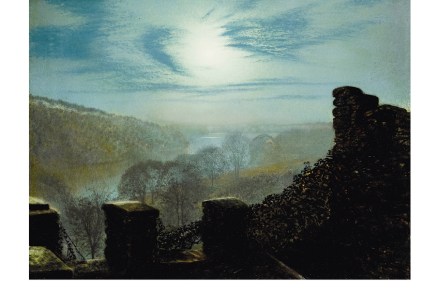
At the less than enticing Guildhall Art Gallery, a purpose-built museum that manages immediately to depress the spirits by its utterly unsympathetic design, is a major exhibition of John Atkinson Grimshaw (1836–93), the celebrated Victorian painter of moonlight. The show is the brainchild of Jane Sellars, director of the Mercer Art Gallery, Harrogate, where it was on view before coming to London. I wish I’d had the time and energy to see it in Harrogate, where I’m sure it looked entirely at home in the very particular spaces of the Mercer. Exhibiting in the Guildhall is an uphill battle with the architecture. Even Grimshaw, chock-full of atmosphere and drama, has a hard time of it here.

Pictorial intelligence

From our UK edition

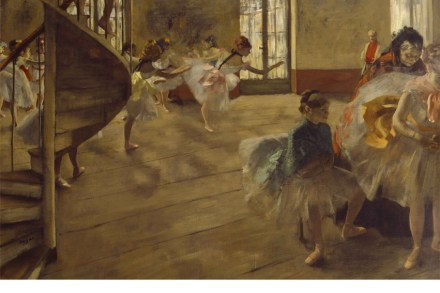
Edgar Degas (1834–1917) was born into a banking family, always knew he wanted to be a painter and was fortunate enough to be encouraged in his enthusiasm by his parents. After a classical training he began to paint portraits and history subjects, before seeing the relevance of real life and developing ways in which to depict it. Influenced by Manet and allied to the Impressionists, he was nevertheless not a committed member of the group and was impatient at its definition of painting. He remained classical in his approach to picture-making but fused this with a keen interest in colour and texture, and an awareness of how photography and Japanese prints had influenced ideas of space and vision.

Unfit for purpose

From our UK edition

In recent months, two new museums have opened to much acclaim: The Hepworth in Wakefield and Turner Contemporary in Margate. Now Colchester is receiving the dubious benison of a new building. What is this assertive new generation of museums in England supposed to be about? Leisure, business or art? There’s precious little of the last in the much delayed Firstsite gallery in Colchester, a long pavilion by Rafael Viñoly Architects clad in gold-coloured metal which looks wonderfully out of place in the Roman city of Camulodunum (the name also chosen for its inaugural exhibition). Don’t get me wrong: I live in East Anglia and would welcome a great new museum in Colchester, as a centre for excellence and a potentially worldwide audience.