Andrew Lambirth

Fruitful oppositions

From our UK edition

There are so many good exhibitions at the moment in the commercial sector that the dedicated gallery-goer can easily spend a day viewing top-quality work without paying a single museum admission fee. The following shows nicely complement some of the current or recent displays in public galleries — such as Mondrian||Nicholson at the Courtauld and the Tate’s Picasso and Modern British Art. Despite the financial squeeze and such new burdens as the bureaucratic nightmare of Artists’ Resale Right, commercial galleries continue to play an extremely important role in the nation’s artistic life, though they are not given much credit for it.

Outside edge

From our UK edition

Unimpressed by the relentless barrage of blockbusters, Andrew Lambirth singles out some small-scale gems Although it can’t be easy to run a major museum in this country, and balance the books as well as fulfil a remit to provide the best possible conspectus of past and contemporary art for the general public, our museums are becoming increasingly narrow in what they offer. The range of art on show in London, for instance, has shrunk alarmingly, as the Whitechapel, the Serpentine and the Tate pursue very similar programmes, vying to be the first to put on the same internationally fashionable artists.

Marketing man

From our UK edition

People go to exhibitions for different reasons, and although I was highly critical of David Hockney’s recent show at the Royal Academy, I accept that a great many people visited it and came out smiling and uplifted. They tended to be individuals who don’t usually go to exhibitions or look at real painting, and it may thus be said that they had very little idea of what they were actually looking at, or indeed should be looking for in an exhibition of painting, but if the experience made them happy, where’s the harm — you may ask — in that? Undoubtedly a great many went because it was the thing to do, and they felt better for being able to say that they’d been there and done that.

Outsider artist

From our UK edition

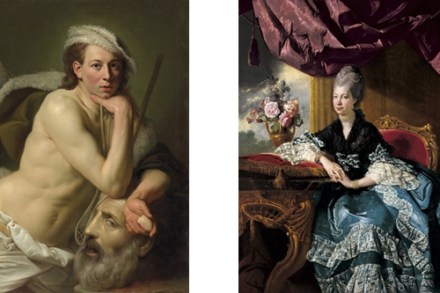
In the various mixed exhibitions I’ve seen over the years that dealt with 18th- and 19th-century British art, Johan Zoffany (1733–1810) has always seemed to stand out. Yet there hasn’t been a museum show devoted to his work in this country since the National Portrait Gallery’s survey of 1977, so Martin Postle must be congratulated on organising the current exhibition (supported by Cox & Kings), already seen at the Yale Center for British Art in Connecticut, especially since plans to hold it at the Tate were scuppered. I wonder why? The show has proved successful: it was very busy the day I went, though I did wonder what proportion of visitors had turned up to see the Hockney show, baulked at the queues and gone upstairs to see Zoffany instead...

Rocky ride

From our UK edition

Now that the great design surveys regularly mounted by the V&A have come up to date, what will it seek to beguile us with next? These exhibitions have always been of interest, at least in parts, and often infuriating, a combination that has helped to ensure their success. The wide range of paintings and objects on display has also given them the status of offering ‘something for everyone’, rather like a vastly superior village bazaar. The current show is no exception. It begins very well, and then conks out repeatedly like an untuned engine. Ah well, who said the course of true progress (and innovation —  don’t forget innovation) runs smooth?

Flying colours

From our UK edition

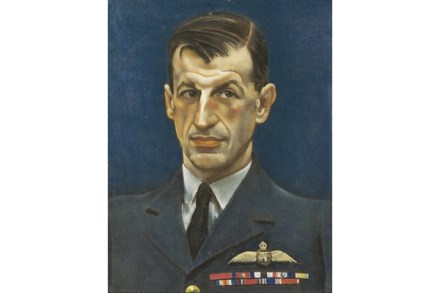
If you take the Tube to Colindale on the Northern Line and then hop on a 303 bus or walk for ten minutes, you arrive at the Royal Air Force Museum, open daily from 10 a.m. until 6 p.m., admission free. The place is full of planes, as might be expected, and has a wonderfully relaxed atmosphere (not nearly as frenetic as the Imperial War Museum) and a feeling of spaciousness. The Museum also mounts temporary exhibitions, and the one that drew my attention is of the pastel portraits of Eric Kennington (1888–1960), a war artist in both world wars, and an incomparable draughtsman, interesting painter and tough, inventive sculptor. The exhibition has been curated by the Kennington expert, Dr Jonathan Black, who has written a substantial and densely informative catalogue (£19.

In the literary tradition

From our UK edition

In recent years there have been a number of exhibitions of Keith Vaughan’s work in commercial galleries, and his prices at auction have climbed steadily, but no major show in the nation’s museums. Yet interest in his life keeps pace with the revival in his art (the standard biography of Vaughan, by Malcolm Yorke, is long out of print and avidly sought after), and 2012 as the centenary of his birth will see the publication of a new monograph, a catalogue raisonné of his paintings and an annotated volume of his final journals.

To the point

From our UK edition

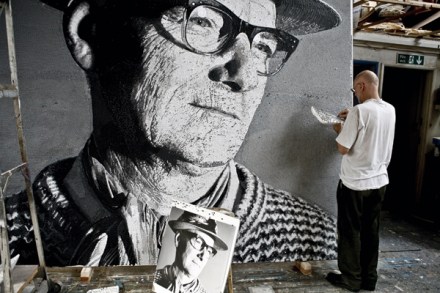
Ten years ago, Duncan MacAskill went into Rymans to buy some drawing pins and was struck by the range of colours on offer. That moment of revelation led him to construct a self-portrait from drawing pins, adapting the ideas of Seurat’s pointillism, and the ben-day dot approach of Roy Lichtenstein, to contemporary needs and materials. Now he has been commissioned by the Royal Opera House’s Deloitte Ignite festival, curated by Mike Figgis, to make two vast pin portraits for The Link at the ROH. These ‘paintings with pins’ hang near the box office over the exit to Covent Garden Piazza, and depict MacAskill’s father in black and white, and the choreographer Wayne McGregor in colour.

Sacramental vision

From our UK edition

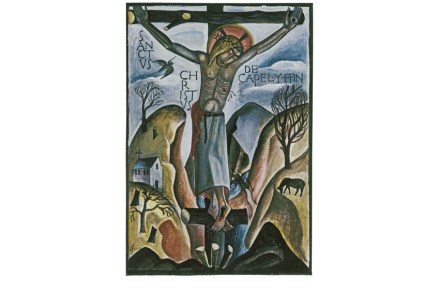
As the focus for an Easter meditation, David Jones’s ‘Sanctus Christus de Capel-y-ffin’ (1925), a small, heartfelt painting in gouache on paper, could scarcely be bettered. The Crucifixion takes place in a luminous landscape with the bird of hope in attendance. This is the world of medieval illuminated manuscripts and ivory carvings, a highly sophisticated spiritualised and classicised vision of existence that is sometimes dismissed as primitive. A Welsh hill pony is set off against a chapel, trees and a bridge over running water in an arabesque design quivering with natural and spiritual life. Rhythm is crucial. As Jones said, ‘I don’t care how static the subject is, but it must be fluid in some way.

On the beach | 31 March 2012

From our UK edition

As exhibitions in London’s public galleries become increasingly mobbed and unpleasant, it is heartening to report that the drive to take art to the provinces continues apace. New museums seem to be opening all over the country, from Wakefield to Margate, and although one may entertain doubts about their sustainability, their enhancement of our current cultural budget is very welcome. The latest public art gallery to open on the south coast is in Hastings, a once rather grand town that has in recent years been down on its luck. It takes more than an hour and a half to get there from London by train, and there isn’t a fast road, and these factors have contributed to keeping the town just outside the easy commuting belt.

A fine and private painter

From our UK edition

Prunella Clough was a modest and self-effacing artist who nevertheless produced some of the most consistently original and innovative British art of the second half of the 20th century. She was by no means reclusive, enjoying an extensive social and teaching life, but she deliberately kept a low profile, being famously guarded with biographical details. So much so, that a couple of young artists I knew in the mid-1980s were convinced that Clough was already dead, though she continued to paint and exhibit sporadically until her death in 1999. How refreshing this is in an age of seemingly unbounded artistic egos, when relentless self-obsession has to make up for lack of real creativity.

Seeing the light

From our UK edition

One of the more considerable pleasures of exhibition-viewing outside London recently was the Claude show at the Ashmolean. London exhibitions are becoming mobbed by crowds, and there is little enjoyment in shoving or being shoved in the supposed pursuit of artistic enlightenment, and absolutely no chance to contemplate individual pictures in the hurly-burly. As the devout will queue up to kiss the wizened toe of a saint, now the football fans of art will jostle to snatch the merest passing glimpse of a Leonardo or a Freud. The being there is all: the experience has very little to do with serious looking. Afterwards, you join the ranks of the blessed and tell your friends that you too were in the presence. There is apparently much comfort to be drawn from such sharing.

Shape shifters

From our UK edition

Someone asked me recently whether I actually liked Mondrian’s paintings. The implication being that his form of geometrical abstraction was too pure — or too antiseptic — to contain the necessary germ of human warmth required to engage the emotions; and that though one could admire his work intellectually, it was difficult to be passionate about it. There’s plenty of passion in Mondrian, but it is controlled fire, banked down to burn with a white-hot flame. Perhaps it should be termed the Higher Passion, as it does not immediately affect the ordinary emotions, but inspires instead to the spiritual ecstasy of the saint.

Spring round-up | 10 March 2012

From our UK edition

The fashion for museum-quality exhibitions in commercial galleries continues apace with two notable shows in Mayfair: Cy Twombly at Eykyn Maclean, and Julio González at Ordovas. Both galleries specialise in this kind of display, which must be more to do with impressing potential clients than with generating income, given that both are loan shows. I hope there’s also an altruistic motive here, however slight: to provide another forum for the public to view high-quality art they might not see elsewhere. Certainly these venues offer a new and welcome resource to the London gallery-goer, and should be better known.

Natural selection

From our UK edition

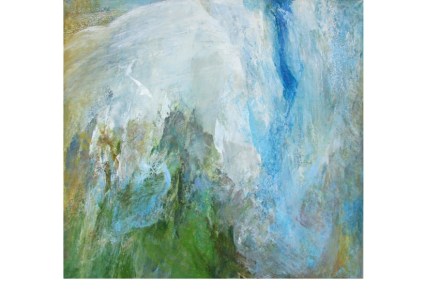
Andrew Lambirth meets the artist John Hubbard, whose work is concerned with atmosphere and the spirit of place John Hubbard makes paintings about landscape which draw upon his early training in America and the influence of the Abstract Expressionists. But his pictures are far from abstract images: they are about the play of light through foliage or the surface of rock seen close to. They are concerned with atmosphere and the spirit of place — with earth, air, light and sometimes water interacting. He denies that these are aerial views, asserting that his paintings try to capture the experience of being in the landscape, rather than looking down upon it, and being in it over a period of time.

The Picasso effect

From our UK edition

Pablo Picasso (1881–1973) cast a very long shadow over the 20th century, not least in England. Although he did not visit this country often, he apparently had a high regard for it, despite his somewhat sketchy knowledge of its contemporary painters. He once complained, ‘Why, when I ask about modern artists in England, am I always told about Duncan Grant?’ This remark is usually taken as a slight to Grant, though the two knew each other and maintained friendly relations.

Displeasures of the flesh

From our UK edition

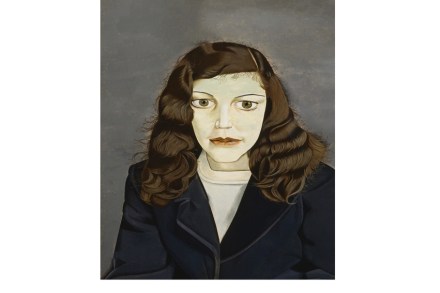
When Lucian Freud (1922–2011) was hailed as the Greatest Living Painter towards the end of his career, it was almost as a mark of respect for having survived so long and kept stubbornly painting in the way he wanted, without any quarter given to fads and fashions, in pursuit of truth to appearances, whatever that term may actually mean. This lifetime achievement award, though understandable (the English love a Grand Old Man), was misplaced, for Freud was not a great painter. He was often a striking image-maker, but from the overwhelming evidence of the knotted, gnarled and pelleted textures of his later paintings, the turgid accumulations of dry pigment, he disliked the medium of oil paint intensely.

Memorable imagery

From our UK edition

The RWA galleries offer a superb setting for a sculptor, and Ivor Abrahams RA (born 1935) has taken full advantage of the beautiful top-lit space of the main rooms to present a lively retrospective look at his principal themes and achievements. The work ranges from the 1950s to the present day, and embraces a number of different media, from drawing, painting, collage and screenprinting to relief and fully three-dimensional objects. The scale also runs the gamut from hand-held to overwhelming (‘Head of the Stairs’ is three-metres high), while the variety of materials includes bronze, plastics, ceramic and flocking. This is the kind of work that cannot be judged from reproductions in books: it has to be seen and experienced to be fully understood and appreciated.

Beautiful game

From our UK edition

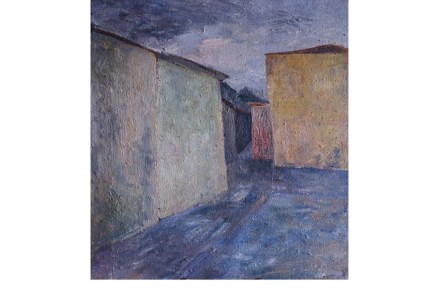
Remarkably, this is the first solo show in the UK of the work of Albert Burri (1915–95) for more than 50 years. Compare the popularity of other Italian postwar artists — Lucio Fontana, for instance, who only had one idea, the slashed or pierced canvas, to recommend him. Burri remains very much an unknown quantity, with a single work in this country’s public collections. A dozen Burris were shown at the Tate in 2005 in a mixed show of modern Italian art, but otherwise nothing. All praise then to the Estorick for mounting this enjoyable and succinct survey of Burri’s career: it introduces the general public to an artist well worth the attention. Born in Città di Castello, the young Burri was a talented footballer with a taste for pirate novels.

Loudspeaker art

From our UK edition

Several people I spoke to when this exhibition was first mentioned thought it would be a Hockney retrospective, considering that he was commandeering all the first-floor galleries at the RA. But actually the retrospective element is very slight, consisting of half a dozen early landscapes and a couple of photo-collages, before we encounter the first of the mainly large-scale landscapes he has been painting since the late 1990s. In fact, the greater part of the exhibition (sponsored by BNP Paribas) consists of work done in Yorkshire since 2004, and Hockney has packed the galleries with hundreds of images (a single work might consist of 36 watercolours, or perhaps 51 iPad drawings with an oil painting on 32 canvases).