Andrew Lambirth

Modernist Marxists skew the Lowry exhibition

From our UK edition

There has been much positive comment about the rehang of the Tate’s permanent collection, which sees a welcome return to the great tradition of the chronological hang and thus gives the visitor a chance to see the development of British art from 1545 to today. At last we are permitted a rest from themed displays and given a proper educational arrangement that maps out our artistic heritage — at least in part. (Most of the larger movements are covered.) This is not a conservative stratagem: there is still plenty of room for discussion and controversy in the various inclusions and omissions (particularly noticeable when we reach the 20th century).

A Crisis of Brilliance makes the trek to Dulwich worthwhile

From our UK edition

This exhibition was dreamt up by David Boyd Haycock, a freelance writer and curator, following the success of a book he published with a similar title in 2009. The Crisis of Brilliance book focused on the early career of five Slade-trained artists and their relationship with the first world war. When I reviewed it at the time, I felt that Dr Haycock was simply retreading rather familiar ground, however agreeable his text, as all of the artists he chose to highlight had already been extensively written about. To the five artists of the book a sixth has been added for the exhibition: David Bomberg. This enables the show to include two large canvases by Bomberg that contribute considerably to the impressiveness of the display.

Exhibitions: Why can’t the critical fraternity make up its mind?

From our UK edition

As more time elapses since the regrettable fracas over Kitaj’s 1994 Tate exhibition and his tragic suicide in 2007, he comes more and more into his own as a great but still underrated artist. When I last wrote about him in this column, back in April, I had not yet seen the portion of his Berlin-originated retrospective which was shown at Pallant House in Chichester. Happily I managed to get there before it closed and was once again deeply impressed by the range and painterly intelligence of this extraordinary artist. Now another couple of shows pay justified tribute to his genius, this time as manifested through his printed work.

Eduardo Chillida — the great modern sculptor, whom we shamefully ignore

From our UK edition

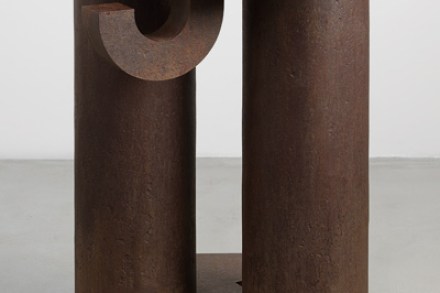
Eduardo Chillida (1924–2002) is one of the greatest of modern sculptors yet curiously little known in this country. The last major show in London was at the Hayward Gallery in 1990, where I first encountered his work in real depth. Before that, he had only exhibited once in the UK, a solo show at the McRoberts & Tunnard Gallery in 1965. Pilar Ordovas is to be congratulated for putting on this small but very choice new show. It’s high time we saw more of Chillida’s work: its powerful sculptural presence combines a satisfying sense of geometry with a love of materials, investigates space and light in new ways and is as much to do with poetry as with construction.

Exhibition review: Rory McEwen: the botanical artist who influenced Van Morrison; Paul Delvaux: a show to savour for its unusualness

From our UK edition

By all accounts, Rory McEwen (1932–82) was a remarkable man, hugely talented in several different disciplines (artist, musician, writer) and very much loved by his friends. Grey Gowrie calls him ‘a spectacular human being’ and writes: ‘Even now, 30 years after his death, he lights up the mind of everyone who knew him.’ Renowned as a botanical artist, McEwen was also an exceptional musician, specialising in blues and folk, whose mastery of the 12-string acoustic guitar rivalled the legendary Lead Belly. With his brother Alexander, Rory toured across the USA in 1956, becoming one of the first British acts to appear on the Ed Sullivan Show. Back in London, Rory became the resident singer on the Tonight programme, later hosting his own late-night TV show.

One leaves the Patrick Caulfield exhibition longing to see more

From our UK edition

In the wake of the Roy Lichtenstein blockbuster at Tate Modern comes Patrick Caulfield at Tate Britain, and what a contrast! Where Lichtenstein looks increasingly like a one-trick pony, an assessment driven home by the excessively large show, Caulfield emerges as fresh, witty and visually inventive. Undoubtedly this impression is fostered by the size of the exhibition: Tate Britain’s Linbury Galleries have been divided between Caulfield and Gary Hume, allowing each enough space for a highly focused solo exhibition. There are thus only 35 paintings by Caulfield spanning his entire career, and one leaves his show wanting to see more, not suffering from the usual museum overkill.

To survive the Royal Academy Summer Exhibition, don’t linger — just scan and pounce

From our UK edition

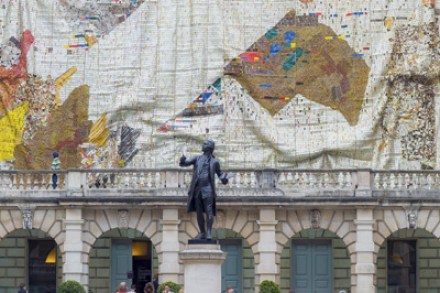
The Royal Academy’s biggest annual prize is the Charles Wollaston Award, worth £25,000, for the most distinguished work in the Summer Exhibition, this year won by the Ghanaian sculptor El Anatsui (born 1944). Although his preferred media are clay and wood, El Anatsui has taken to making installations from found materials woven together like cloth, and has done rather well with them around the world. He was invited to make a hanging for the façade of Burlington House for the duration of the Summer Exhibition, and this junk curtain (composed inter alia of aluminium bottle tops, printing plates, copper wire and roofing sheets) now obscures or ornaments — depending on your taste — the Academy’s noble brow.

Film review: Summer in February: as vivid as a Munnings masterpiece

From our UK edition

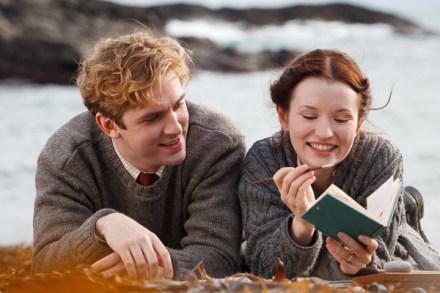
We like our artists to be larger than life and preferably bohemian, even if nowadays we’ve had to accept that the ones we hear about are more likely to live in a castle than a garret. Sir Alfred Munnings (1878–1959) began life as an artist in true bohemian style, carousing with gypsies and horse-trainers, living rough and constantly on the road, painting at full-stretch. On form, he was a superb painter of horses and English country life, and although he is denigrated as a reactionary by the current art establishment, his paintings still sell for large sums. He ended up covered in honours as President of the Royal Academy, but remained a controversial figure, publicly damning modern art in a live broadcast from the RA banquet in 1949.

Exhibitions: Leon Kossoff, The Bay Area School

From our UK edition

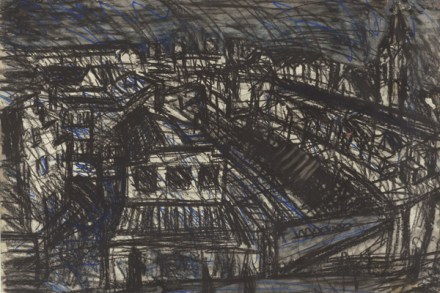
Paint is but coloured mud, pace scientists and conservators, and it can be said that the human animal comes from mud and goes back to it. Thus are the activities of painting and being human linked at a fundamental level, which can be raised by consciousness to impressive heights. As the philosopher T.E. Hulme wrote, ‘All the mud, endless, except where bound together by the spectator.’ This is an apt description of an exhibition by Leon Kossoff (born 1926). Kossoff paints thickly with much piling up of the mud of paint, which is trenched and seamed and dribbled across the surface of board supports.

Exhibitions review: William Scott

From our UK edition

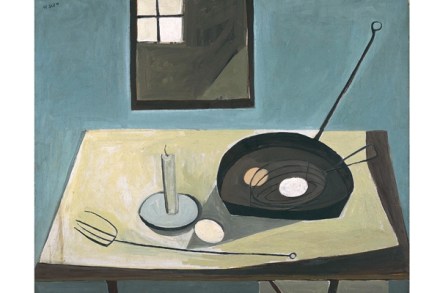
The centenary celebrations for William Scott (1913–89) are well under way, and the retrospective of his work that started in January at Tate St Ives is currently in Wakefield. There are more works in its latest incarnation and more archive material, and the installation looks very impressive in The Hepworth’s riverside galleries. Scott has not always fared well in historical surveys of 20th-century British painting (he was famously excluded from the Royal Academy’s 1987 exhibition), and his reputation does not stand as high today as it might. In his lifetime, he was much acclaimed, represented this country at the 1956 Venice Biennale and enjoyed a significant degree of international esteem.

Exhibition review: Saloua Raouda Choucair, Shanti Panchal

From our UK edition

Forgive my ignorance, ladies and gentlemen, but I must confess that I had never heard of Saloua Raouda Choucair before the advance publicity of the Tate’s exhibition. She’s not in the Yale Dictionary of Art & Artists (always a useful reference book, but by no means infallible) and I don’t believe I’d ever seen her paintings or sculptures before this show. But I may have overlooked one somewhere in a mixed exhibition, for her work does resemble that of a dozen other artists of international Modernism, and even of a number of the British variety. So why does Tate Modern now devote a solo show to her? Could it be because she is Lebanese (and we don’t see the work of many Lebanese artists in this country), female and has reached the distinguished age of 97?

Painting begins at 90 – celebration of Jeffrey Camp, Anthony Eyton and Patrick George

From our UK edition

The year 1923 was a good one for British artists, witnessing the birth of three painters who became friends and whose work epitomises a rich strand of realism in the native tradition. Jeffery Camp was born at Oulton Broad in Suffolk, and studied at Lowestoft and Ipswich Art Schools before going to Edinburgh College of Art in 1941. Anthony Eyton was born in Teddington, Middlesex, and attended the Department of Fine Art at the University of Reading for a term, studying under Professor Anthony Betts. He served five years in the army before continuing his education at Camberwell School of Arts and Crafts (1947–51). Patrick George was born in Manchester, studied at Edinburgh College of Art for a year (1941–2), where he met Camp, and then went into the navy.

Alexander Calder, Eilis O’Connell, Mary Newcomb

From our UK edition

Alexander Calder (1898–1976) needs no introduction. The master of the mobile — that poignant hanging arrangement of moving elements — he also invented the stabile (stationary) and the standing mobile. There was no one who could cut and shape sheet aluminium and suspend it from wire with quite the same wit, economy and shape invention. His imagery is primarily abstract and organises flat geometrical forms in contrasting planes through space: discs and triangles balance more biomorphic shapes and are linked by bent sprung wire into a multidirectional kinetic experience of colour and light. Calder mostly used black, white and red, supplemented with blue and yellow, his forms poised and counterweighted with supreme grace and the kind of intricacy that demands utter clarity.

Cabinet of curiosities

From our UK edition

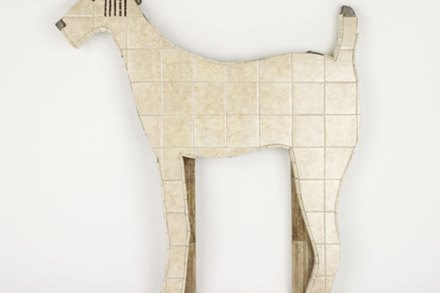
In 1951, the artist and writer Barbara Jones (1912–78) organised an exhibition called Black Eyes and Lemonade at the Whitechapel Gallery celebrating the popular arts of toys, festivities, souvenirs and advertising, to reveal to a largely unsuspecting public the richness of vernacular art in Britain. The original exhibition was evidently an Aladdin’s cave of objects, from decorated pub mirrors to ships’ figureheads, horse brasses, corn dollies and needle packets. Jones crossed the boundaries of folk art, mingling the handmade with the machine-made, and the traditional with the contemporary and ephemeral. She wrote a book about the subject, published the same year and called The Unsophisticated Arts.

Exhibition review: Looking at the View, Tate Britain

From our UK edition

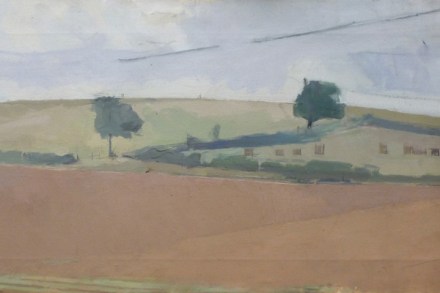
Most of us like to look at a view, though not all are fortunate enough to live with one, in which case art can offer an alternative, a window on the world. Landscape is a great solace, and particularly refreshing for the tired urban spirit, but we want more than holiday snaps of foreign places briefly visited. We need the deeper exploration of art to feed hearts and minds, an investigation through the procedures of painting and drawing, a reordering of shapes and a fitting together, a showing again under other than a purely mimetic guise. With luck and application, through bearing witness to that process of recreating, we come to greater knowledge of our world and our place within it. As D.H.

Exhibitions: R.B. Kitaj: Obsessions The Art of Identity

From our UK edition

Nowadays, R.B. Kitaj (1932–2007) tends to be ignored by the critics in this country — like a bad smell in the corner of the room. It was not always thus: for years he was an admired, if somewhat controversial, presence, but then came his great retrospective at the Tate Gallery in 1994. A large proportion of the British critical fraternity united to condemn and vilify him, to ‘take him down a peg or two’, as if he were an unruly schoolboy too big for his boots, too clever for his own good. This chorus of complaint (some of which amounted to abuse) was deeply felt by Kitaj, and when his beloved second wife, Sandra Fisher, died suddenly in the midst of what he called his ‘Tate War’, he was heartbroken and his love for England all but extinguished.

Life and Death in Pompeii and Herculaneum

From our UK edition

The Reading Room is currently packed with Roman remains and with visitors attempting (or pretending) to look at them. The latest blockbuster at the BM (sponsored by Goldman Sachs) looks set to exceed all other oversubscribed sensationalist exhibitions, with more than 250 objects in a mazy but airy layout. When I first heard about this show, my main concern was how it could possibly compare or compete with the experience of visiting what’s actually left of the cities of Pompeii and Herculaneum in Italy. The principal attraction of this subject for those with some interest in the fine arts must be the famous wall-paintings, and how could these be transported to London? Yet, as is swiftly apparent on entering the display, there is enough here to make even the specialist excited.

George Bellows; Sydney Lee RA

From our UK edition

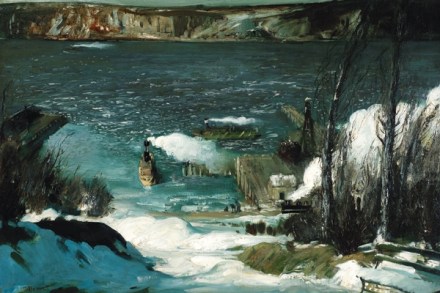
The American artist George Bellows (1882–1925) is best known for his boxing paintings, but as this surprising exhibition reveals, that was only the half of it. We don’t really know his work in this country, apart from the odd picture in a mixed show, but here is indisputable evidence that we have been missing out. Bellows died from appendicitis aged only 42, so this exhibition inevitably offers us work which varies wildly in style and competence, as he tried his hand at different approaches and different subjects. Nevertheless there are at least half-a-dozen paintings of real worth and presence, in addition to the boxing pictures, which I personally find of limited interest, though Bellows’s handling of bodies in dynamic movement is dramatic and convincing.

Cross examination

From our UK edition

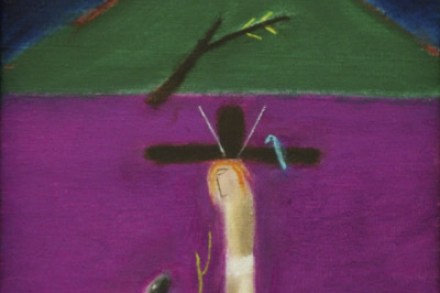
As Easter comes upon us in this bitter spring, many of us are drawn to contemplate the mystery of Christ’s passion: his Crucifixion, Resurrection and Ascension into Heaven. You don’t have to go to church to do this, for reverie or prayer can take place in a quiet landscape or by a cosy fireside, but there are various aids to meditation, and none better than the appropriate visual art. Although we live in an increasingly irreligious age, there have been religious painters of real power in recent years, and perhaps none more so than Craigie Aitchison (1926–2009).

When Picasso was a boy wonder

From our UK edition

Exhibitions are only as good as the loans that can be secured for them, as was seen at the Royal Academy’s Manet exhibition recently. The exhibits at Burlington House were thin on the ground because in some cases promised loans were rescinded, and other items were simply not available. Whatever one thinks of that controversial figure Norman Rosenthal, for so many years exhibitions secretary at the RA, his ability to seek out and obtain loans amounted to genius, backed by two important characteristics: audacity and tenacity. When I first saw the Courtauld’s Picasso show, I immediately thought of a painting of the artist’s friend Casagemas on his deathbed, lit by a flickering candle.