Culture

Culture

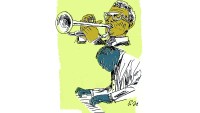
Tenor badness

In Stephen Spielberg’s 2004 comedy The Terminal, Viktor Navorski (Tom Hanks) is a native of Krakozhia, a small eastern European country engulfed in civil war. When Navorski lands at JFK, he discovers that his passport is invalid as America does not recognize Krakozhia’s new regime. He’s stuck in the airport for months and unable to accomplish his mission: completing his father’s quest to obtain the autographs of all 57 musicians in Art Kane’s 1958 photograph ‘A Great Day in Harlem’, a who’s who of jazz greats (including Count Basie, Coleman Hawkins, Dizzy Gillespie and Thelonious Monk), captured on East 126th Street in daylight without their instruments.

benny golson

Finger pickin’ good

The banjo was present at the creation of jazz but, like the clarinet and the fiddle, it fell from favor, and for similar reasons. The saxophone and the electric guitar were easier to play, more expressive and much, much louder. The banjo was on the way out even as it was on the way in — in the Hot Five recordings of December 1927 that instituted the jazz solo as we know it, Johnny St Cyr played both banjo and guitar — but the banjo had somewhere else to go. The fleet-fingered took their four-and fivestringers to the hills — the Appalachians, for instance. There, the banjo thrived with those other refugees from early jazz, the fiddle and the steel-strung guitar. Metropolitan contempt caught up with it in the Seventies.

banjo

The refreshing darkness of Netflix’s Locke & Key

Don’t be put off by the slow first episode, which makes you fear it’s just going to be another of those so-so emo magical-fantasy adolescent dramas in which Netflix abounds: Locke & Key is superior, addictive and bingeworthy stuff in the league of, or possibly even better than, Stranger Things. It begins with an achingly clichéd scenario — family driving across America to seek new life in exotic location, kids bickering in the back, awkward high-school experiences awaiting them, etc. — and the familiarity never lets up.

locke & key

The human clay

This article is in The Spectator’s March 2020 US edition. Subscribe here.The topics in The Necessity of Sculpture emerged randomly, thrown off by successive exhibition calendars and coming to range in time and place from ancient Mesopotamia to 21st-century Manhattan. As I made the selections, what began to take shape, beyond a conventional anthology, was a synoptic history of the art form. The title is a belated riposte to Ad Reinhardt’s famous dismissal, in around 1960, of sculpture as ‘something you bump into when you back up to look at a painting’.

sculpture

Mass appeal: Stanford in Stamford

This article is in The Spectator’s March 2020 US edition. Subscribe here. The exterior of the basilica of St John the Evangelist in Stamford, Connecticut, looms large and gray. Built in 1875 by Irish immigrants who mined and hauled rocks from a nearby quarry, its interior bursts with greens, reds and golds. The saintly lives in its stained-glass windows are said to comprise one of the largest collections of its kind on the East Coast. I was one of 12 singers to perform here at the American premiere of the Mass in G Major by the Dublin-born composer Sir Charles Villiers Stanford (1852-1924). Stanford’s Mass was first performed at London’s Brompton Oratory in 1893, but, like The Spectator, it took its time coming to America.

stanford

‘All rock ’n’ roll starts and ends with Lou Reed’

This article is in The Spectator’s March 2020 US edition. Subscribe here.March 2013 I have written a song called ‘Lou Reed, Lou Reed’. It’s a hymn to the man in the title — a petition, as Jim Morrison would have it, to the gods of rock ’n’ roll. The song runs for just two minutes and consists of a three-note, sub-moronic riff and a two-word mantra repeated 71 times. The two words are ‘Lou Reed’. The song isn’t a hit, but it does cut a bit of a dash. The song’s subject even hears it. I hear from someone who hears that he heard it that he likes what he heard. Then, in October 2013, the subject of my song dies. My song, a throwaway, begins a strange afterlife.

luke haines peter buck
kraftwerk

Uniform beats

This article is in The Spectator’s March 2020 US edition. Subscribe here. Right from the beginning, everything about Kraftwerk was odd. They had no frontman, they seemed to play no instruments and their strange, electronic music owed nothing to blues, soul or any of the other forms of music that underpinned 20th-century pop. Instead, a Kraftwerk gig consisted of four gauche-looking fellows from Düsseldorf standing in a row, each poking at a synthesizer while strange, apparently unconnected images appeared on screens behind them. A Kraftwerk album could be just as confounding. The cover of 1977’s TransEurope Express featured the band in suits and ties, looking more like the partners at an accounting firm than a pioneering electronica band.

An old master who still feels new

This article is in The Spectator’s March 2020 US edition. Subscribe here. Velázquez prized his work, but El Greco’s reputation fell quickly after his death in 1614. Another Spanish painter, Antonio Palomino (1655-1726), called The Greek ‘contemptible and ridiculous, as much for the disjointed drawing as for the insipid colors’. In the 1800s, ‘The Burial of the Count of Orgaz’, now regarded as one of his masterpieces, lay rolled up in the basement of a Toledo church.

el greco

Urbino legend

This article is in The Spectator’s February 2020 US edition. Subscribe here. At the time of his death on Good Friday, 1520, Raffaello Sanzio of Urbino was the most successful artist the world had ever seen. In terms of sheer skill, expert judges like the historian Paolo Giovio rated him third among the supreme trinity of Renaissance artists — after the stiffest imaginable competition, Michelangelo and Leonardo da Vinci. But in terms of worldly success, Raphael died as the unchallenged prince of artists. He was the favorite artist of the greatest patron in Christendom, the Medici pope Leo X. He had been commissioned to decorate the most prestigious monuments in Rome.

raphael

Cyrus the Great

This article is in The Spectator’s February 2020 US edition. Subscribe here. Washington, DC has a proud jazz history: the birthplace of Duke Ellington where he made his first arrangements as a highs-chooler; the home of U Street, where joints like the Crystal Caverns and the Howard Theatre hosted Louis Armstrong, Billie Holiday and Count Basie. Today, jazz holds out in a few spots on U Street and in select clubs such as Blues Alley. A relative latecomer, founded in 1965 near M Street in the heart of hoity-toity Georgetown, Blues Alley touts itself as ‘the nation’s premier jazz and supper club’. Despite a menu featuring such delicacies as ‘McCoy Tyner’s Blackened Catfish’, the supper part can safely be labeled as hearty, but no more.

cyrus chestnut

Wells farrago: gaslighting the Invisible Man

This article is in The Spectator’s February 2020 US edition. Subscribe here. ‘To many young people nowadays,’ H.G. Wells sighed in 1934, ‘I am just the author of The Invisible Man.’ He meant the movie, not the novel. George Bernard Shaw might have said something similar, only at greater length, had he lived to see the improvements by which Alan Jay Lerner turned Pygmalion into My Fair Lady. But would Wells recognize the latest variation on his 123-year-old character at all? This Invisible Man is not much interested in invisibility or men, or men who happen to become invisible. Elisabeth Moss is Cecilia Kass, a harassed woman trapped in an abusive relationship with a sociopathic tech bro.

wells
cats

Cats: The Snuff Movie

This article is in The Spectator’s March 2020 US edition. Subscribe here. In the 1970s, the English humorist Alan Coren set out to create the grabbiest literary cover package in the history of bestsellerdom. He titled his book, a collection of funny essays, Golfing for Cats and hit the trifecta by putting a massive, and otherwise totally irrelevant, swastika on the front. Needless to say, the book sold well. Golf isn’t as big now as it was then, but Coren’s other two ingredients remain staples of popular entertainment.

Land of hope and Victoria: The Kinks’ lost empire

This article is in The Spectator’s February 2020 US edition. Subscribe here. Was there ever a more audacious album title than Arthur, or The Decline and Fall of the British Empire? The name of the Kinks’ 1969 masterpiece could almost be described, in Sixties vernacular, as ‘far out’. But just two years after the lysergic hurricane of 1967, the content of Arthur was ‘far in’, even by the Kinks’ distinctly un-psychedelic standards. Not for them the late Sixties’ return to Americana of the Stones (Beggars Banquet), the Band (Music from Big Pink) and Dylan (John Wesley Harding).

kinks

The Witcher’s hours

This article is in The Spectator’s February 2020 US edition. Subscribe here. If you want to get really depressed about the future of television, consider this: over Christmas, The Witcher was Netflix’s highest-rated original series on IMDb, beating everything from Black Mirror to Stranger Things and The Crown. The reason you should be depressed is that The Witcher’s popularity may send a dangerous signal to screen producers: don’t worry about the script or the acting, just chuck in lots of monsters, ultra closeups of swords cleaving heads, arrows going into people’s eyes and girls in body-hugging leather fantasy outfits, like a Dark Ages version of Hooters.

witcher

Stayin’ alive in ’75

This article is in The Spectator’s January 2020 US edition. Subscribe here. ‘Ford to City: Drop Dead’ was the headline of the New York Daily News. To which the City said to Ford, you first. When the Daily News ran that famous headline on October 29 1975, New York was teetering on bankruptcy. President Gerald Ford had declared he would veto a federal bailout. It looked like the Big Apple was stewed. The world had written off New York. The feeling was mutual: the city had written off the world. Between 1970 and 1980, the city lost nearly a million residents, over a tenth of its population. Still, New York attracted people who, against the reigning wisdom, would not or could not live anywhere else.

meryl meisler

Style on steroids: the power of Jerry Bruckheimer

This article is in The Spectator’s January 2020 US edition. Subscribe here. Jerry Bruckheimer is a quiet man who produces the loudest movies in the world. Early, arty Jerry was the fixer who put together 1980’s slight neo-noir American Gigolo. Thrusting mid-period Jerry, happily partnered with the 1980s zeitgeist and fellow producer Don Simpson, made the classics Flashdance, Top Gun and Beverly Hills Cop. Don died a truly maximal Hollywood death in 1996 — they found 21 different substances inside him — but Jerry, always the sober one, kept going bigger, faster, louder: The Rock, Con Air, Armageddon.

jerry bruckheimer

Is he talking to us?

This article is in The Spectator’s January 2020 US edition. Subscribe here. There’s an old joke about Democrats and Republicans that might help us understand the anti-Trump rantings of pop-culture icons such as Robert De Niro and Bruce Springsteen. Two old guys are talking politics. One asks the other which party he supports. ‘The Democratic party,’ he responds. ‘Why so?’ ‘Because my daddy voted for the Democratic party, and my granddaddy voted for the Democratic party. So I vote for the Democratic party.’ ‘That’s ridiculous,’ rejoined the Republican voter. ‘So, if your daddy had been a hoss thief, and your granddaddy had been a hoss thief, does that mean you’d be a hoss thief, too?

de niro

All modern art is quite useless

This article is in The Spectator’s January 2020 US edition. Subscribe here.Laramie, Wyoming ‘It’s pretty, but is it art?’ Rudyard Kipling asked in 1890. In those days the modernist movement across the Beaux Arts was gaining a grip on the western world that it maintains in the 21st century and is likely to hold into the 22nd, if there is one. One hundred and thirty years later, Kipling’s question calls for a plain response: ‘If it’s ugly, it has to be art.’ Aquinas defined art as ‘right reason in action’; reason in making. Right reason depends upon a man’s knowing what he ought to believe, desire and do. The modern artist is ignorant of all of these things.

art
isaac hayes

The Hayes of our lives

This article is in The Spectator’s January 2020 US edition. Subscribe here. Somehow it’s fitting that in the era of Donald Trump, the blaxploitation genre, which emerged from the black nationalist movement during the original call for ‘law and order’ during the Nixon administration, has been making a comeback. In 2018, Sony released a remake of Superfly starring Trevor Jackson as pusherman Youngblood Priest and directed by Director X. But perhaps no film has done more to signal the revival of the blaxploitation genre than the latest Shaft film. The franchise could scarcely appear hardier. It was Gordon Parks who first adapted the film from the works of the pulp novelist Ernest Tidyman.

The soft power of Italian jazz

This article is in The Spectator’s January 2020 US edition. Subscribe here.New York City The singer and saxophonist Ray Gelato opens his set at Birdland with a cover of ‘That’s Amore’. But this isn’t the sleepy send-up of Neapolitan street waltzes that Dean Martin recorded in 1953. Gelato raises the tempo and swings it four to the bar. As he sprints his way through the verses, Philadelphia’s City Rhythm Orchestra drives the pace, piano, bass and drums holding down the shuffle while the four-piece horn section plays call-and-response to each other and his vocals. It’s the start of a fun, high- energy set, the two hours of which feel as if they pass in half the time. You don’t tap your feet to this music: you stomp.

italian jazz

A hero for the Snowflake age

This article is in The Spectator’s January 2020 US edition. Subscribe here. What have they done to Jack Ryan? That’s a rhetorical question, by the way: he’s been captured by a crack team of Ivy League majors in Race, Gender and Weaponized Resentment Studies — probably the same guys who wrote the Washington Post headline calling Abu Bakr al-Baghdadi an ‘austere religious scholar’ — and they’ve reengineered him as a beta-cuck pantywaist woke dork for the Age of Snowflakes. To be fair, Jack did slightly show these tendencies in the first season of his Amazon adventures.

jack ryan

Christmas crackers: the tragic soul of Natalie Cole

This article is in The Spectator’s December 2019 US edition. Subscribe here. As any Yule fool knows, there’s no Christmas album like an old Christmas album. But there’s not many of them. We’ve had plenty of classic Christmas singles but hardly any classic Christmas albums. In fact, since little Phil Spector went and ‘canceled’ himself and the life of actress Lana Clarkson in 2003, there is only one. Nowadays, a double-sided helping of Spector’s A Christmas Gift For You from 1963 would have the most ardent Wall Of Sound fan hearing sirens, not sleigh bells.

natalie cole

Star Wars: the force a-weakens

This article is in The Spectator’s December 2019 US edition. Subscribe here. The first Star Wars trilogy enraptured by blending classic drama with science fiction. There was Luke Skywalker the fresh-faced hero, emerging from obscurity to save the day. There was Vader the villain, who had once been good but had embraced the dark side. There was the Emperor, the twisted puppeteer. There was the daredevil pilot Han Solo. There was Leia, the princess who had to be saved. There was even that essential companion on any voyage: a bumbling upper-class Englishman. All of it was familiar from classic cinema and adventure stories, but all of it had the strangeness of science fiction. The villain lurked behind a fearsome mask and choked people by mind control.

star wars
wild

The call of the wild

This article is in The Spectator’s December 2019 US edition. Subscribe here. People who go into the wild looking to meet bloodthirsty predators are either a living Xanax pill or some sort of dominatrix version of Jane Goodall. Especially when it’s winter. Save yourself a mauling by a hungry puma, swap your earmuffs for earphones and get wild with The Wild, in which ecologist and award-winning filmmaker Chris Morgan leaps sure-footedly from one wildlife topic to another like a mountain goat. Like Nature itself, The Wild is pretty random but always red in tooth and claw. Morgan focuses on the overlap between animals and humans: something people tend not to consider when they move into areas where the neighbors are bears or cougars.

Leonardo da Virtual

This article is in The Spectator’s December 2019 US edition. Subscribe here. The first time ever I saw her face, she was smiling. I knew her face before I saw it, but I cannot remember when I first knew it, because I had always seen it. But when I first saw her in the flesh, I couldn’t really see her at all. She was behind thick glass and a waist-high wall, and a crowd of people 20-deep were pushing toward her, shouting and pointing and taking photographs. She was still smiling, but as I forced my way out of the crowd, I felt as though the smile no longer expressed the mysterious inner mood of a high-born Florentine sitting in a loggia, but the bemused contempt of a woman sitting in the stocks for the entertainment of the mob.

mona lisa leonardo

Payton’s place

This article is in The Spectator’s December 2019 US edition. Subscribe here. Four episodes in, I finally decided I really didn’t like The Politician (Netflix). Initially, I thought I might because there was lots of advertising assuring me how good and culturally important it was going to be. Also, it’s made by the same creative team responsible for Glee, that slick but likable and quite moreish series about an American high school glee club where an impeccably diverse class of gay and disabled people keeps bursting into implausibly accomplished cover versions of classic pop songs. But no. The Politician leaves you with the same unpleasant, dirty, life-just-wasted feeling I imagine you’d get from watching Japanese hentai porn.

politician

Tough gospel: the twin cities of Sesame Street and Mister Rogers’ Neighborhood

This article is in The Spectator’s November 2019 US edition. Subscribe here. For people who, like me, were born in the troubled times of the Seventies, Sesame Street and Mister Rogers’ Neighborhood were an educational crossroads. As we gazed into the cathode-ray tube for direction, each program led to a very different future. Sesame Street, now in its 50th season, remains unavoidable and familiar. Yet we’re captivated by the return of Mister Rogers’ Neighborhood, the unpolished creation of Fred Rogers that aired from 1968 to 2001. Last year, the documentary Won’t You Be My Neighbor? became a surprise hit. This week sees the opening of A Beautiful Day in the Neighborhood, a movie starring Tom Hanks as Rogers.

rogers

A motel room of one’s own

This article is in The Spectator’s November 2019 US edition. Subscribe here. To gauge a man’s character, note how he spends a month in Paris. Edward Hopper, according to the catalog of his 1933 retrospective at New York’s Museum of Modern Art, lodged with a ‘respectable French family’, studying French and ‘avoiding bohemia’. Asked if he met any painters during his visits, he responded, ‘No, I did not know anyone. Gertrude Stein was on the throne when I was there.’ Hopper knew it wasn’t his scene. Isolation was a persistent theme in Hopper’s art and life. Was he dogged by isolation or did he pursue it? ‘Did anybody really know this silent, non-communicative man?

hopper

Brazilian wax

This article is in The Spectator’s November 2019 US edition. Subscribe here. When Brazilian president Jair Bolsonaro spoke at the United Nations General Assembly in late September, he depicted Brazil as a victim of colonialism. ‘The United Nations has played a fundamental role in the suppression of colonialism,’ he said, ‘and we cannot allow this mentality to return to these rooms and corridors at any pretext. We cannot forget that the world needs to be fed.’ Foreign countries, Bolsonaro alleged, have ‘an interest in keeping indigenous people living like cave men’.

brazilian