Culture

Culture

The poetry of Tommy Robinson

Life’s not all politics. Even for Cockburn. Well, kind of. Cockburn enjoys poetry, but the digital news churn leaves him no time to recline with a slim volume of verse and a glass of dry sherry, as he was wont to do in his youth. Imagine, then, Cockburn’s delight at finding a poem that combines the pleasures of lyric with deep research into global issues—immigration, Islam, the ‘administrative state’ (rhymes with ‘people we hate’), and the budding romance between Steve Bannon and Europe’s new nationalist parties: ‘Letter to England: For Tommy Robinson’, by the American versifier Joseph Charles MacKenzie.

Tommy Robinson poetry

V.S. Naipaul’s gentle side

When I went to see V.S. Naipaul in hospital last week he was feeling marginally better. His wife Nadira had arranged for a violinist to play some Mozart to him, helping him relax. She did not allow too many visitors. This was not the first time he had been in hospital. His health had been deteriorating for the past 12 months and the family had been receiving — as always — a flurry of invitations from literary festivals and heads of state. All had to be declined. In his hospital room we discussed his coming 86th birthday and I suggested that we celebrate with champagne at the Ritz. He smiled and proposed we go to ‘the other place’. He had a better time at the Lanesborough and preferred to head there instead.

V.S. Naipaul’s

Only Aretha Franklin had the soul power to summon the spirit at will

Aretha Franklin, who died this morning at the age of 76, was called the Queen of Soul. But she did not inherit her crown, so much as create it. Nor, though she inspired plenty of oversold and over-souled pretenders, did she ever have a plausible heir. She wove that crown from the music of the black church, the blues and Broadway, from faith, pain and love. No one else could touch her, and she will meet her maker still wearing it. Aretha — the voice was so distinctive that her surname seemed superfluous — was simply the finest popular singer of her generation. Unlike every other pop star of the Sixties and Seventies, she would have been among the finest of the previous generations, too.

Azealia Banks is telling the truth

For a certain slice of the online commentariat, nothing better captured the zeitgeist this year than the surprise romance between tech industrialist Elon Musk and Claire Boucher, the cyberpunk-ish music impresario known professionally as Grimes. This week, we discovered their coupling was just the beginning.The worlds of Musk and Grimes worlds merged bizarrely when the pop star Azealia Banks wound up blasting out status updates on Instagram from inside Musk’s LA manse. Banks painted an unflattering portrait of Musk as a billionaire whose impulsive business decisions made it impossible to get Banks and Grimes in the same room of the same house where, ostensibly, their musical collaboration was supposed to begin: https://twitter.

Thank God for the return of the generation gap in pop

In June, a 20-year-old man called Jahseh Onfroy was murdered after leaving a motorcycle dealership in Deerfield Beach, Florida. Onfroy was a rapper, who recorded under the name XXXTentacion, and he had become extraordinarily successful — his two albums had reached No. 2 and No. 1 in the US, despite moderate sales, because of the amount of online plays they had received. The day after he died, my social-media timelines were full of music writers discussing his death, and the tenor — from those with kids, at least — was clear. Post after post noted that XXXTentacion was a nasty piece of work, and few should mourn him, yet the writer’s 13- or 14- or 15-year-old was devastated by his death. XXXTentacion was, it is true, a nasty piece of work.

Did Ed Balls mean to make a documentary on the joys of Trump’s America?

Ed Balls has become the left’s Michael Portillo, reviled as a politician, now a game, well-loved, almost cuddly TV personality. I met him once on This Week and I was instantly struck by how easy, funny and genuinely likeable he was: as engaging in person as he was totally bloody awful as chancellor. Happily it was the gentle man rather than the leftist bruiser who dominated Travels in Trumpland (BBC2, Sun). One fatuous previewer I read in the papers grumbled that he hadn’t challenged Trumpism enough. Tosh.

The artist who breathes Technicolor life into historic photographs

There is something of The Wizard of Oz about Marina Amaral’s photographs. She whisks us from black-and-white Kansas to shimmering Technicolor Oz. When Howard Carter leans over Tutankhamun’s open sarcophagus (1922), he does so in the glare of pharaonic gold. A photograph of fallen American soldiers on the Gettysburg battlefield (1863) shocks the more when we see the colour of the blood soaking through shirts. The Javanese dancers who performed at the Exposition Universelle in Paris (1889) are gorgeous in madder pinks, jades and golds.

No apology is ever enough for the digital mob

Promoting physical fitness, the left has developed a bracing set of competitive callisthenics. Participants vie over who can complete a marathon crawl on the belly like a reptile, who can flop onto the floor in a pose of the greatest prostration, and who can bend over the farthest, pants down, while begging to have large pieces of furniture shoved up the backside. Athletic displays of public remorse also constitute an increasingly popular spectator sport. The young American poet Anders Carlson–Wee was excited at first about getting ‘How-To’ published in a July issue of the Nation, a storied New Statesman-style weekly.

The Black Arrows come for Zadie Smith

Literary mandarin Zadie Smith has waded in deep this time. We’ll see if she’s allowed back to shore. Smith has been making troubling noises lately, letting off faint signals that her inner life might be insufficiently pasteurised and homogenised for the tongue-clicking clipboard huggers of the modern moral regime. In a Guardian interview conducted earlier this year, Smith said: “I can’t stand dogma, lazy ideas, catchphrases, group-think, illogic, pathos disguised as logos, shoutiness, ad hominem attacks, bombast, liberal piety, conservative pomposity, ideologues, essentialists, technocrats, preachers, fanatics, cheerleaders or bullies.

Ben Brantley isn’t transphobic – he’s pitiful

In yesterday’s Spectator USA, I described the experience of watching Mission Impossible: Fallout as akin to being sprayed in the face with hot diarrhea. This was inexcusably coarse and vulgar. So was my observation that the Fallout of this baggy mess of a film resembled an anal prolapse. It was not my intention to personally insult Tom Cruise, or to imply that he is a ridiculous fake, or to suggest that Paramount Pictures are peddling misogynistic smut. But if I did, so much the better. For that is what I believe to be true. What does Ben Brantley believe to be true? Anything you like, providing you shout loud enough. Since 2003, Mr. Brantley has held one of the toughest jobs in journalism.

Sacha Baron Cohen isn’t funny – especially when he’s mocking the powerless

Sacha Baron Cohen’s latest series Who Is America? isn’t funny. But then, nor was his terrible 2016 movie The Brothers Grimsby. Nor was his rubbish 2012 film The Dictator. Nor, let’s be honest, were his classic original characters Borat, Brüno or even Ali G. Obviously, they had their moments: the ‘mankini’ — that bizarre, electric green, giant-thong-like swim wear worn by Borat; the classic late-Nineties catchphrase ‘Is it because I is black?’ And sure it must have taken some nerve — even in character — to explain to a clearly impatient and unimpressed Donald Trump his business plan for some anti-drip ice-cream gloves. But how often, even at his best, does Baron Cohen ever make you laugh?

David Sedaris, the current king of humourists, is often not funny at all

Since the 17th century, a ‘humourist’ has been a witty person, and especially someone skilled in literary comedy. In 1871, the Athenaeum said that Swift had been ‘an inimitable humourist’. But in modern usage the term seems to describe a specifically American job title: someone who specialises in writing short prose pieces whose only purpose is to be funny. The current king of humourists is David Sedaris, and his books are essentially scripts for his sell-out reading tours. But is he funny? On a line-by-line basis, he sure can be. He helps push someone’s broken-down car, ‘and remembered after the first few yards what a complete pain in the ass it is to help someone in need’.

Bruce Lee: weird, gruesome and oh-so-cool

Every cinema-loving person has a favourite Bruce Lee moment. My own comes towards the end of Enter the Dragon, the film which Lee made just before his death in 1973 at the age of 32, and that would in turn seal his worldwide stardom. There, on one side, stands Lee himself. There, on the other, is the villainous Han, who has a set of metal talons where one of his hands ought to be. The two men leap across each other, leaving Lee with an unpleasant gash on his shirtless torso. He pauses, dabs a finger in the blood, raises it to his mouth — and licks. It is weird, gruesome and oh-so-cool, all at once. Why did Lee do this? The answer is in Matthew Polly’s biography.

Westering

The last thing my mother told me before I left home with no particular object in mind but to see the Sawtooths and the Tetons and perhaps the great-granddaughters of corset-clad Gold Rush “Cyprians” was, “Don’t take risks.” As an explorer’s commission this fell far short of “Extend the external commerce of the United States,” or “Locate a waterway to the Pacific,” or even just, “Have fun.” As an effort at self-caricature it was a great success. As an indirect reminder of why I was going at all, the deeper reason, the subconscious goad, it was right on the money.

Film review: Netflix’s The Skin of the Wolf

There are now more trees to hug in the Northeast than at any point since the eighteenth century. In the good old days, the trees were cut down for construction, firewood, and farming. Now, we build with concrete, burn old coffee grounds in decorative stoves, and convert old farmhouses into weekend rentals for skiers and hikers. This is good for the squirrels. Once, it was said that a squirrel could mount a tree on the coast of Maine or Massachusetts, and scuttle rattily through the canopy all the way to the Ohio River without putting one of his filthy little paws to the ground. But is it good for the humans? Samu Fuentes’ The Skin of the Wolf, newly released into the digital wild by Netflix, is about the dangers of re-wilding.

Channel 4 doesn’t do ‘news’ in any meaningful sense of the word – it’s pure propaganda

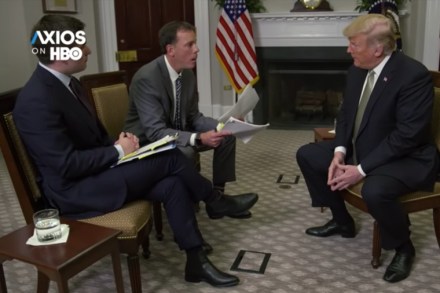
When President Trump refused to take a question from a CNN reporter at the Chequers press conference last week, I imagine a lot of British viewers thought —as Theresa May clearly did — that he was being graceless, capricious and anti-freedom of speech. But I think we’re in danger of underestimating the extent to which the media landscape has changed in the past few years. Gone are the days — if they ever existed — when political interviewers were dispassionate seekers-after-truth on a mission to get the best out of their subjects. Now, it’s mostly activism-driven, the aim being to advance your preferred narrative while showing up your ideological opponents in as unflattering a light as possible.

Paul Simon says farewell with a daring and inventive show

Early in 1987, a middle-aged woman approached me on the record counter of the Slough branch of Boots. ‘What do you have by Ladysmith Black Mambazo?’ she demanded. Nothing. Boots in Slough wasn’t big on South African isicathamiya choral music. ‘Well,’ she suggested, ‘you really ought to get their records in. They’re going to be huge.’ She was wrong, but I knew why she was so sure. Ladysmith Black Mambazo had been among the standout guests on Paul Simon’s Graceland, released a few months before. Graceland made Simon, by my reckoning, the first pop star who had emerged from the rock’n’roll era to make a major cultural impact across three decades. By the 1980s, the Stones had become just a touring machine.

Drake’s soft centre makes him a new type of hip-hop role model

So much rap is outsourced id – music we play to put us in touch with deep animal parts of our inner lives, where we fight and fuck and flaunt our victories like civilisation never happened. The vast sums of money and creature comfort afforded to the play-actors are darkly poetic. Here’s the deal: you tell us about the grinding poverty, violence, drugs you came through and how you’re now rich as fuck, and we’ll make you so. Just pop out of your mansion every few months and remind us how the good life tastes when you’ve grown up hungry. We all want heedless, hedonistic triumph, but we’ll take it vicariously – we have jobs to hold down and mothers to please.

The real reason Scarlett Johansson abandoned her ‘trans role’

There is so much euphemistic reporting about Scarlett Johansson’s decision to drop out of a film in which she would have portrayed a trans man. Ms Johansson ‘quits role’, headlines tell us. She has ‘stepped away’ from ‘trans role’, we are informed. It all makes it sound like she had a simple change of heart, or maybe found herself drawn to a different movie project. The truth is rather different. The truth is Ms Johansson was hounded out of the trans role by an intolerant online mob hurling invective at her. She didn’t merely ‘quit role’ — she ‘quit role’ under pressure from an unforgiving gang of identitarians who think they have the right to tell actresses who they may and may not portray on screen.

Meet Michiko Kakutani, the conservative

Michiko Kakutani used to be an important person in the world of people who cared about book reviews in the New York Times. This was not a world at all, so much as a small village whose borders could be seen from any tall building in Manhattan. Still, her opinion was considered important. Kakutani was notorious for actually reading the books she reviewed, and for not thinking of the reviewer’s desk as an outpost of the publisher’s press office. So, though book reviews are generally not worth reading, hers sometimes were. When Kakutani left the Times in 2017, it was rumored that she had jumped before being pushed by the downward-dumbing of the Times’ arts’ content.

My chat with Harvey Weinstein

He used to ring me via his assistants and make me wait on hold. It was normal; he was, after all, the biggest Hollywood tycoon of them all. This time he called me directly, there was no ‘Harvey Weinstein wishes to speak to you, please wait on the line’ stuff. The old growly voice was the same and he went straight to the point: “I’ve got a world exclusive for you, are you interested?” We agreed that I go to him, as I live in a very stuffy building on the Upper East Side of New York and Harvey’s reputation has taken a beating of late. The last time we met I had gone to his downtown office where many of the alleged sexual assaults had taken place.

harvey weinstein

Chopin’s Piano is an eclectic trip through 19th-century romanticism

It is easier to say what this book is not than to describe what it is. It is not a biography, nor a work of musicology. As an extended historical essay it is patchy and selective. It is partly about pianos and pianism, but would disappoint serious students of that genre. It is not quite a detective story — though there are, towards the end, elements of a hunter on the track of his prey. It is probably best to begin the book with no expectations of where it will lead. It starts in the Palma workshop of one Juan Bauza in the 1830s as he fashioned an upright piano — crude, even by the standards of the day — from local softwood, felt, pig iron and copper.

Cease to strive! Now!

There is a long and noble history of books about doing nothing. In the 5th century bc the sage Lao Tzu argued that the wise man should refrain from action, and Christ’s Sermon on the Mount also told us not to bother ourselves overmuch: ‘Consider the lilies of the field, they toil not.’ For Christ, idling was a spiritual and political position: he taught us to live in the moment and reject riches and status as a source of enlightenment or happiness. Now the self-help industry has taken idling and converted it into, paradoxically, a tool for productivity, i.e. getting ahead and making money, which is not what Christ had in mind.

Donald Trump’s fixation on celebrity is what makes him so…American

The day after Independence Day, 2018, the President of the United States shambled into a packed auditorium in Great Falls, Montana, and delivered these remarks, apropos the size of the assembled audience: “I have broken more Elton John records, he seems to have a lot of records. And I, by the way, I don’t have a musical instrument. I don’t have a guitar or an organ. No organ. Elton has an organ. And lots of other people helping. No we’ve broken a lot of records. We’ve broken virtually every record . . .” Well, that’s as good an epitaph as any. Whoever’s in charge of the giant, gold-plated sarcophagus can sharpen the chisel and get carving.

Ignore Lily Allen’s sub-adolescent politics – her new album is brilliant

Grade: B+ Here we go again, then, I thought — another gobbet of self-referential, breast-beating respec’ me bro sputum against a backdrop of the usual overproduced r&b pop schlock. What used to be called ‘indie’ singer-songwriters are always moaning about how utterly useless they are, taking Radiohead’s ‘Creep’ as a kind of self-flagellating worldview. Chart singer-songwriters, meanwhile, can’t stop telling everyone how absolutely bloody marvellous they are, despite being traduced, which fits right in with the extraordinary narcissism of our current youth culture, its bovine #MeToo grandstanding and exquisite sensitivities. I don’t mind Allen, despite her irritating sub-adolescent Corbynista politics.

The virtuoso virtue-signallers of classical music

All my life I’ve wanted to compose music, and now I’ve done it. I’ve written a sonata for solo flute that boasts two highly original features; it’s five hours long and must be performed by a badger. Though it took me only five minutes to write, my opus one is guaranteed to get through to the second round of the next competition for new composers sponsored by Sheffield University and the Centre for New Music. That’s because they operate a ‘two ticks’ policy, as the Scottish pianist Philip Sharp — possibly the only classical musician in Britain who calls himself a classical liberal — revealed in his blog earlier this year.

Up close with the Rolling Stones

At 7 p.m., panting, I knocked on the door of room 201 of the Hotel InterContinental, Marseille, expecting it to be opened by Patrick Woodroffe, the man who has splendidly lit Rolling Stones gigs for the past 33 years, who would, I believed, hand over two tickets. With any luck, and on the strength of our slender acquaintance, I hoped these tickets would be upgraded to seats a little closer to the action than the ones we had paid quite enough for. Eventually, the door was opened instead by a timid woman wearing a hijab. She blinked at the words ‘Rolling Stones’ but they meant nothing to her. We ran back downstairs to the concierges’ desk. ‘Nope,’ they said, checking a stack of envelopes. ‘Nothing for you here under that name.

Sure, Donald Trump is uncultured – but is that such a bad thing?

In a sardonic email written last year to the New Yorker magazine, the late, great Philip Roth describes Donald Trump as a man “incapable of expressing or recognising subtlety or nuance...wielding a vocabulary of seventy-seven words that is better called Jerkish than English.” I enjoy the crankiness, coming from Roth, and I wish I could say it was wholly uncalled for. Our president, it can’t be denied, is a man little given to nuance, and almost charmingly innocent of any refinements of diction or syntax. This is a loss for us, if a survivable one. The world is complicated, and all things being equal, leaders who speak precisely and beautifully render better service to the citizens they represent.