Culture

Culture

What monuments stand to teach Americans about themselves

Why do we raise monuments? Why do we tear them down? These questions hover over MONUMENTS, now on view at Los Angeles’s Museum of Contemporary Art and the Brick. The premise is straightforward enough: gather the remains of America’s shattered sculptural conscience – decommissioned Confederate statues and their graffiti-marred plinths – and display them alongside contemporary works on racial topics. This comparison is supposed to reveal something about America’s nature and history, and it certainly does: it shows us just how attached we are to grievance. Both the raising and the destruction of monuments nourishes convictions on either side, ensuring that the argument can never end.

monuments
arcade fire

Arcade Fire extinguished

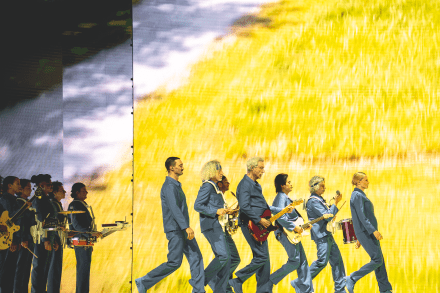
Amid the many disappointments and commercial flops the music industry saw this year, perhaps the most egregious was the complete failure of Arcade Fire’s album Pink Elephant. The failure represents not merely the probable end of the band, but also the death of Obama-era rock. Pink Elephant received dismal reviews and didn’t even chart on the Billboard 200. Given that their last album, We, reached #6 as recently as 2022, and their previous LPs, Reflektor and Everything Now, topped the charts, this is a near-unparalleled fall from grace for a once-mighty act. That the married pair who compose the nucleus of the band, Win Butler and Régine Chassagne, announced their separation a few months later was the particularly rancid icing on the already-stale cake.

bob dylan

When Dylan went folk

For all the billions Taylor Swift has made from guiding her career into carefully delineated “eras,” it was Bob Dylan who pioneered this career path. With practically every new album, Dylan traded one persona for another. There’s the folkie hobo of The Freewheelin’ Bob Dylan, the pill-popping beat poet of Blonde on Blonde, the cleaned-up country crooner of Nashville Skyline, the Christian revivalist of Slow Train Coming and many, many others. This year marks the 50th anniversary of Dylan’s The Basement Tapes, a tranche of previously unreleased hoedowns, goof-offs, shaggy-dog stories and barroom ballads that was never meant to be a proper album, but might be the closest we can get to seeing the man behind the mask.

The new Tom Hanks play is a drag

In This World of Tomorrow – the new play starring and cowritten by Tom Hanks, currently on at The Shed in Manhattan – Tom Hanks plays a classic, well, Tom Hanks character.  Bert Allenberry (Hanks) is the nicest guy in the room: he’s the kind of great guy who will escort a lady home in a taxicab, even if it will make him late. And in This World of Tomorrow being late matters a lot. Bert, you see, is a successful but dissatisfied scientist from the future who travels back in time to the 1939 New York World’s Fair in Queens. Once there he has complete free rein, except for one thing. He must return to his hotel at a certain hour to be whisked back to the future – or risk mortal bodily damage.    Love, of course, gets in the way.

Tom Hanks in This World of Tomorrow (Photo: Marc J. Franklin)

RIP Rob Reiner

The death of the director and actor Rob Reiner in violent and unexplained circumstances is one of the most horrific and surprising stories to have emerged from Hollywood in living memory. One of the reasons why its elites live in areas such as Reiner’s exclusive neighborhood of Brentwood in California is precisely so that they will not be subject to the possibility of random violence in a way that less wealthy Americans face daily. Yet if news reports are to be believed, Reiner and his wife Michele were the victims of intrafamilial strife: a situation that all the gated walls and security cameras in the world could not ameliorate.

Liberation is a witty, genuine snapshot of second-wave feminism

In the second act of Liberation the main cast quietly, and without fuss, starts to undress. By the time the lights go up, all six women are naked. In this masterful play by Bess Wohl, the moment does not feel shocking or gratuitous but somehow comforting. In 1970s Ohio, a group of women meet weekly to fight for equality through “consciousness-raising.” Mostly that consists of free-ranging conversation, of which the women have a lot and which is always smart, funny, vulnerable and eye-opening. But after reading an article about body positivity in Ms. magazine, they meet in the nude.

liberation
tom stoppard

Stoppard, Sappho and me

Many years ago, and well retired, I was working in my study at home when the phone rang and a voice said, “This is Tom Stoppard. David West put me onto you.” David was the professor of Latin at Newcastle University and it emerged that Tom used him when he had queries about Latin, but now had a question about the ancient Greeks. When he couldn’t answer it, David suggested that Tom should call me. I felt a vast chasm of ignorance opening in front of me and have no memory of what the question was – but my reply must have satisfied him because he continued to throw the odd leg-break my way. To give some idea of his range of interests, on one occasion he became interested in the Greek perfect tense. Don’t ask me why, but that was at least something I could do.

The Diddy documentary is required viewing

There are relatively few Netflix documentaries – even in this increasingly sensationalized and prurient age – that have made anything like the splash that the new show about the artist formerly known as P. Diddy has caused. Sean Combs: The Reckoning isn’t just hard to watch, but positively mind-blowing in its account of the imprisoned mogul’s actions and predilections. Although he was acquitted of the most serious charges that he was on trial for this year, Combs will not be released from jail until May 2028. Given the number of allegations and civil suits pending against him, any comeback for the disgraced musician looks impossible – even in an era when Kanye West is, apparently, given second chance after second chance.

The Golden Globes loves Paul Thomas Anderson

Well, One Battle After Another is the toast of the Golden Globe nominations and Wicked: For Good is… not. That’s the biggest immediate takeaway of the first indicator as to how the awards race next year is likely to pan out. The many nuances and surprises of Monday's announcement are not only a fascinating insight into the state of Hollywood in 2025, but also a reminder that the Globes have always prized big star names above everything else – including, perhaps, the worthiness of their inclusion.

The fight for the future of Warner Bros.

That creaking sound you hear creaking is Jack Warner, the founder of Warner Bros. studio, turning in his grave. Last week, it was announced that Netflix had purchased one of Hollywood’s most respected studios for a staggering, indeed insane $83 billion – which makes Disney’s purchase of Lucasfilm for $4 billion in 2012 seem like the bargain of the century. The sale would create a monopoly the likes of which has never been seen before in the film industry. Most people assumed that such a bid – in this increasingly beleaguered business – is very, very bad news. They might be correct. That’s why it’s even more staggering that Paramount have today, with impeccable timing, announced their own hostile takeover bid for Warner, offering an even more outlandish $108.

Will the new Avatar be the last?

For someone who has directed two of the three highest-grossing films of all time – and if we include Titanic in the mix, three of the top five – James Cameron struck an unusually modest figure at this week’s premiere Avatar: Fire and Ash. When asked at the screening whether its inevitable box-office success would result in the planned fourth and fifth films being produced, the erstwhile King of the World responded “I’m not even thinking about four. Are you kidding me? I'm unemployed right now.” Admittedly, Cameron’s definition of “unemployed” is rather different to that of most people, whether they be A-list directors or the less fortunate.

Is there such a thing as right-wing art?

This has been adapted from a speech titled “The Myth-Maker as Nation-Builder,” which was delivered by Jonathan Keeperman, who runs publishing house Passage Press, at the National Conservatism Conference 2025. As W.B. Yeats once said: “There is no great literature without nationality. There is no great nationality without literature.” People often ask me whether it is possible to produce right-wing art, or otherwise to use art to engineer a more nationalist politics. But this strikes me as backward thinking. Culture is the field in which a people encounters the shared symbols and language that make political life possible. Art, done well, discloses the deeper truths a people already carry within themselves. Art therefore does not produce the nation; it reveals the nation.

Truth

The contingent talent of Emily Sargent

When your brother is one of the most successful artists of his time, you might feel reluctant to pick up a paintbrush. Yet, the works of Emily Sargent, in the Metropolitan Museum of Art’s Portrait of a Family, prove that she was an artist in her own right. Sargent (1857-1936) was not in her brother’s shadow, although she was undoubtedly in his debt. John, Emily and their sister Violet were the children of FitzWilliam Sargent, a successful Philadelphia physician, and the artist Mary Newbold Sargent. By the 1850s, the Sargent family were living a nomadic existence in Europe – John and Emily were both born in Florence. Encouraged by their spirited mother, the Sargent children were instructed that no matter how many sketches were begun in a day, at least one must be finished.

Monet

Monet’s Venetian moment

If you crave art that will envelop you, book a ticket, pronto, to Monet and Venice at the Brooklyn Museum. Enveloppe was the term the French impressionist artist Claude Monet (1840-1926) used to describe the “beauty of the air around” the objects and landscapes he painted. “Other painters paint a bridge, a house, a boat… I want to paint the air in which the bridge, the house, and the boat are to be found – the beauty of the air around them, and that is nothing less than the impossible,” he said.

train dreams

Portrait of a frontier life

Death falls from the sky in Denis Johnson’s 116-page novella Train Dreams (2011) in the form of “widowmakers,” broken tree limbs that can strike heedless loggers. Death burns through forests and arrests the heart of a young man hauling sacks of cornmeal; it rots through the wounded leg of a pedophile; it takes Robert Grainier in his sleep in November of 1968: “He lay dead in his cabin through the rest of the fall, and through the winter, and was never missed.” But Train Dreams, often hailed as a “miniature masterpiece,” is not a story of defeat: it is an elegiac love letter to the unobserved life of the American frontier worker who, though left behind by the steady march of progress, endures with quiet grace.

The new Stranger Things is loopy and sweet

So, the new – and supposedly final – season of Stranger Things has arrived in Netflix, just in time for Thanksgiving. Expectations have been through the roof that this installment will not be a turkey, but the good (stranger?) thing about the series so far is that it has maintained a remarkably high level of quality since it began in 2016. This is by no means a given for an Eighties-inflected fantasy show that is so devoted (the cynics might and have said slavishly) to all things that Steven Spielberg produced in that decade that the bearded one might have sued for plagiarism, were it not for the fact that the homage remains an affectionate and heartfelt, rather than cynical, one.

stranger things

When will the Beatles bandwagon end?

The Beatles broke up in 1970, but you wouldn’t know it from the activity of the last few years. In no particular order, we have had an underwhelming valedictory single, “Now and Then,” raised from the dead thanks to the wonders of artificial intelligence and Peter Jackson alike; an eight-hour – eight!– documentary, Get Back, resurrected from the footage of the Let It Be sessions; and now, an all-singing, all-dancing reissue on Disney+ of the Nineties Anthology documentary series, which has been promoted with the fourth volume of offcuts and rare tracks from the band’s career, appropriately titled Anthology 4.

They should never make another James Bond film

The 25th and most recent entry in the James Bond franchise, No Time to Die, premiered over four years ago. Since then, there has nonetheless been Bond drama. In 2022, Amazon acquired MGM, and with it the rights to 007. But it took several more years to wrest producer control from Eon productions, run by the Broccoli family’s Barbara Broccoli and her half-brother Michael G. Wilson, scions of the filmic spy empire created by their father Albert “Cubby” Broccoli. (The family claims that the vegetable is named after them, their fortune having been founded by crossing rabe with cauliflower.) Most recently, writers for the long-delayed upcoming 26th Bond film, set to be directed by Denis Villeneuve, appear to be stumped, plotwise.

What if the Emerald Fennell Wuthering Heights is good? 

Every few months or so, a new film comes along and anyone interested in the art of cinema braces themselves, because The Discourse will inevitably accompany it. There is no clearer candidate for fevered discussion next year than Emerald Fennell’s new adaptation of Wuthering Heights, which is released, with smirking predictability, on Valentine’s Day. Ever since the film was announced, there has been controversy over everything from the casting of the Caucasian Jacob Elordi to play Heathcliff (who is referred to in Emily Brontë’s original novel as a “a dark-skinned gypsy in aspect”) to the excessively clean and stylish-looking clothes worn by Margot Robbie’s Catherine Earnshaw.

wuthering heights emerald fennell

Nuremberg and the overpowering greatness of Russell Crowe 

Nuremberg, the latest film by James Vanderbilt – yes, the writer-director is a scion of that distinguished East Coast dynasty – contains two lead performances by Oscar-winning actors. One is extraordinary, and the other is extraordinarily bad. Yet it is a sign of how Russell Crowe and Rami Malek’s respective careers have developed over the past few years that were you invited to pick which actor is capable of greatness, and which one has descended into bizarre self-parody, it would not necessarily be easy to pick which one was which.   I shall put you out of your misery.

nuremberg Hermann Göring

Give Stellan Skarsgård an Oscar for Sentimental Value

Recently, a friend of mine found himself having a bad day for a reason I now forget. I made a lousy attempt to cheer him up. “Omnia in bonum,” I said to him – all things work together for good. The Latin phrase has served as a salve for me in hard times. Little did I know that I had just made things much worse. He was visibly shaken. I asked him what was wrong. I had unknowingly stirred memories of his parents’ difficult and traumatizing divorce, during which that same phrase had been used by them in a pointless attempt to assuage their children’s sadness. The idea that a phrase, a memory or an object can be simultaneously cursed for one person and blessed for another had never occurred to me. It has occurred to the Finnish filmmaker Joachim Trier.

South America is flush with Nazi-looted art

This summer, a niche story from the art world caught fire: an Old Master painting, stolen by the Nazis from a Dutch-Jewish art dealer, surfaced in Mar del Plata, Argentina. Remarkably, journalists from a Dutch newspaper spotted it on the wall of a house in a promotional photo that was part of a “for sale” real-estate listing. It turned out that one of the sellers of the house was the daughter of a Nazi official who worked for Reichsmarschall Hermann Göring, a notorious art plunderer. When the stolen painting was recognized, the daughter allegedly removed it from the wall, replacing it with another artwork – a tapestry. Argentine authorities then arrested her and her husband and charged them with concealing a crime.

nazi
man ray

Man Ray is alluring in the way a psychopath is

Down to his chosen name, Man Ray (born Emmanuel Radnitzky in Philadelphia in 1890) worked hard to squash anything about him you might call human. At least that’s what is suggested by the Met’s exhibition Man Ray: When Objects Dream. The show spans much of his career – he was associated with surrealism and dada, held a day job as a commercial photographer and experimented with almost every medium imaginable – but coheres around his so-called rayographs, also known, in less egotistical fashion, as photograms. Many will know this medium from elementary school: place objects on top of a light-sensitive sheet and expose them to light to yield white silhouettes against a dark background.

scorsese

Is Martin Scorsese America’s greatest living director?

Who’s the greatest living American film director? Many would say Steven Spielberg, and that can’t be dismissed, but he hasn’t made a really good film since Munich (2005). There are many younger pretenders – such as David Fincher, Paul Thomas Anderson, Quentin Tarantino – and the more esoterically inclined might make the case for anyone from Terrence Malick to Spike Lee. Yet it’s hard not to feel that the don of contemporary American cinema is Martin Scorsese, whose career over the past five-and-a-half decades has existed, sans pareil, thanks to a vast dollop of talent, a considerable degree of good fortune and, crucially, an ability to lure both A-list collaborators and deep-pocketed moneymen into financing his films.

phantom

A new Phantom comes to Broadway

Around midway through Masquerade – the new immersive adaptation of The Phantom of the Opera, which sees a small audience whirled through a labyrinth of rooms and sets – I feel a hand on my shoulder. Smiling, I turn, expecting to see my friend – and immediately recoil. A tiny circus freak grins at me, revealing teeth like sharpened screwdrivers and a painted face lifted straight from Día de los Muertos. Later, in a carnival scene, that same freak hammers three nails into her face and an ice-pick up her nose. The carnival sequence is not in the original Phantom. It is one of the largest and perhaps most important of Masquerade’s additions.

The Running Man runs out of steam

After a spectacularly bad few weeks for the box office – with only the Predator sequel overperforming, probably because it was rated PG-13 – Paramount is no doubt eyeing the release of their Edgar Wright/Stephen King/Glen Powell would-be blockbuster The Running Man with unusual trepidation. As well they might. Although it has been marketed as an all-action thriller in the vein of the studio’s Mission: Impossible films, it comes with the slight air of tainted goods.

Vince Gilligan wins again with Pluribus

Say what you will about Breaking Bad and Better Call Saul creator Vince Gilligan, but there are few showrunners who are better at starting a series off with a bang. Who could forget the spectacle, from the pilot episode of Breaking Bad, of Bryan Cranston’s pants-less, intense-looking Walter White, addressing his family – and by extension, the audience – by saying “My name is Walter Hartwell White. I live at 308 Negra Arroyo Lane, Albuquerque, New Mexico, 87104. To all law-enforcement entities, this is not an admission of guilt?" Or Bob Odenkirk’s half-hapless, half-sly Jimmy McGill, aka Saul Goodman, leading a black-and-white half-life in Omaha, Nebraska, as we slowly, inexorably observe the circumstances that have led to his downfall?

pluribus