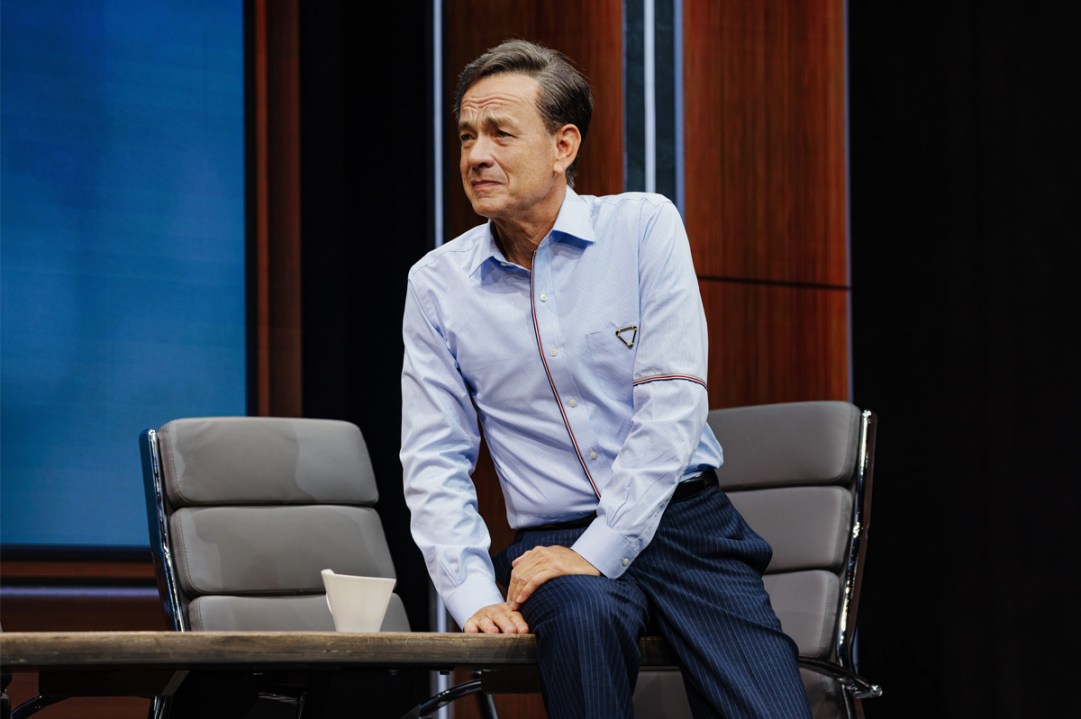

In This World of Tomorrow – the new play starring and cowritten by Tom Hanks, currently on at The Shed in Manhattan – Tom Hanks plays a classic, well, Tom Hanks character.
Bert Allenberry (Hanks) is the nicest guy in the room: he’s the kind of great guy who will escort a lady home in a taxicab, even if it will make him late. And in This World of Tomorrow being late matters a lot. Bert, you see, is a successful but dissatisfied scientist from the future who travels back in time to the 1939 New York World’s Fair in Queens. Once there he has complete free rein, except for one thing. He must return to his hotel at a certain hour to be whisked back to the future – or risk mortal bodily damage.
Love, of course, gets in the way. At the World’s Fair, Bert meets Carmen (played by the iconic stage actress Kelli O’Hara) and her young niece Virginia (a plucky Kayli Carter) and finds himself utterly charmed. He returns over and again to the same day in 1939 to spend more time with Carmen, neglecting his friends, business and safety. Based on a short story written by Hanks, who cowrote the play with James Glossman, This World of Tomorrow is a sort of Groundhog Day (many of the jokes rely on repetition) meets Back to the Future meets About Time.
Yet, despite a stream of talent and funds, including Tony Award-winning director Kenny Leon and Hanks himself (the latest celebrity to take to the New York stage), This World of Tomorrow is a flop.
On the upside, the central love plot is sweet and old-fashioned. It’s refreshing to see a play about love that is so chaste, with just one kiss (lifted straight from the silent movies). I also liked the slow pace with which Bert and Carmen’s love unfurls, so unlike the “more is more” dating culture of today, and the grace and respect with which they treat each other.

On the downside is the script. A versatile set by Derek McLane, consisting of a forest of LED columns which make up both the future and the stately pillars of the World Fair, plus stellar performances from the central trio, can’t rescue a story with this many plot holes.
In fact, the entire future world could have been cut: made-up jargon is used as filler, with whole scenes dedicated to science which makes no sense – better to leave the physics a mystery and let the audience use their imagination. Not helping are costumes that dress the cast like Star Trek (except, inexplicably, Hanks, who wears an elegant suit throughout). And don’t even get me started on the side characters: they are walking talking cliches of their eras (chirpy 1930s cabbies, ultramodern futuristic girl bosses, an artificial-intelligence bot and the like).
Hidden somewhere in this overly long play (it could have been cut by half without losing any substance) are some interesting ideas. In the world of tomorrow, will animal products be a thing of the distant past and will we view raising animals to eat as its own holocaust? (This is touched on but only as a joke: Bert is horrified, and a little titillated, to drink cream with his coffee in his sojourns back in time). Can – and should we – change the past and if so, what will that mean for the future? Can we undo horrors already committed?
More pertinently and pressing for our own time, in a future where AI looms over us and we are all glued to our phones, will we long for the magic of analogue? Carmen is an utterly ordinary woman, living an utterly ordinary life, in a world that is, to her, utterly ordinary. Yet to Bert she is extraordinary. He delights in watching her and Virginia’s excitement at fireworks, or their pleasure in a simple piece of pie at the World Fair café, or their amazement at the technology of television.
Such ideas are grasped at before they fall away. The premise would have more purchase if This World of Tomorrow did not read like an assignment in a first-year script writing class. A convenient – an utterly silly – deus ex machina suddenly solves Bert’s dilemma of death verses love, although he never really felt in danger anyway. Nothing is at stake here: his travels lead to no adverse effects to his business, his relationships, his life. There are no children he’ll leave behind; his friendships, while professed as deep, feel fickle.
The result is bleh. Tom Hanks is Tom Hanks. But even his star quality can’t save This World of Tomorrow: a story about time travel that drags.





Comments