Uk politics

Off target

Target culture. It's a pejorative phrase, and understandably so. As we discovered during the New Labour years, targets designed to encourage good public services can frequently do the opposite — replacing genuine care with box-ticking, and action with bureaucracy. I mention this now because of an article in this week's Spectator (do subscribe, etc.) by an anonymous Metropolitan Police officer. He describes how a target culture has skewed the work of the force and, in some cases, even the law itself. Here's one anecdote, which rather sums it all up: "I know of one instance in which a uniformed sergeant stole (or neglected to hand in) some confiscated cannabis.

Less listening, more talking

There was an exchange on Question Time last night that may go some way to explaining why the government’s health plans are so mired. One panellist, media lawyer Charlotte Harris, said that she was very worried by the substantial cuts being made to the NHS’ budget. Large sections of audience greeted this with rapture. (From 44 mins.) Immediately, Tory Louise Bagshawe and Lib Dem Jeremy Browne tried to grab David Dimbleby’s attention. It fell to Bagshawe to correct Harris, pointing out that the government has increased spending on the NHS when Labour would cut. The audience responded with boos – more in disbelief than disagreement, incredulous that the Tories would do anything other than cut the NHS.

Michael Gove to appeal Shoesmith verdict

Whitehall sources say Michael Gove will appeal the Court of Appeals judgement which decided Sharon Shoesmith’s dismissal was so ‘legally flawed as to be null and void’ to the Supreme Court. Although Gove recognises that Balls blundered in the way he dismissed her, he also believes that there are important constitutional principles at sake in this case about how Ministers make important and urgent decisions and what the role of the courts is in challenging such decisions. Gove wants the Supreme Court to consider these issues because of the huge importance of judicial reviews, which are being used repeatedly by opponents of the government to try and stymie its agenda.

Shoesmith in line for up to a million in compensation following sacking over handling of Baby P case

Sharon Shoesmith, who was head of children services in Haringey at the time of the Baby Peter case, is set to receive a sum that could be as large as a million pounds in compensation. The Court of Appeal has ruled that the way Ed Balls, then the secretary of state, and Haringey took the decision to dismiss her was procedurally unfair to Shoesmith and so she was not lawfully removed, entitling her to compensation possibly including full pay and pension for the last couple of years.    Shoesmith might be legally entitled to this money. But given the circumstances in which she is receiving it and the institutional flaws exposed by Haringey’s approach to the Baby Peter case, the honourable thing to do would be to not accept it.

Tory MPs launch NHS reform counter-offensive

Nick Clegg’s speech on the NHS today has fanned the flames of the Tory backbench rebellion on the issue. Tory MPs’ tribal instincts have kicked in and even those who were worried about the Lansley plan are now swinging behind it. As Nick Watt revealed earlier today, there’s currently a letter from Nick de Bois urging Tory MPs to set out their red lines on health service reform. One thing that Tory MPs keep repeating to me is that they are not prepared to see the Lib Dems ‘take the NHS backwards’. This is their most fundamental red line and it translates to a determination not to have the level of competition and private sector involvement in the health service reduced.

More freedom for some schools means better schools all round

Academies, as CoffeeHouser knows, are booming. There were around 200 of them when Michael Gove became Education Secretary last May. Now, just a year later, and steaming well ahead of expectations, there are over 600. This is, as Benedict Brogan suggests in his Telegraph column today, one of the great successes of the coalition era — albeit one that owes a debt to Andrew Adonis, Tony Blair and all the school reformers that came before them. And it is a triumph of quality, as well as of quantity. The simple, overwhelming truth is that academies are, on the whole, better than the schools they replace.

Cable’s punditry could come unstuck

"It's not imminent. But you can see this happening." So sayeth Vince Cable about the prospect of another global financial crisis, in interview with the New Statesman today. To be fair, you can see his point: there is a pervasive sense that the contradictions of the banking sector still haven't been fixed, and — as I have written recently — our economy, and economies worldwide, are still afflicted by debt of all varieties. But that's not going to calm those Tories who regard Cable as a combustive liability. In the weeks since the Lib Dems'  annihilation at the polls, the Business Secretary has increasingly reverted to his pre-coalition form: a professional commentator on the state of the economy.

Grading Obama’s visit

It was a good state visit. Actually, it has been an excellent visit. Much better than George W Bush's and even Barack Obama's 2009 trip to London. The US president got his photo with Wills 'n' Kate. The Prime Minister got his presidential high-fives. There were some odd points. The personal chemistry between David Cameron and Barack Obama made the ping-pong match better than it would naturally have been. For, let's be honest, table tennis is not a natural US-UK sport. There were policy differences between the two leaders too, for example on Libya and deficit reduction. In the end, though, the way to judge visits is not to think about Evening Standard covers or how much of the Today programme was devoted to the US president, but to look at strategic issues.

Obama re-affirms the special relationship

The speech was not a classic but Barack Obama's address to both Houses of Parliament covered the bases today. He started with a winning line, remarking that the previous three speakers in Westminster Hall had been the Pope, the Queen and Nelson Mandela which is either "a very high bar or the beginning of a very funny joke."   As is traditional in these kinds of speeches, Obama paid tribute to the special relationship, lauding it as the embodiment of the values and beliefs of the English-speaking tradition. He went on to say that both the British and the Americans knew that the "longing for human dignity is universal." Indeed, at times Obama sounded remarkably like the last president as he proclaimed his own freedom agenda.

Cameron and Obama’s mutual appreciation has its limits

And the Word of the Day is "we". Both David Cameron and Barack Obama deployed it liberally in their joint press conference just now, as they ran through all the mutual pleasantries and backslapping that attends these events. "We have discussed the two things we care about the most," flushed Cameron, "getting our people jobs, and keeping our people safe." From there on in it was first name terms — "thank you, David" — and claims about the strength of our two countries' special, essential, unique relationship, etc. With the sun blazing down on the garden of Lancaster House, I'm sure the photos will turn out nice. Cameron appeared to be the more eager of the two men, however.

A good day for Cameron

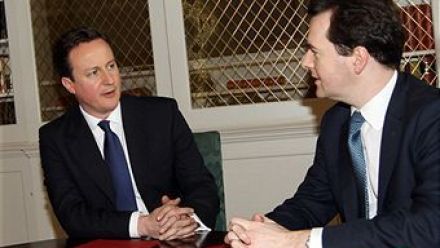
Today is one of those days when David Cameron gets full political benefit from being Prime Minister. He is basking in the president of the United States’ reflected glory. The papers this morning are full of him playing table tennis with Barack Obama and tonight’s news bulletins will lead on their joint press conference at lunchtime. As Cameron stands next to Obama, he’ll look both a statesman and a centrist. It’ll be hard for Labour to attack Cameron as an extremist on deficit reduction when he keeps stressing how he and Obama agree on a sensible level and pace to get their budgets heading back into balance. There are, obviously, substantive foreign policy issues for the two men to discuss. Both Libya and Afghanistan are in need of urgent attention.

The state of the NHS

I know most CoffeeHousers aren't particularly enamoured of paywalls, but the Times has given you a persuasive reason (£) to dive behind theirs today. (Or least to borrow a copy of the paper.) It's the first of three reports by Camilla Cavendish on the NHS, this one concentrating on the Way Things Are Now. It is both a disheartening read and a powerful reminder of how taxpayers' cash is being funnelled into a system that is dysfunctional in the extreme. Here is one snippet for your displeasure: "Care in Britain ranges from world-class to shocking. Between 1998 and 2006, 1.6 per cent of bowel cancer sufferers died within a month at the Manchester Royal Infirmary, compared with 15.6 per cent at Queen’s Hospital, Burton upon Trent.

The Tory divide over European bail-outs

As Obama and Cameron played table tennis yesterday, a considerably more furious game was being waged between the government and Tory backbenchers. It related to a Parliamentary motion tabled by Mark Reckless – and described here – that sought to stem UK involvement in any future bailouts for eurozone countries. All well and good, you'd think, until a rival amendment percolated down from on high to dilute Reckless's proposals. This new amendment would only go so far as to "urge the Government to raise the issue of the [bailout mechanism] at the next meeting of the Council of Ministers of the European Council". The green benches were set for a violent back-and-forth 'tween one side and the other. The outcome of all this was revealed yesterday evening.

A good time to go

Today is, as the saying has it, a good day to bury bad news. With President Obama on the ground and an ash cloud in the air, not much else is going to get a look in on the news’ bulletins. But it is worth noting that Nat Wei, the government’s big society advisor, has quit his role today having scaled back his involvement in February. Wei has been pretty detached from Downing Street for the last few months, his role rather usurped by Cameron’s big society ambassadors, Shaun Bailey and Charlotte Leslie. So his departure won’t make much difference to the government. But it is still rather embarrassing as it gives the press another chance to dredge up all the political problems with the whole Big Society agenda.

A coup for the Tories?

The Tories are cock-a-hoop about the defection of UKIP MEP David Campbell Bannerman – positively crowing, in fact. “There’s nothing more satisfying,” said one CCHQer, “than UKIP suffering.” Activists and MPs alike reckon that the Conservatives could have won a majority last May if it weren’t for UKIP in the south-west. Vengeance is sweet, but is it of lasting importance? Campbell Bannerman has used a blog post to justify his action: David Cameron is an inspiring leader and an avowed eurosceptic. Perhaps it will become a salve for the right, increasingly seen as Cameron’s blind spot. Equally, the answers Campbell Bannerman gave to Total Politics’ Amber Elliott could be used in the tussle for wavering eurosceptics.

Clegg: No MP is above the law

The sun shone on the deputy prime minister at DPMQs earlier today. Nick Clegg usually wears a grimace at the despatch box; but he was assured this morning, successfully defending a Labour onslaught on the NHS reforms. There were even flashes of, well, Flashman. He replied to a question from Chris Bryant by quipping, “Every time the Honourable member asks a question, I wonder why anyone bugged his phone.” Clegg also rebuked John Hemming for breaking the Giggs super-injunction yesterday; a popular move among those MPs who think Hemming degraded parliamentary privilege. Clegg said: “I don’t think anyone should be above the rule of law. And if we don’t like the law in this place then we should act as legislators to change the law, not flout it.

An especially businesslike relationship

The ash cloud nearly claimed its first victim last night: Barack Obama had to leave Ireland early in order to fly to Britain. The Palace’s insistence on protocol has been upset and the President's entourage has been advised not to risk the tap water; other than that, all is well. However, the visit has set sceptical tongues wagging. Some diplomats wonder why the President is here. Afghanistan, the Middle East, joint national security and the world economy are on the agenda, but there is no unifying theme to discussions. Some ideologues fear that the eternal bond between Britain and America is relaxing into a union of convenience.