Uk politics

Another self-inflicted wound by Murdoch

The Murdochs have done a reverse-ferret and now will attend the Culture select committee on Tuesday. The harm done to their reputation by their initial refusal is yet another self-inflicted wound. It was clear, given how previous select committee inquiries on these matters had not received proper answers from various representatives of News International, that parliament would do everything it could to compel their attendance. Indeed, both the Prime Minister and Deputy Prime Minister had gone on the record to say they should attend before the Murdoch’s curt letters saying they wouldn’t were dispatched. Their appearance on Tuesday will, I suspect, now become the focus of this story in the UK. The weekend papers will be full of previews of it.

Coalition’s crime worries ease, but concerns remain

The British Crime Survey is published today and the Home Office had prepared for the worst. For months now, figures close to Theresa May have been expressing their fear that the combination of Ken Clarke’s liberal prisons policy and economic hardship would cause a rise in crime for which the Home Office, graveyard for so many political careers, would be blamed. Today’s figures will have eased their disquiet somewhat, insulating them from Labour’s critique that police cuts are endangering society. The headline is that crime in England and Wales has remained stable over the last year, except for a 14 per cent spike in domestic burglaries according to the British Crime Survey and an alarming 35 per cent increase in domestic violence.

Ed Miliband: Murdoch’s spell has been broken

I have an interview with Ed Miliband in the latest issue of The Spectator, conducted the evening before yesterday's Parliamentary debate on News Corp and BSkyB. Here's the whole thing for CoffeeHousers: Rupert Murdoch’s hold on British politics has finally been broken. The politicians who competed to court him are now scrapping to see who can distance themselves fastest. As the Labour leader, Ed Miliband, says when we meet in his Commons office on Tuesday afternoon, ‘The spell has been broken this week and clearly it will never be the same again.’ Miliband and his staff have just heard that the government will support their motion calling for Murdoch to withdraw his bid for BSkyB.

Clegg contra the British Establishment

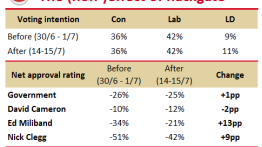
In some ways, Gordon Brown's absurd speech yesterday evening felt like the crest of a wave. It's not that the phone hacking scandal has gone away — far from it. But the initial surge of political activity and spite has abated, having achieved many of its immediate goals: the end of the BSkyB bid, a judge-led inquiry, and so on. Now, our politicians are entering the second phase of this crisis, which will be more about the wider picture and less about News International specifically. There was a hint of this in Nick Clegg's interview with the Today programme earlier, a preview of a speech he is delivering later today. The Lib Dem leader admitted that he sees the phone hacking scandal as an "opportunity" to "clean things up" more generally.

Brown’s version of events

Gordon Brown’s speech in the House of Commons just now was remarkable. It was completely deluded, one of the most one-sided versions of history you’re ever likely to hear. Abetted by the Speaker, Brown spoke for what must have been at least half an hour trying to justify his record in office and depict himself as someone who was prepared to take on the Murdoch empire, which he certainly was not while News International was supporting Labour. Rather than acknowledging—as Ed Miliband and Peter Mandelson have—, that Labour got far too close to News International and was too scared of it, he presented an entirely self-serving version of history. To the fury of the Tory benches, he ignored that he and Sarah Brown assiduously courted Rebekah Brooks.

Britain’s euroscepticism hardens

With the European financial crisis rumbling on, anti-EU sentiment in Britain is deepening. Two polls — one by YouGov for PoliticsHome and the other by Angus Reid — show that 50 per cent of the public would vote for Britain to leave the EU if there was a referendum.   Of course, this is nothing new. Brits have long been the most eurosceptic of Europeans, as Fraser noted a couple of months ago. In fact, we're the only country where more people think our membership of the EU is bad than think it's good: The hardening of eurosceptic sentiment does seem to be due to current events: 34 per cent say that the Greek crisis has made them more favourable towards us leaving.

Will the defence budget rise, fall or stay constant post-2015?

As British helicopters pound away at Libyan targets, another battle is being waged inside the Ministry of Defence’s fortress-like building. The fight is over the post-2015 budget, and it is an arduous one. After the uniform-creasing settlement the MoD got in the Spending Review last year, the Prime Minister said in the House of Commons on 19th Oct 2010 that while the precise budgets beyond 2015 would be agreed in future reviews, his “own strong view” was that the MoD would see “year-on-year real-term growth in the defence budget in the years beyond 2015.” So far so good — the MoD budget may have to fall now, in line with other departments, but at least it will increase post-2015. Or will it?

The OBR warns of a fiscal storm

The Office for Budget Responsibility's 126-page Fiscal Sustainability Report really oughtn't make for electrifying reading. But it does. What Robert Chote and his gang of number-crunchers have done is to gaze into our fiscal abyss, and summon up forecasts so that the abyss can gaze back into us. I mean, look at the graph above. On the OBR's account, our country's debt burden could well rise from around 70 per cent of GDP now to over 100 per cent in 50 years time. It is a perturbing trajectory, to say the least. But, before we go any further, we should slap all kinds of health warnings across this. Long-term forecasting is, by its very nature, an uncertain science — and there are plenty of uncertainties in the OBR's work.

News Corp withdraws its bid for BSkyB

Two things struck me about PMQs today and the Prime Minister’s statement on the forthcoming public inquiry. First, the Prime Minister took a very different approach to Andy Coulson than he did at his press conference last Friday. Today, all the emphasis was on how angry Cameron would be if the assurances given to him turned out to be false.   The second was that Cameron rowed away from suggesting statutory regulation of the press. He stressed that he favoured ‘independent’ not ‘statutory regulation’. This should be more acceptable to the press.

PMQs live | 13 July 2011

A change from the Coffee House norm for this last PMQs before the summer recess. Instead of the usual live-blog, we'll be live-tweeting the session, and our tweets will appear in the special window below (you may be familiar with it from Guido's PMQs coverage). Tweets from other political types may also appear. And you can add your own remarks to the live-stream not in the comments section, but in the space below the window. Anyway, it should all be fairly self-explanatory. It might work, it might not. In either case, do let us know what you think.

Cameron on the back foot

This has been another difficult morning for David Cameron. He’s now taking flak for having said he would take part in the BSkyB debate this afternoon and then deciding not to. But what should, perhaps, worry the Prime Minister more than this criticism is the evidence that the Liberal Democrats are siding with Labour to portray Cameron as being behind the curve on this issue. The FT, the Lib Dems' paper of choice, reports that Clegg and Miliband pushed Cameron for a wide-ranging public inquiry. The paper details how Clegg is demanding an end to the practice of politicians, and particularly Prime Ministers, meeting newspaper proprietors but keeping the meeting secret by not holding it on official premises.

Might Gaddafi shunt Murdoch from the front pages?

Loyal Tories and government types are hoping that the media will soon move on from Murdoch. And the unusually heavy briefings emanating from George Osborne’s office last night were perhaps an attempt to shift the spotlight. But it will take a very gripping story to displace the phone hacking saga, especially if yet more has-been politicians shuffle back into public life to settle old scores with Murdoch. With the British press immersed in this tempestuous revenge drama and the whirl of hypocrisy that surrounds it, you wouldn’t guess that the euro has embarked on a 72 hour ordeal that may decide its future.   But, Rupert Murdoch’s mugshots could yet be superseded by those of Colonel Gaddafi.

Parliament prepares to take on Murdoch

Politicians are swarming all over the phone hacking scandal today, in even greater number than during the past week. If it isn't the main topic at PMQs at noon, then it certainly will be immediately afterwards; when David Cameron delivers his statement on an inquiry into the whole mess. And then there's Labour's Opposition Day motion, urging Rupert Murdoch to withdraw his bid for BSkyB. By the end of the day, our parliamentarians will surely have delivered an official reprimand to the News Corp boss and his ambitions. The news that the government will vote in favour of Ed Miliband's motion has sucked some of the vicious factionalism out of today's proceedings. But, never fear, there will still be plenty of political one-upmanship to go around.

Osborne warns Eurozone that decisive action must be taken now

The UK government is becoming increasingly concerned about the situation in the eurozone and the fact that there does not appear to be the political will to address it. One government source complained to me earlier today that "unless they get their act together the eurozone are in danger of fiddling while Rome burns." Tonight, in a major departure from Britain’s previous softly-softly approach to the issue, George Osborne is issuing a statement calling on the eurozone countries to take "decisive action" to "prevent market uncertainty doing real damage to the world economy." The Chancellor calls on eurozone countries to: "...

The euro’s death rattle

The end might be nigh for the euro. The currency has hit an all-time low against the Swiss franc, as individual eurozone government bond yields vaulted higher due to mounting concerns about the region's debt crisis. To spell out what this means: in Spain, 12 billion euros of interest payments will accrue for every 100 point bond rise in Germany. That is more than Spain's annual public investment in infrastructure (8.6 billion) and its entire defence budget (7.6 billion). At the same time, Greece is heading towards disorderly default or some form of devaluation. Or both. And now Italy looks vulnerable.

Attention turns to the police

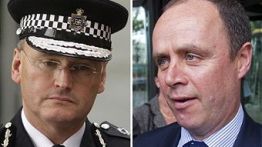
Today, the spotlight in the phone hacking scandal is shifting onto the police — who have an awful lot of questions to answer. Indeed, I suspect at the end of this the reputation of the police will have been hugely damaged. The evidence from senior Met officials — some retired, some serving — has not convinced the Home Affairs committee today. It is a sign of how poor relations are between the police and MPs that a Tory MP has asked the current and former assistant commissioners of the Met if he they have ever taken a bribe from a journalist. Both John Yates and Andy Hayman reacted indignantly to the question but the committee members clearly thought the question was reasonable.