Uk politics

Cameron’s new offer for Scotland could mean a new offer for England

From our UK edition

The consensus opinion across most of today's papers appears to be that Dave done good in Scotland yesterday. And now the Prime Minister's cause has been helped that little bit more by the Lords Constitution Committee. ‘We are firmly of the view that any referendum that is held must be a straight choice between full independence or the status-quo,’ says the committee's chairman Baroness Jay. ‘A third “devolution-max” option is clearly something every part of the UK must have a say in as it has the potential to create different and competing tax regimes within the UK.’ The strange thing is, a UK-wide referendum on ‘devo max’ could actually produce the sort of result that Alex Salmond would want.

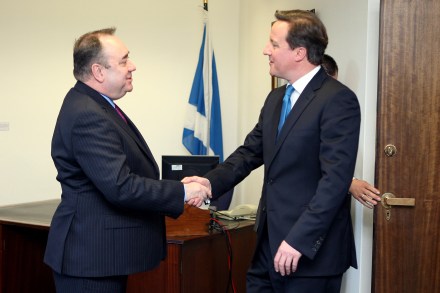
Cameron’s risky move could play into Salmond’s hands

From our UK edition

Not many politicians would conjure up the spectre of Alec Douglas-Home to scare the Prime Minister, but that is exactly what Alex Salmond did today — to some effect. The Scottish First Minister was responding to David Cameron’s ‘jam tomorrow’ offer to the Scottish people. ‘Vote “no” in the independence referendum,’ Mr Cameron effectively told Scots today in his latest attempt to make some progress in the independence debate, ‘And I’ll see that you get major new powers for the Scottish Parliament.’ It was one part bribery, one part political strategy and Mr Salmond was on to it quicker than the average Scot can order a haggis supper.

The Lib Dems prepare their strategy for future coalitions

From our UK edition

Contain your excitement, CoffeeHousers: the Lib Dems are debating whether to change their ‘constitution’ so that their members have a greater say over future coalition negotiations. The amendment has been put forward Tim Farron and Norman Lamb, and proposes that, in the event of coalition talks, the party's ‘negotiating team’ should have to consult with a ‘reference group consisting of not more than nine people appointed equally by…’ blah, blah, blah. In fact, you can just read the whole thing on page 41 of this document. The Lib Dems will be voting on it at their Spring Conference next month.

Cameron’s plan to protect the Union

From our UK edition

‘When the referendum on independence is over, I am open to looking at how the devolved settlement can be improved further. And yes, that means considering what further powers could be devolved.’ These words in David Cameron’s speech today, which follow on from what the Scottish Secretary Michael Moore said at the weekend, make clear what the Unionist campaign’s message will be. They’ll say to the Scottish electorate ‘Vote no to independence and then we can talk about devo-max’. This strategy will probably ensure victory in the referendum. But there are risks to it. First, more constitutional debate will create more uncertainty.

At least it won’t go to penalties…

From our UK edition

Who's winning in the latest match between Vince Cable and the Conservatives? The Business Secretary did take an early lead, with the news that No.10 had grudgingly yielded to his demand to appoint Professor Les Ebdon to the role of ‘university admissions tsar’ — a man who has hardly been kind about the coalition's universities policy in the past, and whose appointment had been blocked by the business select committee. But, according to the Telegraph this morning, the Tory leadership appear to have scored a goal of their own: Cable's proposal for imposing penalties on graduates who pay off their student loans early is to be dropped. We can, and should, cheer the wheezing demise of that policy.

Prescott’s pitch for the police commissioner job

From our UK edition

How strange — John Prescott is fast becoming the poster boy for elected police commissioners. He appeared on the Today Programme earlier to explain why he's putting himself forward for that very job in his home of Humberside. But has he acquiesced to Tory thinking? Don't bet on it. As he told John Humphrys, he doesn't actually support the legislation, but he does believe that Labour should have a man in the fight: ‘The Labour Party didn’t like this legislation and I voted against it, but once there is an election the party isn’t going to stay out of it and they will want to see it doesn’t go the way they feared it might go.’ Which probably explains why Prescott sees the role of elected police commissioners as quite limited.

Post-Moody’s, King backs Osborne

From our UK edition

Moody's doubts might not be making much difference to the actual economy, but they could make a good deal of difference to the political battle being waged over it. George Osborne, of course, is citing this as further proof of the need for fiscal consolidation. Ed Balls, meanwhile, is redoubling his call for a ‘change of course’ — and somewhat misleadingly too. But what does Mervyn King think? Thanks to his comments in a press conference this morning, we don't have to guess.

How can employment and unemployment go up at the same time?

From our UK edition

The employment level has risen since the election, according to today’s figures — albeit only slightly, from 29.0m to 29.1m. But unemployment’s up too: from 2.46m to 2.67m. So how come we’ve seen both more jobs and lengthening dole queues? Well, that’s because the ‘economically active’ population (people who are in work or ‘have been actively seeking work and are available to start work if a job is offered’) has grown faster than employment has. There are now 31.8m people in the UK who fit that description, an increase of 320,000 since the coalition came to power. But with only a 110,000 rise in employment, that means the number of folk unemployed has risen by 210,000.

Minimum pricing, maximum controversy

From our UK edition

Just because there's no PMQs today, it doesn't mean you won't hear from David Cameron. The Prime Minister is readying his anti-booze cruise once again, and taking it on tour to a hospital in the North East. Once there, he will rail against ‘alcohol abuse’ and its consequences, which include, he will say, a £2.7 billion a year bill for the NHS. And he will preview some of the solutions that may make it into the government's ‘alcohol strategy’ next month: ‘drunk tank’ cells where binge drinkers can be dumped overnight; ‘booze buses’ to deliver people to these cells; police heavies in A&E wards; and, possibly, minimum pricing for alcohol. Confusion abounds on the last of these.

Why Baroness Warsi has it wrong

From our UK edition

For someone who has profited so well from her religion, it is particularly striking that Baroness Warsi should claim today that our societies are suffering because of ‘a militant secularisation’ which she claims is ‘taking hold.’ And worse, she says, that ‘one of the most worrying aspects about this militant secularisation is that at its core and in its instincts it is deeply intolerant. It demonstrates similar traits to totalitarian regimes.’ Not merely ‘militant’ and ‘worrying’, but ‘similar traits’ to those of ‘totalitarian regimes.’ Before addressing the numerous ways in which Warsi is wrong, I should note the one point on which I think she is right.

Why Prof Dawkins has it wrong

From our UK edition

No sooner does Baroness Warsi denounce militant secularists who try to marginalise Christianity than, bang on cue, up surfaces Richard Dawkins with a survey commissioned by his Foundation for Reason and Science intended to demonstrate that Christianity is a minority pursuit. His Ipsos MORI poll, published today, is intended to unpick that bit of the 2001 census which found that more than 70 per cent of respondents identify themselves as Christian.

How Obama’s new budget fits into the UK debate

From our UK edition

Yesterday, Barack Obama set out his budget for ‘Fiscal Year 2013’ – that is, for the year beginning October 2012 (in the US, the fiscal year runs from October to September, rather than April to March as it does here). Of course, the federal budget has to be passed by both houses of Congress before being signed off by the President, so the final version will look very different to this one. It is better thought of as a statement of Obama’s intent, and his starting point for the negotiations between Congress and the White House. Nevertheless, it throws up a few interesting points, not least in how it relates to our own economic debates in the UK: 1. Deficit reduction.

How to kick-start the economy

From our UK edition

This morning's news is a stark reminder of the desperate need to get the UK's economy growing faster than the 0.9 per cent it managed in 2011. So far, George Osborne's seemed short of ideas in this area, so, back in November, we asked a select group of economists and politicians to suggest some for him: Cut the 50p tax Arthur Laffer, Chairman, Laffer Associates Reducing the burden which government places on the economy, through tax cuts, is the surest way to promote growth. I have never heard of a country that taxed itself into prosperity. Yet Britain last year raised the top rate of income tax from 40 per cent to 50 per cent. For more economic growth, and more tax revenue, this rate should be lowered immediately.

A warning for Osborne and his economic agenda

From our UK edition

Why did Moody’s downgrade Britain to AAA with a negative outlook, but leave other countries on AAA? One crucial factor is the scale of our debt increase: 60 per cent over the parliament. You won’t find it mentioned much today. The Chancellor is talking about austerity, helped by Balls who talks about his harsh deep cuts. Osborne today swears to keep ‘dealing with the debt’ — but his definition of ‘dealing with debt’ would even make an Italian blush: As Balls said on the radio this morning, the plan isn't working. But Balls' narrative — that Osborne is cutting harsh and deep — is untrue, as Moody's knows.

Labour’s plan would have cost us our AAA rating

From our UK edition

For Ed Balls this morning, there is only one conclusion to be drawn from the news about our credit rating: ‘A change of course is needed.’ But to what? Balls no doubt means a shallower course of deficit reduction — less far, less fast. But Moody's are clear that we have been placed on a negative outlook because of doubts that our fiscal consolidation will continue strongly enough. Specifically, they say that, ‘Any further abrupt economic or fiscal deterioration would put into question the government's ability to place the debt burden on a downward trajectory by fiscal year 2015-16.’ So how would Labour have fared? We already know that they didn't propose to put debt on a downwards trajectory back then (see my post here).

Moody’s puts UK’s AAA rating on negative outlook

From our UK edition

‘It's now clear that Britain's economic reputation is on the line at the next general election, another reason for bringing the date forward and having that election now ... For the first time since these ratings began in 1978, the outlook for British debt has been downgraded from stable to negative.’ So said George Osborne when S&P placed Britain's AAA credit rating on a negative outlook in May 2009, when Labour were in power. But guess what? Another credit-rating agency — Moody's — has just done the same to our rating this evening. Given how much Osborne made of Britain being a ‘safe haven’, it's rather a tricky one for him.

Curb your enthusiasm, kids

From our UK edition

Iain Martin has flagged upan article from the latest Times Educational Supplement, in which a Norfolk sixth-form teacher bemoans overenthusiastic pupils. Yes — you read that right. In the article, Jonny Griffiths highlights the ‘other aggravation’ in a teachers’ life: ‘Sometimes ambitious children need to slow down. It is 4pm. My weary colleagues and I are slowly unwinding in the maths office, when there is a knock on the door. Could I have a quick word with Jonny, please?” says Michael in a bright, nervous voice. I don’t sigh, but inwardly I think, “Is that my ‘quick’ or yours?”’ And that's just a fraction of it.

Nick Clegg’s NHS squeeze

From our UK edition

Andrew Lansley's career prospects were boosted yesterday — when Simon Hughes said that he should ‘move on’ after the NHS reforms have been implemented. Since then, Downing Street has redoubled its defence of the Health Secretary; with a spokesman explaining tersely this morning that, ‘Simon Hughes speaks for himself ’. And Nick Clegg himself has added that, ‘Andrew Lansley is the architect of the NHS bill. He cares passionately about the NHS. He's the right man for the job and he must see it through.’ Clegg's general support for the Bill — and Danny Alexander's — is worth noting because it's one of the factors helping David Cameron hang on to both it and his Health Secretary.