Uk politics

Why property tax rises aren’t the answer

From our UK edition

When Tim Montgomerie first started calling for new wealth taxes I was horrified. Sweden has only just abolished its wealth tax after seeing hundreds of billions of kroner leave the country in capital flight over a number of years. Other countries have found wealth taxes are associated with narrow bases, high costs of collection and often very unfair treatment for different classes of assets. We should not replicate that here. As his proposals have been refined though, it isn’t that bad. More bands would be a relatively reasonable way of making the Council Tax system more progressive.

Why George should listen to Danny

From our UK edition

In the new Spectator, we back the Liberal Democrats’ plans to raise the tax threshold to £10,000 — provided that the money is found by cuts in state spending rather than the pensions raid they propose. It’s not top of my list of tax cuts, but we have to accept the realpolitik. It’s the only tax-cutting option that has advocates in the Treasury. There are plenty of proposals around to cut taxes and wake the British economy from its ‘lost decade’ slumber. The need to use tax cuts as a remedy to the deficit will be familiar to anyone who has followed the American presidential debate: every candidate, even Romney, has their own list of radical tax cuts.

How to remain a nation state

From our UK edition

Britain out of Brussels' clutches by 2020? It can happen, says David Owen, in a piece for the magazine this week. It's based on a speech to Peterhouse College, Cambridge. Here's the full version: In all the controversy about the eurozone and Greece it is easy to ignore one simple fact: maintaining a core eurozone is creating an unstoppable momentum towards a United States of Europe. On 7 February 2012 the German Chancellor Angela Merkel indicated very clearly her direction of travel. The eurozone crisis for her is to be the springboard to another Treaty to replace the Lisbon Treaty. She said ‘Step-by-step, European politics is merging with domestic politics.

Rumble in the Commons

From our UK edition

From the Sun: ‘A LABOUR MP was arrested late last night for assault after allegedly headbutting a Tory rival in a House of Commons bar. Witnesses allege Eric Joyce, 51, launched an unprovoked attack on Stuart Andrew, 40. It is claimed Joyce, MP for Falkirk, had to be held back by several Labour colleagues. A source said: “Stuart was given a Glasgow kiss.”’ Read the full report here. UPDATE: Joyce has been suspended by the Labour Party. The Standard's Joe Murphy has a particularly detailed account of it all here.

The forgotten victims of the Troubles

From our UK edition

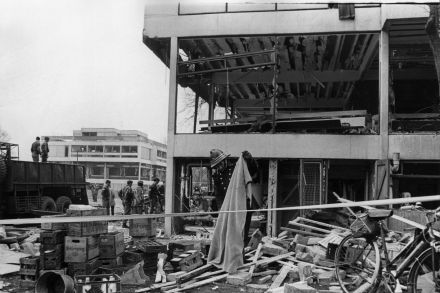
This post, marking the 40th anniversary of the Aldershot bombing, was published earlier on the Biteback website. But as its author, Douglas Murray, is a regular here on Coffee House, and as its subject matter is so important, we thought we'd re-post it here: The 30th January this year was the 40th anniversary of Bloody Sunday, the day when members of the British Parachute regiment shot dead fourteen civilians on the streets of a British city. The constant commemoration of that day by families of the dead and injured was one of the things that kept its memory alive and eventually led to the British government setting up the Saville Inquiry.

Your guide to all those tax cut proposals

From our UK edition

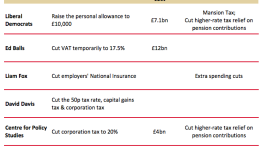
Nick Clegg, Ed Balls, Liam Fox, David Davis, the Centre for Policy Studies, the Centre for Social Justice and the Sun. It seems almost everyone thinks George Osborne should cut taxes in his Budget next month — the only disagreements are over how. Here’s a quick guide to the main proposals so far: There will doubtless be other suggestions before 21 March when we will finally learn which, if any, Osborne has chosen. UPDATE: The table originally gave the cost of the CPS' corporation tax cut as £8.5bn. This is their 'static' estimate of the cost, but a more realistic estimate, derived from the Treasury's ready reckoner, is £4bn.

Miliband snipes, Cameron deflects, Bercow bobs

From our UK edition

Let’s be honest. I shouldn’t say this but I can’t help it. I’m fed up. The NHS reform process has been dragging on for months, and still there’s no end in sight. Ed Miliband brought it up at PMQs for the third week running. The position remains the same. Miliband loves it. Cameron lives with it. The PM claimed that 8,200 GP practices are now practising his reforms and the Labour leader replied with a list of professional bodies — nurses, doctors, midwives, radiologists — who oppose them. And that’s exactly the trouble, for me, at least. If the issue were a race-horse some crazy campaigner would plunge beneath its thundering hooves. But it’s not. It’s a set of abbreviations.

Murphy launches Labour’s defence review

From our UK edition

Remember when Jim Murphy spoke about defence cuts last month? It was not only a smart refinement of Labour's fiscal position, but also a preview for the defence review that they're conducting as an alternative to the government's SDSR. Well, that review was officially launched this morning, and I was in the audience on reporting duty. Here's a quartet of quick observations that I bashed out on my phone: 1) Cuts, cuts, cuts. There was, it is true, a greater emphasis on the ‘constrained fiscal circumstances’ in Murphy's opening remarks than there is the consultation paper that Labour released today. But that emphasis was still striking in itself.

A taxing problem for George Osborne

From our UK edition

Today’s FT reports that additional council tax bands are being considered as part of the Budget process. But there are several problems with introducing new council tax bands. First, this would require a wider revaluation, something that the coalition has ruled out explicitly and that would almost certainly drive up council tax for most people.   A revaluation, as a parliamentary question from George Osborne’s former chief of staff Matt Hancock established, would cost around £200 million. It would also take two to three years to complete, meaning revenues from any new band wouldn’t start accruing until either very close to, or even after, the next election.

When failure actually counts as success

From our UK edition

Michael Gove's latest prognosis for schools was delivered at a lunch in Westminster yesterday, but it's important enough to repeat the morning after. The Independent has a full report here, but the key quotation is this: ’Education is like trying to run up a down escalator. There are some uncomfortable decisions that will have to be taken. There will be years when, because we are going to make exams tougher, the number of people passing will fall. There are headteachers who have been peddling the wrong sort of approach to teaching for too long, who are going to lose their jobs.’ Just read that bit again: ‘the number of people passing will fall’. It's a deeply encouraging admission by Gove, and one that he ought to repeat frequently.

Nick Clegg’s NHS squeeze continues

From our UK edition

As I said last week, Nick Clegg is in a tricky position when it comes to this Health Bill. Thanks to the concessions that he secured and welcomed last year, he can't now just slander it outright. But thanks to the concerns of his own party, he will also be reluctant to endorse it in full. The result is the sort of ambiguous performance that the Deputy Prime Minister put in on ITV's Daybreak show this morning. He did get stuck into Labour for their ‘outrageous’ misrepresentation of the reforms. But when it came to actually supporting the Bill, it seemed to me that he used generalisations — such as, ‘I am behind reforming the NHS to improve care for patients’ — that could permit a slight change of heart about the specifics in future.

The Lib Dems step up their push for £10,000

From our UK edition

Set your TiVos. At 6.55 tomorrow evening, BBC1 will air the Liberal Democrats’ latest party political broadcast. For those of you who can’t wait, here’s a sneak preview: In the video, Nick Clegg describes his proposed increase in the income tax personal allowance as ‘a £700 tax cut for ordinary working people — that’s an extra £60 in your wages every month’. I’ve remarked before on the similarities in both rhetoric and policies between the Lib Dems and Barack Obama, but Clegg’s ‘£60 a month’ pitch is as close as you get to the way Obama sells his payroll tax cut extension as ‘about $40 in every paycheck’.

IDS defends his work scheme — but he may have to change it

From our UK edition

Articles by politicians are often flat and passionless. Not so Iain Duncan Smith's effort for the Daily Mail today. The welfare secretary sets about defending the government's Work Experience scheme for unemployed young people, but it soon turns into a full-blooded attack on its detractors. ‘I doubt I’m the only person who thinks supermarket shelf-stackers add more value to our society than many of those “job snobs” who are busy pontificating about the Government’s employment policies,’ he bristles, ‘They should learn to value work and not sneer at it.

Osborne accidentally makes the case for more savings

From our UK edition

Rhetoric aside, what’s the difference between left and right in British politics? You won’t catch either party quantifying it, because the answer embarrasses both. The ever-cautious George Osborne is cutting just 0.6 percentage points a year more from government departments than Labour planned to (see table, above). The great joke is that the difference between the two parties is actually within the margin of error. Government is a gargantuan machine that just can’t be controlled to that degree of precision: a billion quid is, to Whitehall, a rounding error.   Today’s public finances have demonstrated that.

The implications of today’s border security report

From our UK edition

Today brought closure of a kind to last year’s border fiasco (which I covered for Coffee House here and here), with the publication of the report by the Chief Inspector of the UK Border Agency, John Vine. On first reading, there is no ‘smoking gun’ which would trigger a ministerial resignation. The report does find that, in early 2011, the immigration minister Damian Green had authorised the relaxation of one of the checks at the centre of the controversy: ‘Secure ID’, which verifies the fingerprints of foreign travellers with visas. But the report also finds that Green’s authorisation should have been superseded by later instructions from the Home Secretary Theresa May.

The Tories desert Cable in the Commons

From our UK edition

When a Secretary of State is in trouble, it is traditional that his governmental colleagues rally to his side. But as Vince Cable defended overruling the Business Select Committee’s objections to Les Ebdon, there was but one Tory Cabinet minister on the front bench. This despite Cable having rung round private offices in search of support, as Patrick Wintour reports. In total there were three Tories on the front bench for most of the statement, Cable’s junior minister Mark Prisk, the whip Mark Francois and the Leader of the House Sir George Young in his normal seat. The absence of Tory ministers combined with 13 hostile questions from Tory backbenchers shows just how uncomfortable the Tories are with this appointment. By contrast, the Lib Dems are delighted.

Miliband guarantees a return to Brown’s Big Idea for the NHS

From our UK edition

It would be so much easier for Ed Miliband to attract headlines if he could shout in Andrew Lansley's face. As it is, the Labour leader has had to make do with giving a speech today attacking the NHS reforms. Within the parameters of what he might say, it's an okay effort. The predictable lines about ‘creeping privatisation’ are leavened by the admission that ‘the question is not reform or no reform. It is what type of reform.’ And he adds, by way of a cross-party sweetener, that he would ‘get round the table’ with David Cameron to discuss ‘the future of the NHS’. But the substance of the speech, rather than its rhetoric, is a little more questionable.

The depressing appointment of Les Ebdon

From our UK edition

Today brings confirmation that No.10 has not stood in the way of Vince Cable appointing Les Ebdon as the new director of fair access. Ebdon’s appointment is depressing for several reasons. First, Cable has ridden roughshod over the objections of the BIS select committee to his choice. So much for all of the coalition’s talk about respecting parliament — this is executive arrogance at its worst. Second, Ebdon represents the mindset that has done so much damage to British education in the past 50 years. It is worrying that he does not seem to appreciate that the biggest ‘root cause’ of poorer pupils not getting into top universities is the quality of state schooling in deprived areas.