Uk politics

All that matters now is growth

With every Budget, the early Cameron emphasis on greenery and General Well Being not Gross Domestic Product seems a more distant memory. Today’s Budget showed that, to Osborne at least, growth now trumps these more abstract concerns.   So, we saw an announcement that the planning rules would come into force pretty much as planned from next Tuesday. This means that Osborne has simply overridden all the bureaucratic and legal objections from DCLG. Although, I understand that councils who already have a sufficiently pro-development local plan will have a year to adjust to the new rules.   Sunday trading rules, a classic bit of General Well Being paternalism, are also going on the scrap heap.

The Lib Dems are happy with what they got

This Budget told us something interesting about the coalition: that there’s more juice left in it than some of us thought. Judging by recent coalition tensions, one might have expected the two parties to devote their time to blocking each other’s proposals. But, instead, they’ve struck a deal that suits both of their political priorities: the Liberal Democrats have got a sizeable increase in the personal allowance, the Tories a 2p cut in corporation tax and a reduction in the economically destructive 50p rate. Interestingly, close allies of the Deputy Prime Minister are now briefing that ‘differentiation’, pointing out where the Lib Dems disagree with the Tories, will be dialled down a notch.

Behind Osborne’s 50p tax change

How significant was this Budget? On an economic level, not very. There's no discernible impact on growth: all of the main forecasts have more or less stayed the same since the Autumn Statement. Borrowing is the tiniest bit lower, mainly thanks to a £23 billion accountancy trick with Royal Mail pensions. And even many of the policies announced today will barely rouse the Exchequer's attention. That cut in the top rate of income tax to 45p? It will mean only £100 million a year less in direct revenues. That stamp duty increase for properties worth over £2 million? It will net only £300 million a year. The overall effect is a fiscally neutral document, as expected. The fuss-to-impact ratio for Budget 2012 is pretty high.

The Budget: What you need to know

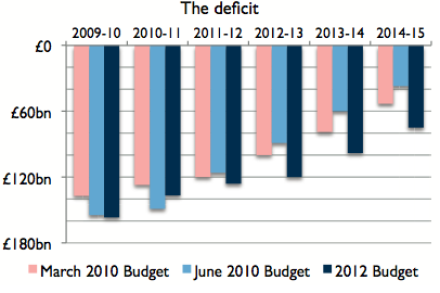
1. Growth. The OBR's forecasts are essentially unchanged from the Autumn Statement, but nevertheless represent a much bleaker outlook than we were given a year ago:  2. Debt. Despite Osborne's talk of 'paying down the debt', he's actually adding to it — by 59 per cent over this parliament. He is, though, on course to meet his second fiscal rule to see the debt to GDP ratio falling by 2015-16: 3. Deficit. Ignoring the effects of transfering the Royal Mail pension deficit, there's hardly any change to the borrowing forecasts since November. Progress on deficit reduction will be much slower than announced in Osborne's first two Budgets: 4. Unemployment. The OBR expects unemployment to peak at 2.

A Budget by and for the coalition

The coalition has found the second year of co-habitation more difficult than the first and it will find the coming year even more difficult given that House of Lords reform is on the agenda. But today’s Budget is a reminder of the political benefits of coalition. When George Osborne stands up today and announces, for instance, the reduction in the 50p rate he will do so with the support of two parties. Equally, a minority Tory government wouldn’t have been able to get more spending cuts to help finance a tax cut through parliament. It also seems that there should be measures in the Budget to please both Tory and Lib Dem backbenches.

More advance snippets from the Budget

The big Budget news tonight is that the personal allowance will rise to £9,205. This is a larger increase than expected and, intriguingly, will be paid for — in part — by a couple of billion more of spending cuts. So, the Lib Dems see considerable progress on their main budget priority, raising the income tax threshold to £10,000, but this will be partially funded by something Tory MPs have been calling for, more spending cuts. It also appears that the coalition will further increase the pace of its corporation tax cuts as well as introducing a new higher rate of stamp duty for £2 million plus houses. There’ll also be a slew of anti-avoidance measures to accompany the reduction in the 50p rate.

Why Labour’s 50p tax wobble is dangerous for Ed Miliband

Why did Gordon Brown wait until the last few weeks of Labour's thirteen-year reign to implement a 50p tax rate? Easy. Because it wasn't so much a fiscal policy as a fiendish trap, designed to cut into a Tory government's flesh. But now, it seems, the trap has snared another victim: Labour itself. The Telegraph's Daniel Knowles has already neatly summarised the politics arising from Sam Coates' report (£) that Labour will neither back the scrapping of the 50p rate nor promise to reinstate it either. But the basic point is worth repeating: if that's the approach that Labour chooses, then they'll be left in a complete mess. They can attack the coalition all they like for cutting taxes for high earners, but the answer will come back, ‘well, would you keep it?

Has Osborne learnt the right lessons from Adam Smith?

According to Rachel Sylvester in The Times (£) today, George Osborne’s love of soaking the rich — from the non-dom levy to the tycoon tax – stems from the importance he puts on the ‘empathy’ described in Adam Smith’s Theory of Moral Sentiments. If so, he’d better start re-reading his Adam Smith. Certainly, the Chancellor is familiar with Smith’s other great book, The Wealth of Nations (1776). He wrote an introduction to a recent edition of it. That book is a passionate call for free trade and for open and competitive markets, and a stinging critique of the mutual back-scratching between businesspeople and politicians — what today we would call crony capitalism.

Ken launches his negative campaign

A dark, damp and freezing cellar beneath Waterloo station isn't an obvious choice for launching a political campaign — but that's where Team Ken officially kicked off their Mayoral bid last night. Various prominent lefties were brought into the Old Vic Tunnels to warm up for the man himself. Eddie Izzard was also present to fill in the gaps and keep everyone engaged until the bar opened. Most of the policies discussed have already been made public, but there were a few new, colourful additions. Ken pointed out that Transport for London purchases energy at half the normal price, so why don't they buy more and sell it back to ordinary Londoners? An inexperienced, local government-run energy firm is just what Londoners need, after all.

Tax transparency is a triumph for Osborne

Transparency marches on, and what a joy it is. According to the newspapers today, George Osborne will tomorrow turn Ben Gummer MP's call for tax transparency into government policy. And so we will all get statements detailing just what our tax pounds are spent on. To use the example being bandied around this morning, a £50,000 earner will learn that they contribute £4,727 towards welfare payments. As James put it at the weekend, George Osborne tends to have both economic and political motives behind his actions — and the two are present, if almost indivisible, here. No doubt the Chancellor hopes that taxpayers, on seeing where their hard-earned ends up, will be keener for cuts in both spending and taxation.

Yes to new roads, no to a pensions raid

New roads in Britain are badly-needed, but who should bear the costs? Motorists, says David Cameron — and his speech today is a move in the right direction. No tolls would be slapped on existing roads, so motorists are free to drive as freely as they do now. But if they want a shortcut, they'll have to pay for it. What I'm uneasy about is Cameron trying to raid our pension funds to help subsidise this. There are many ways to raid pension funds — QE is one. The National Association of Pension Funds estimates that a scandalous £130 billion has been wiped from the value of our collective pensions because Sir Mervyn's Magic Money Machine is artificially lowering interest rates.

The coalition needs to get a move on

David Cameron’s speech today says all the right things about infrastructure. But the test will be whether Cameron forces these changes through the system.   Already, the planning reforms have been held up by a lengthy consultation. The government will respond to this consultation this week. But that won’t be the end of the matter. For even after the government has set its plans before parliament, there’ll be a ‘transition’ period between the old rules and the new ones.   All of which is a reminder that if Britain, and especially the capital, is going to get the extra airport capacity it so desperately needs, then decisions will have to be taken soon.

A significant moment for the minimum wage

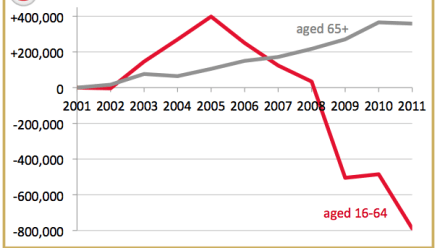
Here are some numbers for you: the adult rate of the national minimum wage will be raised, this October, by 11p to £6.19 an hour, but the separate rates for 16-17 and 18-20 year-olds will be frozen, at £3.68 and £4.98 respectively. I mention this not just because these figures were announced today, but also because it's the first cash freeze in any of the rates that we've seen since 2005 (and even that was when the 16-17 year-old rate was kept at the same level after its very first year of existence): The question is, what now? The government is defending the freeze by saying that, ‘Raising the youth rate would not benefit young people if it meant it was more difficult for them to find a job’ — and rightly so.

Where will Cameron’s road proposal take us?

Are we facing ‘toll road UK’, as the Mirror suggests this morning? That is certainly a possibility arising from David Cameron's plan to allow private firms to bid for chunks of Britain's motorway system — but I wouldn't get too excited just yet. It's a very distant possibility at the moment. After all, just note the details of the story. The routes that the coalition has in mind are very significant ones, but they still add up to only 3 per cent of the national network — ‘toll road UK’ may be pushing it. And then there's the fact that nothing has been entirely decided yet. We're told that, ‘The Treasury and the Department for Transport will carry out a feasibility study with a view to reporting back to Mr Cameron in the autumn.

Taleb in 30 minutes

Nassim Taleb, the Lebanese-American academic whom we interviewed in The Spectator last month, is the subject of a Radio Four profile by The Economist's Janan Ganesh that was first aired last Monday but will also be on Radio 4 at 21:30 this evening. David Willetts is interviewed, saying that Taleb's work underlines the folly of long-term forecasts because ‘the big events that shape the world today are those which no one predicted four or five years ago’. The discovery of Shale gas, for example, could utterly change Britain’s energy requirements. Taleb’s heroes are Burke and Popper: his emphasis is on the need for humility, on how hard it is for any government to know what’s going on in society.

Downing St plans to boost construction

In the last few months, there’s been a distinct change in the attitude of the Tories at the heart of government. They are now far more cognisant of just how difficult it is to drive change through the government machine. It is no longer just Steve Hilton and Michael Gove complaining about this, but Osborne and Cameron too. The Chancellor’s particular frustration at the moment is over the pace of planning reform. Osborne and his brains trust believe that simplifying the planning rules is one of the things that they could do to both give the economy a short term stimulus, by encouraging more construction, and improve its long term prospects. But the coalition is making slower progress on the matter than Osborne would like.