Uk politics

Assange’s balcony scene

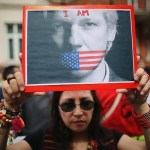
Julian Assange appeared in public for the first time in two months this afternoon to make a statement about his continuing resistance to attempts to extradite him. The Wikileaks founder made a number of claims and arguments which it’s useful to have a look at in further detail: 1. ‘If the UK did not throw away the Vienna conventions the other night, it was because the world was watching’. Foreign Secretary William Hague has insisted that there are no plans to ‘storm’ the Ecuadorian embassy to arrest Assange. Either officers will attempt to arrest him when he leaves the building for Ecuador (although there is an interesting theory he may

Darling: Osborne has given up on growth

‘Unless you do something now it will be years before we recover.’ This morning those words come from former chancellor Alistair Darling in an open letter to George Osborne, but they could just as easily be from a member of his own backbench, or from Boris. Darling’s letter, published in the Sunday People, accuses both Mr Osborne and the Bank of England of having ‘given up on any plan for growth’. ‘Your policies since 2010 simply haven’t worked, you need another plan – call it plan B, call it whatever you like,’ he writes. He’s essentially saying the same thing as Boris Johnson did this week, but using slightly more

Ed Miliband, Olympic winner

Before the last election, I had dinner with a Labour minister who told me her number one fear about the Tories getting in would be seeing David Cameron lap up the Olympic limelight. The Olympics, she feared, would hugely benefit whoever happened to be in power – and that was, she feared, going to be Cameron. She needn’t have worried. The Prime Minister was barely visible during the Games (to his credit, he’s not the type to hog limelight). Boris was Boris. But now the games are over, which party leaders have benefited the most? Oddly, all of them – and Ipsos-Mori polling suggests the number one winner was Ed

Police commissioners: how a flagship policy could embarrass ministers

The staggeringly low turnout that the Electoral Reform Society is predicting for November’s Police and Crime Commissioner elections comes as little surprise to those involved in organising the vote. In fact, I was quite surprised that the ERS expects a turnout as high as 18.5 per cent, and I suspect the Home Office might be, too. Nick Herbert betrayed his nerves about the turnout earlier this week when he was harangued by Evan Davis on the Today programme. Today the ERS’ chief executive Katie Ghose predicted that this could be a ‘perfect storm, which could result in the lowest turnout for a national election in British history’ and could ‘degenerate

The losers of the Libor scandal

The Treasury Select Committee published its stinging report into Libor today, and it makes uncomfortable reading for all involved. ‘That doesn’t look good,’ committee chair Andrew Tyrie said when describing the failure of both the FSA and the Bank of England to spot the manipulation at the time. His committee’s report also pointed out that things did not look good for Bob Diamond’s ‘highly selective’ evidence, either, saying: ‘The committee found Mr Diamond’s attempt to subdivide the later period of wrongdoing [following his telephone conversation with Paul Tucker] neither relevant nor convincing. It does not appear that the conversation between Mr Tucker and Mr Diamond made a fundamental difference to

The weak contract worth £100 million

Moving people off sickness benefits and back into the workplace was never going to be an easy job. It’s a sensitive process dealing with all the grey areas that complex illnesses and disabilities throw up, and has always needed careful handling. But today ministers came under fire for the way they hold the company that carries out the assessments for fitness-to-work decisions to account. The National Audit Office has identified weaknesses in the Work and Pensions department’s contract with Atos Healthcare, which carries out the work capability assessments. Comptroller and Auditor General Amyas Morse has written a letter to Labour MP Tom Greatrex, who is investigating Atos’ performance, saying: ‘We

The green belt isn’t as green and pleasant as you’d think

The two best fights to watch in Westminster this autumn will be about land: the shape of constituencies, and where developers will be allowed to build the new homes that ministers are increasingly seeing as the best solution to Britain’s growth problem. Tim Shipman reports in the Daily Mail today that the Quad is ‘thinking the unthinkable’ and considering relaxing rules around building on the green belt as part of those planning reforms that Eric Pickles and colleagues are dreading. Cue outrage and news reports featuring photographs of beautiful rolling green meadows. Sources in the Communities and Local Government say they do not recognise the Mail’s report. But why is the green

Ministers fail to sell themselves on playing field sell-offs

If you’re a minister, or even the Prime Minister, and you take to the airwaves holding a page of figures aloft, it’s always a good idea to make sure the figures are actually correct before you enter the studio. When David Cameron read out a break down of playing field sales on LBC radio during the Olympics, he was trying to crush reports that under this government, schools are continuing to reduce their sports facilities in return for money. You can watch the film of Cameron with his sheet of paper here. The problem is that this sheet of paper wasn’t actually correct when it said there were only 21

How students are mis-sold the benefits of university

What do you say to an Arts graduate? ‘Big Mac and fries, please!’ I used to laugh at that joke until I was served a Junior Whopper by one of my fellow arts graduates in Edinburgh and ever since then I’ve been suspicious of the story I was sold at school: that going to university takes you into a new league of earning potential. The A-Level results came out yesterday, and anyone who has opened an exams envelope will be familiar with the feeling. That you may as well have the results tattooed on your forehead because they will define the trajectory of your life. But in the 22 years since

Hague stands firm on Assange

William Hague took a robust line on Julian Assange at his press conference this evening. He made clear that the British government would not allow the Wikileaks founder safe passage out of the UK, and warned against using diplomatic immunity as a means of ‘escaping regular process of the courts’. Assange is wanted in Sweden on allegations that he raped one woman and sexually assaulted another in August 2010. He denies both charges and has spent the past 56 days hiding in Ecuador’s embassy, where it was today confirmed that he is being granted political asylum. The police still intend to arrest Assange as soon as he leaves the embassy,

Housebuilding slumps

If ministers needed any more encouragement to improve the supply of new homes in this country, today’s figures on house building starts and completions from the Communities and Local Government department might just do it. Housing starts in England in the three months to the end of June fell by 10 per cent on the previous quarter. If you compare the figure for starts in this quarter to those in the same quarter last year, there has been a 24 per cent drop. The number of completions has also fallen by five per cent between the first and second quarters of this year, but has risen seven per cent on

Conservative Corby slips away

The first polling on the Corby and East Northamptonshire by-election is out today and not surprisingly, it suggests that Labour will take the seat by a landslide. The poll commissioned by Lord Ashcroft predicts Corby will fall in line with national polling trends — a collapsed Lib Dem vote, reduced Tory presence and a resurgent Labour: If the by-election result follows this pattern, it will represent a 9 per cent swing to Labour since the 2010 general election. If this were replicated at a national level, it would be enough to sweep Ed Miliband back into Downing Street. The poll also gives some reaction to Louise Mensch’s resignation. Over half

A-level results crib sheet

This year’s coverage of A-levels has been a little different to that in previous years. Sure, there are still plenty of blonde twins coming out of the woodwork to take impressively high jumps in the air but there are no headlines about results breaking new records for the proportion of top marks awarded, and that’s because tough new rules on the exams came into effect this year. Last year results remained static for the first time in a decade, and this year, they saw a drop. The number of marks at A or above fell 0.4 per cent to 27 per cent of total grades awarded. Just under 7.9 per

Twigg takes aim at Gove on school playing fields

The Olympics may be over, but the political row over school sports fields is set to rumble on into the autumn. Stephen Twigg today announced that Labour will force a vote on the matter when the Commons returns in September. His motion will demand that the government restore a minimum space requirement for outdoor space in schools. It does take some chutzpah for Twigg to launch this attack, given Labour managed to approve the sale of 42 playing fields in just one year, which is twice the number sold off since the coalition came to power. The Education department insists that of the 21 that have been signed off for

The ideological row over profit-making schools

Earlier this week IPPR published a paper which made the case against for-profit schools. Two of the leading proponents of such schools, Toby Young and Gabriel Sahlgren, have since responded. Young accuses me of being ‘an evangelical believer in an ‘evidence-based’ approach to public policy’. He implies at the start of his piece that empirical evidence should play little part in policy development. Confusingly he goes on to set out which types of empirical analysis he values and which he doesn’t. It is unclear from this what role he thinks evidence should play in policymaking. Young is particularly scathing about the use of cross-national evidence. He is right that we should

Boris accuses Cameron of ‘pussyfooting’ on growth

Last week Boris Johnson was in jellyfish mode, drifting along and delivering the occasional sly sting to the coalition. Now that the Olympics are over, the Mayor has launched something of a shark attack on his Westminster colleagues. In an interview with the Evening Standard, Boris accuses ministers of ‘pussyfooting’ and calls for the government to ‘make a very powerful statement of ambition for London’ involving new infrastructure and even a new airport: ‘The government needs to stop pussyfooting around. I don’t think you can rely on Heathrow. Even if the government was so mad and wrong to try to do the third runway or mixed-mode, those solutions would rapidly

First’s risky win highlights fundamental problems with the rail network

Euston, we have a problem. Richard Branson found out today that Virgin Trains has lost the rail franchise for the West Coast Mainline to First Group. From 9 December, First plans to ‘offer substantial improvements in the quality and frequency of services’ on one of the country’s key arteries. This overhaul will bring in 11 new trains and 12,000 extra train seats by 2016. Branson is sore about his company’s loss, and has attacked the government’s ‘insanity’ for handing over the network to First: Under our stewardship, the West Coast Mainline has been transformed from a public liability into a valuable asset for the UK, worth many billions of pounds.  The service is

Good jobs news goes against grain

Ministers are generally cautious in welcoming falls in unemployment in case they represent a blip for just one quarter. But Iain Duncan Smith was pretty chipper this morning when the Office for National Statistics announced a fall in the jobless stats for the fifth quarter running and the strongest employment rise since the middle of 2010. In the three months to June 2012, 29 million people were in work, up by 201,000 on the previous quarter. The employment rate rose by 0.4 per cent to 71 per cent, and there are 4,000 fewer unemployed young people.  The number of unemployed people fell by 46,000 to 2.56 million. As the graph